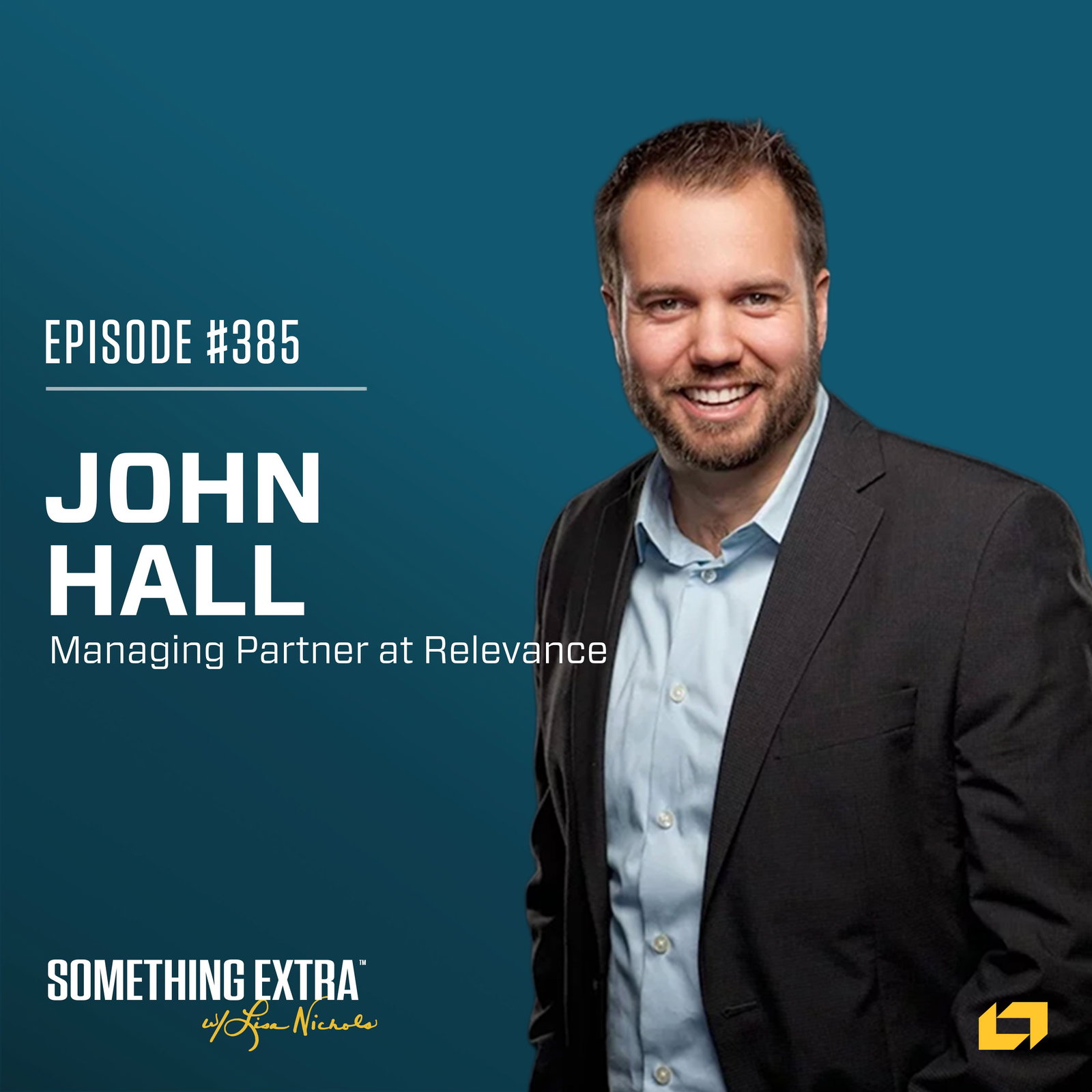
The Power of Value Journalism and Radical Helpfulness w/ John Hall
Episode Details
Transcript
Discover the power of radical helpfulness and building long-term trust with John Hall, speaker, author, and Managing Partner at Relevance. In this episode, John details how his entrepreneurial mindset evolved from a third-grade lunch brokerage to a multi-million dollar real estate portfolio, all centered around identifying what people truly value. He shares practical insights on mastering deliberate time-blocking, navigating the massive shift into AI search engine visibility, and why leading with humility and core values ultimately outlasts ego.
Guest Links:
Credits: Host: Lisa Nichols, Executive Producer: Jenny Heal, Marketing Support: Landon Burke and Joe Szynkowski, Podcast Engineer: Portside Media
John Hall
The number one thing to build trust is if you feel like somebody genuinely cares about you, that is by far. You know? And when you look at the most trusted people, who are they? Their teachers, their coaches, their advisors, their parents, you know, those are the highest trusted relationships that we have, and it's because they genuinely care about us. And I call it value journalism, is identify what is truly valuable to people. Because if you understand what's valuable to them, you can care about their futures. Lisa Nichols
It takes something a little more to lead with impact. I'm Lisa Nichols, author of Something Extra, and this podcast was inspired by our daughter, Allie, whose additional chromosome has shaped how I see people in leadership. Each episode features conversations with inspiring leaders from around the world about what truly defines how they lead and serve others. If you enjoyed today's conversation, please consider leaving a five star review. It helps more people discover the show. And if you'd like to go deeper, my book, Something Extra, is available on Amazon and through other major book retailers. Our guest this week is John Hall, speaker, author, and the strategic advisor at Relevance, who is currently reshaping how brands dominate the new era of AI search and answer engine optimization. A renowned growth investor and the author of Top of Mind, John specializes in helping leaders build radical trust and master their most precious assets, their time and their relationships. Well, John Hall, welcome to the something extra podcast. I am so excited about our conversation today. We have already been talking for about twenty minutes, and I have laughed more. My jaws are hurting. John Hall
I have laughed so much. Lisa Nichols
So I just know we're just gonna we're gonna have fun, and we're hopefully gonna give some good stuff away to our listeners. But, you know, I just have to laugh because you you you and Jenny had hopped on before I got on here. She said, how do you want us to introduce you? Tell tell Jenny what you said. John Hall
Well, yeah. I I just, like, it rolls off the tongue really easy. I said, hey. So just in introduce me. I'm the captain of Lisa's Scrapbooking Club. And so you just say with a straight face and serious, and she was like, what? What? And so yeah. So I I always just like the reason why I joke around on things like that is I always think that whether you're and I've I've given people permission to do that when I speak too, because in any situation, if you can break down a barrier and create some level of comfortableness at the very beginning, you have so much more progress you can make in that conversation as silly as it is. So Lisa Nichols
It's so true. But what our listeners are gonna find out, I mean, about John is he is incredibly brilliant. You're brilliant, John. But you are also funny, and you've got a great sense of humor. And I just I love the authenticity of you. So I cannot wait to jump into this. But you and I met. We were at the Realign conference together. You spoke and I spoke, and we have our dear friends, Matt and Maria Granados, to thank for connecting us. Right? John Hall
Yeah. They had talked very highly of you for, a a long period of time, actually, and and it was kinda one of the reasons why I went to the event because they were just like, hey. We're bringing together these really good people, and you were one of the top names on the list. So I'm glad we we made the trip. Lisa Nichols
I'm glad we did too. I'm glad we did too. Well, we're gonna have fun. Well, I know that you're originally from Peoria, Illinois, but you live in Columbia now. I think you went to Mizzou. Right? John Hall
Yep. Yeah. Went to Mizzou and ended up staying there. Lisa Nichols
Yeah. Well, here's what I really wanna talk about. John, I was looking at your bio, and I mean, you're not that old, really. All the things you've done, I counted up twenty, and I'm just gonna name a few of these. Okay? I mean, you started out with the affordable equity partners. You've been a teacher at, University of Missouri at Mizzou. You were the cofounder of influence, American program bureau, advisor for code base. I mean, it goes on and on and on and on. I know that you were, you know, a calendar dot com. Right? You were a founder there and advisor, investor. Now you're with Relevance. I mean, John, you have done a lot, but it didn't start then. I mean, you started, like, this entrepreneurial journey when you were in third grade. John Hall
Yeah. Yeah. It's I'd started a lunch lunch brokerage business when I was in third grade, and I would basically find out what, kids valued. Then I'd talk other kids into talking their parents into packing that in the lunch because then I knew that, you know, like Gushers, you could get this for. Twinkies, you could get this for. And so then I would, you know, find out what was valuable, identify the supply, get them to change the supply so that it was the highest valued. And then I'd, you know, sell to different grades. And I actually got in trouble for it where the principal called me in because I was disrupting the, the lunch because there was a lot less hot lunch going on, because I was able to kinda disrupt that. So, yeah, that was my first, kind of, entry into entrepreneurship or or at least, like and also just understanding what people value. The more you understand what people value, the more you can build real relationships and also, you know, build, success. Mhmm. Lisa Nichols
Yeah. And I think that's probably been one of the secrets of your success with all of your different companies and what you're doing now with relevance. But, you know, this is this was remarkable to me too. But by the time you graduated college, I think I think you were a millionaire by the time you graduated college because you started you bought a home and you flipped it, right, and started your own real estate company, John? John Hall
Yeah. So what I what I did there is same thing. It's, you identified at a young age. I mean, it's kind of a crazy situation because my freshman year, I was supposed to actually go to Miami of Ohio. I ended up going to Mizzou, because I I read a bunch of Nicholas Sparks novels. I thought I was in love and meet this, you know, girl on a trip and, ended up, she ended end up coming there. And so I was, like, actually lonely because I was like, what the heck am I doing? So I didn't know anybody. Ended up making friends with, people in the dorm. One I'm still friends with to the day to this day, but then another one, was a new friend that is, that I ended up, going into, or we went to a party together. I left. He ended up staying. He tried to break up a fight and was murdered. I know that's a crazy situation, but, but afterwards, I was in depression. And so when I was in depressed on kinda how the world was going, I got out of depression by, kinda working hard, and I got multiple jobs. I saved money and just kinda tried to not focus on it. Well, the business that was created from that, kind of sadness and and, motivation to kinda take my mind off, it was a real estate business where I'd identify what people needed, in housing, and I'd meet students at, events, and they'd say, hey. I want this. And I'd say, okay. Great. If I can find that for you, will you sign a lease? And so I get it prelease, go to the bank, and even though I only had, like I think I saved seven thousand dollars to when we did our first home, it it allowed me to find value, identify it before, go to a bank, and kinda talk them into it and say, hey. You know? And so I started doing that. And by the time I was a senior, I had done it, I think, eight or nine times and maybe even more than that. And, yeah, I had a real estate portfolio around student housing in in Mizzou, which ended up being pretty valuable. So, yeah, it it ended up, you know, I the reason why I explained it is that a lot of people just focus on, like, the, oh, yeah. I was I was a millionaire or this. And I I instead of saying that, I I like saying the real story of, like, hey. Like, there was strategy. There was reaction to strategy. There was people that supported me throughout that, and then there was getting on a page where you could add value for others, and then it resulted in success. And that's kind of a, you know, formula rather than just being like, yep. I've made a bunch of money in college. So So Yeah. Lisa Nichols
Your motivation behind it. You know? And and, like you said, finding out what was important to people. I mean, you still carry on that mindset today, and there is a a mindset with a with an entrepreneurial, kinda mindset. You know? I mean, a lot of people don't even develop that mindset maybe ever, John, but certainly later in life. I mean, nineteen eighteen, nineteen years old, that was a pretty, amazing that you had that mindset of, you know, finding out what meant what what was meaningful to other people and, the risk too. I mean, the taking the risk. I mean, did that did that ever come into your mind, like, thinking about risk reward or, you know I mean, what gave you the courage, you think, to just try something that you've never done before? John Hall
Yeah. I'm actually a fairly risk averse, entrepreneur as as funny as that is. Like, I didn't make that jump until we knew, the numbers worked that even if it wasn't going well, that I was still not gonna be kind of, like, in a in a bad place. Even to this day, out of our entrepreneurial friends, I would be consider myself risk averse, because some of them like, even my one of my business partners now is like he's like, oh, yeah. Let's double down on this. Let's do this. And I'm just not wired that way. I'm wired in a way where, like, I'm okay with hitting singles, and I'm okay. I don't need to go for a grand slam. So a lot of times when you go for the grand slam, you hit it and you hear those stories of the grand slam. So you wanna hit that grand slam. I'm a fan, whether it's like a Buffett, Warren Buffett style or others, I'm a fan of, you know, identify value, for others, surround yourself with good people and be okay with just compounding and building. And sometimes as funny as it is, I've I've been able to hit some, you know, big I I hit some things at some unique times, which have been great. But at the same time is that that my mindset is still, like, hitting a single, being calculated, actually being thoughtful. And so I'm just a different type of entrepreneur where I'm not like, hey. Let's put it all. I've never put everything on the line. Even when that's that seven thousand dollars, I that first deal, I had a business partner partner we had preleased. We had, these things going for us. I was one of the tenants too. There there was such limited risk there, so I don't wanna I think a lot of leaders act like they're just, like, such a brilliant, entrepreneur in a way where it's like, yeah. I put it on the line, and I was right. And mine was just, like, simple. Like, oh, this kinda makes sense, and I set this up in a structure that is, risk averse, and then I've built on it for twenty years. So Lisa Nichols
Yeah. I mean, we're very much the same way. I mean, I just say slow and steady wins the race. You know, there could have been times probably where we would have taken on more risk, but just, slowly. So I think that's a really good word for our listeners. You know? I mean, that, hitting that grand slam, yeah, it might happen, but, you know, it's the things that you do day in, day out with consistency, I think, that really make the difference. Now this is funny to me because you have really built your businesses, everything around relationships. Relationships are, like, the most important to you, John. But you have a master's in accounting. John Hall
Yeah. Mhmm. Lisa Nichols
Tell me about those two worlds because I have an accounting degree as well, and I'm like, I just tell young people all the time. Listen. There were not assessments out there when I went through school. Grateful that I've got it, but, yeah, I'm very much more of a relationship person. Tell me about those worlds and how they collided for you. John Hall
Yeah. As funny as it is, I don't like accounting, and I got my master's in. But part of it was because I wanted I knew I wanted to be good at business and at that age, and, and I'm a fan of, like, working on your weaknesses. So because a lot of times, your weaknesses are something that will just kill you, but you don't need to, like, like, I I want people to focus on their strengths in a way, but also it's kinda like sometimes if you don't work on your weaknesses, even though you have a great strength, that weakness will bring you down. So I looked at it as I was I always valued and I enjoyed relationship. I love like, we're wired in that same way. We we when we get on the phone together, we're just so happy to see each other because we, you know, value the relationship there. What I don't enjoy is is finance and accounting and those things where I kinda told myself is that if I go to school and finish out this way and I'm made to do this, then it's going to make me know this, understand this more, be able to make better decisions. So my advice there is, like, I know it seems, like, counterproductive, but but if you do have an area that you know is gonna be important to your future and you don't enjoy it, still try and be good at it because it's important to your future. And now, like, my director of finance who's in the office next to me, I can speak her language. Like, I can understand where she's coming from when she's like, hey. Like this. And I'm like, okay. You're right. This makes sense. And as funny as this, like, my business partner on on a lot of deals does not understand that. And then I can translate it to him. It's like, hey. Like, I was just on a call where I was like, hey. Like, these numbers affected because of this. And he's like, well, why don't we do this? And I'm just like you know? So, I think that a lot of times education and learning is about how can you make yourself the best version of yourself and not necessarily what you want or like to do. And so I do want people to like what they're doing and play to their strengths, but I also think a part of education is making sure you are well rounded, can under and that's a part of relationships. I have a strong relationship with her because I can speak her language and relate to her, and that's where, like, I really try to educate myself to support relationships. So, like, even if I don't like something, like, I didn't like plays. And but at the same time, I run into a lot of people who like plays and this, so I I made myself understand, and I actually started understanding the the beauty in them after I educated myself. Yeah. So I think that I it's funny as it is. Relationships is still number one for me, but I try and learn so that I can support those and relate to people better. Lisa Nichols
Yeah. Oh, gosh. There's so much that you just said that's so good, because those weaknesses I have a friend, John, Renee Vidal, that NCAA, seven time champion. He's now a collegiate tennis coach. You know, I was just talking to him last week, and he goes, listen. He goes, you may hate doing the backhand, but he said that's your blind spot. That's your weakness. Mhmm. Because the blind the backhand the fact that you did not practice that backhand will be the thing that your downfall, you know, in a tournament. And so, I I do think I'm a very much of a strength finders kind of person, but you do have to be aware and you have to continue to work on those things. So well, I do believe, and I wanna talk about this a lot, but, you know, because you've you've had a mutual we've had a mutual friend that, you know, really made a a big impression on and a big impact on a lot of people. So I know, like, you know, I do believe that relationships and your ability to relate to other people and be caring and, truly love people and help people, I think is a differentiator for you, John. I really do. But you talk a lot about, being top of mind. And in fact, I'm gonna show our listeners. I've got John's book here, top of mind, and it is so good. Here's what it says. Use content to unleash your influence and engage those who matter to you. You talk a lot about being top of mind. What does that really mean, like, when it comes to branding and marketing? John Hall
Yeah. And for anybody who like, if you recommend that book, it's like I wrote it eight years ago, maybe even nine with the initial ideas. And something I would say is that, like, some of it is very dated. That was before AI. It was before different things that you can scale some of the some of the strategies with. So, but still the idea of it will never change. Because the way that humans connect and the way that our memories work is that the more we're connected to someone and that we show up in their long term memory, the more opportunity can happen. So when you think about that is that, the first idea coming out of the top of mind is like building trust, like actually having an element where someone feels like you genuine the number one thing to build trust is if you feel like somebody genuinely cares about you, that is by far. And when you look at the most trusted people, who are they? Their teachers, their coaches, their advisors, their parents, you know, those are the highest trusted relationships that we have and it's because they genuinely care about us and we know even if we, like my daughter this morning, she's not happy with me about advising her about something. She still knows that I can't genuinely care about her, and that's why there's a level of trust with us that just is super strong. So you've gotta first form that, and that's where, you know, genuinely actually keep an eye out for people. So I always try to end relation like, even before we got on here, I was like, hey. Is there anything I can do to be helpful? And I call it value journalism, is identify what is truly valuable to people. Because if you understand what's valuable to them, you can care about their future. So if, a connection, if Taylor Swift tickets are valuable because their kid, you know, really wanna do them, you and we have a connection there, that's valuable, and I care about them. And I'm like, hey. I, you know, I I can do do this or and by the way, I don't have Taylor Swift hookups there, but I was just giving an example. But, like, but that can be, like, kind of a personal one, but there can also be a, hey. Like, you know, we were just talking and we're you're talking about Nick Vee, and and I was like, you know what? I have a nice connection in film financing. You know, maybe I can connect the dots there, and I'm not doing it. I'm I'm not gonna be like, hey. By the way, man, I want a a twenty percent referral fee on if anything happen. No. It's like No. It's not legitimately that. Now we do have structures of, it is good to align incentives sometimes, but I think genuinely the vibe that you can if you behind top of mind is form that trust, care about others, get do value journalism is where you identify. And the reason why I call it journalism is because it's beyond just one question. If you say, hey. What's value? Oh, send me a client. Okay. Well, what about your clients? Because you just say send me clients. I'm not gonna send you clients because I'm not gonna send people unless I know that they're the right fit. It's gonna be mutually beneficial. So you have to ask more questions. So once you get that, then it is understanding how you can consistent what we call trust touch points, where even if it's, like, on someone's birthday, hey. Checking in. Just I sent three birthday messages this morning. I have another friend that has health issues. I am on my calendar to check-in with them. You start creating these processes to stay top of mind. And it's not just for business value. It's also just for relationship value because the more you kind of do these trust touchpoints, the more you have a real connection. And the real, and you, I'm not saying it has to be once a month, but, like, even if you're touching base, like I have a friend, I have coffee with him once a year. We have a real deep conversation. And if we run into each other, great. But he knows that if I can help him, he'll, you know, come in. I know vice versa. So so, yeah, that's what the idea behind top of mind is that the more you kind of build trust and have consistent trust touchpoints, and then I give examples of that, then you can actually have a a relationship where when something comes up or there's an opportunity, typically, there will be the connection that happens that is mutually beneficial for everyone. Mhmm. Lisa Nichols
Yeah. And I know I mean, John, with Relevance, you guys are using AI and you're optimizing with AI, all that. But I will tell you this for our listeners, this is an awesome, awesome book. I mean, there's so many different practical practices in here. It's one of these that, you know, I've been reading it, and I've just been thinking, gosh. I just really want to slow down and really dig in and dig deep, you know, and go over it again and again. Sometimes I have to read things a couple of times, you know, I'm just telling you, you know, to really get it into my DNA, but I just it I highly, highly, highly recommend John. I highly recommend his book. So and we just kinda talked about this, but this this is your philosophy, is really radical helpfulness Radical helpfulness. And I love this, John. You say that you do not keep score when you're helping people. In a world that feels transactional, you know, I mean, you wanna be genuine. You really do, you know, want to to let people know that you genuinely care about them. And I just I love that. But you have a friendship with, a a friend of mine, the late John Ruhlin. And I know John clearly impacted you deeply, John. But what are the some of the greatest lessons? And a lot of people knew John Ruhlin. He wrote the book Giftology and, just this radical, generous, giving and, you know, thoughtfulness around gifting. Right? But what are some of the greatest lessons that John taught you about relationships in life, John? John Hall
Yeah. I think a couple of them, like, the first one was, like, curating good people and getting behind them and support them. So, like, what I mean by, like, we're not it's not our position to judge others, but when we identify someone as someone who is serving others and it's kind of like why I was connected with you where I'm like, oh, like genuinely, I think she's trying to serve others and do good, like yes, is she gonna make money on the way? Does she have a business? Yeah, That's perfectly fine, but I like getting behind those types of people. And he did it for so long. When we started kinda combining circles, there was all these, like, genuine good human beings that we were like, wow. Like, you can have real conversations. You can identify how to serve others more. You can build companies where the people are treated well and the clients are served better. And so, like, that was really cool because when we kinda combined our our, networks together and we both had aligned values, I'd be like, oh, like, it was never like a, hey. Introduce me to somebody who has this much money or this or whatever. It was like, hey. Good humans that, and it's funny because, like, I could get a connection to a billionaire and then nothing happens. Then I get a connection to somebody new from Ruling and you genuinely look out for each other. Like, I mentioned Justin Donald on the call. Like, that was an intro where Donald, like, is super successful now. But back when I met him, he was kinda leading Cutco and starting his own kinda brand and lifestyle investor. And it's funny just because, like, I didn't even barely know him, and Roland was just like, look out for him. So he had a situation where he needed to be in Columbia, Missouri where I barely knew him, but I had an extra rental or, basically, a property that was really nice that, I had some flexibility. And I said, hey, you gotta be in here because of this challenge that you have. Just stay there, don't worry about it. I'll take care of it. And I go, I will even watch your kids personally because you have to take care of this stuff. And he's like, what, well, it's kid. And I was like, and so he's like, you're really willing to do that? And I was like, yeah. And he was like, and that was coming from Rulon where he's like, when you have this curation and these, like, kinda networks, like, and this, you know, that was a situation where, you know, it put our friendship on a track where, like, we I mean, I just texted him the other day. It's like, hope things are going well in this, and we're just in such a comfortable, mode, but, like, I've helped his business. He's helped me out. And so I think that that's the first thing with Rulon is that, like, you know, when you kind of identify someone that's on a track that they can, you know, really do a lot of good in the world, then, you know, support them. And I'm not saying if somebody comes up and they're like, like, because I do think, I also have the side of me that when people are struggling, you need to serve them as well. But I think that that's one of the things. And then the other thing is, with Ruan is that, like, just when you kind of identify, like, I had this thing programmed in me from him when someone, like, needs something, or like they're in a vulnerable state where it's like, hey, like, just be there and serve them because it's like, no matter what, like that is a way to connect with someone when there's, like, let's just say somebody, oh, somebody recently was having health issues. So it was like, hey, do what you can, identify what would serve them better. And like a lot of times he would do these thoughtful gifts for, like, celebrations, but he would also do thoughtful gifts when someone needed it at the right time to kind of get them on track. So I think that, I had it ingrained in me that when you, a, you get behind, you know, people that and you kinda create a network of not people just because of money or their status, but just because the the type of person there and the path you can support them on. And then in addition to when you identify moments, and the these moments are ones where it could be like they have a business accomplishment and you're doing something, or it could just be, hey. There's a like, the one that I did two weeks ago was, there's a very wealthy person in town that he serves other all the time. So I said, hey. Like and for his birthday, it was a big one for him, and I said, hey. Let's spend time doing the mug that which I you know, you kind of showed, but this is the mug that Ruan did that is super customized. But we did that for him, and, you know, it probably took fifteen of my hours, but at the same time is that that's someone who serves others all the time, and he never asked for anything in return. And so I you know, you just gotta step up for people at the right time because then that recharges them. Lisa Nichols
Yeah. That's so good. That is so good. Yeah. So, yeah, I've done a few of those mugs myself. So if you need a purse I mean, this is a really cool mug, people. So if you want a gift like that, reach out to John, and he can he can help you, navigate. Oh, goodness. Yeah. What do you think that leaders often misunderstand, John, about influence? John Hall
Well, one of the biggest, like, big like, this is one that I could even see in in you is that, like, a lot of the times, with building influence comes the battle between ego and influence. And and what I mean by that is, like, you're a really good human. And, a lot of times branding and influence comes with this, like, oh, I would say this challenge of, well, if I do these things, then it could come off like Egotistical, and you're a very humble person. And, like, I think that's one of the biggest things with people that I see constantly, especially honestly with women. Women, men have less of a problem with getting their their brand out there, and trust me, I could there's data that supports us. I'm not just being like that. But, I think that with influence, you gotta look at, like, why are you building in? You're building it for the right reason. What I like, I've talked to you is, like, you're a vehicle for trust in this for your company. And I think a lot of times people are, have imposter syndrome or they have this, like, oh, if I I come off wrong and I think and what I try to tell people is, like, look. Like, actually, one, we need more people that are humble and are, out there. Like, Like, the friend I was just telling you about, it's a very successful company. I have to, like, fight him to you like, to accept an award, and I have to do this. And so I would say that, a, reduce your barriers to get your brand out there is but, genuinely, try and do it for the right reasons. Like, when I talk to you about your brand, you're doing it for the right reason. You're not like, hey. I like, doing this stuff because I want the personal attention. You're doing it because you have a good company, you have a good brand that you can actually create opportunities for people. So I think the first thing is, like, get past those those self imposed barriers, and that happens it's it's actually it's a strength and a weakness. Your strength is that a lot of times you're humble, thoughtful, and look out for others. The weaknesses, that gets in the way of of becoming the vehicle. And and I'm not saying you have I'm just using an example because it's more of a compliment because this is how your personality is is is that, you know, when when there's good, humble people out there that are meant to be out there, don't let that distract because there's a lot of super humble people that are out there that, like, I love seeing where, where I'm, like, encouraging them. I'm just like, look. Like, do that more because the egotistical people, I guarantee they're going to. We don't want this next generation to see that. So first, reduce the barriers there. And then also it's like you're a vehicle for not just your company but for other opportunities. And so that's where it's like when you think of influence as this vehicle for good for your company, for others, for then it becomes this sense of doing this for the right reasons, and now I can push forward. And just don't put self imposed barriers in the way because then if you do that, then you're almost you're hurting yourself, but then also you're the people out in the industry, they need people like that to be out there. So, you know, that's gonna be good for everyone because it filters down. And and that's why with relevance, a lot of the companies we're working with are ones that we feel like should be at the top. They should be the leading the industry leader. If somebody comes to us, like, there was I don't wanna bash any companies, but there was a company that came to us and huge budget, and they're like, hey. Want you to work work with us and make us the most relevant company in the space. And we're like, no. And and I don't I don't say because you suck. I say just not a fit. And Right. Because I don't wanna see them as industry leaders, because honestly, it's like the way that they treat people, the way that their agenda is, it's just it's definitely not coming from a good spot. So I think that I try to gravitate towards the people that should be the industry leaders. And if we all do that, it's a spread effect because it's kinda like a company if a company leader is good, the employees typically are, you know, in a better place. Same thing with company industry leaders in in a sector. If the sector leader is good, it filters in the other companies tend to follow suit. Lisa Nichols
Yeah. That's so good, John. That's so good. My brain was going, you know, two hundred miles an hour thinking, yeah, it was so good. I love that. But we do need to take a quick break, and we'll be right back with John Hall on the Something Extra podcast. AD
Hey there. In a challenging business climate like this, savvy leaders look to leaders look to technology to find an edge. This can mean the difference between staying ahead of the curve or playing catch up. It's time to collaborate with the highly skilled experts at Technology Partners. Our team of technologists draws upon decades of experience for your project. With each bringing a passion for solving problems and a track record of success, how can we help you overcome your biggest technology challenges? Visit technology partners dot net to book a free consultation with one of our leaders. Lisa Nichols
So welcome back, everyone, to the Something Extra podcast with my friend, John Hall. Boy, have we been having fun. I just boy, you are just a wealth of wisdom and insights and just fun. You're just fun, John. I just love being around you. But I want you really to talk now about, relevance and what you're doing today. And like I said, you know, I mean, John has been part of so many different companies. It's it's really incredible, and he's not that old. So it's just really incredible all the things that he's been allowed to do. But I want you to talk a little bit about relevance. Tell us what relevance is. And I love this mindset of you, you know, John. And I just think you're talking about humility in our segment before. You're a humble very humble person too. In fact, today, you've got on a hat that says be humble and kind, and I love it. You know? And and so one of the things I know that you do at Relevance, there's no job that's beneath you. You know? Whether it's fixing an air conditioner or taking out the trash, you know, that mindset's really important to you. But tell us about Relevance, and then tell us about that mindset, if you would. John Hall
Yeah. Well, actually, I'll start with the mindset because it started, when I was doing the real estate company, I worked for a a larger company while I was building that. And the the the boss there was, very, I first, then once I'm done with kind of my servings, then you can as a entry level employee, or here's parking spots for the executives and then the the entry level people you park in the back type thing. And I remember how it made me feel, doing that, and I and I remember and there's modeling, role modeling, and there's modeling. And what I love about opposite modeling is that I looked at that, and I said, I never want people to work under me and feel the same way I did as, you know, this person who was working my butt off, but then this p like, kind of, like, cog in the wheel or just not valued. And because that's how it made me feel. So I think that, you know, I try to eat last when there's, you know, a company meal or, I think, like, a lot of times, like, I'm out there pulling weeds or doing things because I think that it it looks the more you say, like, hey, like, I'm here, it's kinda like the Ted Lasso, like, I love that show because it's like the the more that you can say, hey, like, I'm not above you. I'm not, like, like, I'm certainly not smarter than some people in the building. I've just had some experiences, and I've been blessed in a certain way that it's like timing lined up. God has given me gifts at certain times, and there's certain reasons. So I think that the way to kind of, you know, support others a lot of times is just to say, hey. I'm not above you, and and I'm here to support you. And I think that's a little different. It was something that I changed in leadership over the years because I I wanted them to feel like they were very valued and and, you know, I appreciate them. So and then with relevance, relevance was just following value. Again, I I when we sold influence, which was the the company was started in twenty eleven and ended up being one of the larger, creator and distributors of expert content and media, sold that in, I think, twenty eighteen. I had no intentions on being involved with an agent a service company again. Like, no interest. We started investing in we bought, we acquired calendar dot com. We invested in Gabb Wireless. We, and that was purpose investing. It was like, hey. And, like, it was funny because I was like, you know, Safe Kids technology was a very important part of what I thought our next generation needed. So we invested in it very early on, and now it's like a several hundred million dollar company. And it's it's really cool to to see that because that's where, like, hey. Like, let's do some good. But then what happened was as we were working, investing in Gab, as we were doing some of these things, the need for growth marketing and organic marketing in particular, like trust building and stuff came into place. So we basically had a side kind of, company that started out with like five people where it was like, hey. Like, we wanna use this on our our investments because we, one, had not had a lot of great experiences with other agencies, and so we were like, well, we'll just have, like, a team that does this. So then we had friends that were like, well, can they do it for us? We're like, sure. Then we had other, like, large companies that were like, well, can you do it for this? Then it was, like, ten people. Then it was fifteen. And then what happened was we made an investment in AI technology and a company called Adigi where we, actually, one of my best friends who was two doors down from me, was like, hey. You know, there's an opportunity here. He ended up leading, those efforts. So then we had a sister company that started from there and was investing heavily in AI technology and tech and, kinda the tech side of things. Well, then what happened was we had kinda two parts of relevance. One that had a lot of media connections and, one that was really good at content and SEO and things like that. Well, so what happened in the last, like, year or two where we've had a significant amount of growth because the demand for our services has gone up significantly is because these three areas, where we had a separate company, we had, two parts of relevance, they all became the biggest parts of AI visibility. So when you look at how you show up in Chad GBT, how you show up in Gemini, how you show up in, this new world of marketing, The three components that are very important are technology and AI so that you're actually your data on your site is consumable, that you're actually set up structure wise for AI to understand your brand, what's being talked about, and we had a company dedicated towards that. Then also with content and actually thought leadership and SEO tech, like, expertise, which that's the next kind of phase where just think about it. If you're an if you're an AI crawler, you want it to be consumable set up the right way. You want to actually trust the company and and actually that they have a good source of information and it's set up the right way, so they understand SEO and and the thought leadership aspect. Then the next element is the PR media, which a lot of companies just don't have because either there's PR agencies over here or there's a content agency here or there's an AI tech. We just happen, like and I'm just telling you, honestly, Lisa, we did not plan it. We weren't like, hey. In the future, we're going to be ahead of AI visibility and this, this. It legitimately like, last year, we were like, let's combine these. And part of it was because it would just naturally happened. And then all of a sudden, we got this we hit the ground running. And then on top of that, we had invested in a company that owned media properties where we could test these strategies. So just imagine a publication is starting to struggle. We'll buy them, fix it up, and get it running again well. Well, we have these media places where we can test these strategies out too. So we have these synergies with these three three areas. Then you have a playground to play at because everybody can say best practices and, oh, yeah. I learned this on, you know, from some big company getting content. We actually had a playground to play in. So that's where it evolved into. Now we're really known as this AI visibility leader that understands, you know, a, how to fill gaps with your current marketing strategy so that you can be set up for the future. Because that's the key thing right now is that everybody's excited about AI visibility, but you still need to kind of naturally translate where you're filling gaps in your current kind of, strategies that you're doing and setting it up where there's some short term, you know, results, but you're moving towards these long term because this is where in the next year or two, everybody's moving towards this kind of AI is helping me make decisions. So if if that's where relevance has kind of gone on this really great growth path where we're helping people fill those gaps, set up for the long term, get the short term kind of, systems going where you're set up to basically this next phase. Because this next phase is the biggest change in sales and marketing that's happened in twenty years, which was when Google came out. When Google came out and they started doing ads and things like that, that's where the most category leaders were starting to be created. When you look at, like, Adobe, HubSpot, a lot of those types of companies, Salesforce, they really gotta jump on Google advertising and Google organic, and that's what kind of had them scale. We're in that same twenty year cycle where something is coming up that is so major that we have to kinda get on the track, be positioned. And if you're good in about a year, then you can kinda scale from there. So that's kind of the excitement of relevance right now. Lisa Nichols
It it's so exciting. And I'm just John, I mean, I've had multiple conversations with you. I think everybody needs you. I I think you I think the the beautiful thing about you guys is you've got all the pieces. Right? You've got the content. You've got the PR, the media connections, then you've got this AI piece that, you know, we all need to be paying attention to, and it is gonna change. It's gonna change, every industry, but certainly, when it comes to marketing and sales, I think it's gonna be, just, you know if you don't if you don't prepare for the future, you're probably not going to continue to be relevant. No. No pun intended. You know? John Hall
Yeah. Especially b two b right now, it is so important. Like, b two c, you got a little runway because we're seeing conversion rates, like, a little little lower, but it's still important with especially with some companies. But, like, b two b, it's vital right now because it's funny is that, like, we're seeing conversion rates fifty percent or higher from a GPT or Gemini or or lead like that because it's like, hey. I'm looking for a tech company with awesome leadership that's this, that's this, that's this. It's like fourteen different things, and then it's like your company comes up. And so and it's like this one, and then there's these four other ones that could be, well, if you get that lead, they're like, oh, same thing with us. When people are typing in AI visibility and specifically one with media context and this and that can do this, then it's like it serves you on kind of this, like, like, it's it's, kind of like, the first time where, like, Google Ade is never really, like, I trust this result. It's like, here are the options. Now chat knows me more than a lot of my friends do. So, like, it's like, by the way, you should deal with this company because I know you you you don't wanna work with anybody who's unethical or this. This company has these reviews where it said they, like, fired twenty people at once and treated them like crap. Why don't you pick this one? And I'm just like, you're right. I should pick that one. Great. Sign it up. You know? So that's where we're going, and it's just changed a lot. Lisa Nichols
Yeah. I agree. Well, I wanna hey. There's a few more things I wanna talk about, and then we're gonna talk about something extra. You are so incredibly intentional, John, with time management. The only thing that we can't make more of, you know, we can make more money. We can, you know, hopefully make more energy, you know, by getting proper rest and stuff. We cannot make more time. You track your days in fifteen minute increments. John Hall
Yeah. In, fifteen to thirty minute, yeah, it just depends on the day and how busy it is. But, yeah, they call it time blocking, so that's an actual, like, really effective strategy. And, yeah, like, I do it both digitally and written, so that's also a memory kinda exercise where it it people joke around, they're like, wait a minute, you own and I'm still an owner in calendar dot com. And they're like, so you own that software and you still keep it daily. And then actually it's Granados' planner that I showed you. This is from Matt Granados with LifePulse. Right. But every, the day before, I always plan out my day for the next day, and I and it's these increments. And then I actually can only kind of hijack that if something becomes a priority over those to do lists. So I think that, like, I I I'm a very big fan of being very deliberate on your time, blocking it off and and prioritizing, and it's not like rocket science. It's planning out the day before, understanding what's important, and it's not just, like, with your business. Like, I go on a white walk with my wife every morning now. If if it's gonna be reasonably and it's not stormy, we go on that walk. And, people that can't be, like, the we did there's one priority last week that that Trump did, but it was also, like, it's not more important. My wife my I was just like, hey. I have to do this board meeting or something at this time, and she's like, no no big deal. But I think that, like, that's the way you gotta think about time. And it as funny as it is, like, I went through the stage where I just felt busy, and that's where I felt valued. It's like, I'm on twenty calls a day. I'm this, this. And what's funny now, it's like, I can just, like, really be deliberate about time and have one conversation and just sit back and chill out the rest of the day, and that's more effective than my twenty calls that I was on because it's a pride issue. It's a I feel valuable the more harder I work. But now it's like, hey. Work smarter, and the start of that is is being value or valuing your time and also just happiness. You know, we want a a balance with people you care about, so you gotta be deliberate about it. Lisa Nichols
Yeah. That's so good. I think I read somewhere where you, like, the night before, you even, like, put five just five priorities, five or less priorities on sticky notes. John Hall
Yeah. Lisa Nichols
And and, you know, I mean, we can't really and, I mean so, like, give me give me an example of, like, what that would be. Your walk with your wife is gonna be a priority. Right? Maybe Yep. Time with your children. You know, this podcast with me was John Hall
a Yeah. So I I'm I'm looking at this. So this is the the coffee stains as you can tell, but, I just pulled this. But, like so this was one where, this is a combination of to do. So I have priorities and to dos and, same thing digitally, but I can just show you the, the the the, like, in this case, the to to dos where I needed a client report done, there was one of our companies was looking at a, potential acquisition. So it was like this, this, and it's listed in rank, but then it's like, a lot and then it's, priority one would be pay kid kids because my kids did this work for me. So I I, you know, treat like, they have their own money and they have their own accounts, and that took priority. So, like, the first thing I did to start the day was make sure my kids was aligned because if I forget that, that's huge. And then, then it actually has a self care. What can I, also improve today? And so, yeah. So the night before, the to dos, you prioritize them. And then, and then, yeah, the way that I I go is, so this this is maybe not the healthiest thing, but if it is a super important thing, I typically will not either leave the office or whatever until I get it done. And what's funny as it is is that I made that rule, because I didn't wanna be a procrastinator at all, and I didn't wanna leave. And so now I rarely have to stay later because, if it's super important, I prioritize it early on the day, and I make sure because I don't wanna be in a time where it's five o'clock, and I wanna see my kids. And I'm like, well, you failed. You didn't get your three things you needed done. And so you you just gotta make sure of that. So Lisa Nichols
Yeah. Eat the frog. Right? Or as my grandson says, eat the green peas. You know? You do that thing that you've got to do, and maybe you don't even want to do, but you do that first. So good. I just love the intentionality, John. I love the intentionality because if you don't if you don't plan it, then somebody will. Right? And, so good. Oh my gosh. There's just, you know, in in the distractions, I feel like the noise of the world is so much greater than than it's ever been before. So I just I I love that you do that. There is so much. I know that you you prioritize your family. I think I read something where you play chess with your daughter every night, which is so awesome. I bet she's getting really good, John. John Hall
Well, that that evolves. Now we're playing volleyball every night with that specific daughter. So it's that changes. I don't want you to think that my daughter plays chess for her whole life, but, yeah, she knows how to play it well. Lisa Nichols
Yeah. John Hall
But I I I think that for for that, it's, it's being intentional about what a relationship means to you. Like, and the example that I give when I'm speaking is I always wear a pink shirt. Nobody has, I don't think, has ever seen me speak in the last seven years without a pink shirt. And even when I went to the New York Stock Exchange and was on TV, like, I would not get on unless I had a pink shirt, which was against her dress code. They didn't like it. And, you know, I guess I haven't been back there, so maybe that sends me a signal. But but but for me, that's important. And the reason why I wear Pink Shirt is because my daughter, when she was, she's almost thirteen now. It was, like, when she was six or seven or something like that. She, commented on she's like, hey. You're traveling a lot, and, you know, I love when you're home. And I and I'm like, you know, do you like, do you ever think about us when or me when you're, you know, traveling? And I was like, oh, that hurts me that, you know, one, you want me to be home. Two, you you are thinking that, like, oh, I want a day Dan's probably busy with work. And I was like, you know, we need to I and that's like a setback where it's like, hey. I need to be intentional about this relationship. And so I said, hey. I'll always wear a pink shirt moving forward so you know that, you know, that that is that I'm thinking of you and that you guys are always my priority. So I think that that, like, those, those things are you like, we get caught up, and we're tempted to not show what we value. So I'll give you an example. If I'm on a call with an important, you know, business deal, you know, me ten years ago would have been like and my kid walks up to me. I walk, hey. Hold on. Like, I'll I'll get you like, I'll it's important. So, you know, whatever. Now it's, excuse me. Sorry. I've gotta take a break for a second. Hey. And I sit down. I'm like, make sure I send the signal that, you you know, you're the priority. And, you know, and basically okay. It's some is it okay if I give like, I'm gonna end this call this. Okay. Great. Doesn't matter who it is because that's showing to me is, like, my kids know that they are a priority over anything to do with business. And and it's okay. If it screws up the call, then is that somebody I do wanna do business with that doesn't you know, that wants to judge me for me being there for my kids? Yeah. And so I think that that's been an above evolution where I used to say, hey. I'm doing this for you, so you you you let me be, and that's a priority because I'm making money so you can have that's the shift in psychology where you have to be like, well well, it it's kind of a a the the BS thing to think of is, like, I'm working really hard to provide money for my kid, and I'm feeling this value where if my kid if I don't prioritize them, they don't feel that value. So it's like it's kind of a conundrum there where you're like and now I've kind of taken and the reason why is because pride and ego come into play there is that I want to feel like I'm providing, so my ego makes me feel like it's but the truth is is that most most kids in relationships want that quality time and that you care and you're gonna drop. So and what you're what you're doing for them. So Lisa Nichols
Yeah. They want your presence more than a present. Yep. They want your presence the most. I just I love it. Gosh, Sean, we could get going, but I have to ask you. This is called something extra. And I ask every guest this question. What do you believe? Is this something extra that every leader needs? John Hall
I mean, I would say that the the the biggest thing that's extra in my life is all has been faith and, and so it's like as crazy as I don't think that it's faith for everyone. I mean, for me, it is, and I don't push it on others. I try to to communicate, but, the value the more that I've seen people become more value driven and doing the right thing and this and even in situations where you're like, it seems stupid at the time, I've just seen that make the biggest difference over time as it had that guiding light. For me, it's it's faith now. And and the more that I've been around people is that, no matter what, they end up in a better place, the more that they just kinda use that as a guiding principle. And I have atheist friends who they kind of changed and evolved into that value driven mindset, and and better things have to inform them too. So, I mean, that's cheesy and it's very simple, but I think that the more we hone in on that and make decisions based on that, it's it's unbelievable how things work itself out. The one of the examples that I I just gave with added with, the company Adigi that ended up merging the tech side. One reason why that company existed is because I was a landlord for a a tenant that just signed a seven year lease, and they were two entrepreneurs starting out, and they they business wasn't working out as well, and they had another opportunity. Well, Well, I could've said, nope. I'm not letting you out and screw you over, and, and you're gonna I'm just gonna keep collecting money until you get out of business. Instead, I was like, hey. Let's work this out. I want what's best, you know, for you as well. Let's you know? And I ended up supporting them as not just a mentor, but as a as, hey. Like, let's get you guys on a good track. Now they're extremely successful. It's it's, like, laughable. They're so successful, but the gap that was filled was Adagie. And we kind of made that jump because of the opening. I was like, hey. I have space, Tim. Why don't, you know, why don't you do this? And then Adity became this, like, force of nature that now it's put us on this track where now our company is on this momentum. So it's like like, at the time, that was stupid. Who lets somebody out of a seven year lease in year one? And so so I think that, the the more that you do that and, the more that I believe it's faith, but if it's I don't want to push that on someone. I just would say in my experience, it is. In other's experiences, sometimes it's just value driven, decisions and, you know, surround yourself with good people, value driven, and that's what makes the difference. So Lisa Nichols
Yeah. I, you know, I, I I concur. Yeah. I concur. Yeah. John Hall
I know that's not anything new, but for me, it's, like, it's the big difference the last ten years or five years in my life that's made a Lisa Nichols
bigger difference. Made all the difference for me. It's been made all the difference. So this has been so much fun. Thank you so much, my friend. This was a lot of fun, and I just know that it's gonna help our listeners. I hope that people reach out to you. Follow John. He writes, we didn't even get into that. But you write for Forbes. You write for, like, lots of different publications and stuff, John. So, you know, just follow follow John CNBC, Fast Company, many, many others. He's got a lot of thought leadership out there, and I know that it's gonna help you. So follow John, and, yeah, thanks again for making the time. John Hall
Yeah. Always happy to be here for you. Announcer
Something extra with Lisa Nichols is a Technology Partners production. Copyright Technology Partners Inc. Twenty nineteen. To learn more about this week's guest, check out the show notes at tpi dot co slash podcast. If you enjoyed this episode, consider leaving us a review. Thank you for listening to Something Extra.