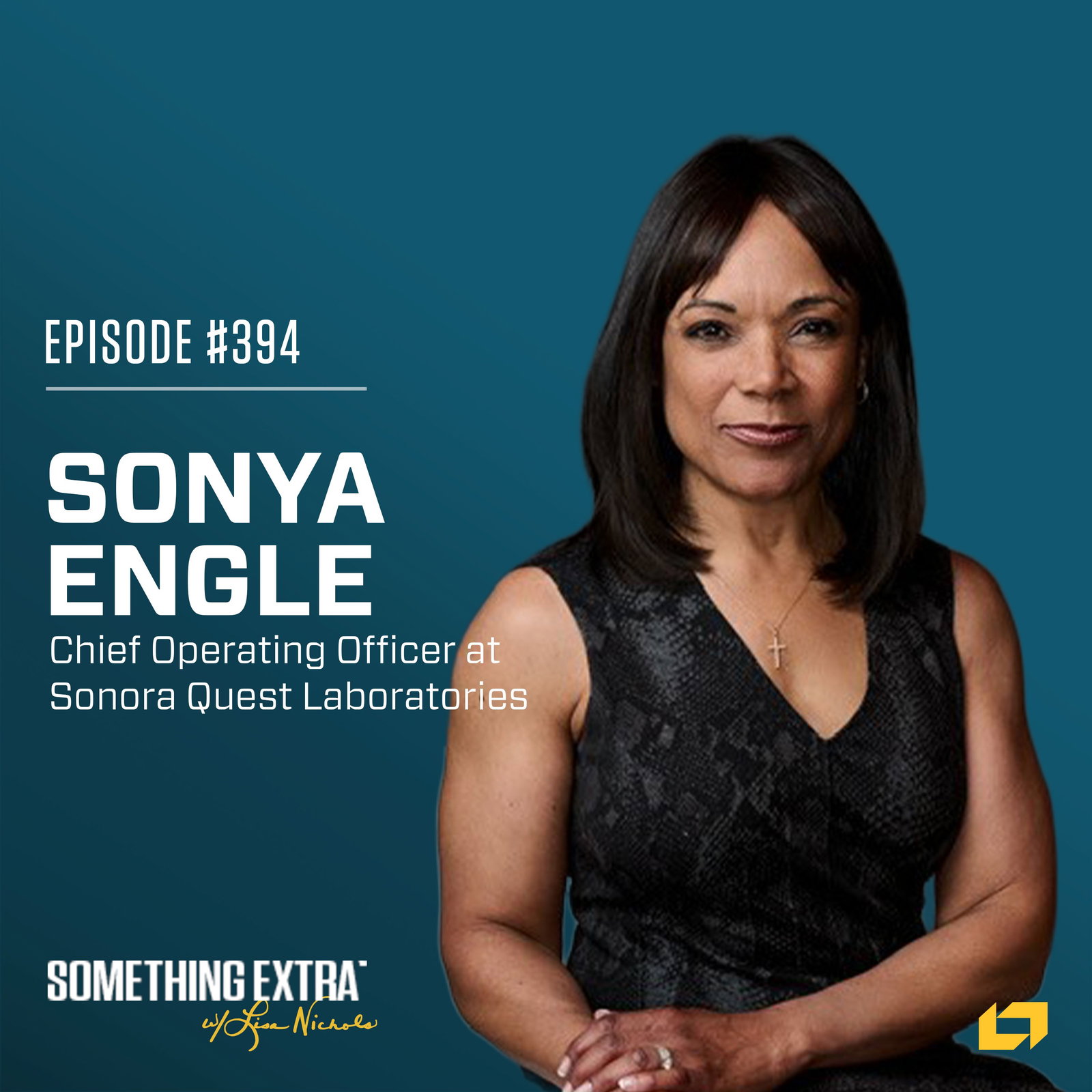
Sonya Engle
You know, it it does give me purpose, and I have to say that, our noble purpose is care you can trust, results that matter. And I love that, and it really resonates because there are so many patients, consumers, people on the other side that have this anxiety time until they get their results, and they're trusting that we care about them. That I'm thinking, for me, for everyone on our team, is thinking about what we can do to serve them. And that really aligns with who I am and and what I'm called to do. Lisa Nichols
It takes something a little more to lead with impact. I'm Lisa Nichols, author of Something Extra, and this podcast was inspired by our daughter, Allie, whose additional chromosome has shaped how I see people in leadership. Each episode features conversations with inspiring leaders from around the world about what truly defines how they lead and serve others. If you enjoyed today's conversation, please consider leaving a five star review. It helps more people discover the show. And if you'd like to go deeper, my book, Something Extra, is available on Amazon and through other major book retailers. Today, I'm joined by Sonya Engle, a true powerhouse in the healthcare and operational space. She currently serves as the chief operating officer at Sonora Quest Laboratories, where she oversees massive diagnostic workflows that impact millions of patient lives every single year. But beyond her impressive executive title, she's a passionate servant leader, a champion for workplace culture, a dedicated community advocate, and a resilient cancer survivor who brings deep lived experience to everything she touches. Well, Sonya Engle, hi, dear friend. It is so good to see you. Listen. If we have to do a podcast together to get to see one another, that's okay with me, but I just adore you. I'm so grateful to you to make the time to be on the show today. Sonya Engle
Lisa, I am thrilled, and I adore you. And you just inspire, and I'm so thankful for this time and excited to be with you today. Lisa Nichols
And we're gonna have fun, and there's a lot to Sonya. I mean, my goodness, Sonya. So you lead Sonora Quest Laboratories as the COO. I think you relocated from California to Arizona in about twenty nineteen to take on that role. You know? And so there's just a lot to you, big responsibilities. We're gonna talk about that. Can you just real quickly, before we get into it, and then I'm gonna get into kind of when you were eight years old. We're gonna go all the way back to when you were eight. But tell our listeners, Sonora Quest, it's huge. I mean, you guys got thirty two hundred employees. I mean, tell us a little bit more about, about Sonora. Sonya Engle
Yeah. Quickly. Sonora Quest, is the largest integrated laboratory network in the US. And what that means is laboratory testing is information. Right? When you go get your blood drawn or if you have a biopsy for cancer, there's valuable information that the laboratory testing professionals, perform analysis to give you information. And what I, like to say is we're behind the scenes, but we are unlocking powerful information. Seventy percent of the insights that doctors use to make decisions about you as a patient come from laboratory test. We do about a million tests per year. It's Sonora Quest laboratory. (Editor's Note: 100 million tests per year)Lisa Nichols
A million tests per year. Lisa Nichols
That's phenomenal. I had no idea that it was that that many. That is that so you guys are really kind of that, like you said, that one that's really given sites to the physicians on how to treat. It's just so important. And you can even there's so much predictive stuff right now. Right? And predictive tests even see, you know, are are do you have the gene for Alzheimer's or, you know, the BRCA gene or, you know, those kind of things. Sonya Engle
Spot on, Lisa. And it's so not just being a patient, but to your point, being an informed consumer and knowing that your genetic information doesn't change. And we have genetics tests that help you to see if you can process or metabolize medication so that you're not potentially taking medication that, isn't gonna be effective in your body or maybe even harmful. Lisa Nichols
Harmful. Right. Yeah. Oh, goodness. So important. That's got to give you so much purpose every day. Sonya, knowing that you're in an organization like that that is truly affecting lives. Sonya Engle
You know, it it does give me purpose, and I have to say that, our noble purpose is care you can trust, results that matter. And I love that, and it really resonates because there are so many patients, consumers, people on the other side that have this anxiety time until they get their results, and they're trusting that we care about them. That I'm thinking, for me, for everyone on our team, is thinking about what we can do to serve them. And that really aligns with who I am and and what I'm called to do. Lisa Nichols
Well okay. So that's the perfect segue. Thank you for setting me up, because I want you to go back to when you were eight years old. Lisa Nichols
And you figured out when you were eight years old that helping was part of your gonna be part of your calling andhelping people. You know, you I think you worked I think it was a friend of your family that had a medical practice. And what were you doing at eight years old, Sonya?Sonya Engle
I know. That sounds crazy. It does. What were you doing? Yeah. There there were child labor laws. Right? Yes. Yes. You know, we, my my parents were teenagers when they got married. So they they met in French class in high school. They didn't know what they were doing. They were literally just out of high school. And I am so thankful for people like, this family friend who was like a grandfather to me that, allowed me on Saturday afternoons to to shadow him. So that kind of inspired the the interest and desire to be in health care, but, really to serve because he was, originally an educator. He was a a teacher and he went back to school to become a medical doctor. But my little job at eight years old was putting cotton balls in, each exam room, a little bit of filing. And I took that job so seriously that, I just said Saturday morning, I need to get to work. That's the way I started my work ethic, I think, pretty, pretty early on, but that's the way God made me. Lisa Nichols
I love that. I love that. And to your point, it really inspired your love for health care. In fact, I think I read that you originally thought you wanted to be a physician. I did. Sonya Engle
And, you know, it was those early days of, seeing what it's like to to interact with patients. And then I thought that would be something like because I've always been a people person. My buyers break, I'm an extreme, extrovert. No surprise like you, Lisa. I'm sure. Yeah. But so that that made me think that I want to be, a a physician. And I actually, when I went to, undergrad, I went to University of Maryland, grew up in Philadelphia. It's a whole another story. But I I started off, engineering. My dad was an electrical engineer, and I thought I wanted to be like my dad. You know, when you're that young, you don't know what you wanna do. Lisa Nichols
You don't know. You don't even know what it means to be an electrical engineer or anything. Right? So it's like, oh, I'll do what my dad does. Sonya Engle
Exactly. And and so I'm thankful that, through that exposure, I was literally in, a program called the, pre engineer exposure program. And so, again, as a teenager, doing my air quote work in my little job, I Yeah. Had, the the boss at that time, first day of work there say, Sony sent me down in his office, and, he said, work for pay and pay for work. Any questions? I said, no. And he sent me on. So, you know, so I I went into undergrad with, a love for people, a love or interest in science, whether it be engineering or or pre med. And and I found that I was young and immature, and, I really didn't buckle down and get really serious. And so I was at a fork in the road, a decision point, had would need to, like, get serious about school if I was gonna be a doctor. And it just wasn't in in me. It wasn't my heart, and I was in school myself. And I just could not see, incurring all that debt and trying to, I guess, buck against my nature because I just wanted to hang out and have fun, rather than do what I needed to do. So I ended up switching to business, which I also really enjoy business at an early age.
Lisa Nichols
Yes. I love that. Well, I think you started on the front lines, I read, as a specimen processor. And I love that you did that. I love that you started on the front lines of that, you know, Sonya, because I just believe it's like I don't know. I just know so many leaders that have risen, you know, through the ranks, and they started, like, where like, you know, on that front line right where the business happens. So I love it. So how do you think that experience shaped you as the leader that you are today, starting on the front lines like that?
Sonya Engle
I strongly recommend it. I mean, there wasn't a show called Undercover Boss back in those days. So Right. I think that, if nothing else, you get an understanding, soup to nuts, how the process works. So that was true for me. And, when I started in that was an entry level job. This was way back. I won't say when, but I wasn't the fastest person, in terms of productivity. But quality, I was on top. And I can remember having conversations with my boss and saying, well, there's a patient on the other side. I gotta get this right. And so that really informed, the way I understood the work that we do and how important it is that we do it right. And because fast and wrong doesn't help.
Lisa Nichols
Right. Well, I'm glad that that's your highest value.
Lisa Nichols
When you're talking about patient care, quality needs to be at the top, really. You know? So not necessarily being fast. You know, were there ever moments, Sonya, when you look back through your career, because you've done a lot. You've done a lot. Were there ever moments where you're like, I could never have imagined myself being here, or was it more like I I knew I would be somewhere in this you know, because of that that early experience of knowing that you love to help people.
Sonya Engle
You know, Lisa, I love that question, and I've thought about it so much throughout my career. I was the first born, and my brother was almost five years younger than me. So I enjoyed being in that leadership position. And for reasons, that were beyond my control, I grew up with just my dad and my brother. So my mom wasn't there. And I just had all this responsibility, and I I welcomed it, and I took it really seriously. And so there was, you know, a time pretty early in in my career. It was actually my first promotion. I was twenty one years old, and I became a supervisor of a small group in a stat lab. And, I had, I was leaving work one evening, and a young lady said to me, how'd you get that promotion? And I said, what do you mean? She said, they don't promote us. And she was a black woman like me, and I just did not think that way. And so, what I saw in that moment is that I saw leadership as an opportunity, a privilege, and my mindset started to shift because I had started at that point, when I got this early promotion, I set my target really high. I literally with my little supervisor business card on my dream board, I made little business cards from supervisor to manager, to regional, to vice president, to CEO. That was really the dream that I set pretty early on, but then it occurred to me that it's not just about me. And so it made me realize, at various points in my career, my journey, that this is not about me. And that was so powerful and freeing and, in that moment. And then it continues to be like a daily, you know, look myself in the mirror and say, it's not about you. What does God have you to do today in this responsibility that your kid gives you?
Lisa Nichols
Sonya. Oh my goodness. I can sell that so resonates with me. Because I think when you're younger or at least in my experience, it was more about climbing the ladder and but there is a point where you come and you're like, no. I am here to serve. And to your point, this is not at all about me. This is about who I can carry with me, you know, along the way and, how am I serving the team. And, yeah, I remind myself of that all the time. And it really, honestly, it's there's so much more joy in that. If you think it's all about you, I mean, there's really no joy in that. I mean, there really isn't. But when you know that you've helped another person or, you know, seen them on their career trajectory and helped guide them, there's nothing that gives you more joy than that.
Sonya Engle
I completely agree. There is more joy and satisfaction.
Lisa Nichols
Yes. Because Yes.
Sonya Engle
I don't know about you. I know a little bit about you. You are a very driven and talented person when it's about me. So I was a an athlete. So I loved, I played field hockey.
Sonya Engle
I loved competing. I played tennis. But when it's just about me and the score, there's always there's always more. You're always striving.
Lisa Nichols
Isn't that the truth?
Sonya Engle
When it's not about you, it can be about what does success look like in the eyes of the person that you're serving, whether it be a customer, a patient, your employees. As a leader, we are servants. We serve and care for and shepherd and develop and love on our people.
Lisa Nichols
Yeah. Could not agree more. No. I I love that. And to your point, when it is about you, it's like, okay. That next thing and it's like, boy, that's empty at the end of the day, And it's never enough. It's so new. No. It's never enough when you have that kind of mindset. Right? I love that. Well, what lessons did you learn, you know, through your and we've just talked about one. But are there other lessons that you learned earlier on in your career that serve you now as the COO?
Sonya Engle
Yeah. So one lesson that, just I love is there was a CEO, Ken Freeman, is his name, and he's world renowned respected. And I had, the privilege to, in a company at that time of seventeen thousand, he granted me an interview. And so, I had a list of questions, and I just stayed to the questions. I felt like this big CEO, you know, this, you know, publicly traded important company. I can't wait for your time. And so I stayed to the scripted questions, and there was so much that I really wanted to know about him. And I stayed to the questions, but I didn't really get to dig into the things I was really curious about. Well, fast forward many years later, when I guess I was more confident, had, you know, nothing to lose. I reached out to him. I wasn't more he was, now a professor, at a university in Boston. And so I just reached out and said, you know, fifteen years ago, I interviewed you, and I didn't ask you the things that I really want to know. He replied to my email and said he would grant another interview. There's the two of us, and it was a phone call. And I asked questions.
Lisa Nichols
Give me an example.
Sonya Engle
Oh, well, okay. So one of the things I remember was leadership, public speaking, for example, that he had attended this professional training seventeen times. And that was what, you know, was urban legend. He said at least seventeen times. So one lesson was professionals, leaders, and he was a brilliant communicator. He was authentic, clear, finance by background, but moved on to be CEO. So I think he had a balance of the the facts and data, but then had a very approachable way about him that, made his communication amazing. So I didn't think he needed seventeen times or even more than that, but that was, I think, honing his craft and making sure that he was the best he could be. So that was just one example. There are so many more.
Lisa Nichols
I love that. He was sharpening the saw. Yes. We gotta always be sharpening the saw. Absolutely. Right? And getting better. We can always get better. There's a next level.
Lisa Nichols
What a great lesson.
Sonya Engle
So the funny thing is what I didn't know when I interviewed him, and we had this great discussion and, the humility and graciousness that he had to grant this time, this interview. The day that we, got on the phone, he, was actually sick and his voice was very weak. And to me, he could have easily canceled or rescheduled, but no.
Sonya Engle
Just that kind of person. That conversation, what I didn't know at the time that we spoke, maybe I should have done my research, but he was the mentor of the person that became my boss, the CEO of the company that I joined. And I did not know that the lessons I had learned were the same lessons that my new boss had learned over twenty-plus years of being mentored by the same person. So it's...
Lisa Nichols
Wow. Sonya, that's there's a divine hand there that you can't make that up. That's amazing. I love that. Well, you talk a lot about servant leadership. We've already talked about it. It's not about you. You talk about you have the primary pillars of leadership style, and you talk about three different vital attributes. Integrity, you know, this is the baseline requirement without and I agree with that. Boy, if you don't have integrity, you don't have anything.
Sonya Engle
Completely agree.
Lisa Nichols
First of all. Because you're not gonna have trust. You're not gonna have there's so much that stems from that. Right? Courage. And then the last one is effective communication. Mhmm. And you just talked about, that with this particular gentleman and how, you know, how good of a communicator and effective of a communicator he was. You know, what is there anything else that you wanna say about any of those three? I mean, we've kinda touched on them. So it's integrity is the baseline, courage, and then, effective communication. Yes. Have you added any other ones since then, or there's those still kind of the...
Sonya Engle
There are so many, but, I would stick with those top three. And, I mean, integrity, I mentioned that, the the role that I'm in now, as chief operating officer for Sonora Quest Laboratories. The CEO has recently retired, and we have a new CEO. And, she's wonderful. But the CEO that was in the role for, almost thirty years when I, met with him and, I had worked for part of the parent company, Quest Diagnostics, and our values were very similar. And so quiz me if you will, asking if I knew the values of the company I work for now. Listed them off. I mean, I knew them that I that they I had internalized them. These are my values. And he said, okay. Well, pick one. And I said, absolutely. It's integrity. Without integrity, it all falls apart. Falls apart. It does. And so, when so when Dave Dexter asked that question, it was very, very easy. And I could look back at times in my career when, not at this company, and I won't name the company, where there were situations that I was presented with that my North Star, my my confidence, my ability to know what to do as as an individual and as a leader was always very clear because I needed to do the right thing always. And so, that's a nonnegotiable for me and for the people that I surround myself with. And so to join a company where that was one of the values and that the senior leader, the CEO that we shared, that made it so easy. And then it was that, that bonus point that, the person that I had seen as a, a leader to emulate a model, that was his.
Lisa Nichols
That's really, that's so beautiful. That is so good. I love that. Well, I'm going to ask you just a couple more questions and then we do need to take a quick break. Sonya, I know I'm gonna get a little bit more personal here. So I know that your mother you're so passionate about health care. Your mother lost her battle to to cancer, breast cancer at forty eight, which is so young. I mean, I'm sure that experience shaped you somehow. I mean, tell me about that. And then I know that you went through your own battle. Right? And, I think you I think I read at the time that you used one of the the tests...
Lisa Nichols
To determine. So tell me, I mean, I I know that that that had to been so hard because you were, what, in your you had to be in in your early twenties.
Sonya Engle
So, thank you. My, my because my parents had me so young Yeah. I was a little bit, Yeah. I had just my mother passed away. God bless her. It really she was dying, and I was with her and it was the day before my birthday where I was, saying farewell, because she was insistent that I go back to work, which is but I really think that it was just hard to let go when looking at my eyes and my hands just pleading with her not to go. So went back to work. It was my birthday, thirtieth birthday. And then she did pass away that when I was, thirty in one day, she did not pass away on my birthday. Which to me, I feel like she just willed it. Right. She just,
Lisa Nichols
Yes. She willed it just to hang on.
Sonya Engle
But her story is one that, has shaped a lot of what I do in terms of leadership with American Cancer Society. My mother, was, healthy for the most part. She like no one in Philadelphia, because I know how much you know about Philadelphia, but the diet, the natural diet isn't necessarily, the, the one that, can do some.
Lisa Nichols
The simple seven or the.
Sonya Engle
Exactly. Cheese spread is not good for you. But she didn't, she ate healthy. She exercised. She was actually even responsible for starting, the, the wellness program at her company. This is back in the early eighties. Who even heard of that back then? But she she knew that. So here's this, picture of health. She detected a lump through a self exam and ignored it. She, figured I have mammograms annually and it was March. And so this lump that she found, she said, if it had been anything that I should be concerned about, it would have been detected in the mammogram, so I'm gonna ignore it. So she ignored it and watched it grow, and until the point it was larger and larger. And, when she finally went to the doctor, it was advanced. If she had gone sooner, I it's possible that aggressive treatment could have, prolonged her life. She ended up, dying within eighteen months. And so that was, devastating, but it was kind of the end for me in a good way. You know, we hit the bottom. My mother, because she wasn't there, for some years of my childhood, in my adult life, we became best friends. And so my best friend was dying, and I was, having my baby girl. And so I was on bed rest. I had a high risk pregnancy, which is a whole another story, and so I couldn't be with her. So when she died, I felt like I didn't have enough time with her. I had my baby girl. So I don't know if it was a combination of depression of losing my mom and depression of having, you know, the postpartum depression. But it was six months after she died when I had a house full of guests, great career, home, husband, everything the world would say should make you happy. And I was not. I felt like I could just drive my car off the side of the road. I was so sad and lost and depressed because productivity, profits, people pleasing does not satisfy.
Sonya Engle
So it was my mother's cancer journey, her death that led me back to a personal relationship with the Lord.
Lisa Nichols
Your faith? Yeah. Oh gosh, Sonya. Well, let's let's end there, and we're gonna pick up there. I wanna come back. So we're gonna take a quick break, and then we'll be right back with my dear friend, Sonya Engle, on the Something Extra podcast.
AD
Hey there. In a challenging business climate like this, savvy leaders look to technology to find an edge. This can mean the difference between staying ahead of the curve or playing catch up. It's time to collaborate with the highly skilled experts at Technology Partners. Our team of technologists draws upon decades of experience for your project. With each bringing a passion for solving problems and a track record of success, how can we help you overcome your biggest technology challenges? Visit technology partners dot net to book a free consultation with one of our leaders.
Lisa Nichols
So welcome back, everyone, to the Something Extra podcast with my friend, Sonya Engle. So, Sonya, we just left a cliffhanger there. It was really your mom's passing away. And you were in a very dark place. I think all of us probably can relate. We've all been at least in a dark place, if not many, But you knew that there was something missing. And that you needed more. And you had success. You had a husband. You had a this baby. You had, you know, by the world standards, everything that could it was that would define success, but you felt empty inside. Tell me about that journey, and then talk to me about how faith then has changed how you do everything else in your life going forward.
Sonya Engle
Thank you. Well, Lisa, that moment of the bottom was the beginning. And there was no answer in myself, in my own effort, in my marriage, in anything that I could control. And so, this was many years ago before the internet basically, which sounds so weird. So I had a house full of guests and I pulled out the yellow pages because I had early faith, but I had walked away from my faith and just tried to live, the way I wanna live. And so I flipped through the yellow pages looking, for churches. And I pick up the call and if there was an answer and they said they were open, that's that would be, the indicator that's where I should go. So I found a church that was open on Mother's Day at four PM and, went in and sat behind a woman that I know God sent. This woman had her back to me, but it was when she turned, it was like the eyes and arms of Jesus, just seeing and knowing all my pain, all that I was going through. And, it was exactly what I needed. And that began the the new beginning. I went and discovered whose I am, who I was even when I was striving for all those years and feeling broken and lost and feeling not loved, not worthy, that I was loved and that the Savior was there for me and was bringing me in and her arms wrapped around me. And she was like a mentor and and guided me. I was at the bottom, and it was the beginning of my faith journey, and it changed everything. And so that was, the beginning of me, learning who God was, what I was, what was true about me, that I was loved, and that the things that I had believed and, like, if I were pretty enough, smart enough, made enough money. I mean, fill in the blank. There's so many enoughs.
Lisa Nichols
Amen to that. Right. And what does God say?
Sonya Engle
What does God say?
Lisa Nichols
You are enough. Yes. You have everything you need in me. I think you're beautiful. I you are my treasure. You know? I in fact, I love you so much. I sent my only son to die for you. I mean, you know, that's when you get ahold of that, Sonya, it does. It changes everything about our identity. And, I think when we're rooted in that and we're confident in who we are in him, it just allows you then to love other people. It just allows you to then go. Right?
Sonya Engle
It does. It does. So that ultimately changed everything. And so that was, boy, you know, almost oh, actually, thirty years ago.
Lisa Nichols
Thirty years ago.
Sonya Engle
So I have had thirty years on a different trajectory. Hey, I'm still, you know, a broken sinner and I have, you know, fallen into some of the old traps or the lies. Oh. But it's been, different. Yeah. And I have found that every aspect of my life. Unfortunately, my first marriage ended in divorce, but god is a god of reconciliation in every way. When I even go back to that hospital room when I was saying farewell to my mother, my parents had a very, tumultuous, marriage. There was all kinds of reasons where there was unforgiveness. My father was invited into the hospital room by my mother because she was extending peace, recon reconciliation, forgiveness to someone that in my mind didn't deserve it. But isn't that the gospel? Isn't that truth? We all deserve God's grace.
Sonya Engle
I saw that my mother and, and that was an example, I think, throughout my my personal faith journey. And, actually, even in my career, I have seen so many opportunities that what was meant for evil or wrong, be turned into something that is, for for good. And I look for, that truth in so many ways, and I see it.
Lisa Nichols
Wow. What a beautiful example your mom gave you. And I'm sure, Sonya, there have been times where maybe, you know, someone has done something to breach, trust with you, and you can even think back to your mom and how she how she handled herself, you know, and extending the the olive branch. I love that.
Sonya Engle
That is so beautiful.
Lisa Nichols
It is. My goodness. And and you know what? And you're right. We're all on a journey. It doesn't mean that all of a sudden, you are you're perfect. No. We are not. In fact, that's why we need...
Lisa Nichols
The Savior. Right? Is because we're not. And, oh gosh. We could just spend a whole podcast just on this, girl. But, I know. Let's talk about you had a breast cancer diagnosis at thirty five. You know? What was going through your mind at that time? And I know that that is why you are huge with your mom and yourself, like, you know, a big advocate for early detection and getting the testing done. Right?
Sonya Engle
I am. And, what I had for me, and I want for other people to have the education, the awareness, the access so that they can have a good outcome like I've had, because I've had cancer twice and there are many people that their story is more like my mother's. And so, because of my mother's early cancer and her sister's too, I was first diagnosed with cervical cancer in my twenties. And, once that was diagnosed, treated, sat across from a oncologist, and he said, you know, you're young and we want you to be able to have kids. And that was like a light bulb went off. I didn't even realize that my life was at risk or my future fertility. And I realized, boy, I just don't even know what's going on. And that's what it's like for a lot of patients that they are like blind going, you know, so number one, get educated and informed so that I can help myself be there for my family and then, be in a position where I can help others as well. So because I was armed with so much information, I was, having mammograms in my twenties. And so they did find some, some things that were suspicious pretty early on, and then I was not only, able to get the biopsy to confirm that I had cancer, but at the same time, have the genetics test that confirmed that was a BRCA two gene carrier. Which, increase, the the probability of breast and ovarian cancer. So I, went through pretty aggressive treatment, bilateral mastectomy, when I was just in my, mid thirties. So that was not, the ideal, but, it was the decision that I knew would not only take care of the cancer, but make it so I wouldn't have to keep looking over my shoulder worrying about it coming back.
Lisa Nichols
Right. Right. To have other people. Right. Yeah. So if there are female listeners out there and and men too, I mean, because what we're talking about here are some of these testing that can be done, even predictive type testing. Right? But don't put it off. Don't put it off. You know? If there's anything you take away from this, you know, the early detection is really, really important. And, Sonya, I know that you've served on the American Cancer Board. I think you've been the chair of that many years. I think you maybe roll off. Do you roll off this year?
Sonya Engle
I did, Lisa. Thank you. I had five years as chair. I'm very proud and it felt so good to pass the baton. I'm still on the board. But isn't that the wonderful thing about leadership? Succession planning. Yes. It's knowing that, you are identifying the person that's gonna take your seat.
Lisa Nichols
Right. Exactly. Exactly. But, well, thank you for serving. Thank you for serving. I know that, yeah, the board work. I mean, it's important work, but it's it it is work. It is work.
Sonya Engle
It is. It is. I have my day job. I have my day job too.
Lisa Nichols
A day job too. I get it. I totally get it. Well, you know, I and I just I wanna just touch on this real quickly. I mean, I'm just thinking, like, the challenge of COVID. Wow. What a crisis that was. Right? I think you guys I think I read where you had to scale, Sonya, from six thousand tests a day that you were doing up to thirty-six thousand tests a day. That's crazy.
Sonya Engle
It is crazy. And when I think back to twenty twenty, for us, we were not only a large employer. Right? So we had our employees that were, you know, not sure about their own health. They had families. We could not close. We're twenty four by seven, seven days. So, they had to come to work. I can remember employees, you know, worried about their health or their families saying, I I don't want you coming in with, the clothes that you wore when you were in a lab testing.
Sonya Engle
And, so that scaling that you described, is because we were in a worldwide pandemic. As you know, it affected everyone, and there was no ability to get what was needed to test that volume. The instruments, the reagents or chemicals, the people to do it just weren't available for a lot of reasons. So with that, constraint, our our CEO, Dave Dexter, and I give him huge credit, came up with a a solution that took us from, six thousand, which was what we could do with the instruments and and what was available, and went, to, OEMs and struck up a a a deal that, as COO, I I have responsibility to, work with, kind of a unproven. So we had to build the methodology, build put the instruments together because traditional testing platforms were not available. So we had to piece together kind of a very creative way, a solution that enabled us to build capacity to not only test for the state of Arizona, but we were in a position to be the safety net for our parent partner. We're in a joint venture. Quest Diagnostics was referring volume that they couldn't handle. Right. So we built capacity to test, close to sixty thousand patient samples per day. And to this day, I had, someone, join my team recently, who wasn't there during the pandemic, and, went to a lab tour and heard the story of this small department of twenty people that had to grow to, two hundred in less than two months. And she said, I didn't know. I had no idea. All I knew is I couldn't travel or take my kid to soccer without a lab test, a COVID PCR test to confirm, and you guys were doing it. That's amazing. And I still need to hear that because, as we talked about, you do what you need to do. And we're serving others, but it was so intense that there wasn't time to reflect document. I really think there's an amazing story and what was accomplished there. And someday, hopefully, we'll get to tell that story more fully.
Lisa Nichols
It will be in the history books.
Lisa Nichols
It will be in the history books. Well, you know, I let's talk about culture a little bit and employee retention. I think you are the one that implemented the stay in interviews instead of exit interviews. Right? Or was that your CPO? Or was that you, Sonya?
Sonya Engle
Oh, well, I won't take credit. Yeah. I our our chief people officer and her team, do amazing things. And I think the state interviews, looking at the valuable insights from exit interviews. And also, of course, looking at, you know, our hiring. How do we attract the best? How do we, make that value proposition that helps them to see our noble purpose and how it aligns and how we do things that, other companies don't do. And it is, something I'm really proud of Sonora Quest, is a a leader in the market in in our industry, but in the state, we're at the top in terms of giving back, philanthropy. Our employees serving and giving. And that is part of our value prop to help us hire and retain the people that share that value system. And so we have almost four thousand employees across, our our system. It's primarily in Arizona, but we're with, Banner Health and six states sharing that value. And that to me is the secret Yes. Is to have people that want to be there because their, their heart is aligned with the purpose.
Lisa Nichols
With the purpose. Right. And I think I love that. And I know you guys talk about that. The culture, it's very intentional. You know, my friend, Mark Miller, that was VP of high performing leadership at Chick fil A, he said, you have a culture. It's either by accident or design.
Lisa Nichols
And you guys have designed the culture there. I mean, by listening to the employees, the state interviews, very, very intentional. You know, helping people see how what they are doing really, aligns and floats right up to the to the bigger mission, you know, and the purpose of the organization, which I think is really important. I know that you're really passionate about helping people, realizing their potential, developing future leaders. But, Sonya, you know, I just I have to ask you. We're running out of time here. And so I just I have to ask you the question that I ask every guest that comes on the podcast is would you believe, Sonya, is there something extra that every leader needs?
Sonya Engle
I believe that something extra is humility and passion. I know that people think humility is, like, thinking less than no. No. Humility is occupying that God space, who you're meant to be.
Sonya Engle
Smaller or greater. And so and when you have that perspective about who you are and what you're doing as a leader, that responsibility and align that with your passion, your purpose, knowing that you were given one more day on this earth to do something very important and do it well. I think that makes a leader someone that is inspiring, that others wanna follow, that customers want to do business with, and really is a differentiator.
Lisa Nichols
Oh, beautiful combination. I love it. I love it. Well, girl, this has been so much fun. Thank you so much. And I just know, Sonya, that your journey, all of the leadership insights that we've talked about today, I just know it's gonna help our listeners. So thank you so much for investing in other people, And thank you for being my friend.
Sonya Engle
Oh, thank you, Lisa, for the opportunity. I just adore you. Hope to meet Ally in person sometime soon. I think she is amazing.
Lisa Nichols
I know. I know. Yes. I want you too. Well, thank you again. Have an amazing rest of the day, girl.
Sonya Engle
Thank you. You too.
Announcer
Something extra with Lisa Nichols is a Technology Partners production. Copyright Technology Partners Inc 2019. To learn more about this week's guest, check out the show notes at tpi dot co slash podcast. If you enjoyed this episode, consider leaving us a review. Thank you for listening to Something Extra.