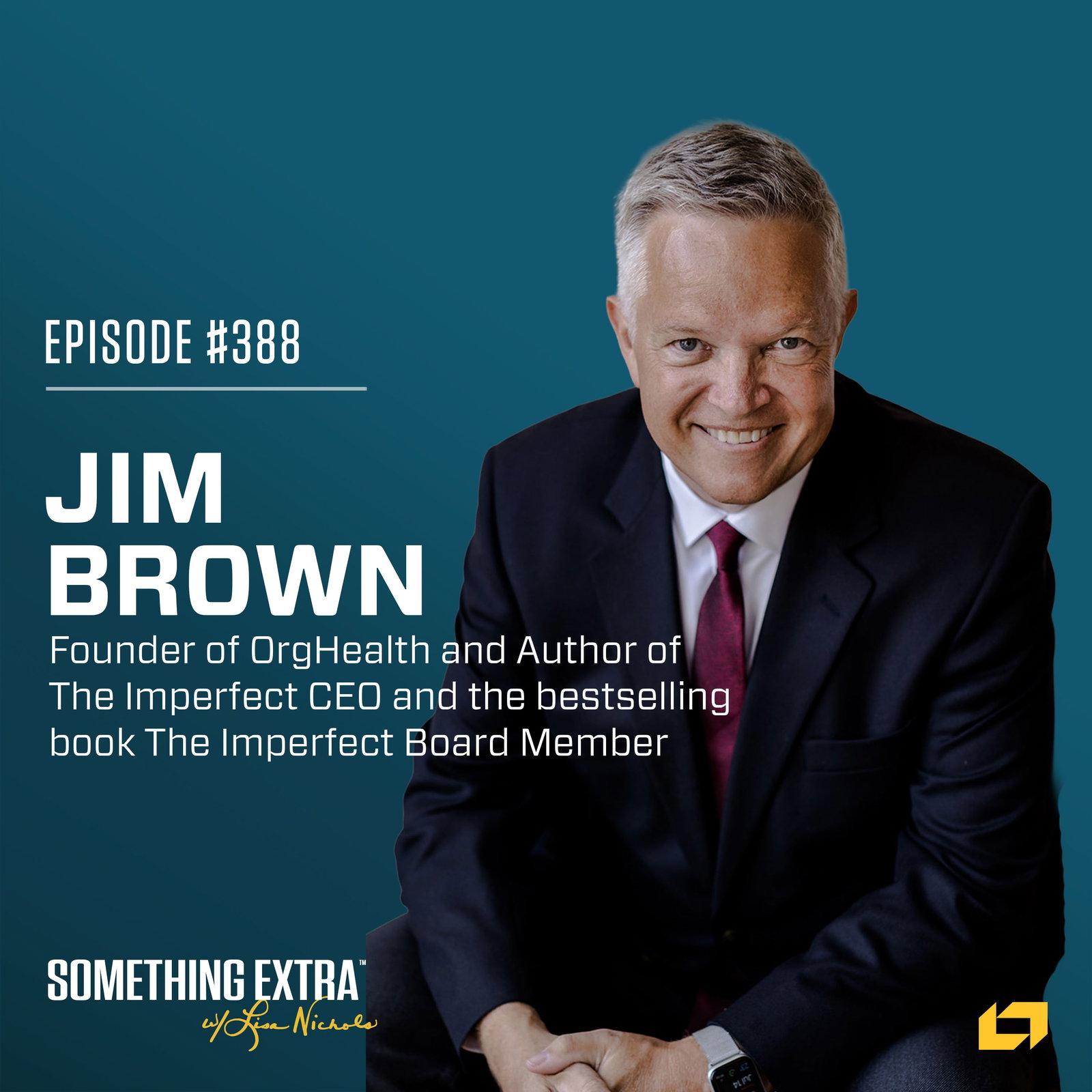
This episode features a conversation with leadership veteran Jim Brown, founder of OrgHealth and author of the new book The Imperfect CEO, about how executives can build high-performing organizational cultures by embracing vulnerability and human limitations. Brown discusses the "org health ascent model," explaining how breaking down internal competition and modeling accountability allows a team's collective strengths to thrive. He also shares powerful personal insights on prioritizing family over career demands and utilizing faith-driven disciplines like conversational journaling to navigate leadership challenges.
Guest Links:
Credits: Host: Lisa Nichols, Executive Producer: Jenny Heal, Marketing Support: Landon Burke and Joe Szynkowski, Podcast Engineer: Portside Media
Something Extra with Lisa Nichols
Jim Brown
Yeah. And I love what you point out is that if we don't understand what we are uniquely able to bring, we can't be the best leader, best person that we can be. So we we need to understand ourselves more. By the way, this comes back to blind spots. The things that we do the best are so natural for us that we don't even recognize them as strengths oftentimes. And it's not until we've created the kind of relationships with people around up where they feel like it's safe for them to say, "You know what I love about you? It's when you do this. This is, this is the greatest strength you bring."Lisa Nichols
It takes something a little more to lead with impact. I'm Lisa Nichols, author of Something Extra, and this podcast was inspired by our daughter, Ali, whose additional chromosome has shaped how I see people in leadership. Each episode features conversations with inspiring leaders from around the world about what truly defines how they lead and serve others. If you enjoyed today's conversation, please consider leaving a five star review. It helps more people discover the show. And if you'd like to go deeper, my book, Something Extra, is available on Amazon and through other major book retailers. Today, we welcome Jim Brown, author and cofounder of Org Health. Jim is a veteran leadership consultant who spent fifteen years partnering with Patrick Colincione to redefine corporate culture and team dynamics. He is the author of the bestseller, The Imperfect Board Member, and his recently released book, The Imperfect CEO, draws on thirty years of in the trenches experience to show executives how to build healthy, high performing cultures by embracing their own human limitations. Welcome to the podcast, Jim Brown. It's so good to see you today. Jim Brown
So good to be with you, Lisa. I'm excited for the conversation we're gonna have. I just feel there's so much that we are aligned with, and it's gonna be energizing for us to talk and share about that. Lisa Nichols
Oh, I completely agree. And I just have to give a shout out. Canada. Oh, Canada. You're sitting in Canada. I'm sitting in Saint Louis, Missouri. I love technology. Jim Brown
And let's just, declare, we are happy to be partnering with our friends in the US. There's there's so much that we can do better together. Lisa Nichols
Oh, there is no doubt about that. Well, I am like you said, I'm so excited. I told you before we started, I said, I don't know, Jim. I've got so much I wanna talk to you about. I don't know how we're gonna get it all in, but we're gonna try. And, you know, my my hope is that, you know, you've got a book that just came out Jim Brown
called the Empire Strikes CEO. Lisa Nichols
Yes. And it is so good. I would I had a preread of that, which I'm really grateful for, but, there's just so much wisdom in there. And so my hope is that, you know, our listeners will want to go deeper, get the book, you know, follow you. You're a speaker. You're an organizational health coach. All these kind of things. So, that that's really my hope because there's just no way we can capture you in one podcast, Jim. So but, let's just get into it. I mean, you have spent thirty plus years in boardrooms and with CEOs. I mean, you've been, many times a board member, chair of boards. I think you worked for Patrick Galiciano or with him in the table group for, what, thirteen years? Jim Brown
I think it was fifteen years that I was a consulting partner, and and we remain good friends. I was interacting with him just recently. Yeah. Lisa Nichols
Yeah. Such a good guy. He was, episode three hundred of the Something Extra podcast. Yeah. So, love love all of Patrick's work, but, you know, now you're the founding partner for Organizational Health. Jim Brown
And and we just go by the short form, org health. Jim Brown
We kind of made up a name. Lisa Nichols
Gotcha. It makes sense. Org health. Right. You know, but let me ask you this. So what drew you first to this work of working with CEOs and organizations and Jim Brown
It it's kind of a a crazy story, Lisa. When I was nineteen years old, I had a job in a factory. And I had arrived as a farm kid that was used to getting up early in the morning and working because that's normal life. And I went to the off or to the factory and punched the clock. I'm bushy tailed and bright eyed and good morning to everybody, but nobody is nearly like that. Like, I'm getting some foul looks and, Lisa Nichols
Nobody was as enthusiastic Jim Brown
as he were joking. And and what I discovered and I started to read about was most people in our countries actually hate their job. And the idea that people spend the majority of their waking lives doing something that they don't enjoy seems like a tragedy to me. Mhmm. And it's even more so the case, Lisa, because I've since discovered that when leaders create the right culture, a healthy culture, people can enjoy their job. They can look forward to getting to work. They feel appreciated. They feel like their contribution is, man meaningful and important. And then they go home, and they feel better about their life. And that makes things better at home. So Jim Brown
This was a a discomfort from before I was twenty, noticing too many people don't like their lives. But it turns out that if leaders took responsibility for creating the right context and space, that can all be transformed. Lisa Nichols
Mhmm. Right. And I know that that's what you're doing. That's what you're helping, leaders and CEOs with. You you know, you talk about, Jim, you talk about imperfect leadership. Let's just talk about the leaders. Lisa Nichols
What is this myth that we have that as a leader, you have to be perfect? You have to know it all, and, I've got a lot more questions around that. Jim Brown
Sure. Well, I think there's a lot of pressure and scripting in our society that leaders are supposed to be the all knowing types. And and frankly, Lisa, it's it's even worse in our Christian world. Because we look to Jesus as our example, and we we've heard Jesus is perfect. But we need to recognize that Jesus never called us to be perfect. He called us to be authentic. He called us to be obedient. He called us to recognize God as the perfect father and Jesus as the perfect savior, we are imperfect. And he's okay with that actually. He is working in us to continue to refine us. But the problem is too many people in in leadership roles, especially Christians, feel like they're supposed to show up like they know all the answers. They have total confidence. Don't worry. You I've got you. I've got this taken care of. And it's just an unrealistic and unreasonable weight to put on ourselves. Lisa Nichols
Yeah. You said the operative word is a white. It's a heaviness to feel that way. Right? Yeah. Well and I think, you know, since you brought up, you know, Jesus, you know, I'm I'm thinking about the verse. The verse immediately popped into my head, Jim, that says his strength is perfect in our weakness Lisa Nichols
Not in our strength. Right? Right. And so, yeah, it's, we we are not called to be perfect, but I love what you said. We're called to be obedient. We're called to be faithful. We're called to recognize that he is the perfect one, and we need his help. Right? So Indeed. Yeah. You know, what and and I wanna talk about this. I mean, your book that just came out, it's a phenomenal book, the imperfect CEO. I love it. But it's a fable, and it, it has it follows a CEO David Slater. And I love this because he gets really vulnerable. Yeah. At some point, Jim. Jim Brown
And this is this is the critical leadership opportunity for everyone that's listening. Again, we have this old mindset that we're supposed to show up strong and able and confident. And people think that vulnerability betrays weakness and shortfalls. But what we're discovering, and people like Brene Brown, who have has written so many great books and and done some great TED Talks, are helping us to recognize, actually, it takes a lot of strength to be vulnerable. Jim Brown
And by being more comfortable with ourselves and our imperfection, we invite everyone around us to recognize that they can be safe and comfortable with their imperfection because we are all imperfect. Jim Brown
And now we start to actually work together. Lisa, I have this picture in my mind that I believe is very biblical. I mean, we can think about Romans eight, for example. Everyone has God given strengths, but we all also have weaknesses. Jim Brown
if I would submit my weaknesses to my team and allow them, invite them to bring their strengths to cover my weaknesses, now we have the best of all. And it totally changes what's possible. I believe this is actually God's design, that we need each other. We're not supposed to be an island unto ourselves. Jim Brown
So if I can be vulnerable, then I am creating space for people around me to be vulnerable, to bring their good questions, and I'm gonna receive those as reasonable options to consider as opposed to being the one that feels like every good answer needs to come from me. No. I I'm the leader. I'm just responsible to try to make space for the best answers to come to light and for the hardest questions to get asked so that we can get the biggest problems solved. Lisa Nichols
Yeah. Oh, I love the way you just said that, that you're supposed to make the space for the best answers to come to light. Lisa Nichols
Not to have the best answers. Jim Brown
Right. But if we've done a good job of attracting great people to our company, we better have a bunch of people that know more than we do. That that's that's the whole point. Lisa Nichols
Yes. Yeah. I so agree with that. Well, I I do think that I do think, like you said, though, vulnerability has been seen as a weakness, right, in in the past. It really has, but it takes, like you said, strength. It takes courage. Yeah. It takes humility. Lisa Nichols
You know, Jim, in my book, Something Extra, humility is my very first chapter. Jim Brown
It's it's critical. What a critical starting place. And, again, what a Christ like starting place. Lisa Nichols
Yes. So good. Well, let me ask you this. You know, have you have you seen like, maybe I mean, I know you you've got thirty plus years of working with CEOs and organizations. Do you remember a story? I mean, you don't have to obviously say the leader's name, but do you remember a story where a leader did get very vulnerable and it changed everything? Jim Brown
Yeah. A lot of them, actually. So so here's one. I remember a a woman in the role of CEO, and she had come in after kind of a messy thing happened in this larger company. So in some ways, she felt the pressure that she needed to turn things around. But rather than showing up as the, boy, I'm the smart person. You you should be glad that I'm here. She humbly began by saying, I am so grateful to have the opportunity to work with all of you. You are the experts on this company. You've lived here and worked here, and I'm going to be leaning on you to help me learn about our greatest strengths, understand the challenges that we face, and and together solve the problems so that we can be great again. And this this was so disarming to people because, you know, in some people, you could see them in that first meeting with their arms folded. It's like, yeah. Show me, like, you're gonna really be able to make the difference here. But she didn't come with that mindset. She came with a humility mindset. And quickly, people started to, engage with her, dare to believe that she was being truthful about her how she was stand showing up, and meet her there, which quickly created some momentum, not with everyone, but with some people. But that becomes infectious. I'm sure you've seen this, Lisa, where Jim Brown
When when some relationships start to work and people realize, oh, And they know Frank, and they know that Frank has good ideas. They probably also know that Frank has, kept a lot of ideas to himself in the past. Right. But now they're seeing some credit go to Frank because she is not needing to claim the credit. She's generous in giving credit. Lisa Nichols
Okay. This I wasn't planning on going here, but you just brought up something else for me. Why? Because you do see that sometimes. Right? Where people take the credit. Yeah. You know, leaders take the credit for other people's work. Right? And the best leaders I've seen, Jim, are like, no. This is this is the team. The team is the one. What is it inside the leader? I've got my own ideas, but I wanna hear from you. Why do we believe sometimes that leaders feel like they need to have the credit? And what you just said is she did not need that. She did not need that to validate herself. Right? Jim Brown
It's I I don't pretend to see myself as an armchair psychologist. I simply acknowledge that when people need the credit Mhmm. It betrays an insecurity that there is inside them. Jim Brown
Whereas, the the woman that I was using as the example in this story, she had enough self worth that that wasn't the credit that she needed. The credit she needed was that she was investing wholeheartedly in her people so that they could be the best they could be, which would make the company the best it could be. Lisa Nichols
Mhmm. Yeah. That's so good. That is so good. You know, we've kind of already talked about this, but, you know, this archetype of hero Lisa Nichols
Versus being authentic. You know, why what what does that kind of pressure actually do to the culture when the the leader is like, I need to be the archetype of a hero Lisa Nichols
Rather than authentic and Jim Brown
Unwittingly. And and, again, I've worked with leaders that have had this whatever, the the self image, the pressure on themselves that they they need to have all the answers. So I've been in rooms where a question would get asked and everyone turns their head to the leader. Jim Brown
And they recognize everyone's waiting for them to speak, so they share an answer. I I debriefed with a client after that first meeting, and that's how I like to begin my work is sit in a leadership meeting, and see what happens. Jim Brown
So after this meeting was over, I I talked with her and I said, did you notice what was happening when it whenever a question came up? Oh, yeah. People kinda look to me. I have the answers. And I said, right. And what what does that do to the the team and the company? Well, I mean, somebody's gotta have the answers, so I, you know, I guess I'm that person. I said, well, what if what if there are some other answers? What if you don't have the very, very best answer? Do you recognize that unintentionally, you are telling everyone to hold their answers back and just wait until you speak? Jim Brown
And by that, you become the bottleneck of the organization. It can never be better than you are. Mhmm. But what if they felt like you were interested in their answers? And the best answer was the answer that would get everyone's energy, not your answer. Mhmm. So my coaching, Lisa, was the next time a question gets asked, I would like you to respond by saying, oh, that's an important question. What do you think we should do? And refuse to give your answer until somebody else brings something forward and build on that. And it took months, actually, for change to happen in that setting. But eventually, it did. And people started to bring their thoughts. And Jim Brown
It's so much better. See, it turns out that real leadership begins when we stop pretending. We stop pretending we're the all knowing person with all of the answers. We surrender to the wisdom of the team. And, again, I'm gonna use my faith perspective. I'm gonna dare to believe that God brought people around me to be on my team. If that's the case, I want to make all the room that there is for them to bring their greatest strengths to it rather than think I'm the person that has all of it. Lisa Nichols
Yeah. That's so good, Jim. I was just thinking, as you were saying, that that that if you are doing that, if if the team is looking to you, two things. One is the team is gonna turn their brain off. Jim Brown
Yes. They stop thinking of an answer because they know that Lisa Nichols
They're gonna stop thinking. They're gonna stop being creative. They're gonna stop being innovative. And that's not what you want. Right? That's not what you want. Jim Brown
The last thing you want. Lisa Nichols
That's the last thing Jim Brown
you want. Every leader that I've worked with wants their innovative ideas. Jim Brown
They just aren't noticing. They aren't recognizing that unintentionally, they are preventing that from happening. Lisa Nichols
Yes. I don't know if you know my friend, Bob Tidi. Do you know Bob Tete? No. He wrote the book Leading with Questions. Jim Brown
Oh, that's a great title. Lisa Nichols
It's a great title and is such a great book. But, you know, to your point, if that is happening, really, just a very, the next thing you can do, like you said, is to turn it around and say, what do you think? You know? And then Bob Bob says you just keep drilling down. Keep drilling down. Well, what else? Yeah. Yeah. Is there something else? What next? You know? I mean, just keep asking the questions. So, I just I love that. That is so good. What about this, Jim? You've said that organizational health is both moral and strategic. What do you mean by that? Jim Brown
So, of course, let's start with strategic. If we have people working together and bringing their best ideas, their best energy, then we have just released or amplified all of the potential in the company. It is a remarkably strategic thing for a leader to do. But that's come back to moral. Leadership is about people, not stuff, not dollars. Of course, those things are all part of the picture, but leadership is about people. And if we have been charged with, privileged with a leadership role, we need to accept responsibility for people. And I know that what God wants us to do is see in people what God sees in them and bring out the best that they have. Yes. I I just think of so many conversations I've had with people. In fact, just last weekend, I I had a incredibly energizing visit with Stephen M. R. Covey.Jim Brown
Who wrote The Speed of Trust and his his latest book is Trust and Inspire. And and he beautifully talks about the leader's role is to inspire people to be all in, to bring the best ideas, bring their best version of themselves, and be that person. And it usually requires that we, as leaders, see it in them even before they see it in themselves. That is a moral responsibility. Yeah. It's obligation.
Lisa Nichols
Responsibility. Yeah. That is so good. Well, let me ask you this. Maybe there's a leader out there, and how can they tell if their organization is unhealthy? How can they tell? What are some of the telltale signs, Jim, that they should look for?
Jim Brown
Well, so this connects to the model that is presented in the book, The American CEO. We call it the org health ascent model. That there are four peaks that every organization has to climb in order to create a healthy organization. And the peaks are, first, collaborative culture. We have to begin by building that place where people can bring their best ideas, their best questions, and work together, rather than competing with each other. And, oh, my goodness. The the competition that happens in most organizations is alarming. Collaborative culture brings us to leadership accountability. And here, I'm not talking about leaders holding everyone accountable. Yes. They they do need to do that. But the more important piece is that leaders are holding themselves accountable. Mhmm. They are ensuring that everything they're asking of the people in the company, they are exemplifying themselves. So take collaborative culture. Are they working together? Or are they in contest with each other? Is this division collaborating with the next division? Or trying to look like they're better than the other division? Mhmm. And a story I share from some client work I did many years ago, is is a a company where they were on the verge of being shut down by their global head office because costs were higher than anywhere else in the world. And they began to really work together to the point that people leaders would offer up people in their department to go and help where the need was greatest that week.
Jim Brown
And and people would just be moving. And then they started voluntarily giving some of their budget to where the need was the greatest. And within a year, Lisa, this is so exciting to be a part of this. They went from being the highest cost manufacturer in their global operations to the lowest cost manufacturer. Wow. That is the potential that's available. But it requires that the division leaders, the top level leaders truly collaborate, truly see that we are one working for the best of all, as opposed to I'm gonna prove that I'm the rising star in this in this company. Jim Brown
I'm gonna be accountable to demonstrate the behavior. Nature Exactly. Lisa Nichols
And the behaviors that you want your people to to exhibit. Right? What are the other two? Jim Brown
So then it's strategic momentum where we have a very clear strategic plan, and we are getting progressive success in accomplishing that. And then finally, the cap, the the crowning glory is what we call talent magnetism. This is when the culture is so healthy. When people like their work so much, they're telling everyone else about how great it is to work here. Jim Brown
And people are lining up for the opportunity. We work with some companies, Lisa, that are spending millions of dollars a year to attract and, secure new people to work with them. Jim Brown
It's a huge difficult challenge that they work with. But it it can be totally reversed to where your energy is trying to decide who not to hire because there's so many people eagerly waiting to join what you're doing. Lisa Nichols
Right. Well and, Jim, if your people if your current people are so engaged and they love it so much, what are they gonna do? Like you said, they're gonna go tell their friends. And then your recruiting and your talent magnetism cost Lisa Nichols
Goes down. Right? Yes. Because you got your internal people building the team that they want. Jim Brown
They are the ambassadors. And and they usually know the people you know, they tell their friends, but they're also conscious that, oh, I've got some friends that shouldn't work here. No. They're not gonna fit. Jim Brown
And and and they don't try to get them to come. Lisa Nichols
That's right. Jim Brown
So in a sense, they they are not just the magnets. They're also helping be the filters so that you're only talking to the people that are most applicable, most relevant for your company. Lisa Nichols
That is so good, Jim. Oh my goodness. I'm enjoying this so much. But we do need to take a quick break, and we'll be right back with my friend, Jim Brown, on the Something Extra podcast. AD
In business, the tendency is to seek out partners who are bigger, faster, stronger. When it comes to IT, you should be looking for smarter, faster, better. That's just what you'll find with the talented technologists at Technology Partners. Our experts develop custom solutions to tackle your most complex challenges, all to simplify your processes in the smartest, most efficient way possible. The time to be swift and nimble starts now. Go to technology partners dot net slash solutions and see what's possible. Lisa Nichols
Welcome back everyone to the something extra podcast with Jim Brown. Boy, have we just been getting some gold from Jim today. Thank you so much, Jim. There's so much more here that I want to dig into, but, you know, I know that you're known. They say that you're known for helping leaders see what they cannot see. And you had already mentioned this that, you know, we all have blind spots. We we need to work from our strength zones, but we need to have we all have blind spots. Whether you believe you do or not, you do. Jim Brown
But Yeah. We're blind to them. That's the problem. Lisa Nichols
Blind to them. That's the problem. What is the common is there a common blind spot that you see in high performing leaders? Jim Brown
I think there are a lot of leaders that would admit that sometimes they feel like the last person to know what's happening in a company. And the blind spot attached to that is that they are telling people not to tell them what's happening. Jim Brown
They they get some bad news. And rather than being grateful for that insight, they punish the messenger. So why would that person want to deliver that bad news next time? They don't. They talk about it off to the side where somebody's listening, but, usually, those are the people that can't do anything about it. What a mess that we are in if we are unintentionally telling people, don't tell us what's really happening, and then we wonder why we don't know what's going on. Lisa Nichols
Well, Jim, I love that. And it reminds me when you were saying that, it reminds me of one of my when I was at McDonnell Douglas, my boss's boss. This is a a a mantra of his, max I think, you know, and and it's his. I've never heard this before, but he said, come to me early, and you have a coach. Come to me late, and you have a judge. Lisa Nichols
His name was Don Imholtz. He ended up being the CIO for Boeing, but he really did. He said, I want to hear it all. And and he lived that too, Jim. He did because then he after he retired from Boeing, he went on to be the CIO of another large company, and we were a partner. And I remember Don just calling me one day and said, Lisa, I need you to tell me the good, bad, and the ugly. And it wasn't to punish Lisa Nichols
But it was to understand so that he could help with a solution earlier. You know? So Lisa Nichols
I just I love that. And so I think Jim Brown
So that that reminds me of a an important piece, and that is that clarity, is crucial. And it turns out that confusion is actually a a threat to culture. Two two that I would highlight. Yes. Confusion and avoidance. These are the biggest threats. And what we find too often is that we we don't get clarity. We we have incomplete information. People nod, like, yeah. That's true. But nod doesn't mean it's all the whole story. It means that's all they feel safe to say right now. Mhmm. So then it turns out that we're confused about what's happening, and we're avoiding dealing with the real problems. Leaders have to get past that. They have to figure out how do we minimize confusion, therefore, maximize clarity. And how do we have the courage to have the hard conversations? Because, Lisa, I believe hard conversations are the entrance fee to a healthy leadership arrangement. Mhmm. Lisa Nichols
Oh, that's so good. Well, I wanna let's talk just a little bit. I've got, like, goodness gracious. I've got so many questions here even about your book. I really want our listeners to go out and, and get your book. You know, it is a fable. It follows David Slater. He has a strong track record of success, begins struggling with the culture. And I'm gonna highlight this again because you say in there that the moment that he said, I don't know how to fix this, was the moment that transformation really started to happen. Jim Brown
That's the turning point. That's that's where we're inviting other people to help solve problems rather than need to be the hero or unconsciously be the hero. I'm not saying people are always aiming to be the hero. They just unwittingly are operating as if that's the way it's supposed to Lisa Nichols
be. Mhmm. Yeah. I mean, how you know, what what would you say? Because I do believe self awareness. I talk about self awareness in my book. That's kind of its you know, the beginning of my book is it starts on the inside. It starts with a leader. Jim Brown
Yeah. And I love what you point out is that if we don't understand what we are uniquely able to bring, we can't be the best leader, best person that we can be. So we we need to understand ourselves more. By the way, this comes back to blind spots. The things that we do the best are so natural for us that we don't even recognize them as strengths oftentimes. And it's not until we've created the kind of relationships with people around us where they feel like it's safe for them to say, you know what I love about you? It's when you do this. This is this is the greatest strength you bring. And they're not feeling like they're making themselves look smaller when they're making us feel better about who we are, because they know we're not gonna make them look small by being better in that Mhmm. One way. No. I have a strength. Thank you God for that strength. Jim Brown
And you have strengths, and I'm thankful that you're part of the team. We're all gonna work together. Lisa Nichols
Yeah. It's it's really beautiful. It's a tapestry. Yes. I mean, it really is if you if you think about it that way. You mentioned Stephen M. R. Covey, and I love, leadership at the speed of trust. Lisa Nichols
I do believe trust is the currency that we need. Yeah. But, you know, what are the things that you've seen, Jim, that diminish trust? Mhmm. And then what are those key things that really build trust Yeah. In the team. Jim Brown
Well, an angle that Steven really does a great job of helping us with is talking about trust from both sides. So on one hand, we should all be trustworthy. So we need to follow through on the things that we say we're gonna do. We need to, demonstrate character that that we're we can be trusted because we will be consistent in how we show up. I think we've overestimated not estimated, overemphasized trustworthiness. Of course, it's important. But what Steven really gets at is trusting, as in learning to trust people as an act of leadership. So in our leadership team, are we going to trust that people are bringing their ideas, because they have thought them through? And they do believe that these are ideas worthy of us to explore. Rather than questioning that and there's something about our Western culture, Lisa, that has promoted that we start by questioning everything. And and Stephen Stephen says, turn that around and start by daring to believe in the person and believe that they're gonna be bringing their best and doing their best. Yes. We are gonna continue to work with them, and if they demonstrate they aren't, then we have to help them rise to the best they can be. But unintentionally, by questioning that and essentially not trusting them to start, then unconsciously, they don't trust us even though we're trustworthy. But because we're not being trusting, they're not trusting in response. So trust is a a curious dynamic that is almost fluid. And, yes, if we would embrace, of course, we're gonna be trustworthy. But as leaders, can we be at the front of the line in demonstrating that we are trusting? Trusting in the people that are around us. Trusting God that he has brought the right people to us. That, that he's giving us the opportunities that we need. So, yes, I Lisa Nichols
That's so good. Jim Brown
Pray we could be. Lisa Nichols
Trust I pray we can too, and, we could probably do a whole podcast on this, Jim. Yeah. Because, you know, right now, you know, I've got three adult children, and this applies to parenting. Lisa Nichols
It really does. Because if you're questioning every decision, you know, I mean, I'm Yeah. Really, I mean, your your child, your adult child does not believe that you believe then that they can make good decisions. And, yeah, I mean, it really applies. It's a cure like you said, it's a curious thing. We could probably do a whole podcast on that trusting other people. No. I mean, people are gonna make mistakes. Yep. We all are. Right? Yeah. So just go into it with eyes wide open. I mean, people are gonna make mistakes, but, you know, when you, let's talk about that. So psychological safety Lisa Nichols
Like, even innovation. We talk about that with technology. You've got to create an atmosphere where people are not afraid to fail Right. And and not afraid to experiment. Right? Because there is no innovation. You're not gonna get it right every time. Jim Brown
Yes. So so let's let's drill into that more because Yeah. Again, I believe the leader needs to take responsibility for creating psychological safety. Jim Brown
What are some ways that we do that? We we are more transparent with our team about our real life. This is this is one on the very edge, Lisa. Because we have tended to compartmentalize. We're at work, so it's only gonna be about work. Jim Brown
Whereas, what we can do is say, hey, gang. Let me just admit to you, I'm not gonna be my best today. I apologize. There's some things happening with my daughter. I'm making this up right now. But imagine Why? And, probably every every other minute, my thoughts are going to what's going on with her. Jim Brown
So, hey, I'm I'm not asking for you to solve any of those problems. I'm just admitting that that's going on in my head. Mhmm. Please, forgive me if I'm not as engaged as would be best. People people only respond with grace to that. They they don't they don't judge and say, well, you shouldn't have had a daughter. Right. No one says that. Jim Brown
Okay. So there's stuff happening. And then if I'm a little in fact, I remember a great example where, this was in a board meeting. And one of the persons, shared that his daughter was going through a divorce, and it was ruining her. It it was the worst thing that she's experienced. Jim Brown
And by by as a dad, he said, therefore, it's the worst thing for me. Later in the meeting, he was a bit owly. You know, he would snap at people and and but everyone in the room was fine because they realized he was snapping because of something else happening in his life. Yeah. It's nothing to do with the person who's sitting across the table. And it wouldn't have been like that if he hadn't have been open at the beginning of our meeting. They would have thought, why is he so angry and think that his idea is the only idea that matters? Why is he so argumentative? I've got good ideas too. No. It's not even about that. Lisa Nichols
They knew immediately that it was not that he had something else going on. And so just, yeah, admitting those things and being transparent about it, I think is Jim Brown
Yeah. So go to that. Do that. Admit mistakes. Ask for help. Apologize. These are the kinds of simple actions that transform how people experience the group, hopefully, the the team. And it starts to feel like, oh, you admit mistakes? I I have mistakes. I make mistakes too. Oh, you need help? Really? It's okay to need help? You're not supposed to be able to do everything? Now we've got safety. Now a person can share. Hey, gang. Here we are. We are four weeks into our ten week push, and I feel like I'm already behind in my department. Here's what's happening. I don't know what to do about it. What that is saying is, does anyone in the room know what I could do? Could you help me? And when we start to lean in and assist one another, now we're starting to function like a team rather than a group that's all coming around the leader to report. Lisa Nichols
Yeah. That's so good, Jim. Oh my goodness. So good. So good. Well, let's talk about this. Let's pivot a little bit. You made a decision early on in your career to prioritize your family. You have, five adult children. I think at least seven grandchildren, at least. Maybe more now. Jim Brown
Each one is coming in a couple Lisa Nichols
more months. Congratulations. That's awesome. You know, what really shaped that decision for you? Jim Brown
So I had years and years ago, I was part of something called the Enjoy Life Club. Every month, we would get a tape from John Maxwell. And he would do a leadership lesson with his team, and we'd listen in, so to speak. And he had shared early in his career that he interviewed pastors to learn how to be a great pastor. And I thought, what a brilliant idea. So I started to interview and this is in my early twenties. Jim Brown
Interview CEOs that I looked up to and thought, oh, I would like to be a successful CEO like this person. A very unexpected and uncomfortable discovery was made early, like, probably eight interviews in. I noticed this pattern that all of these successful CEOs had failed marriages and disenfranchised families. Mhmm. And it it it struck my soul. It it's like, oh my goodness. I want to be successful like that, but I want the bigger package. I want to be successful at home. It meant that I had to take a different path. Mhmm. I couldn't be all in on whatever the business requires. Indeed, I was all in on what the family requires, and I'm so thankful that I I love my kids. I love the lives that we share together. I'm glad that I don't have a lot of regret about how my thirty years of career had unfolded. Lisa Nichols
Right. Well, there's so much that that reminds me of, Jim. You know, What is it if you win the world and lose your own soul? I'm thinking Randy Grabit, winning at home, Corey Carlson. There's a lot that say that. Right? That what is it if you gain all of this, but then you lose your family? Lisa Nichols
And so but there's some intentional things that you have to do, though, right, to prioritize. You you probably had to say no to a lot of things, Jim. Jim Brown
Yes. And I had to make investments that, meant other things were not getting Yeah. Investment. Right. Like, I would I would try to take the family with me on certain corporate events I was going to. I remember years ago my goodness. This is probably twenty years ago. And we all flew to a to Minneapolis and then drove up to a lake, resort in in, Minnesota and had I was I was working at a a leadership event, but my whole family was with me and they experienced the living on the lake resort sort of feel for that week. And I don't think I had any money left over from all that they paid me. It was, like, for nothing, so to speak. Right. Except it wasn't. It was forever, actually. Because my kids still laugh and talk about Lisa Nichols
that experience. Jim Brown
Being on the boat, on the lake, and doing things that they had never done before. Lisa Nichols
Yeah. Oh, I love that so much. I love that. Well, I know that you're a faith filled man. Jim Brown
How do you God is the center of my life for children. Lisa Nichols
Amen. Amen. How do you, you know, what what what's faith meant to you? And, I mean, how does it really inform leadership? Jim Brown
Well, you talked about how we could do a whole podcast on a different topic. There's another whole podcast. Let me let me first say that faith is very personal. I don't mean in a sense of we shouldn't talk about it with others. I mean, it it better be very personal, not just something that's, whatever cultural or generational. You know that verse that talks about, perfect love casts out Lisa Nichols
Cuts out fear. Fear. And mhmm. Jim Brown
And and this these implication seems to be we shouldn't be fearing or we are therefore lacking faith. Jim Brown
This is me being vulnerable with you, Lisa. There was a period in my life where I tried to tell myself I didn't fear anything because I'm faithful. And it was a lie to myself because there was fear inside, and I wasn't actually giving that to God. I was cramping it down, like Mhmm. Stomping it down. And what I've personally had to learn to do is acknowledge there's a lot of times when I'm afraid. There's a lot of times when I'm in doubt. But thank you, Jesus, that you are my comforter, my savior, my companion. I'm gonna admit this to you and invite you to direct me, sometimes to carry me, certainly to protect me. And I am thankful that I have a lot of hard earned stories for myself of how God has met me in those in those times. No. I'm so sorry. Yeah. So that's all that's all inside. And, you know, I try to share about this more and more with my wife and a couple of close friends, but, it has to be inside first. We have to Mhmm. We have to do the work. Faith is a personal journey. Then the bigger piece of now we are in a position of responsibility in leadership, in a sense, that better scare us a bit. It better make us Lisa Nichols
Tremendous responsibility. Jim Brown
Yes. Therefore, Jesus, help me. Help me see what I don't naturally see. Help me catch what I've done and apologize quickly so that I am keeping short accounts. Help me see as big as you see so that the future of our company isn't capped by me and my limited view. There's so many ways that our faith should inform and, raise our leadership. Lisa Nichols
So good. I mean, Jim, what you're talking, how you're describing that right now, it is a personal relationship Lisa Nichols
Where you are just talking to Jesus about these things, right, and, inviting him in to every aspect of your life. So, Jim Brown
I'm I'm just looking on my and I don't see it right at my fingertip, but, one of the disciplines in my life is journaling. And I I have a a book now, like, many volumes, and I sit down with a blue pen, and I start writing like I'm talking to God. Yeah. And then I put down the blue pen and I pick up a red pen, and I prayerfully say, God, I want you to speak to me. And it's a conversation, red and blue, red and blue, where I am having this conversation. And it's so powerful for me, Lisa. This is when I have the deepest, hardest questions, I go to journaling because that's a discipline that I've found reliably helps me know what God is saying. Plus, I have a couple people in my life that periodically I take my journal to, and I say, I want you to read through the last, few months of points. And just would you flag anything that seems like it's written in red, but that can't be gone? Lisa Nichols
Well, I love that you write it in red, because it's the red letters. Lisa Nichols
Right? It's the red letters. Oh, it is so beautiful. I'm so glad you brought up journaling because it's been really a huge practice for me as well as as long as I can remember. Yeah. Jim, and it's just so helpful to get your yeah. I'll write out my prayers just like you a lot of times. And, but, you know, the other piece of that, the other side of that is listening. You know, it's it's a relationship. And in a relationship, it's a dialogue, not a monologue. Lisa Nichols
So that is so good. Well, let me ask you this. What do you believe, Jim, is this something extra that every leader needs? Jim Brown
I think it's a love for people, and they don't teach this in MBA programs. Lisa Nichols
No. They don't. Jim Brown
I I again, I I said earlier, leadership is about people. And if we love them and and help them see what's best for them, then they will bring their best to our organizations, and we will be effective and successful. But can we start with it being about the people as opposed to being about the bank account, for example? Mhmm. Lisa Nichols
That's so good. I could not, agree more with you. I love love. I do. I love I love the and it's a it's a verb. Yes. You know? It's a verb. We're we're to to do love. Right? Yes. What what is Bob Goff's Love Does? Lisa Nichols
His book, Love Does. Right? So oh my goodness. Well, Jim, thank you so much. I just know that your wisdom's gonna help our listeners. Listeners, please go out and get the imperfect CEO. Jim's book, The Imperfect Board Member, is also out there, and that was a best seller. Jim Brown
Yeah. And and, interestingly, let me highlight that in September, the twentieth anniversary edition, brand new version is coming out. I'm actually super excited about it. I I began the publisher said, hey, we really need to refresh this. It's people love this book. Oh, yeah. Okay. But I I got deep into it and had so many people from around the world that I've worked with over the twenty years, speak into it. So this is a richer, very, very valuable update of the book. Yes. Lisa Nichols
Oh, good. Good. Good. Good. I I can already think of a few people I wanna get that book for, Jim. So thank you so much again. Enjoy the rest of your day, and, I hope to see you again real soon. Jim Brown
Thank you, Lisa. Announcer
Something extra with Lisa Nichols is a Technology Partners production. Copyright Technology Partners Inc twenty nineteen. To learn more about this week's guest, check out the show notes at tpi dot co slash podcast. If you enjoyed this episode, consider leaving us a review. Thank you for listening to Something Extra.