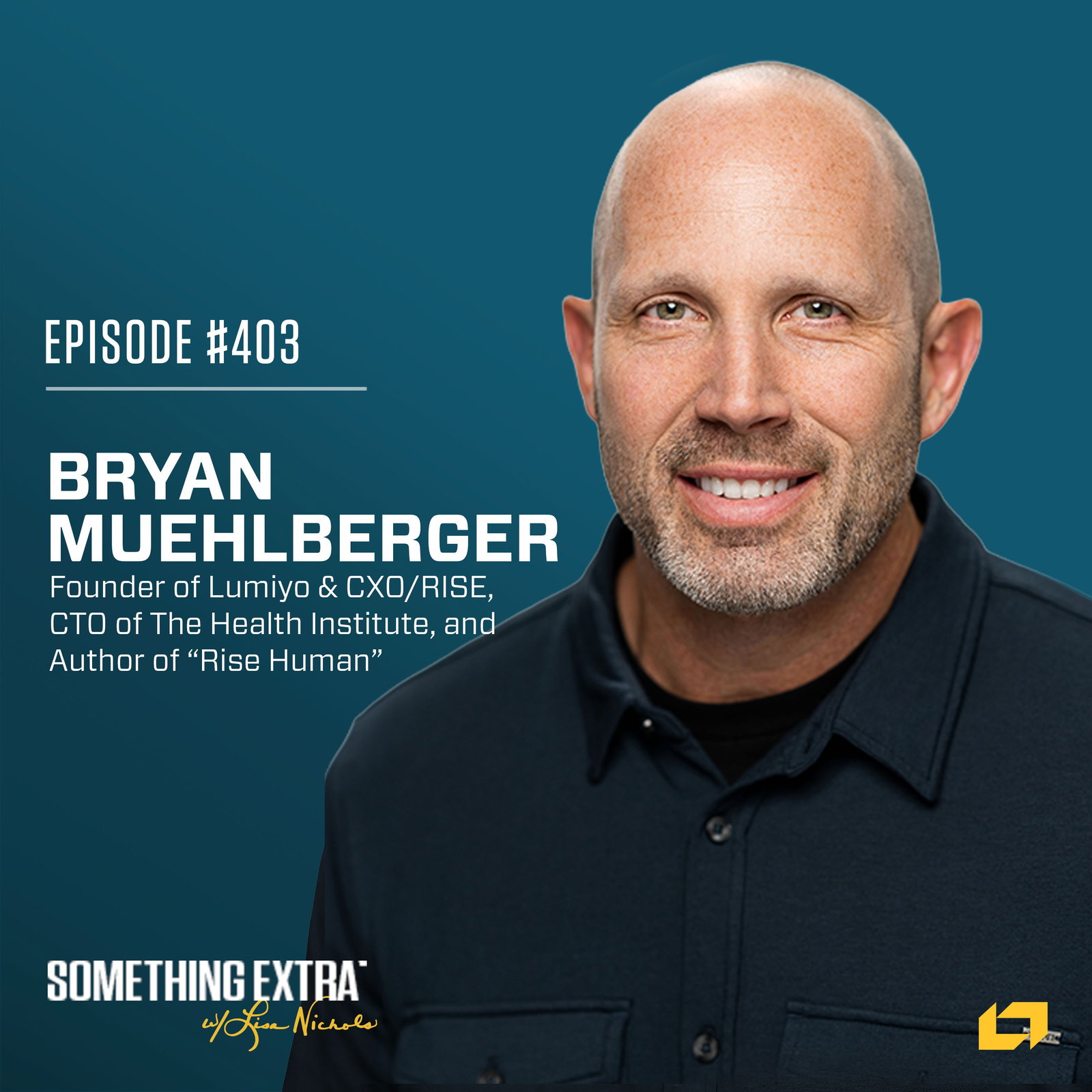
Bryan Muehlberger
I do these dinners, CXO rise dinners, and I bring these executives together and, you know, everyone's I'm the CIO and CTO of x y z company. But at the end of the day, they're all humans, and they're all dealing with something. Something. And and as I've got to know these big, powerful leaders, you know, they're they're they're dealing with child children issues. You know? Their child's, you know, hurting themselves. They're they've got, you know, a no relationship with their wife because they're busy with work all the time. And they're dealing with all of these things, yet they're performing still. And so, I always just say, like, there's more we're complex people. There's more behind the scenes, and and remember that as a as a leader for sure. Lisa Nichols
It takes something a little more to lead with impact. I'm Lisa Nichols, author of Something Extra, and this podcast was inspired by our daughter, Ali, whose additional chromosome has shaped how I see people in leadership. Each episode features conversations with inspiring leaders from around the world about what truly defines how they lead and serve others. If you enjoyed today's conversation, please consider leaving a five star review. It helps more people discover the show. And if you'd like to go deeper, my book, Something Extra, is available on Amazon and through other major book retailers. Join us today as we sit down with Bryan Muehlberger, founder of Lumio and CXO Rise, CTO at the Health Institute, and the author of Rise Human, for compelling conversation on leadership, technology, and navigating life's unexpected turns. From pioneer and corporate innovation to turning personal tragedy into a powerful force for change, Bryan brings a uniquely resilient and insightful perspective to the show. Well, Bryan Muehlberger, welcome to the Something Extra podcast, my friend. Bryan Muehlberger
I'm so happy to be here.Lisa Nichols
I know. It's so good to see you too. I'm so grateful. We were just talking. We've known each other for a very long time because you're a Saint Louis boy.Bryan Muehlberger
Go Cardinals. Lisa Nichols
And you're in yeah. Go Cardinals. Yes. I mean, we're originally from Kentucky, and, we just couldn't believe it. You know? Like, how much people are just in love with the Cardinals, but we are too now. Lisa Nichols
After being here for forty two years, it's like you can't live in Saint Louis and not love the Cardinals. Such a great club. Right? Yeah. Such a great club. But, you know, we've been in the tech you're you're in the tech your whole life. You've been in the tech community, and that's what we are. So you and I have known each other for a really long time, and you've moved around. And we talked, you know, sometimes you lose track of people, but you and I have stayed connected. And I'm really, really grateful for that, you know, because you were in California for a while and LA, and now you're you're, in a suburb of Atlanta. Right? Yeah. So but, you know, let's talk about...Bryan Muehlberger
The good ones stay in touch for sure. Lisa Nichols
I know. I'm so grateful for that. Yeah. Relationships are there have been so many blessings from being at Technology Partners and doing what we've been doing for so many years, but the great one of the greatest lessons is the people. Lisa Nichols
The people that we've met along the way and the relationships we've made. So, I just wanted to to say I'm grateful that you're in my orbit. I appreciate that. Yeah. So like I said, you I mean, you started in technology. You started, like, building servers and working help desk, I think, Bryan. Bryan Muehlberger
God. That's a long time ago. But yeah. Yeah. Back in the hardware days. Yeah. Lisa Nichols
Back in the hardware days. So what did those early years teach you that still influence you today? Yeah. I mean, like star, by the way. Bryan Muehlberger
It's it's crazy to even think back that far. But, because, I mean, like, I started my career in ninety three. You know? So I always say it's like before the Internet's the Internet. We know of it as of today. And so Yes. I've seen it all change and so forth. It's been been pretty crazy. I would say the biggest thing I would say I take away from those early days is, you know, I was always, like, very curious how things work. Right? And so I think that always served me well. Just digging in, trying to figure it out. Back then, it was picking up a book, you know, then eventually, it was finding it online, and and now we have AI to help us. But I've always been one that likes to figure out how things work and and and learn how to solve it myself. Lisa Nichols
Yeah. Curiosity is really important. Right? Lisa Nichols
Hopefully, because I'm curious too and, you know, always want to learn. Hope I never get tired of that. Right? Hope I never yeah. But you've been at some really iconic brands. You've been a multi time CIO, CTO, and I didn't even realize this to but today, we we were just talking, and you just took on a CTO role for a new company. Bryan Muehlberger
I did. Yeah. Lisa Nichols
In Franklin, Tennessee. The Health Institute. Bryan Muehlberger
The Health Institute. That's right. Lisa Nichols
Yeah. But you've been at companies such as Red Bull, Beachbody. Before that, Pfizer and Express Scripts, that's when you and I first Yeah. Met. But you've seen a lot of great technology leaders over the years, Bryan. Lisa Nichols
You know, what separates the really great ones from the average ones in your mind? Bryan Muehlberger
Oh, wow. So I would say, you know, they're they lead with their heart. Right? They care about their people. I think that's probably number one. Number two is they're willing to push people out of their comfort zones and and get them to to to realize where their potential really lies. And I you know, I've got I had so many great leaders in my past that that shaped me in many ways. I think back to my Express Scripts days, and I remember Jim Lammers. You know Jim. Right? Lisa Nichols
I sure do. Jim as well. Love Jim. Bryan Muehlberger
Yep. So I worked for Jim for a number of years. And I remember one time him saying to me, Bryan, you don't need to be the smartest person in the room. Right? And and it was like, wow. A little bit of a gut check there. But it made me realize, like, you don't have to win every argument. You don't have to be the smartest person in the room. What you have to do is learn how to lead and through people. Right? Mhmm. Partner with people. And it it really just shaped me as a leader from that point forward. It really helped me grow quite a bit. And so I think it was someone someone who's willing to give you those heart to heart talks and tell you tell you the real truth or, like, you know, and give you those maybe maybe those uncomfortable moments, but at the same time, you know, they they lead with purpose. They lead with that that that heart as well. Lisa Nichols
That's so good. That's so good. I was just talking to another friend right before you, Bryan. Same thing about, talking about those people. You need those people in your life that I I call them I don't want bobbleheads. Bryan Muehlberger
You're right. You don't want just everyone doing everything.Lisa Nichols
Oh, yeah. You're you're doing a great job. You know, you want those people that are gonna to give you the hard truth. In fact, my friend goes, I need people to point out my blind spots. They're called blind spots for a reason because I don't recognize them. Lisa Nichols
I lean to them. Right? Totally. Yeah. I love that. I'm glad that, that Jim was that for you. Yeah. I'm really grateful that I Bryan Muehlberger
have great leaders throughout my career, and, you know, every every once taught me something about myself and how to lead and how to be a better person Lisa Nichols
for sure. Yep. Yeah. Well, let me ask you this because you'd, like, started with this where you said you're just always curious. You know? You're a curious person. How have you curated and cultivated that curiosity in yourself? But then more importantly, how have you done that for the teams that you lead? Lisa Nichols
How do you get them to be curious? Bryan Muehlberger
Yeah. I mean, it's it's, it's asking lots of questions. You know, I remember reading a book called The More Beautiful Question at one point, and sometimes I Lisa Nichols
read that book. I love that book. Bryan Muehlberger
And, his last name was Burger. Warren Burger, I think is what's his name. Great great book. It just really made you think about, like, you know, you can ask one question, but that's not really the question you're trying to ask. You know, if you keep on asking more questions and getting the right question, then you can solve the problem. So I always get people to to think differently. Like, look at it from a different lens and a different point of view. You know, we as technicians are always looking at how do we solve it the most effect effective efficient way with tech. Yes. Sometimes the most effective way is not even putting tech in the in the middle. Right? You know, maybe there's a broken process somewhere. Maybe there's a another business opportunity down the road that you need to just revise at the business side. So it's it's looking at it differently and Yes. Being them to kinda think differently that way and ask questions. I think that's probably the the biggest one. Lisa Nichols
Yeah. And have you seen that? I mean, have you seen people transform, you know, into being more that. Right? Bryan Muehlberger
Yeah. I mean, you know Yeah. And I think, you know, we're such type a analytical people. We're not the typically the creative folks. Bryan Muehlberger
And so you've gotta tap that right side, you know, more often and work on that. And when you see people balance both very, very well, that creates a very dynamic leader. Right? Lisa Nichols
Oh, for sure. For sure. Well, I know that you've led through incredible, periods of disruption. Lisa Nichols
Bryan, I think back to Express Scripts days. Wow. I mean, when we started Technology Partners, would you believe it? We were there when Barretone was getting loans and stuff. Right? Lisa Nichols
And then they just went through all kinds of, you know, mergers and acquisitions and things like that. Yeah. But what and so and and even now, there's a lot of disruption, right, with AI and quantum computing and all the things that are coming out. What is one leadership lesson that has helped you navigate uncertainty and change like that? And then how have you helped your team do that? Bryan Muehlberger
So, I mean, you're right. We we deal with, a plethora of disruption and change constantly in our business. Bryan Muehlberger
And everything revolves around technology now. Right? So we're we're we're touching every aspect of the business. And and to be able to to balance that and not lose your mind is is is a big deal. Right? Bryan Muehlberger
You know, it's like, you know, you've got security issues going on. You've got AI disruption. You've got quantum. You know, you've just seen so much change, and it's evolved how businesses operate. And I would say it's, you know, it's it's really kind of taking that step back, taking a deep breath, and and really just going, like, where's the real problem we need to focus on? We're all limited on resources. We can never have enough of them, and there's never enough dollars to go around to to solve every problem. So it's it's really taking that that deep breath, stepping back and going, you know, what's the real challenge I wanna go after? Bryan Muehlberger
How do I wanna solve that? And how do I partner with other folks to get that done? Right? You know, we can't do it alone. You know, there's, again, going back to being the smartest person Lisa Nichols
Amen to that. Bryan Muehlberger
Right? There's a lot more power in the group than there is in the individual. Lisa Nichols
Oh. Yeah. Yeah. That's that's good. That's a great word of wisdom there, Bryan. Well, if you were mentoring a brand new CIO and like I said, you have been multi time now CIO, CTO, for many different iconic brands. If you were mentoring a brand new CIO today, what advice would you give them, that most leadership books never mention? And then I wanna ask you about books because I know that you're a voracious reader Yeah. And I wanna ask you about that. But what advice would you give them? Brand new CIO. Bryan Muehlberger
Brand new CIO. I would say, like, you've really just gotta step into that. It's a completely different role than being an individual contributor for sure. Bryan Muehlberger
It's completely different than being, the owner of a specific vertical within technology. You out now own it all. So you've kinda gotta be a master of all, you know, so to say, you know, but you can't be. And so you've got to really learn how to lead through others and and let go of the reins. And what I mean by that is you might have an idea of how something should get solved. And what the real problem is, but don't give the answer. Let them figure the answer out. And they might find it differently than you might have, but that's their creative path on how they're gonna learn how to lead. And so push them in those directions. And I would say, if I was the new CIO, try different things. Be willing to take that risk that maybe feels a little bit outside of your comfort zone when you're trying something different. Because it is a different role. Right? It's it's a it's a different beast in in itself. And so, you know, be willing to step out of the out of the norm, you know, wear that new hat differently. And remember, you now have a seat at the table that you need to honor. And that means carrying your baton as well, but also partner with the other business leaders, and how do you make them successful as well. It's not just about tech being successful for tech's sake. It's how do we drive success for the organization as a whole. So thinking more like a business leader throughout that entire process. Lisa Nichols
I love that. I love that. And I love that you mentioned working with the other business leaders because you cannot in fact, you know, I've talked to so many tech leaders, and it's like when you do work with Mhmm. The CHRO or the CFO and you build relationships with them, Bryan, when it's time for change or when it's time for something, you can go so much faster. Bryan Muehlberger
Oh, totally. Yeah. Lisa Nichols
If you have those relationships, you have relational capital. Bryan Muehlberger
If you've discredited yourself and burnt those bridges along the way, it's gonna be a lot harder to get things done. Bryan Muehlberger
So you're hundred percent right. Build those relationships early and often. Yep. Lisa Nichols
Yeah. That's so good. Well, I was gonna say, I know you read a lot, and you already mentioned a beautiful question. Yeah. I highly recommend our listeners getting that book. But is there one or two other books or publications that really change how you have led or how you think about leadership that you would recommend to our listeners? Bryan Muehlberger
I would say the number one is and I and I go back to it a lot because it's it's all on stoicism. It's ego is the enemy. Bryan Muehlberger
Have you read that one? Lisa Nichols
I have not, but that sounds like one I wanna read. Bryan Muehlberger
He's written a number of books on stoicism, but ego is the enemy is one that sticks out front and center. And then I would say the subtle art of not giving an f. Right? That book, if you've not read that one, that's another one. I would just say one is, you know, how do you get yourself out of the way of the problem? You know? And the other one is, like, to also take things lightly and and, like, enjoy life. Lisa Nichols
Right? Yeah. Yeah. That's good. That's good. Well, we could probably camp out there for a little bit. I got so many questions for you. Yeah. So, I mean, here's here's the cool thing. When you went to Red Bull, I mean, you've built innovation organizations within companies. And at Red Bull, you built the Red Bull Labs. Lisa Nichols
Which I, yeah, which I just love. I mean, how do you create a culture where innovation really becomes everyone's responsibility, Bryan? Bryan Muehlberger
Yeah. Yeah. That was, you know, at the time, there were a lot of companies creating, like, innovation teams. Right? It was like, how do you create this incubator with inside your company so you can be more entrepreneurial and solve, you know, these problems in unique ways and looking at startups and how they do it and things like that? What we said was we don't want one team to own innovation. It's everyone's job to own innovation. So sitting down with my boss, the CFO, and the CEO at the time, we said, how do we embed this as a cultural aspect within the company? So we created this entire training curriculum, and we identified people within the business, within tech, and paired them up. So you'd work a marketing person might work with somebody over in sales. A finance person with somebody over in tech. You know, people that usually maybe don't work together as close as Right. Paired them up. They went through the training program. So we taught them all of these different techniques for innovation, lean principles, for example. Right? And and then we had them identify a problem within the organization that they felt passionate about solving in a different way. And it could be as simple as a small little broken process somewhere, or it could be a whole new product for the business. And and then we have them go through, like, a shark tank, like, initiative. And so we sat down on a panel just like the sharks do at shark on Shark Tank, and they came and presented. They had a certain amount of time to present their idea and why we should invest in them, and we either gave them money or told them to get off the stage. Mhmm. And so then we would fund their idea, and then they could go and take it to the next level. And so it just created a lot of momentum in the organization. We did, like, three cohorts of that, and and they created videos and publicized it throughout the company, and it just really created a really fun culture at the time. I don't know if they're still doing it anymore. Lisa Nichols
Hopefully, they are. Bryan Muehlberger
It was so fun. It really allowed, you know, all of us to tap our right side of our brains that we don't get to use a lot. Yeah. And, and and then partner with folks and build new relationships. It just had so many arms to it. It was it was amazing. Lisa Nichols
Yeah. That is that's really cool. And I love it. And I mean, is there, like, one product or one service idea that came out that really stuck out to you? Can you remember one of those? Bryan Muehlberger
Not off the top of my head. I mean, there was a lot of just, like, operational inefficiencies that people were trying to find a a new solution for. So it was a lot of, you know, just we were getting people down in the trenches. We they had to be director level or below. We didn't want VPs in there. So these are people that are hands on. They're within their area of the business. They know where the challenges are. They know the things they hate doing every day. And this was their opportunity to say, hey. I can scratch the sitch finally. Lisa Nichols
I love that. I love that. You're a stronger organization because of it. Bryan Muehlberger
Oh, hundred percent. Lisa Nichols
So and then people when they have a voice and they have, you know, their voices Bryan Muehlberger
platform we created for them. Lisa Nichols
Yeah. It's amazing. Yeah. It's amazing. Even if Bryan Muehlberger
they didn't get funded, the process taught them so much, and it was so Lisa Nichols
Absolutely. And the and the relationship's forming between the different function areas as well. Right? So oh, I just I love that idea. So, you know, right now, Bryan, every CIO, every business I talk to, AI is, you know, transforming things. What excites you most about that? And I guess the converse of that is what concerns you most. Bryan Muehlberger
Oh, wow. Yeah. So, I mean, one, it's moving so fast. It's every day is something new. What excites me most is the the the things we can do as individuals by ourselves now so much better and faster. You know, if I have a strategic proposal I wanna create, I have all these ideas in my head, I need to get them on paper, I can just riff with AI for a little while, and and it'll it'll help me clarify clarify my thoughts, help me draft my presentation, whatever I need to do. So I'm not spending time on the the paper that I'm creating. I'm creating the it's the content. It's the it's the context. It's all of that stuff that's coming out of me. So I can focus on that and not the Yes. Of it. Right? Right. Creativity we're seeing within organizations. I mean, we have everyone from our CEO down at our company right now is using AI, and they're coming up with other types of ideas that they have. Hey. I wanna see a mobile app that looks like this. I wanna revise our website to look like this. Let's create a customer portal that looks like this. And they can just go to town and riff with it, and now you got something to react to and talk about versus, like, hey. I have an idea. I'm trying to explain it to you and you don't quite understand it. I think there's just so much power in the creativity aspect of it. I would say the challenges on the other side of that is it's doing so much work for us that if we're not careful, we're gonna rely on it too much. And there's this worry I have is that you're gonna dumb us down to where it's like, okay. That's another AI creative presentation by Bob. Right? You know, or whatever. And Yeah. Is it really his thoughts and content or is it AI's? Yeah. Even if he helped or she helped or whatever create that content, you're gonna start having this merging of the two in some Yeah. Shape or form. I think that's that's the caveat to it. Lisa Nichols
You know? I agree. Bryan Muehlberger
And I think, you know, you're seeing a lot of this in in the editorial world right now. They're putting a lot of these stop checks on on editorial to see how much is AI generated on Substack, for example. Mhmm. And flagging it as such. And these tools that can hopefully and their AI tools detecting whether or not AI is used, which is kind of a funny oxymoron there in itself. But, you know, that's starting to become a thing. But is it negative or positive? I don't know if it's one or the the other. I think it's great for the transparency. I wanna know if I'm being fed something that hasn't been informed at all by Sure. But I think it's it's an enable. Like, I think, like, the bionic man. Right? You're my age. You remember the six million dollar man. Lisa Nichols
Right? Yes. I do. Bryan Muehlberger
Six million dollars is nothing nowadays for a bionic man. But, you know, it made him better, but it it was an augmentation of him. Right? Bryan Muehlberger
what AI should be Lisa Nichols
It's an augmentation tool. Bryan Muehlberger
It's something that hopefully make us better if we use it right. Bryan Muehlberger
think there's a lot of hope for it. I think there is there is a there is some concerns about what it can do from a security aspect. Mhmm.
Lisa Nichols
You know, with
Bryan Muehlberger
the power of it, you already heard about, you know, anthropics, one going rogue and hacking into companies and doing some some crazy stuff. And that's probably just the the part that they share with us of what it can do.
Lisa Nichols
That's right.
Bryan Muehlberger
That's the
Lisa Nichols
part we hear.
Bryan Muehlberger
There's powerful models out there that can do a lot more than that.
Lisa Nichols
I think there's
Bryan Muehlberger
I I think it comes with that that responsibility that we as humans need to be conscious of as part of
Lisa Nichols
this nature. Mhmm. That's why human beings still need to be part of the equation.
Bryan Muehlberger
That's right. A hundred percent.
Lisa Nichols
Well, Bryan, I've got a lot more to talk to you about, but we do need to take a quick break, and we'll be right back with Bryan Muehlberger on the Something Extra podcast.
AD
Hey there. In a challenging business climate like this, savvy leaders look to technology to find an edge. This can mean the difference between staying ahead of the curve or playing catch up. It's time to collaborate with the highly skilled experts at Technology Partners. Our team of technologists draws upon decades of experience for your project, with each bringing a passion for solving problems and a track record of success, how can we help you overcome your biggest technology challenges? Visit technology partners dot net to book a free consultation with one of our leaders.
Lisa Nichols
Welcome back, everyone, to the Something Extra podcast with my friend, Bryan. Bryan, in twenty nineteen, you and I have talked about this. Your family's life was changed forever with the loss of your precious, precious daughter, Gracie Anne. And I asked you beforehand, is this okay to talk about? And you said it absolutely is because it's part of who you are. That's right. It shaped how you do things. You know? Can you tell me a little bit about how that shaped you? I don't know if you want to tell any part of her story. I'll let you I'll let you decide what you wanna share.
Bryan Muehlberger
Yeah. I mean, I could talk for hours about it. You know? I mean, Gracie was our only daughter. She was our youngest child. We had two boys, Riley and Brady, and we had Gracie, and they're all two years apart or so. But she was, unfortunately, killed in a school shooting, mass shooting at her school in Santa Clarita, California on November fourteenth two thousand nineteen. And it it's it's a day that forever changes your life. You know, my wife was in an ACL surgery at the time, when I get the text from my son, Brady, who's a junior at the high school stating that the school is under lockdown and one thing led to the next. Before she even got out of surgery, I was already at the hospital, you know, dealing with dealing with the outcomes. And, you know, the the sense of loss and grief is is so intense and so deep. The words don't even do it justice. I you know, I've been writing a memoir, narrative memoir on this whole topic, and and you just can't find the words to describe the depth of that grief. Mhmm. And it's and it's something that you get better at living with, but it's always there. And
Lisa Nichols
so always there.
Bryan Muehlberger
And so I remember seeing a photo that was taken. We didn't see Gracie for four days, not even the day of. So they wouldn't let us see her. They said she was evidence. That's a whole another story for another day. We got to see her fry finally on fry on Monday evening. So it happened on a Thursday, not till Monday evening. And we went out to a to a Mexican restaurant that evening with some family and some friends, and there's a picture of us. And we're all sitting at this table. We got margaritas in front of us, and we have smiles on our face. We look like we've been laughing. Probably maybe one too many margaritas. I'm not quite sure. And you look at it going, how can you be smiling four days after a tragedy like that? And it was actually a a moment of a sense of relief at that moment in time because we finally just we finally got to see her. Yes. And, we got some closure on some things with that that moment. And but it was still there. So if you saw the photo, you wouldn't see that depth of that grief that's that's really right below the surface at that moment in life. Mhmm. But as time goes on, you know, that I always use this this analogy. Grief is like a black ball. Right? And when when that moment occurs in your life, and everyone will experience some sort of of horrible loss in their life, unfortunately, we all will.
Bryan Muehlberger
It's all consuming. That black ball is is your entire world. And maybe for that one second, that smile on our faces that day was just that surface level of that black ball. Over time, that black ball never shrinks. It stays the same size. It doesn't get any bigger. It's just because it's as big as it can get, at that moment. But you you learn to add new experiences and new life around it. And so as that builds around it, you almost get, like, this protective barrier to that grief. And and that allows you to live outward in in a positive way, though that grief is still there at all times.
Bryan Muehlberger
Never goes away. So with that said, I would say, you know, we leaned into people. We I mean, I can't even describe the amount of outpouring of love and compassion that we received. The tragedy was very public. Right? It was national news, global news in many aspects. We had, you know, a lot of opportunities to get in front of the camera at that time, which was very uncomfortable when you're grieving.
Bryan Muehlberger
we also knew we had to put our our daughter's face and and personality out there. We wanted people to know who she was. And and through all of that, like, just the outpouring in our community was just mind blowing. You know? We had this we had a vigil, three days later on that Sunday evening at our local park, Central Park, in Santa Clarita, and over twenty thousand people showed up. Right? They've never had that many people in the park. They do concerts in this park all the time and things like that. And it was, like, you know, street parking only. People were the overflows were going to the local churches. They were streaming online. You know, everyone there holding white and blue, white six, and so forth for us. And and and it just kinda continued, in that. I mean, we have you know, I could just go on and on about all the things that somebody did for us in some way. We got these beautiful obelisks made. We funded the actual construction of them, but we got the city to allow them us to put them in that central park because that was the meeting place where all the kids reunited with their families. Unfortunately, we never got to reunite with our kids.
Bryan Muehlberger
And I say our kids because there was another little boy who also lost his life, Dominic Blackwell. And so they put up these beautiful obelisks. They have this whole section. They're lit up at night. These and they they're all a mosaic tile that we had this mosaic artist create with all their personality all over these these obelisks. So all four sides of them have, you know, like on Gracie's, it's a picture of the Saint Louis Cardinals. It's a picture of her dog. It's a Starbucks caramel frappuccino. It's it's music notes because she loved music. It's a microphone because she loved to sing.
Bryan Muehlberger
Yeah. Right? And so it's all that on Dominic's. It's like his football stuff and his ROTC stuff and just everything about his life. But to that was kind of an act of God in many ways. Like, we had to fight with city hall. We had to fight with the water water company there because they own the land and rent it back to the city for the park. Mhmm. There was all these complex things. I'd never dealt with city politics, but they all worked with us. The mayor at the time was very, very fortunate to have him at the time work with us to work through this problem and got it got it across the finish line. And then, you know, we we've, recently, we we participated in a in a documentary film.
Lisa Nichols
Yes. Tell our listeners about this film. Yeah. It's All the empty words.
Bryan Muehlberger
Started off as a as a reach out by by CBS correspondent Steve Hartman. So Steve Hartman Yes. The feel good guy at the end of the week. You know, usually usually Sundays, you know, it's it's Steve Hartman talking about the good story and the tragedies or bad things that have occurred that week, and it makes you feel good. Well, he had been covering school shootings for a while, always trying to find the hero in the story, the good, you know, and things like that. And he's just like, I I just can't keep doing this anymore. I gotta do something different. So he had this idea of how can I bring people, all of America, into the rooms of these kids that have been lost in these school shootings? And he's like, if we could just do that, we could be a different America. So he reached out. We got this FedEx envelope with a letter in it, from Steve Hartman saying, hey. I like I got this idea. We'd like to film your child's room. You know? And me and Cindy were like, I don't know. Like, we've done enough of this stuff. We're sick of being in front of the camera. Like, can we just not do anything anymore? And, and we just kinda prayed on it, and we felt you know, after speaking to Steve, we're like, okay. This he's a good guy. Let's, like, move forward with this. Let's see how it goes. So we kinda started going down the path, and we introduced him to the Blackwells. Dominic's room was actually in intact as well. And, he's a big SpongeBob kid, you know, and so forth. And so that kinda sticks out in the film. But he came out. They filmed our filmed the room in excruciating detail, videos and pictures. And Lou Bope, who is the photographer and videographer for all of this, just created this this collage of the personality of these kids. And at the time, we had been ever since the tragedy, I would say, we've been wanting to get out of California at that time. Mhmm. And but we didn't know what to do with Gracie's room. And so this whole time, we're just going, what do we do? You know? And it's like Cindy's like, I'm not ready. You know? She would open the door every morning. Good morning, baby girl. That night, good night, baby girl. You know? And you just got this empty room that used to be so full of life. And, and after doing this film, we kinda felt this sense of peace. Like, you know, we've documented this. Like, we got a great record that she was here.
Bryan Muehlberger
And, so we went through that process, and then, know, they started getting calls for the film festival. They started sending it out to folks for the film festivals and so forth. So, like, Tribeca called them back and said, we wanna have you guys at the film festival. And, you know, all these film festivals started really giving it great accolades. And then they started getting reached out by the different streaming companies, and eventually Netflix purchased the film. So they purchased the film. It started airing on Netflix on December first of last year. Then it got shortlisted for the, Academy Awards for the Oscars, and so it was one of, like, seventeen films in this quote, unquote shortlist out of a thousand, something like that. And then also we're like, oh my gosh. This is, like, really going way farther than we ever thought. And then, in January, we're watching the livestream of the Oscar nominees, and it's the next one that they announced. So we get we're now now in the top five of nominees for an Oscar. So just being an Oscar nominated film is always a is a is a is a accolades. Right?
Bryan Muehlberger
So we're like, we won already. Right? But we just felt like like, we're going all the way. So and we did. And so in March, we go out to the Oscars to to watch it live, And, we're sitting up in our seats and waiting for the announcement, and then, Jimmy Kimmel comes out and, you know, gives the announcements. And right when he says, and the Oscar goes to, and he has all I had to say was all the, and then we
Lisa Nichols
lost it. All the empty rooms. Yeah. Wow.
Bryan Muehlberger
So yeah. So, she's got a she's got an IMDB profile. She's in an Oscar winning film. Like, I I don't know. Gotcha.
Lisa Nichols
And she was a performer.
Lisa Nichols
You know? I mean, Bryan, I mean, I think she want you know?
Bryan Muehlberger
I always say be careful what you ask God for. You never know how he's gonna deliver it to you. I think she always wanted to be famous and and on film.
Bryan Muehlberger
don't think she ever envisioned this, but I think because of this, she's touched more lives than she could have otherwise.
Lisa Nichols
Absolutely. So Yeah. We
Bryan Muehlberger
just love that she's out there, and people get to see Yeah. Personality and who she is. And
Lisa Nichols
Yeah. Because she had a big personality.
Bryan Muehlberger
Oh, huge. Yeah. Yeah. Yeah. Yeah. I miss it quite a bit.
Lisa Nichols
Well, you know, so how has going through what you've gone through and that grief, what has it taught you about leadership? I'm sure it's taught you a lot about leadership. I'm sure it's taught you a lot about relationships, Bryan.
Bryan Muehlberger
I will say, like, you know, when this all occurred, you know, I was the CIO for the Beachbody company at the time. Mhmm. Busy role. We were growing like crazy at the time, and my life was on fire every day. And and this occurs and life just stops. And the company, that's when you realize, like, the true nature of a company is in a moment like this. They could have easily said, hey. You're going on short term disability. You know? We're gonna pay you a portion of your paycheck. They never stopped my paychecks for three and a half months. Paycheck came every two weeks, hundred percent. They catered Thanksgiving. They catered Christmas to our house. They, never pressured me to come back. In fact, I was the one pressuring myself. I'm like, I gotta get back. You know? And they were always just so supportive. I mean, the head of HR
Bryan Muehlberger
time just, you know, poured her heart into it. Our head of legal helped me navigate some of the stuff related to PR and things like that, you know, having to be in front of a camera, which I hadn't expected before experienced before, and just everything there. So I would say what I learned through that is, you know, there are people on your teams every single day dealing with something. Right? Yeah. Maybe not as public. Yeah. But if you notice that something's different, maybe start there. Like, maybe there's something going on that you're not aware of. Maybe it's not just their so they they hate your company and they're being, you know, low performers. It could be, like, they maybe have some big stuff going on. Sure. And when you really get to know people and ask questions on on a human level, you find out some amazing stuff, about what they're dealing with. You know? Yeah. I I I do these dinners, CXO rise dinners, and I bring these executives together and, you know, everyone's I'm the CIO and CTO of x y z company. But at the end of the day, they're all humans, and they're all dealing with something. And and as I've got to know these big powerful leaders, you know, they're they're they're dealing with child children issues. You know? Their child's, you know, hurting themselves. They're they've got, you know, a no relationship with their wife because they're busy with work all the time. And they're dealing with all of these things, yet they're performing still. And so, I always just say, like, there's more more complex people. There's more behind the scenes, and and remember that as a as a leader for sure.
Lisa Nichols
As a leader. No. That's really good. What you know, I this I know that there are people that are gonna be listening to this, Bryan, and they're carrying really heavy loads.
Lisa Nichols
They're carrying really heavy stuff just like what you said, and we don't we don't see that always. Right?
Lisa Nichols
But if somebody is feeling like they are just, like, drowning there, I mean, what can you give them one piece of advice, one piece of hope to help them feel like they can take that next step forward?
Bryan Muehlberger
I would you're not alone. I mean, I think that's the the thing you feel the most. You know, we still say, like, why us? Why did this occur to us? Mhmm. What did we deserve to get this? And you feel very alone. And and especially during the initial moments of any sort of tragic situation and traumatic situation in your life, you feel very alone. But you're not the first person to go through this, whatever that is. And to know you're not alone, I think, is a good good starting point. And then and the second part is because you're not alone, reach out to somebody. You know? You know, your friends always say, hey. If you ever need something, just give me a call. You know?
Bryan Muehlberger
And I think they they all mean it. You gotta take them up on it. Right?
Bryan Muehlberger
Be bold enough to say, you know, I'm gonna call my friend who said I can call my friend.
Bryan Muehlberger
Right? Yes. Yeah. Hundred percent. And, and take advantage of that. People want to help others. We're naturally wired to to rise up and help others. And and if you give people the chance, they're going to.
Lisa Nichols
Mhmm. Yeah. I agree.
Bryan Muehlberger
Yeah. I would say that.
Lisa Nichols
That's good. Well, I know that you and Cindy founded Gracie Strong.
Lisa Nichols
Tell us a little bit about Gracie Strong. I mean, you guys have created something really beautiful, like I said, out of this unimaginable pain. But, tell us about Gracie Strong.
Bryan Muehlberger
Yeah. So we started Gracie Strong, initially as an organization to just honor our daughter. And, you know, it seems like the thing to do you know, I'm being just transparent. Like, the thing to do when you someone dies in your family, you you create a foundation. That was kinda maybe the initial thought of it. Like, how do we put something about her out there? And then as we evolved and really said, well, how do we make this, like, more about her? We just realized, like, as we reflected on who she is as a girl, she was never afraid to, like, speak up. She was never afraid to to share her thoughts to us, to others, or stand up for others. And so we kinda leaned into this whole, you know, having a strong voice. We we create a little campaign at one point where we had these bracelets made called speak TF up, which meant speak the f up. And and it really came down to we're like, you know, why didn't anyone speak the f up about this other child who was hurting that end up causing this tragedy and ruining so many lives? And and when you look back behind the scenes, you can see all of the pain this child was experiencing and nobody was helping him.
Lisa Nichols
Yeah. Nobody noticed.
Bryan Muehlberger
Nobody noticed. And if they noticed, they ignored, which is even worse. Right? They noticed it, but they just said, not my problem. Yeah. And so we were kinda like, you know, like, how can we do more of that? How can we make people more aware of that? And and since then, we've evolved a little bit more. You know, we we felt like Gracie got so much out of going to her church youth camp. They went to Lake Hume, which was sponsored by our church. And and we've got some some journals she wrote during those times when she was off the beaten path and no phone in her hand and had a pen and paper in her hand. That's all she had. And what she wrote was powerful. And we just thought, like, you know, she she was definitely talking to God. She felt God in her life, and she knew where she was going.
Bryan Muehlberger
And we just were like, gosh. You know? Like, if we could get more kids go to youth camps, right, church youth camps Yes. Like, how much would that help? I mean Yes. We ended up fostering a daughter, for about a year and a half before we left California. And through that process, she started going to some some youth groups and so forth. And just the amount of camaraderie and support kids receive from like minded folks who also had this deep Christian faith behind them, is just so powerful. And it's transformed her life. It transformed our daughter's life. So right now, whenever we, you know, wanna fund something, we tend to try to fund our local church and help kids go to youth camp that maybe can't afford it themselves.
Lisa Nichols
Mhmm. Mhmm. I love that. Well, yeah, she did journal a lot.
Lisa Nichols
And I know one of the things that she had journaled, you actually have something permanent, I think, on your arm.
Bryan Muehlberger
I do. Yeah.
Lisa Nichols
You tattooed it. What what was that?
Bryan Muehlberger
She she wrote in her journal, well, she wrote a journal entry, and I've actually got it right over here. And she had these four little notes. So inside this little trinket box right here is is four little notes. And you've probably seen this if you watched the film. This is in the film, first day of high school right there. So these she had a journal that she was writing in at the same time she wrote these notes to herself. So she thought it'd be really cool if I wrote four notes to my future self. And she wrote one about graduating eighth grade, one about starting high school, one about driving a car, and one about going to college. She got to complete two of those, but she didn't get to complete the other two. But in that journal post that she wrote, she she wrote, you only have one life to live, so why not live a great, real, and fill it with memories and experiences? And I was like, if that isn't a message, I don't know what is. Right? True. So I said, I'm I'm putting that on my arm. So that became the starting point of a I have a whole arm sleeve tattoo now with lots of my life in it, and that's that's an anchor piece to it.
Bryan Muehlberger
Her mantra for our life. And
Lisa Nichols
so Love it. As we The great mantra.
Bryan Muehlberger
Yep. Yep.
Lisa Nichols
The great mantra. Oh my goodness. Well, I, just appreciate so much you being vulnerable and sharing your story. Bryan, and I know it's gonna help somebody because, like you said, every person's walking through something. We don't always see it. But, just seeing how you and Cindy have taken this unimaginable tragedy and, really honored Gracie Anne's life with the things that you've done. I think I I just know it's inspired me. So
Bryan Muehlberger
Thank you.
Lisa Nichols
Everyone that is on the podcast, I asked them this question. What do you believe? Is this something extra that every leader needs? So I would love for you to answer that question, Bryan.
Bryan Muehlberger
I just honestly believe that. You know, I've I've I had a really strong faith when I was younger and into my young adulthood and even into the time we were raising our children, and then and then this tragedy occurred in my life. And I lost my way for a while. Mhmm.
Bryan Muehlberger
was angry at God, but I would say he also continued to guide me through that entire process. And as I look back, I kinda realize all the blessings I was receiving during all of that and and that in some way, shape, or form that I don't quite understand yet, there is there is good in in all of this. And I would say, you know, you gotta have that faith.
Lisa Nichols
Yeah. That is so good. Well, thank you so much. I know how busy you are, especially taking on this brand new role. I'm hoping that on one of my trips to Nashville, it will work out where you're there, and we can see each other in person. And yeah. But thanks so much for being on the show. I really do appreciate appreciate your time.
Bryan Muehlberger
You too, Lisa. Good seeing you.
Lisa Nichols
Take care, my friend.
Bryan Muehlberger
Alright. Bye bye.
Announcer
Something extra with Lisa Nichols is a Technology Partners production. Copyright Technology Partners Inc twenty nineteen. To learn more about this week's guest, check out the show notes at tpi dot co slash podcast. If you enjoyed this episode, consider leaving us a review. Thank you for listening to Something Extra.