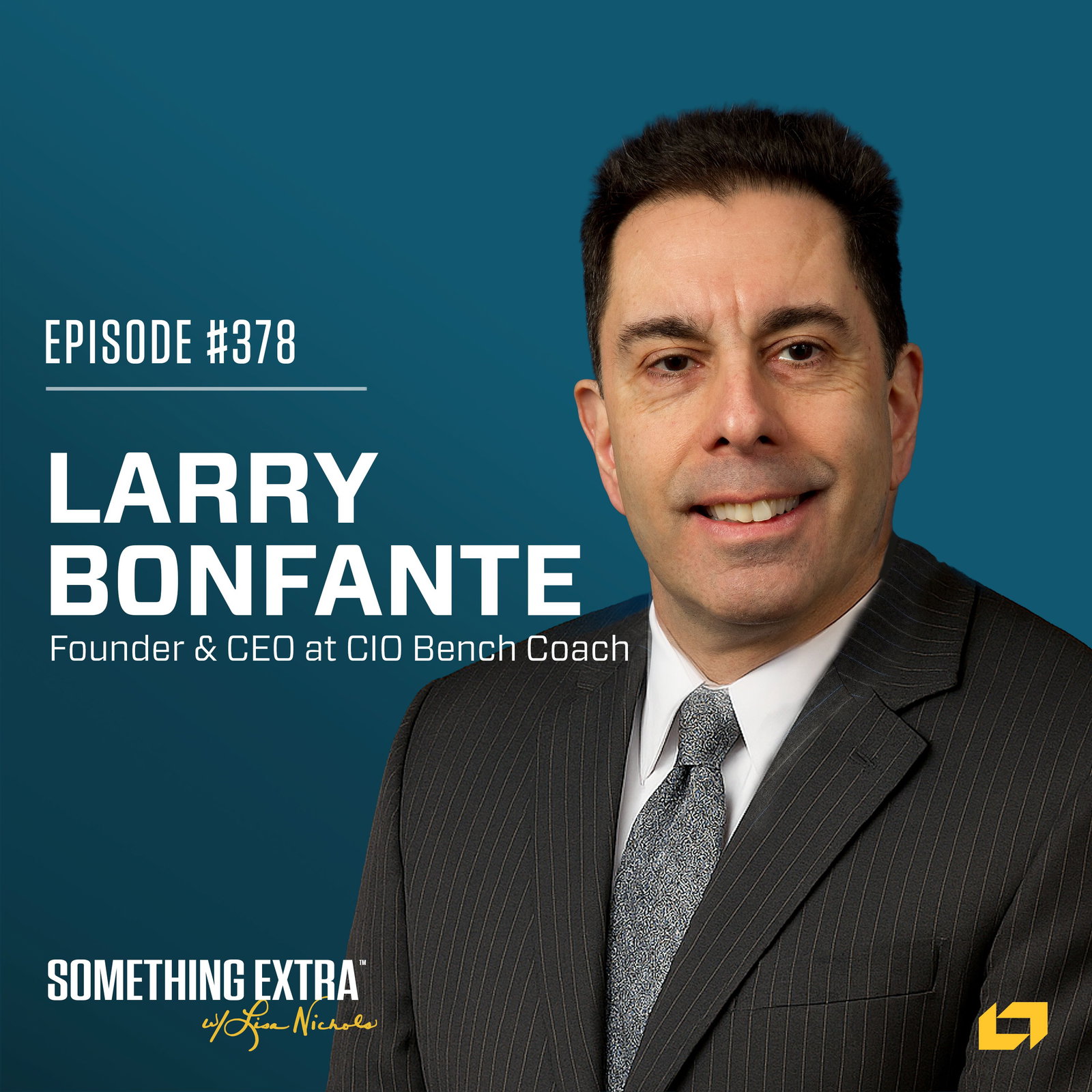
Larry Bonfante
What are the three most important things you want people to say about you, to say about their experience of working with you and their experience of working with your team versus passion? Because I always want people to feel that when they work with me, I'm never mailing it in. I'm never giving them some half baked effort. I'm bringing all my energy, all my passion, everything I have to every engagement and they know that they're getting the best for me, right? The second for me is results. I want them to know that when they worked with my team that the widget was going to come out of the machine on time, on budget, on value. And the third is integrity because I want people to work with me to feel that I say what I mean and I mean what I say.
Lisa Nichols
It takes something a little more to lead with impact. I'm Lisa Nichols, author of Something Extra, and this podcast was inspired by our daughter, Ali, whose additional chromosome has shaped how I see people in leadership. Each episode features conversations with inspiring leaders from around the world about what truly defines how they lead and serve others. If you enjoyed today's conversation, please consider leaving a five star review. It helps more people discover the show. And if you'd like to go deeper, my book, Something Extra, is available on Amazon and through other major book retailers. I'm excited to have Larry Bonfante on the show today. Larry is the founder and CEO of CIO Bench Coach. Well, Larry Bonfante, welcome to the Something Extra podcast. I have been looking so forward to this time with you. Thank you so much for making the time. I know how busy you are.
Larry Bonfante
It's my pleasure. So happy to be with you today, Lisa.
Lisa Nichols
Happy to be with you too. I wanna read just a few things, and then we're just gonna get into a lot here. But, I just think this is so good. From the courts of the US Open to the boardrooms of Fortune 500, our guest today is a titan of leadership. He is a CIO hall of fame nominee, the founder of CIO bench coach, and a mentor to over four hundred world class executives. He's the author of "Lessons in IT Transformation," which I have a copy of here, and "Reflections of an Executive Coach," a classic rock musician, we're gonna talk about that, Larry. And a master of turning tactical reality into strategic success. Welcome, Larry Bonfante. I'm so excited to have you. So, Larry, I always love to go back and tell my listeners how we met and how you know, they they wanna know, like, how do you get these guests, you know, on the podcast? And you are part of our leadership development team. In fact, you have led several of our technology leadership, workshops. You're getting ready to do a storytelling workshop for us that we're very excited, and we're just grateful to have you on the team. You, I get nothing but rave reviews about Larry after someone has experienced his session.
Larry Bonfante
Well, that's so kind of you to say. Yeah. It's been my pleasure to be a part of the team now for going on eight years, doing countless TechLXs working as an Executive Coach for some of our clients and doing custom workshops from everything from storytelling to understanding the value of IT to understanding how to develop senior relationships so it's just been a real treat and a real gift to be able to work with our clients.
Lisa Nichols
Absolutely. Yeah. And we always say that we are not necessarily teaching how to program in Java, how to program in Python. We're teaching the human side of technology, right, Larry?
Larry Bonfante
Exactly. And that's really my focus. What I learned is when I started doing executive coaching is many leaders I work with very talented IT executives, very talented technologists, technology, talented business people but when you got to the point of how they engaged at the C suite, how they engaged in the boardroom, how they created relationships, how they communicated with people, how they motivated people, those weren't things that didn't always come naturally to IT executives. So that's really what I've worked in. I hate when people call it this, but people refer to it as soft skills, but to me soft skills have hard results.
Lisa Nichols
That's a good way to put it. Yeah. Soft skills have hard results. And, gosh, sometimes in today's world, Larry, I've seen leadership change where I believe people are yearning for more the human side. Right? It's no longer just command and control. I mean, people, leaders need to have emotional intelligence and, understand a lot more about the human side and how to interact with people. My goodness. Our organizations are made up of people. Things do not happen without people.
Larry Bonfante
Organizations are living, breathing organisms, alright? And they're made up of people and I always joke with my clients that depending on the culture you build and depending on how you lead people determines how they're going to engage at work. You know, we all lead volunteer armies. The people on our teams could decide to go take their role and go somewhere else. And I joke with people that there's two ways that an employee could think about life on a Monday morning. If they're working for a leader that they respect someone who treats them well someone who is an advocate for them and a partner for them they're excited about the work they do and the people they do it with they wake up on a Monday morning they say Good Morning God! And if they're working for somebody who doesn't respect them, who doesn't treat them well and they're not excited about the work they wake up on a Monday morning and say good God it's morning. So we have to be very thoughtful about the way we treat people and why we lead people in corporate America.
Lisa Nichols
So incredible. And that is what you are so gifted at. So, Larry, you have led across the highest levels across multiple industries, multiple industries. When you look back, what drew you to leadership, not just technology?
Larry Bonfante
To me, it was more about leadership than technology. I kind of almost got to technology by default. I had an internship my last year of college and I was gonna be a human resource director. I was working for an agency doing HR work and the IT director said we've got these new things these PCs people seem to like you, you seem to be able to work with them, would you like to train people on this and you offered me a whopping eighteen thousand dollars and before you knew it I was in IT. So but my real focus was on leadership because it was about how do we work with people to get results. And I think a lot of people try to get into leadership for the wrong reasons. They want to be leaders because they think they can control things. They can be the boss, they can dictate how things go. I get the big office, I get the big paycheck. But to me leadership isn't a privilege it's a responsibility. It's about being able to have an impact on other people's journeys and if you look at it that way then you come to it with the right heart and the right approach to it because it's all about servant leadership, it's all about helping people grow and all ships rise with the tide when you help other people grow then you'll succeed. You know, I found that in my career, whenever my focus was on helping my clients succeed and my people succeed, my career took off. On a rare occasion, I was more myopically focused on what's my next promotion, things kinda stalled out.
Lisa Nichols
Yes. I could not agree more with that. Well, here's here's what you have said. I've read this somewhere that you learned the hard way how to be a CIO early in your career. Is there one mistake, Larry, that you made that shaped really, even more it shaped you as a leader more than success?
Larry Bonfante
I think that early on, I was in leadership positions very early at the age of thirty, which quite frankly was a mistake on their part, but I'm glad they gave me opportunity.
Larry Bonfante
But one of the things I learned is you don't lead people, you lead persons. When you try to take a one size fits all approach to leading people, it's a mistake because what excites Lisa, what excites Karen, what excites Joe are three different things. And to get the best out of these people, I need to know who they are. I need to know their strengths. I need to know their areas for development. I need to know what motivates them. The other thing I learned early on is we in corporate America make I think a common mistake. I certainly believe in development. Obviously, I'm an Executive Coach. So I believe in helping people get better at the things that are opportunities for development but one of the things we don't do well enough is find the things that people are good at and give them the opportunity to shine. Play to their strengths while we're working on their areas for development. I think so much time is spent focusing on, well, you need to get better at this without thinking about what are the things this person is already great at. How do we make sure that we give them opportunities to exercise those muscles so that they can be the best version of themselves at work. So I think it's a combination of continuing to develop people while giving them opportunities to shine.
Lisa Nichols
That's so good. Yeah. I'm a huge believer in Strength Finders. And not that we should not address our blind spots. Sure. And let me just say we all have them, whether you believe it or not. That's why it's called a blind spot. Right? Sometimes we're blind to it. But I am such a big believer in playing to the strengths. Why wouldn't you do that? People tend to be more engaged. They tend to be more passionate Yeah. When they're working in their strength zones, I believe.
Larry Bonfante
Yeah. I learned I learned an interesting lesson that my first day on the job at USTA, I was given a spreadsheet by our secretary treasurer of our board, and I shook his hand and said Jim it's nice to meet you. Could you tell me what the spreadsheet is? And he said this is your severance spreadsheet. You need to fire everyone. There's no one worth keeping. And I said well let's take a deep breath and let's do some due diligence to figure out what's going on. And there was one individual in particular that they wanted me to fire. And what I learned after working with this individual for a few weeks is that they had miscast him. They put him in a role where they asked him to be a budgeter, a politician, a presenter, and he was none of those things. But he was an excellent coach. He was an excellent technologist. He was great with the clients. And I shifted his role to focus on the things he was good at and I didn't fire him. And fifteen years later, when I left, he was still there. And he was considered a rock star because we found ways to play to those strengths while we were working on the areas where he was miscast. So a lot of times we do people an injustice by promoting them to a different set of muscles that they have and expecting that they're just gonna figure out how to do that.
Lisa Nichols
Sure. That's such a wonderful leadership blessing right there. As a leaders, we need to pay attention. We need to pay attention and make sure that people are in the right seats. Well, is there a specific moment, and and you said, really, leadership was kind of your jam, if you will, from day one. But was there a specific moment that you realized, Larry, that I'm no longer just a technologist? I truly am a business leader.
Larry Bonfante
There was a couple of things that were moments for me. One was the first time I walked into the room, all eyes were on me. Because when you are a leader, all eyes are on you. And people are going to model the behaviors that you exhibit. People are going to look to you for direction and you know we've all worked with people who are very good at talking the talk and God bless them. But talking the talk doesn't mean a whole lot if you're not walking the talk. And I learned very quickly that my people were gonna look to me and the way I carried myself had to be congruent with what I told them. And only if it was would they model those behaviors. And if I wasn't doing that, they would model behaviors I wouldn't be too excited about. So that was an moment. The other moment was when I realized when I asked for ideas and all eyes were on me that I had to make sure I created an environment where people felt comfortable contributing, collaborating, because none of us have all the ideas. But leadership isn't about having all the ideas. It's about bringing out the best in people to make sure that we bring the right ideas forward. So those were kind of a couple of lessons early on in my career, that really stood out in my mind.
Lisa Nichols
Those are good lessons. Those are good lessons. Well, you've now spent nearly fifteen years as CIO. You were fifteen years as CIO of the USDA supporting US Open, which I believe is the most highly attended sporting event ever. Right?
Larry Bonfante
Most highly attended annual sporting event in the world. The only one that's hired just ended, which is the Olympics, which happens every four years.
Lisa Nichols
Yeah. Yeah. You know, and this is a live event, Larry. Very much so. With no do overs.
Larry Bonfante
It's it's a live event and we used to lovingly refer to it as twenty one days of Black Friday because ninety percent of our annual revenue came from the proceeds of the US Open. So you don't get them all again. Okay? If the concessions system isn't working, that's a problem. If ticket scanning isn't working, that's a problem. If WiFi isn't working, that's a problem. So it it was a high wire act. It was a high pressure situation and my biggest goal was making sure that I kept people centered and kept them calm during the event. Because it's very easy when you're under that kind of pressure to make that pressure cave you in and you're hearing noise from every angles and my goal was to be the human shield so that people could focus on what they had to do and I was making sure that they had the opportunity to do that while I was providing political cover for them.
Lisa Nichols
That's good. Yeah. I was gonna ask you, what did that teach you? And you just told me. So that's that's really good. Well so now you have coached other CIOs, high level C suite executives. How has that changed how you show up?
Larry Bonfante
You know, I I think that one of the benefits, that I bring to the coaching opportunity. I've worked with a lot of people who are outstanding executive coaches, but they don't understand what it is to work in IT day in day out.
Larry Bonfante
I've worked with a lot of IT executives who have tremendous expertise in running an IT organization but they don't necessarily know how to coach and mentor people. And I think one of the things that's helped me be successful in this is the ability to bring both of those things together. To have the empathy of understanding what their world is like because I'm not coming at it from a place of theory or academia I'm coming from a place of having lived that life for thirty five years. Right. But at the same token having worked with people and being able to understand how to nuance a message how to work with people who are coming from different perspectives to help them get that message and and tell the story in a way that resonates with them. So I think those sets of experiences combined have helped me be effective in what I do.
Lisa Nichols
Yeah. Yeah. You're very good at it. You coach over four hundred executives. Is there a common blind spot? Larry, we talked about blind spots before. Is there a common blind spot that you sometimes see in leaders, or are they all over the board?
Larry Bonfante
Well, you know, every human being is different.
Larry Bonfante
So I need everybody where they live. So everybody is a little different and you have to support them in a little bit of a different way. There are some common themes that I see again and again, especially with IT executives. Communication critically important. Making sure because a lot of people think we've communicated but maybe not so much.
Larry Bonfante
So making sure you're telling people as much as you can as soon as you can as often as you can Constantly being on theme so that people get the message. Delivering that message in different ways through different media so that it resonates with people because people hear and learn different ways. So communication is so critically important. Something I mentioned a couple of minutes ago, Managing persons not people. Yeah, I love that. Really understand who is this human being who I'm working with? What makes Lisa special? What can I do to help Lisa? What motivates Lisa? You know, one of the things I've learned, IT executives are great at the how. You know, most of us are left brained, and we're great at the how. We're very analytical. We know how to connect the dots. If I ask an IT executive about a project she's working on, she'll whip out an eight page Gantt chart with all kinds of milestones and dependencies and tests, we're great at the how. But one thing sometimes a lot of IT executives are not great at is the why. Why are we doing this? Why should these people care about this? Why should they be motivated to help us and collaborate with us? So focusing on the why, helping people understand the value proposition not for us but for them. Now all my clients say to me, Larry I'm a leader, I have to motivate people. How do I motivate people? And my message to them is you don't motivate people by getting them excited about Larry's agenda. You motivate people by understanding what's their agenda, what are they trying to accomplish, and how can you help them accomplish that, and where are the points of synergy between what you're asking them to do and their agenda? Because when you could accomplish those points of synergy, that's what's gonna motivate them to move forward.
Lisa Nichols
That's so good. Yeah. I mean, I think about Simon Sinek. Right? You start with why. You start with why. And I feel like, Larry, I'm just thinking here, that's kinda where the storytelling comes in too. Right? And that is an art, like, telling the the story. Why are we doing what we we are doing? Right?
Larry Bonfante
Absolutely. It's so critically important that we're able to first of all engage people, get them to take that journey with us and see the value of what we're trying to do and it's all ultimate storytelling. You know I learned a lesson really hard way. My first executive board meeting at the USTA, we had a gentleman on our team who had responsibility for all systems that supported the US Open and when I got there IT was not actively engaged in supporting the US Open which is insane when you think about ninety percent of our revenue coming from it. So he was only supporting four systems. Well, fast forward two years and now we're ingrained in everything, which was wonderful. Now he was supporting forty systems. So I went to our board of directors and I said we have this gentleman who's supporting forty systems and we're killing him. We need to have another person to take on someone's workload. And when I said to them we're killing him, their response was well if he dies find someone new. Which shocked me but then I said you know what Larry, shame on you because you told the story through your lens what mattered to you, you didn't tell the story through the later lens. So the next Board meeting I went there and I said to the Board, we have a gentleman who's supporting forty operational systems at the US Open. There's more than four hundred million dollars in revenue associated with those systems. If God forbid this man has a heart attack two weeks before the US Open or says you know what I can't take the stress anymore and leaves we're putting four hundred million dollars of revenue at risk. They approved two headcount. Because that time, I told the story to the lens that they cared about.
Lisa Nichols
Sure. Yeah. That's a great story. That's a great story. Gosh. You know, we we've talked about, you know, emphasizing the human side of IT leadership. Why do you think this piece is still hard for some leaders to master?
Larry Bonfante
I think there's a couple of reasons probably, Lisa. One one is that a lot of people who come in through up through the ranks of IT are focused on the technology, on algorithms. They're focused on things that are very cut and dried. It works for a dozen, it's a zero or a one. It's very logical. Well, you and I, we're not quite as logical.
Larry Bonfante
Okay? So I think one of one of the things that we have to realize is that in order for us to to be successful, we've got to be able to work with people and through people and people are messy. Right? So I think that messiness is challenging for a lot of IT executives. A second thing and we mentioned this a little while back is that a lot of IT executives are more left brain wired than right brain wired. And my goal is not to turn people into something they're not. My goal is to help to tap into them to see how they're coming across to people and to understand how to best engage people so that they could be a better version of themselves. World works in progress, when I do our leadership workshops I always ask people how many of you know a perfect person and not a single hand is going up yet. I always joke with them that my wife Denise is pretty close but she's not even perfect right? There are no perfect people. There's just us humans walking around. So if we want to be able to get the best out of humans we have to be able to have patience, to have emotional resilience, to have emotional intelligence, to know what motivates people and these are things that don't always come naturally tied to executives and these are things that haven't been necessarily their focus for a lot of their careers. You know there's a book by Marshall Goldsmith I'm a big fan of his work and the book is called "What Got You Here Won't Get You There."
Larry Bonfante
So as you as you go up the ranks of IT to a certain point being a tremendous technologist and having business acumen is enough. Well, once you start really becoming a leader that's not enough. It's less about your technical acumen. It's more about your emotional intelligence.
Lisa Nichols
Yeah. That's really good. That's really good. Let me do you because we do this in TechLX. We we teach a whole session on marketing. Yep. Marketing and the value of IT. Now this kinda maybe, for some people, feel like it's self promotion, which kinda can feel icky.
Larry Bonfante
But People have all kinds of problems with it. Yeah. And I'll share with you. So whenever I I use the word marketing to IT leaders, the first thing you see is their eyes roll back in their head.
Larry Bonfante
Because they think of this as something unclean. It's almost like they think you're asking him to be Willy Loman in Death of a Salesman and that's not what marketing is at all. What I try to explain to people is marketing isn't selling anything to anybody. What marketing IT is is very simple. Our boards of directors, our leadership teams are giving us dozens of hundreds of head count and millions of dollars that they're investing in us. Larry Bonfante
And we have a fiduciary responsibility to these people to help them understand what's the return on that investment. OK? With all the money and all the people you're giving me, what are you getting in terms of business value and return? So one aspect of marketing is helping people understand that we have a fiduciary responsibility to help people understand the value because if we can't help them do that we're not going to get that investment, we're not going to get that support. The second thing I try to explain to people I always ask them how many of you have someone on your team who you'd like to promote or get a nice salary increase? All the hands go up. I said, well, if nobody knows or understands the work that person is doing or the value that they're bringing from a business perspective, when it comes time for me to get Lisa a promotion, the reaction I'm gonna get from my board is who's Lisa? Okay? But if people know who Lisa is and understand the work she's done and how that work is helping us drive sales, helping us create operational efficiency, helping us create a better customer experience, Then I have a much better opportunity to support Lisa and get her what she deserves. So even if you don't wanna do it for you, you have to do it for your people because they deserve your support. And when you look at marketing through those lenses, people think about it different. Lisa Nichols
Oh, that's so good, Larry. I love that. I love that. Let me ask you, like, one or two more questions, and then we need to take a quick break. And then Sure. We'll we'll come back and talk about a lot of lot more things. But you've helped a lot of and this is kinda going kind of what we just talked about. It's kind of branding. You know, we all have a personal brand whether we believe we do or not. Right? Yeah. And you've helped a lot of leaders clarify their leadership brand. I went back and looked at tons of recommendations and tons of things, testimonials that people have said about you and how you really helped them clarify. How do you define how do you personally define a strong leadership brand without it becoming self promotion? Larry Bonfante
Because it's not about self promotion. It's about you represent your team. So one of the things I learned very early in my leadership career is that if I have two hundred people working for me, to a large degree their success, their promotion, their salaries are depending upon how I represent them. So I'm not representing Larry, I'm representing Team Larry. Right. Okay. I'm representing these people and the way I think about brand is you know as I've gotten older I stop thinking about eulogies because I don't want to think about eulogies as I get older. Larry Bonfante
We used to say when we were younger what would you want people to say? What would you want Lisa Nichols
people to say? Larry Bonfante
What would you want people to say? What would you want people to say? What would you want people to say? What would you want people to say? Yeah. What would you want people to say? So I asked them. I call it the three adjectives of brand. What are the three most important things you want people to say about you, to say about their experience of working with you, and their experience of working with your team? What are those things? Why are they important to you? Why are they important to your team? And think about brand through that lens. What are those three things? And I always give them my personal example. The first is passion. Because I always want people to feel that when they work with me, I'm never mailing it in. I'm never giving them some half baked effort. I'm bringing all my energy, all my passion, everything I have to every engagement and they know that they're getting the best for me, right? The second for me is results. I want them to know that when they worked with my team that the widget was going to come out of the machine on time, on budget, on value. And the third is integrity because I want people to work with me to feel that I say what I mean and I mean what I say. I say what I mean meaning I'm transparent, I'm honest, I'm forthright you don't need a decoder ring to figure out what's up Larry's sleeve what's the real hidden message what did he not tell us now I don't want you to run out to think about that and I mean what I say which means if I write you a check Lisa you could drive to the bank and cash it because I'm a person of my word. So those were my three adjectives of brain. I want them to think about what are the most important things I want people to feel about working with you and your team and why are those things important to you. Lisa Nichols
Yeah. That's so good. I was thinking about a couple different things when you were talking there, Larry. You had said the passion. And a lot of people I don't know if you ever watched Ted Lasso.Jenny and I love Ted Lasso and all the leadership lessons. But Donnie Campbell is the guy in real life that Jason Sudeikis, like, patterned Ted Lasso after. And I had Donnie on the podcast, and I've never forgotten this. He goes, I tell you know, because he still coaches. He still coaches basketball. And he's like, I, he goes, I tell my players I will bring the juice. I will bring the juice every day, but I expect you to too. You know? And, I mean, I was just thinking, that's it. I mean, it's like, why if you're not passionate, why would anybody else be passionate? Larry Bonfante
Exactly. You know, if transformation is a marathon, it's not five hundred yard dash. It takes an enormous amount of emotional investment, psychic investment, physical investment. If I'm not excited about where we're going, if I'm not passionate about it, why should you be and why should you put forward the kind of effort that's required to do this if there's no passion about it? So if I can't get you excited about it then I'm doing something wrong but the most important thing I can do to get you excited about it again is help you see yourself in that journey, help you see your success in that journey and how it's going to impact you and a personal value proposition for you. But if I'm walking around I always, I always used to joke you know FerrisBueller's Day Off with Ben Stein...Bueller, Bueller. So if I'm showing up running a workshop and I have no affect what whatsoever and no enthusiasm about my message, I'm gonna put these people to sleep in ten minutes.Right? So I've gotta bring the passion because I can't expect other people to be passionate if I'm not willing to dial that up. Lisa Nichols
Right. Bring the juice. Bring the juice, Larry. Bring the juice. Yeah. And then the the third the the other thing that I was thinking about, your third, attribute there that you want people to remember about you is the integrity. Lisa Nichols
And it just made me think because you and I have talked about this. There's leaders that say the right words, but then their feet don't match what they say.
Larry Bonfante
Yeah. Yeah.
Lisa Nichols
And, boy, that will destroy trust.
Larry Bonfante
Yeah. There's good information. That says what you do speaks so loud I can't hear what you say. Yes. And I'm a firm believer in that. I think it's important to be able to articulate the right message, but how you carry yourselves in those quiet moments when no one's looking, that's gonna determine what kind of person you are and what kind of leader you are. So I could make all the right noises, but if I'm not backing out with all the right actions, that's gonna fall on deaf ears very quickly.
Lisa Nichols
Yeah. Could not agree more. Well, we do need to take a quick break, and then we'll be right back with Larry Bonfante on the Something Extra podcast.
AD
In business, the tendency is to seek out partners who are bigger, faster, stronger. When it comes to IT, you should be looking for smarter, faster, better. That's just what you'll find with the talented technologists at Technology Partners. Our experts develop custom solutions to tackle your most complex challenges, all to simplify your processes in the smartest, most efficient way possible. The time to be swift and nimble starts now. Go to technology partners dot net slash solutions and see what's possible.
Lisa Nichols
Welcome back, everyone, to the Something Extra podcast. My friend, Larry, we've been talking about so much wisdom. I mean, it's like every, every minute here has just been filled with amazing golden nuggets from Larry. But, Larry, let me ask you this. What about we talk a lot about executive presence and executive voice. Right? It's really important to I mean, sometimes you've got somebody that's technically competent, but then they don't have that executive presence about them. What advice would you give to someone that's kind of in that that space, if you will?
Larry Bonfante
Yeah. I think there's a couple of things that are important. The first is authenticity. You know early in my career, I tried to impress people by sounding like people who impressed me and that was horrible. That was a nightmare and I learned that for better or worse, I had to be Larry. Not had to be the best version of Larry but I had to be Larry. You know a kid from Brooklyn you could tell my accent and you know I'm not third generation Ivy League school, I was the first generation of my family to go to college but I had to be genuinely who I am. So I think authenticity is important, don't try to be phony, try to be who you are. Do your homework. There's no there's nothing you could do that will make up for preparation. So, if you walk into a room and you're not prepared, executives and board level people could be like sharks in the water. If they spell blood, you're in trouble. So you better be prepared. Third thing with executive presence is be concise. Get right to the punchline. What I, I joke with my clients when we do our workshops that most executives have the attention span of a four year old kid. Okay? So if you're trying to build out this big story for them, a lot of times they don't have the patience for them. Hit them with the punchline, hit them where they live, hit them with what matters to them and then if they want to unpack it and they want the details, have those in your back pocket but don't try to build it from scratch without first making sure they understand why this is important. So doing your homework, being concise. The other thing is I when people say how do you how do you present to a board? You don't present to a board. You're presenting to twelve different people in that room. And what matters to Greg and what matters to Lisa and what matters to Karen are different things. So within the context of my message, I'm gonna make sure that I look at every one of those individuals and hit something that I know is a hot button for them. Certainly, there's gonna be an overarching message Yeah. That's gonna wrap everything together that everybody cares about. But within the context of that message every one of them cares about something slightly different and I want them to know if you care about it I care about it and we're going to address that. So I think being prepared, knowing your audience, speaking to people, being authentic. There used to be a a commercial years ago for deodorant, and the and the commercials tagline was never let them see you sweat.
Larry Bonfante
Okay? You never let them see you sweat. You might be sitting there in in a pool of your own sweat. Alright? But keep your wits about you. Alright? Never let them see. And if you don't know an answer, don't make it up on the fly. That is the absolute worst thing you could do. If you don't know an answer, that's a great question. I'm not a hundred percent convinced of that. I'll get back to you in a timely fashion with that because when you're a leader, the leader isn't the person who has all the answers. The leader is the person who knows how to get all the answers. Okay? You're not the subject matter expert on everything. The higher you get, the more impossible it is for you to be a subject matter expert on everything. I always joke with people, if your CIO is the most talented technical person in the room, you're probably in deep trouble. Okay? You need to you have the only subject matter experts that that person has to lean on. So if you don't know, admit you don't know, but minimize the times you don't know by doing your homework.
Lisa Nichols
Sure. Now those are that's really good. That's really good. Well, you know, you encourage leaders to slow down and celebrate success. Something that you said didn't really come naturally to you, Larry. Why is celebration such a leadership discipline?
Larry Bonfante
It's so important. As you've probably already figured out, I'm a type in New Yorker. Okay? So I'm running a hundred miles an hour. So for me, when we completed a project, my motorcycle on there was great. Check that one off. I'm off to the next one.
Larry Bonfante
But what I learned is that while I was appreciating people and their contributions, it didn't feel like them to them, like that to them because I was running off to the next thing. So you need to stop and realize transformation is a marathon and at points along the marathon, you need to stop and say, Hey, look at the progress we're making. You know, my daughter Danielle has run the New York City marathon twice. And the two times we went to cheer her on, we didn't go at the starting gate because everybody's got adrenaline at that point. We didn't go to the finish line because by that point, it's too late. We're rather half halfway through the race because that's when people are starting to get physically ill, start to question why am I doing this, start to doubt themselves. Yeah. That's when people need a blast. So what I made sure that throughout the program, you know, I think of it as a football game. We're not going to spike the ball because we're not in the end zone yet but you know what? We started at the twenty yard line. We're at midfield. Look at all the ground we've already made. We're already halfway down the field. Now we still have work in front of us, but look at the progress we made. So stop, recognize that progress, make sure people feel appreciated, feel seen, feel heard, feel valued. And, yeah, there's still more work to go, but look at the progress we made. Look at the great work that's and calling out people individually, not in some the team did a great job. No. Lisa, when you did x, it was really impactful. John, when you delivered y, this is the impact it had on our client community. Call people out for real things. Make sure that they feel seen, feel valued, and because it's it's a marathon. It takes a lot of energy and if you're not putting fuel back into people, they're gonna run out of gas.
Lisa Nichols
Right. Yeah. Some of these transformations, Larry, can take years.
Lisa Nichols
Like, I think about an ERP, you know, implementation. Right? An SAP implementation could take three years.
Larry Bonfante
Absolutely. I always joke with my clients that if you're doing an ERP implementation, that a hundred years of health when you die and go to heaven, just say to say, Peter, I did a ERP implementation, and it'll open up the gates without any further questions.
Lisa Nichols
Oh my goodness. I agree. Well, you know, I think this is so important. So humility. Because you just said it while ago. You know, there is no way that you can have all the answers. I say the best leaders don't have all the answers, but they ask really good questions.
Lisa Nichols
And like you said, they know where to get it. How has humility played a role for you in your growth as a leader?
Larry Bonfante
Being humble is critically important, especially making sure I've seen a lot of so called leaders that when something goes right they're the first ones on stage taking the bow, patting themselves on the back. I feel as a leader when something goes right you should be recognizing the people around you who made it go right. People on your team, maybe peers in other parts of the organization, your clients who contributed, make sure they feel seen and valued and you be humble about it. Don't be the first one to take that bow. All ships rise with the tide. I always joke with our clients that the good news about working in IT is that humility is built right into our profession. Because the first time you start thinking good about it, you say, you know, maybe I really am pretty good and start reading your press clippings, a system will go down, something will happen and, you know, it'll make you humble in a hurry.
Lisa Nichols
Yes. That's so true. And and typically, IT hears about it when things go wrong. Right?
Larry Bonfante
Yeah. I always tell our I I tell my clients that IT is an interesting field of endeavor because ninety nine percent of the time things go right and you don't hear a blessed word. But the one percent of the time things don't go right, you hear a lot of words and some of them are not very kind.
Larry Bonfante
That's exactly right. Why it's so important that we recognize our people and make sure that they feel seen and valued because imagine a poor soul who's working at your your service desk who eight to ten hours a day, she's taking calls from cranky people because they're having problems. If we're not making them feel valued and appreciated and and seen, who is?
Lisa Nichols
Oh, that's really good. Your book, Lessons in IT Transformation, focuses on moving from expert to leader. What do you think is the hardest letting go that this transition requires, Larry?
Larry Bonfante
A lot of the IT leaders I work with got into IT because they love the technology. And I would hearken it to, like, being a Swiss watchmaker. They love to tinker. They love to, you know, they they love to see the finished product. Well, when you're a CIO, you're not working on the finished product.
Larry Bonfante
OK? I always used to joke with my team that as CIO, I didn't actually do any actual work. OK? Because I didn't touch a wire. I didn't write a line of code. I didn't do any of those things anymore. You don't want me writing code anymore. Last time I wrote code, it was Fortran and COBOL. That's a scary thing.
Larry Bonfante
Alright? Yeah. We're involved in making sure we have the support we need, the resources we need, the budget we need, the partnerships we need, the people get recognized. That's the work of a CIO. So letting go of actually touching the technology is something that's very hard for a lot of people. And I ask them, why do you want to be CIO? If you want to be CIO for the reasons that you want to impact things in a positive way from a business perspective, from a leadership perspective that's great. But you need to let go of these things and if you're not willing to maybe you should consider doing something else. You know I had a person on my team when I was at Pfizer and whenever I did annual reviews with people, I always used to ask them as part of the review, what do you wanna be when you grow up? A, because I wanted to know what their goals were and B, because that question put a smile on their face like you just gave me and it kinda got the tension out of your room. And I had a gentleman on my team, Darren, who was my network architect when I ran Global Networks at Pfizer, and he said, Larry, I want your job. I said, great. Let's talk about it. And we had a twenty minute conversation about it. And at the end of the conversation, here's what we determined. He wanted my salary, he wanted my office, but he sure as heck didn't want my job. Okay? So be careful what you wish for. So make sure you're going into things for the right reason. That's because what's the next step up is gonna be more money. Is it what you wanna do? Because you're gonna be spending fifty, sixty hours a week doing it. You better make sure you have some passion about it because that's a tiring way to live life.
Lisa Nichols
Yes. I agree. I agree. Well, okay. I wanna talk about this because this is fun. You're a singer and a guitarist in a classic rock band. And what? Larry, I read that you opened for Aerosmith.
Larry Bonfante
So that that's a funny story. So Aerosmith had a period where they were rolling drug rehab and, you know, they had fallen off the face of the earth. And then they got the band back together and they were trying to, like, get their chops, as we say in music industry, and and put their set together. So they were playing small clubs around the country to just get in front of everybody's and start working on their material again. Well, a friend of mine who was in my band, the bartender for this little club in New York, called him up on Thursday and said, our opening act tomorrow night just canceled on us. Are you guys available? So Jeff reached out to me and said, you wanna, I said, yeah. Sure. Let's go play. And we went to open up on Friday night, and sure enough, the band we were opening up with was Aerosmith. Now they had nothing to do with us. They were not interested in talking us. Don't get me wrong. But it's still kinda cool. We opened up for hours.
Lisa Nichols
That is so cool. So what's your band's name?
Larry Bonfante
So I've been with a couple of bands over the years. So the band I spent the longest time with from when I'm fifteen years old is a band called Sunburst. And we we still we got two of the guys retired and moved south now so the band kind of dissolved because of that. But up until about four years ago we were still playing together. I have another band called Backstage that I jam with and another band called P & L that I jam with. So a lot of overlap between some of the guys in the bands, but most of the guys that I've played with, I've known forty or fifty years.
Lisa Nichols
That is so cool. I love love love that you that you do that. And, Larry, I know that you know this, but it has always fascinated me how much of a parallel there is between IT and I can't even tell you how many IT people I know that are also musicians.
Larry Bonfante
Yep. I mean, that that whole we talked about theory. We talked about the way your brain is wired. Musicians, the way their brain works, and not and technologists, the way their brain works. There's a lot of commonalities.
Lisa Nichols
Very similar. Yeah. Well, you've been married to Denise for forty years.
Larry Bonfante
Forty years.
Lisa Nichols
Yeah. Forty years. Greg and I have you beat by a year and a half.
Larry Bonfante
Well, we will be forty three in September. So we'll we'll get
Lisa Nichols
Forty three. Okay. Well okay. Alright. No. Okay. You got us beat then. You got us beat because we're not until December. But what has marriage taught you about partnership and patience?
Larry Bonfante
It's taught me a lot of great leadership lessons. One thing is taught me that if you want somebody to put up with your nonsense, you better be willing to put up with theirs.
Larry Bonfante
So it is truly a partnership. So we all come with baggage. You know, mine might be American Tourister, yours might be Samsonite, but we all bring baggage.
Larry Bonfante
Right? So if if I want you to put up with mine I gotta put up with yours. It also taught me that as much of a great communicator as I might fancy myself to be, maybe not so much. Right. So sometimes I gotta take a step back and think about what I say and how I say it differently because Denise might hear it differently or react to it differently. Another thing is it told me about personality types. And we talk a lot about emotional intelligence and personality types. My wife is an analyzer. Okay. So about twenty years ago, we redid our kitchen and we had four contractors come to the house to give us quotes. Three of them talked to me, one of them talked to Denise. You can imagine which one got the job. Okay. So we we made the decision. We're moving forward. And we had talked in great detail about the kind of cabinets, this and that. And after so much dialogue, Denise was still asking me a million questions. And I said to myself, my God, we've been at the time. We've been married over twenty years. Doesn't she trust me? It had nothing to do with trust. It had to do that Denise is an analyzer and the way she processes this information is by connecting the dots. And until I gave her enough information to connect the dots, she wasn't able to feel comfortable moving forward with a decision. So understanding who your audience is, understanding how they process information, and leaning into their communication style and their behavioral style is really important. So she's told me a lot of things, including how to swallow my tongue. And That's been an incredibly valuable message as well.
Lisa Nichols
Oh my goodness. Wow. That's awesome. Well, I know you've got daughters, and now you've got a grandson, Ethan. What which really you know, we talked about this the last time we had dinner, but it really reminds you, doesn't it, Larry, about what really matters?
Larry Bonfante
Listen. What matters in life is the people you touch. You know, we talked a little bit about my career. I've had the privilege of being part of the team at Pfizer that in the ten years I was there, we put out life changing drugs like Zithromax and Zoloft and Viagra that made a real impact on people's quality of life. And I'm proud of being a part of that team. You know, I was part of the team that ran the most highly attended annual sporting event in the world. I was proud of that. But the real impact about it as a leader is touching people and helping them on their journey. And I cannot tell you how gratifying it is that people I've worked with in the past or people I've coached reach back to me telling me about promotions telling me about wonderful things that happened in their lives and and giving me far too much credit for that. But even if in some very small way you planted a seed that helped that process that's what really matters is the impact you have on people's lives. So looking at my eleven year old grandson who's a character, who's funny, who's athletic, who's smart, and and just seeing the world through his life reminds you how important it is, the impact you have on others.
Lisa Nichols
Yeah. I know that you love talking about, the the legacy, the true legacy of a leaner, And I suspect that's it. It's the people that you touch, right? And the people that you do.
Larry Bonfante
And John's legacy. You know, my my mom passed when I was sixteen years old. And she had a high school diploma. She never worked a job of any significance in her life. But she left the greatest legacy of any human being I've ever met, which was every person who she was in their life was better off because she was in their life. And she left the planet better than she found it. And if we could say that as leaders, we've probably done something right.
Lisa Nichols
I agree. Well, Larry, this is called something extra. So I would love to hear from you. What do you believe is the something extra that every leader needs?
Larry Bonfante
Always remember, it's never about you. It's about your people. It's about your clients. It's about your stakeholders. It's about the people you serve. And if in some small way you can help them on their journey, they're better off because they were a part of your organization, they learned something from you that could help them project their career forward, that's what really matters. So take your eyes off yourself, put it on other people, and make that your focus.
Lisa Nichols
That's so good. Larry, this has been so much fun. Thank you so much for spending this time with me. I know that your wisdom is gonna help our listeners. And, I'm just I'm so grateful. I'm so grateful that we get to work together the way we do. So
Larry Bonfante
It's been an absolute pleasure, Lisa, and I I so value our partnership.
Lisa Nichols
I agree. Me too.
Announcer
Something extra with Lisa Nichols is a Technology Partners production. Copyright Technology Partners Inc. Twenty nineteen. To learn more about this week's guest, check out the show notes at tpi dot co slash podcast. If you enjoyed this episode, consider leaving us a review. Thank you for listening to Something Extra.