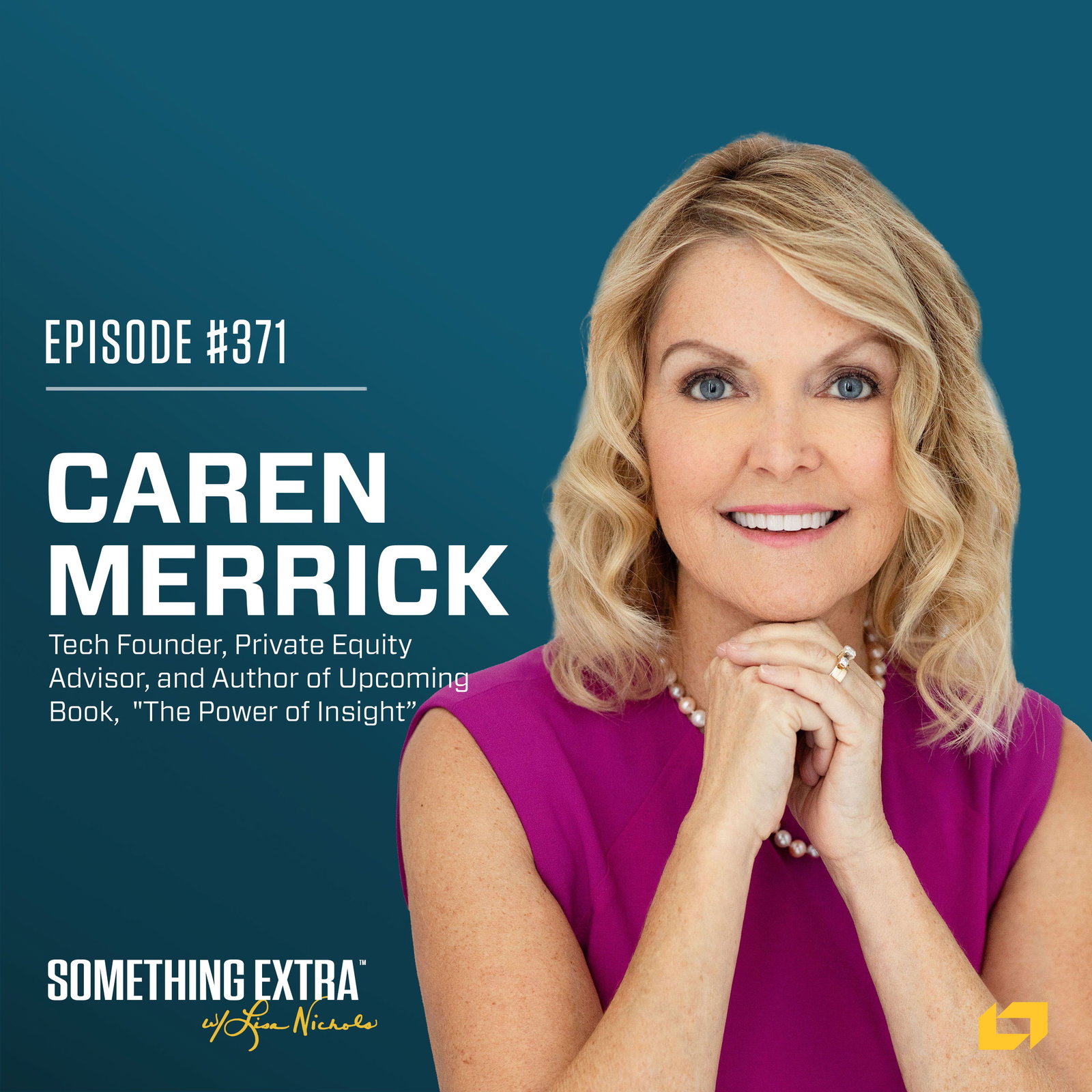
The Discipline of Clarity w/ Caren Merrick
Episode Details
Transcript
Discover how a tech entrepreneur turned her basement startup into one of the most successful IPOs in history and eventually managed a $3 billion budget as a cabinet secretary. Caren Merrick, Tech Founder, Private Equity Advisor, and Author, discusses the "Power of Insight" and why cultivating clarity is the essential discipline every modern leader must master to avoid the traps of bureaucracy and "scope creep." Learn why the most effective leadership begins with uncomfortable self-awareness and the willingness to ask, "What is it like to be on the other side of me?"
Guest Links:
Credits: Host: Lisa Nichols, Executive Producer: Jenny Heal, Marketing Support: Landon Burke and Joe Szynkowski, Podcast Engineer: Portside Media
Lisa Nichols
Chromosomes. Little strands of nucleic acids and proteins are the fundamental genetic instructions that tell us who we are at birth. Most people are born with forty six chromosomes, but each year in the United States, about six thousand people are born with an extra chromosome, making them a person with Down syndrome. If you've ever encountered someone with Down syndrome, you know that they are some of the kindest, most joyful people you will ever meet. They truly have something extra. My name is Lisa Nichols, and for thirty years, I have been both the CEO of Technology Partners and the mother to Ali. Ali has something extra in every sense of the word. I have been blessed to be by her side as she impacts everyone she meets. Through these two important roles as CEO and mother to Ally, I have witnessed countless life lessons that have fundamentally changed the way I look at the world. While you may not have an extra chromosome, every leader has something extra that defines who you are. Join me as I explore the something extra in leaders from all walks of life and discover how that difference in each of them has made a difference in their companies, their families, their communities, and in themselves. If you liked this episode today, please go to Apple Podcasts or wherever you listen and leave us a five star rating. Lisa Nichols
Before we get started, I'm excited to share that my book Something Extra is now available. It is rooted in the remarkable spirit of our daughter, Ally, and the heartfelt conversations we've had on the podcast. You'll find wisdom and practical tools to ignite the leader within you and uncover your own something extra. Visit something extra book dot com or find it at Amazon or in all major bookstores to order your copy today. I'm grateful to have Karen Merrick on the show today. Karen is a tech founder, private equity advisor, and the author of the upcoming book, The Power of Insight. Well, Karen Merrick, hi, sweet sister. It is so good to have you on the something extra podcast today. I'm so delighted that we can make this work. Caren Merrick
Thank you. I'm just you're you're my favorite podcast. I want you to know. I've left you five star review. And every time I listen, Lisa, I get a new insight. I get something valuable that I would not have gotten otherwise. So thank you. Lisa Nichols
Well, thank you for saying that. Thank you for saying that. And, Karen, the deal is I do too. Every time I have a guest on, I feel like I'm learning and I'm growing. So, and I know that this is not gonna be any exception. There's so much to you, girl, though. I mean, we could do, like, a three hour podcast and not cover Karen Merrick. There's so much so much good stuff, with you. But you and I know each other. I always love to go back and tell our listeners how we meet people. Right? And so you and I know each other through an amazing organization that you and I have both come to love in that CEO forum. Caren Merrick
Mhmm. Yeah. So there's there's it's such a great fellowship of women in business. We are all very mission driven, and we want ourselves, our teams, and our companies to flourish. And I I'm so grateful that we're a part of it, Lisa. I wouldn't have met you otherwise. Lisa Nichols
I know. I know. Because you're in Virginia, and I'm in Saint Louis, the the chances of us our paths crossing probably would not have happened otherwise, but I'm I'm very, very grateful, for the CEO forum. So, Karen, oh my goodness. We're gonna talk about all this, but you have lived in boardrooms. You've lived in basements. You've lived in government offices, and you've been in the start up trenches. When you look at this season in your life, how do you describe you to yourself? Caren Merrick
Oh, wow. That is such a great question. I had never really thought about that, but I but I do believe that we are all given these opportunities for a reason, and it's part of how we fulfill the purpose that we have in our lives. And so I look back on all of these opportunities, and it wasn't like when I was a little girl, I said, oh, I wanna do a start up. I wanna be a cabinet secretary. I want to write a book. But I will say that I I did from a very early age want my life to count for something. I really did, and and it was part of my faith journey about how I became a Christian as I, you know, I looked at the world and I thought, you know, what's what's gonna really last? Everything is so passing and temporary, but I want my life to count for something. And so this is what it's all led to, and now I'm in a new chapter where I hopefully will be able to use all of those experiences in a way that that is helps people flourish. Lisa Nichols
Oh, that's so good. That is so good. I was just telling you about my friend, Paul Hood. And at the end, you know, his something extra. And I said, Paul, nobody's ever said this, but he said, the something extra is for you to know that this is not about you. None of this is about you. You know? And, I mean, that's precisely what you just said using what you've been given, the experiences, the education, everything that you've done in your life, Karen, to help people in your sphere flourish. And that could be people in government. That could be people in the tech start up. I mean, people in the community. Right? So, it's really not about us. It's really about what we give back to the world and to others. So I love that. Well, tell me this. What do you feel is the most life giving piece right now for you in this chapter of your life? Because you've you you have turned the page on another chapter, which is so exciting. Caren Merrick
Oh, indeed. You know, what's so fascinating to me is to realize that everything that has happened so far is bigger than I could have ever imagined. And that that means that my future is going to be the same way. If I look back on my life, it every single time there was a challenge that it gave me something. You know? It gave me an insight, which is something that I'm really fascinated by right now, and we can talk about that more later if you'd like. But I do I really do. Just getting back to sort of, like, knowing yourself and knowing who you're who you are, I am happiest when I am helping either people or businesses or organizations flourish. There's something so life giving about playing a part in that. And, honestly, every time I get a new experience or I'm doing something or even when I like, I'm traveling with my husband or sailing with my husband, I think this is really so much fun, and I love it. But how can I use this to help someone else? Like, what insight can I gain? What what can I do in all of this that's going to be that's gonna help someone else flourish? Lisa Nichols
That's so good. That and that's such a a wonderful question to ask ourselves daily, whatever it is that we're doing. Right? So, how can you use that? Well, I, you know, wanna get into this kind of like you're growing up. I mean, you were the first woman or first family member to earn a college degree, but you've got three other siblings. Right, Karen? Caren Merrick
Yes. I was the first woman in my family to earn a college degree. And what's remarkable to me is that as I consider my parents, they were very, very young when they got married. Like, my mom was seventeen. My dad was twenty. And because of that, they both worked, and they had children and have four children, like, all in a row. By the time my mom was twenty six, she had four kids. And yet they had the presence of mind to give us a solid, stable upbringing. There was a lot of love and adventure in my family. And our parents, because they both worked, they asked a lot of us. And so all four of my parents' children are entrepreneurs. And I think that's so fascinating because my father worked for he was a utility company lineman, and every night after work, he would go to college on the GI Bill. So he put himself through college with the GI Bill with four kids in the house, and then he went on to get his MBA. My mom worked full time, and she was a big support to my father. And what ended up happening is because she was working, she'd say, alright, to the to her two oldest daughters, my sister and I. She would say, I want you to have dinner ready and the house clean and your homework done by the time I get home from work. And so you have to figure it out, and I am so grateful to her and my father for giving us a work ethic. Lisa Nichols
Oh my goodness. Yeah. Because that is remarkable. I mean, how many families have four kids and they're all entrepreneurs and in business? I mean, you know, that's that's I think that's probably not very common. Caren Merrick
Right. I I have to just credit our parents for asking a lot of us and and really engaged in what we do. The other thing my mom did is she got a job at the local high school so that she would have all of the same holidays off as we had. Lisa Nichols
Oh, that's awesome. So you had her presence. Yes. A lot too, which is really wonderful. Gosh. I love that. I love that. You know, what did your I because I read this. What did your mom say to you all the time about college? Caren Merrick
Oh, my goodness. Yes. So my mom would say a a couple of things. She said three different things that were so important. She said to me, god is and was and always will be. That's a really important thing to say to a little kid. And then she would say, you can be anything you wanna be if you work hard enough. And but the third thing she said, which was very specific to me is, she said of all my children, Karen, you're the one who's going to college. And I'm grateful that she did because I think I really took that to heart, and I thought, oh, I need to honor that. My mom is saying that to me. That's part of my destiny, and I don't take that lightly. Now what ended up happening is after twenty three years of marriage, sadly, my parents got a divorce, and so there was not the financial means for me to go to college. So I set out on my own and started to support myself. And so I went to college a little bit later, but I did go, and I did the degree in three years. Lisa Nichols
Yeah. I know. I I I read that that you didn't start until you were twenty five. There's a lot there, but I want to camp out on this for just a minute. The words I was thinking when I was reading that, I'm like, the power of words. The power of words. I mean, your mom kinda spoke that into you, Karen, and that kinda became a little bit of what you expected from yourself. Right? Yes. So, you know, talk about this because I know that you had this pivotal story because you didn't really have the money or you just said your parents weren't able to financially help you. You had to put yourself through college. But I love this that you went on the press your luck. Caren Merrick
You read that. Yeah. Tell that story. Oh my goodness. So I I had actually been out on the mission field first. I had such a profound experience when I was twenty years old that I thought, oh, the whole world needs to know about Jesus. And I was just so it transformed my life. And so I'm out on the mission field, and I end up I'm in a missionary training with youth with the mission in Lausanne, Switzerland because I I have had high school French, and I loved French speaking countries. Yeah. And so we end up going to a place called Labrie with a man named Francis Schaeffer. And Francis Schaeffer said, you missionary kids, we'd go every Friday night. And he'd say, you missionary students need to realize that the whole world is a mission field, and and we need people like you in education and in business and in in every kind of industry that you can imagine. Lisa Nichols
Everything. Right? So Caren Merrick
I had sold everything to go on the mission field. So I come back thinking, alright. He's right. And I felt this that that was my my leading and my calling is to go go back, find a way to to go to college, and then go into the world. And so I joined this wonderful church, and there we had a great friend in this church. All of my friends actually were at Fuller Seminary. And so there was this wonderful man named Kent Norell who eventually became a a pastor, and he went on Press Your Luck. And he said, Karen, you should do that too. And I said, oh, I did not have the confidence to do that at all. And he said, look. I'm going to help you understand how this works. So I went to take I took the test, passed the test, and they called me in for an audition, and he said, this is what you do in the audition. You clap for everybody else. You just show up with energy. So I was selected for the show, and then I'm on the show, and and I won. I won. At at that point in my life, I won eleven thousand five hundred dollars, which was exactly the amount of money that I needed to go and put myself into college and pay for my rent, and it was enough to get me started. And it was it was as if the good lord was saying, no more excuses. You can do that. Lisa Nichols
That's so awesome. I love that story so much. I love that story so much. I think you started in community college, but then you ended up graduating from UCLA. Yes. I do. Really good school. Oh, I love that. Well, you know, do you think that maybe I mean, because this changed your the trajectory of your life. Right? It really did. Probably your time with Francis. I remember, like, what was his one book I read many years ago? This is How You Are to Live. Caren Merrick
How Then Shall We Live. Yeah. Lisa Nichols
How Then Shall We Live. Oh, such an amazing book if listeners wanna pick that up. But I'm sure, like, the time at Liberty and then this, I mean, truly changed the trajectory of your life. So I kind of wanna get into, into this. In nineteen ninety six, you cofounded WebMethods. Caren Merrick
Yeah. Lisa Nichols
In your basement, with with Philip, who is your husband, and, he was from Australia, I think. But, you know, I there's so much here that I wanna talk about, but you grew this into one of the most successful IPOs in history. I mean, I think you guys were two hundred million dollar company, eleven hundred employees, and then ended up going IPO, and we'll talk about that. But tell our listeners about webMethods. And I thought it was really funny, Karen, because I'd read where you had told Philip even on your date, now listen. I'm gonna be starting a company. I just want you to know. Caren Merrick
Okay? And then, well, Lisa Nichols
I wanna start my own company too. So you guys were very like minded. You said you really hadn't dated anybody that was that, I guess, confident that that's what they wanted to do with their lives. So that's so cool. And, of course, you know, I think this is why you and I connected so much because Greg and I were the same way. You know, we dated and said even in high school when we were dating, hey. What would it look like if we could build a company and that company could do well, and then we could do a lot of good in the world? You know, that was kind of our mindset, and, we started our company together in nineteen ninety four. So you guys started in nineteen ninety six. Tell our listeners about webMethods. What did you guys do? What were you hoping to accomplish in the world? Caren Merrick
Oh, well, thank you. So, yes, you're right. On our first date, we talked about starting a company. I was on my path to becoming an entrepreneur, which is an a story in and of itself. And and so life to first date, I thought, oh my gosh. This man also wants to start a business. I've never heard that before, and that's why I kinda like to float the idea as a little qualifier, if you will. And then seven months after that first date, we were engaged. Four months later, we were married. And so on the anniversary of our first date, we we were married. And then about a year after we got got married, we had been talking about, you know, starting a business, and I had started a business. I had started the business that I was already on my way to starting when we first stated, which was a market research and marketing and communications company. And America Online was my first client, and things were going well. And then we found out that his mom had a terminal illness, and he's from Australia. And so we knew that we needed to go spend time with her because we knew her that her days were even more numbered than most of us know. It's actually a blessing if you have if you know in advance. Oh, yeah. Right? And so we moved to Australia, and we both end up working at the same software company. As I was director of marketing, he was the VP of engineering. And then his mom went into remission. And so we were only there for a year and a half, and we and his mom ended up living for four more years, which was wonderful. We had four more years. And then while we were in Australia, some important things were happening on the Internet. It was really exploding. And so we had we talked about this, and my husband had this idea about how to use the Internet as a platform to integrate huge supply chain systems and huge internal systems, huge IT systems, Lisa, which you would understand. Before that time, they were so siloed. All of these finance was siloed from from HR. Job. Was siloed from manufacturing, was siloed from everything else. And so my husband invented a way, and he patented it to use the Internet to do that. So I made the first, so I started looking for investors. I made the first friends and family call for investors to my father, and he immediately invested. And then we set about just going throughout our friends and family, former bosses and whatnot. And we had enough money, and we felt confident. So we came back, and then we came back to the United States to Virginia, which is a very great place to start a business as I can tell now, especially after being the secretary of commerce and trade here. And so what ended up happening is we bootstrapped that company, and we did what a lot of companies do, which is we we built a we built a a smaller version of the product. We got a couple of early customers, and then we needed money to continue to expand and grow. And we went across this entire country looking for venture funding, and we were rejected. And so we were reaching this cliff of death, running out of money, credit cards are maxed out, and we needed to we we we were about ready to shut down when there was an an amazing venture fund from Virginia who invested two million dollars into our company. And so from there, we did hire the engineers that we needed. Yes. We made our product even better. We hired more sales reps, customer service reps, more marketing people. And then Goldman Sachs wanted to invest, and then Michael Dell wanted to invest, and then we ended up having a bidding war, if you will, between Morgan Stanley and Goldman Sachs as to which bank would take us public. And in the end, it was Morgan Stanley. And on the day of our IPO, it was the most successful software IPO in history. And that's because we had a shipping product. We had customers when when when when it would we were b two b before it was cool. Mhmm. Lisa Nichols
That is so awesome. Yeah. I think I read, like, your your, price per share was, like, thirteen dollars, but then at the end of the first day when you went IPO, it was three hundred dollars a share. Caren Merrick
Yes. That's really That was so wonderful. So many people were so many people and companies, and families and investors prospered, and we were grateful because when we took my father's first investment, I said to my husband, we've and we both said and then my brother invest we we said, my father and my brother have invested. We can't lose their money, or else it's gonna be really hard at Thanksgiving. Lisa Nichols
Yes. Exactly. Very awkward. Very awkward at Thanksgiving. Oh my goodness. Well, well, I, you know, I I we've been there too. I mean, here, and we bootstrapped our company, you know, to start with. I mean, we got a thirty thousand dollar home equity loan because these people, you know, that we place are very highly paid. Right? And the last thing Greg and I wanted to do is for people to be calling going, okay. When am I gonna get paid? You know, we wanted a a regular sequence, you know, that they're gonna be paid biweekly and come hell or high water. You know, we were gonna make sure that our people were paid. And so, yeah, I mean, it's, but, you know, the thing is and it sounds like you guys did the same thing. I mean, we, you know, maybe if we'd taken on some venture funding, we could have grown faster, but we were just slow and steady. And we were just, you know, making sure that, you know, our cash flow was good, watching that, and, you know, because sometimes I see companies fail because they take on too much too soon. Caren Merrick
Oh, Lisa. Lisa Nichols
And your overhead can kill you. Caren Merrick
That's right. Yeah. Will kill you. And and I will say that one of the observations that I've made is that there were a lot of other companies that eventually got into the same space as us that got millions and millions of dollars of venture capital, but that sometimes money covers a multitude of bad decisions. Lisa Nichols
Yes. Caren Merrick
And and this idea of losing your focus on what you're supposed to be doing, and then it's just not as noticeable when you've got a a lot of money in the bank. Whereas with us, we didn't. And so we had we had to it it drove ingenuity and innovation, I believe. Mhmm. Lisa Nichols
Yeah. No. I could not agree more. Well, you know, talk about then I want you just to touch on webMethods, the foundation, that you became, I guess, the CEO of. I mean, talk about webMethods because I know the foundation because I think you were teaching your people even how to write grants in that and how to yeah. Which was really amazing. Caren Merrick
Well, it's so funny because when we were what what's interesting to me is getting back to what I said about my drive. It must be a a a gift from the good lord because I could never feel happy knowing that that I was prospering if I didn't know that other people could prosper too. And when we were thinking about starting this business, we would take these long walks on the beach in Australia, and we would pray. And we said, if this company is successful, we're going all in on the communities where where we are because it's not enough for our company to prosper. Our company is going to be in a physical location or locations, and we really want to invest. Now, Lisa, we both come from very modest families, working class families. My husband's the first person in his family to get a college degree. I'm the first woman. We had no concept for philanthropy or any of this, but we just knew that we would have a role to fulfill, that we would have a responsibility. And so what happened was on the day we went public, my husband and I looked at each other, and there were obviously a lot of things going through our minds, but we said we're we need to act on this on this. And so we immediately set aside, the the ten percent tide of our own shares, and then some of our board members set aside some shares. And we started the a private foundation, but we named it after the company. And then we looked around because we did not know how to run a foundation. We did not know much at all about philanthropy. And so I looked for who was best in class in our region, and they mentored us. And I did interviews, and they came in and, talked to us about it. And then we also then had our we left it open to our employees. We said, does anybody wanna volunteer and be on a grant team? And a lot of people did volunteer to be on grant teams. So we had a variety of different organizations come in and teach us what the economic conditions were in in our regions, who would come in and teach us about the world of nonprofits, came in and teach us about they came in and taught us about how to make grants. And what we decided was we formed a board. I was president and chairman of the board. We hired a full time executive director. We had four members on that team of the foundation. And we we decided that we wanted to make grants in areas that were essential for nonprofits, but that were not always made. So we would do the infrastructure. We were an infrastructure company. We felt like software infrastructure. So we would help we would help nonprofits with their IT systems or their accounting systems or some professional development. Lisa Nichols
Yes. Caren Merrick
And and what we really wanted to do, Lisa, is help people achieve their potential through education. So we supported a lot of education nonprofits because our experience, our personal experience had been that education changed everything. Lisa Nichols
Right. Yeah. Oh, I love I love that you did that. Well, gosh, Karen, we got lots and lots and lots more to talk about, but we do need to take a quick break, and we'll be right back with my friend Karen Merrick on the Something Extra podcast. AD
Hey there. In a challenging business climate like this, savvy leaders look to technology to find an edge. This can mean the difference between staying ahead of the curve or playing catch up. It's time to collaborate with the highly skilled experts at Technology Partners. Our team of technologists draws upon decades of experience for your project, with each bringing a passion for solving problems and a track record of success, how can we help you overcome your biggest technology challenges? Visit technology partners dot net to book a free consultation with one of our leaders. Lisa Nichols
Welcome back, everyone, to the Something Extra podcast with Karen Merrick. Oh my goodness. So much to this woman. So much to this woman. In from twenty twenty two to twenty five, Karen, you served as Virginia's secretary of commerce and trade, under governor Youngkin. And I'm just gonna read a few of these things because I know you wouldn't say these about yourself. But, you know, she managed a budget of three billion dollars, thirteen different agencies. When you left, you had raised a hundred and forty billion in new capital investment across key sectors, data centers, energy, advanced manufacturing. Fifteen thousand plus high wage, high growth startups were launched. Remarkable. C n CNBC recognized, Virginia as America's top state for business. That was in twenty twenty four. I mean, you guys had new trade office in Taiwan. You accomplished a lot, Karen. What was that like for you? Caren Merrick
Well, what is amazing to me is the team. Starting with the governor, he's a businessman. He is so good at building teams, and I have been his friend, and I've done work with him over the years. And being able to work up close with him as a partner in his vision for Virginia was remarkable. And it and and I really did love our our his vision and our mission. And it's interesting, though, coming out of the private sector. Yes. The governor had just come out of the private sector. For him, it was his first gover government job. It was my first government job. And I would say about half of the cabinet came from the business sector, and it was our first government job. And so we had to rely on people who had been there before us and would be there after us, like the all of, you know, the agency, the the teams there. But I will say that after, the first couple of months, it's pretty intense. I mean, I moved to Richmond a month before inauguration, and and we had a lot of transformation that we wanted to do. And we also know that in Virginia, the governor is limited to one term, one four year term. So we wanted to get eight years worth of work Work and achievements. And progress and transformation done in four years. But I but after the first couple of months, it was it was so fascinating and I I sat back one day and I said, what is this like? What is this like? It's it's not exactly like anything I've ever done. And I realized, Lisa, it was like three things. It was like working for a start up, a merger, and a turnaround all at the same time. And once I had that framework, I thought, okay. Now I know what to do. Now I know what to do with the folks that the the start up folks. It was like the new political appointees. We were the start up team. We had never worked together before. I had worked with the governor, but none none of us had worked together before. So I employed some of those those start up. The merger part, you know, we came into a a lot of, you know, tens of thousands of people who are employed by the state of Virginia, who love the commonwealth, who are mission driven people. And we were a merger because we were coming in, you know, several hundred of us, and we were starting to lead. Mhmm. And then the turnaround is what every governor wants to do. Every governor has a vision of of what they think they need to do to be better. And the governor appointed a cabinet to help him, not only to help him shape his vision, but to implement his vision and to lead. Lisa Nichols
Yes. Well, fifteen thousand startups in that period of time, Karen, is just really remarkable. But I know that that's your heart too. I mean, you started by saying, I want to invest. I wanna see people. I wanna see organizations. If I can help them flourish and grow Caren Merrick
Yes. Lisa Nichols
That's what is life giving to you. Caren Merrick
It is true. And and and the other for me, it was such a tremendous honor to have this opportunity because I had been an entrepreneur. I have started businesses, multiple businesses. I have had to write that paycheck. I have had to do what you and your husband, Greg, have had to do. I've had to make personal sacrifices in order to make payroll. Yeah. And I've had to listen to my customers, and I've had to pivot, and I've had to learn from failure and and and and those things. What I realized, and and I started a foundation and and helped to set that up, but that was another startup. But what I realized is that whether it's in the private sector, in a startup, in the nonprofit sector, and then in government, there is a framework that you need that that if you use, you will flourish, your team will flourish, and your organization will flourish. And and and it's that framework that really matters. And I believe that we we collaboratively developed a framework there in the state government that we hope will last now that we are at you know, the end of the term is just weeks away. Lisa Nichols
Mhmm. Mhmm. Yeah. So let me ask you this because I know we had said before education is really important to you and Philip. I mean, that's you were investing in that through your foundation. Were you setting up boot camps for these startups? Did you have some sort of education that you're providing to them, Karen, during this time? I mean, there may have been a a an initiative, you know, from the governor's office to Caren Merrick
Yes. Yes. And so and so in the state government, it's fascinating because you have agencies that can that by their design access federal funding. And so of my thirteen agencies, the premier agency that is engaged in the start up ecosystem is called the Virginia Innovation Partnership Corporation. And there was there were hundreds of millions of dollars that were coming down the pipeline unlike at any other time in Virginia's history that every state was getting this this pipeline of funding. And so what we did is we channeled this funding into partnerships with organizations that do seed funding, that do boot camps, that do there's a whole ecosystem of mostly nonprofits that will help entrepreneurs. And so we partnered with them because every every good strategy requires good partners. Right? Yes. And so and we needed those partners because we didn't have the team in the administration and at the Virginia Innovation Partnership Corporation. What ended up happening, though, is in my role, I was able to I was vice chair of this organization for nearly four years, and so I was able to work very closely with the CEO to to come up with a strategy and align that strategy with the governor's vision, with my mission, and also with the opportunities that existed in Virginia. And that was part of the fifteen thousand start ups. Lisa Nichols
Yeah. Oh, that's so good. Well and as a tech as an entrepreneur starting out, you've got to have somebody like you, Karen, that's helping you navigate the system and find out who are those partners out there that you can collaborate with. Mhmm. Exactly. You know, Caren Merrick
because Yeah. Lisa Nichols
The training that you need. And sometimes, I think that's that's kinda where there's a gap because the the entrepreneur doesn't really even know where to go. So I love I love that you guys had it, structured that way. And, yeah, that's I mean, I'm sure that's why you guys, you know, won won America's top state for doing business, you know, in twenty twenty four, which is amazing. Well, let's talk about this because I know this is something you're very excited about, and I'm very excited for you. You got an upcoming book, and it's titled The Power of Insight. You know, how do you define insight, Karen? I would be very curious, to to hear your definition, and why Caren Merrick
do you think it's so rare? You know, insight is that it's it's an insight is it's like it's an intuition, but it's really clarity. Insight is clarity. It's not a moment of brilliance. It's something it's a discipline. It's something to be cultivated. And it's clarity whether you on something that could be an opportunity, recognizing an opportunity, or it could be clarity on solving a problem. And it might be a problem that you're having with a team member. It might be a problem you're having with your business growth. It might be something unforeseen that happens to us every day. And And the reason that I believe insight is so important is because insights are all around us, Lisa, but sometimes we miss them. Yes. We miss them for a variety of reasons, and we don't need to be missing them. I believe it's just this discipline of learning how to cultivate, recognize, capture, and apply insights. And so I'm developing a framework for that. Lisa Nichols
That is wonderful. Why do you think we miss them? I think sometimes we're just moving too fast Yes. Karen, and we don't take the time. Like, you took the time to sit in your office and going, what what is this like? Now what what am I really doing? You know? And that's when you came up with, well, it's a merger. It's a, you know, turnaround. I mean Yeah. Sometimes we don't take the time to really just spend time thinking. Caren Merrick
Lisa, it's it's it's the time. It's the power of the pause. It's asking questions. I do believe the first and most important part of of cultivating the discipline of insights, of of capturing an insight is self awareness and self understanding. That famous that famous analogy of putting the oxygen mask mask on first when you're on a plane. Yes. Because when you understand yourself, then you then you are coming from a a position of much greater strength, and you're also recognizing, do you do you have a bias? You know, really knowing yourself. And and something that fascinates me is that, you know, a lot of great leaders do assessments. They do, you know, they'll do cliff, CliftonStrengths, which I'm a big believer in that, or the disc, or there's any number of assessments. But I believe that it's more than that. And I I recently spoke at, Harvard the har Harvard University has a the flourishing summit, and I was grateful to be invited to speak there. And I spoke on self awareness as essential to leadership. And part of that has to do with I don't think we spend enough time thinking about our own biases. For example, when I was, I I know I knew this going into this job as a secretary that I am allergic to bureaucracy, Lisa. I don't like bureaucracy, and yet I was going straight into it. Into it. Lisa Nichols
Mhmm. Caren Merrick
And sometimes I would I would sense this coming in myself when I'm where I was speaking to someone who wanted something from the government. And I had to really pause and say, you know, tamp this tamp this down. Pause. You're alerted to bureaucracy, and so you're just not listening or you're or you're maybe not as empathetic as as you as you could be right now. That's one example. But, also, I've come to realize that all my strengths have a shadow side. And I see this all the time. I see this in leaders that are above me. I see this in my peers. For example, when you think about when you're really competent, the shadow side is you can become arrogant or dismissive. If you're a visionary, you might be impatient or undervalue execution. When you are optimistic, you might avoid things or or over prime or overpromise. And so when I think of self awareness, I I think of it like that. And I also think of it and this is something that it really challenges me, which is when you think about a week that you've had that was a tough week or a big week, one question that really causes me to stop at my steps is what what is it like to be on the other side of me? What would it like to be on the other side of me this week? And I would I would ask my team when I did my weekly one on ones. I would say to them, is there anything I could be doing more of or less of for you to succeed? And so that's part of self awareness. It's it's it's bringing other people in. And by the way, not every direct report even has the confidence to answer that, honestly. Lisa Nichols
Right. Yes. Yes. I mean but you need those people in your life that will speak truth. You do. But I know I Karen, I love that you said that because I have said that so many times. I love that question. And this can be not just in business. This can be with your family. Caren Merrick
Mhmm. But I'd Lisa Nichols
like to be on the other side of me. And I just think that's a really good question for us to ask ourselves constantly, you know, because, if we answer that honestly, you know, there's sometimes where, you know, it's, boy, I come across too harsh. Or Caren Merrick
I I agree. You know, there's another one that I, there's another two that I wanna share with you. One of them is, what do your team members know you care about most? And then the other one is, what feedback do you most resist and why? That's the hardest one for me. Lisa Nichols
That that I know. I know. And I say it all the time. Feedback is a gift. But, you know, it's not always easy to receive it. Right? But goodness, we need to. How are we gonna do better if we don't know better? Right, Karen? So Caren Merrick
Exactly. Exactly. So when you're thinking about, you know, how do you cultivate an an an insight or recognize an insight, part of it is just doing your own little inventory and saying, is this an insight coming or, you know, or am I resisting it? Lisa Nichols
Mhmm. Mhmm. Or Caren Merrick
am I making something up just because it makes me feel better? Lisa Nichols
Right. No. That's good. That is good. Well, you know and I just right now and, you know, I've talked a lot about data. Right? So we do a lot in the data space. Sometimes, I feel like and, I mean, organizations can be drowning in data. People can be drowning in data. There's so much coming at us all the time, Karen. I I will never forget this. Somebody that you and I both know and love, Sheryl Batchelder. I'll never forget her saying one time, sometimes you don't need more input. You just need to act on what you already know. Caren Merrick
I love that insight. Is it isn't that gold? Lisa Nichols
I know. See if you can quote her in your book. Caren Merrick
I'm gonna I'm just gonna interview her, I think. I think. Lisa Nichols
Yeah. Here you go. Sometimes you don't need more input. You just want you need to act on what you already know. But, you know, there's so much stuff coming to us all the time. How do you, you know, advise leaders to choose wisely? Because, I mean, I know for us, like, in our business even, oh, we could be doing this over here. We could be doing that. You know, I think that's another trap that sometimes, leaders and entrepreneurs can fall into, trying to be all things to all people. And we know that if that's the if that's your reality, you know, there's gonna be a dilution Caren Merrick
there Yeah. Where you're not gonna do Lisa Nichols
anything well. But how do you advise leaders to to choose wisely? Caren Merrick
Lisa, what you've described about yourself is a it's a positive that you're mission driven, purpose driven, generous. You want people to flourish, and you want your customers to flourish. And most leaders should aspire to that if they don't already, and most of the leaders I know, they they do. Right. And recognizing that and accepting that about ourselves is, like, getting back to my first point about self awareness, that matters. What I've also discovered is that and one of the first exercises I did with all of the agency heads is ask a very simple essential question, which is, who is our customer? Who is our customer? Who are we serving? Or who are our customers? We may have different types of customers. We also need to understand if we have a hierarchy of customers where there's some that have a different sort of priority. Mhmm. But who is our customer? There were so many agencies that couldn't clear answer that with clarity. And what happens or start ups saying Yes. Yes. Or or, you know, startups, nonprofits, government agencies. And this is because often mission driven people do have scope creep because they don't wanna say no to anybody. Right. And Yes. And people who are in public service like the state government, they're there to serve. And yet if you cannot define that, then you are going to have duplication of effort. You're gonna have a bunch of subscale initiatives, which which I discovered. I discovered that different agencies had similar programs that were not within their scope or their mission, but they just wanted to help. But that doesn't help if you're not spending your resources wisely. So the first question is, who's my customer? And the second one is, what problem are we solving for our customers? Lisa Nichols
Mhmm. Caren Merrick
Really important to know this. And back in the day with WebMethance, we were doing this this software solution for enterprise software for global two thousand companies, and yet there were a lot of little dot coms coming around that wanted to use our software. And we said, we have to say no to this customer because that's not the kind of customer that's going to build this business. It's not our what we do best. It's it's revenue, but it's not the kind of business that we want to to invest our time and talents and product development into. And, Lisa, that was a very important distinction for us because I thought that was went bankrupt. Lisa Nichols
Sure. Caren Merrick
And so by saying Lisa Nichols
They were trying to serve everyone. Right? Caren Merrick
Who's not our customer. All important. Yeah. Who's not our customer? Mhmm. Lisa Nichols
Yeah. Because yeah. That's that's so good. I mean and and, Karen, in all transparency, we've been there where, you know, there have been times where we've, like, you know, even serviced a little startup that has no money, and then we become the bank. I mean, you know, it's like, oh my goodness. Yeah. We could that is so, so important to have clarity around that, I believe. So that is so good. Well, let me ask you this. You know, if a leader you know? And I know that you're still working on it, but what is one insight principle? Would that be it? That like, if you left the reader with one's insight principle from your book, what would it be? And I'm not I'm not putting words in your mouth, but maybe it's discernment. I don't know. Discernment between good and best. Caren Merrick
My my meta insight would be make recognizing and capturing insights a discipline. Take it seriously. And not only should you take it seriously, model it for your teams, get them involved. You know, you can actually, you know, say to them in a in a meeting, let you know, let's work on this together. Let's ask better questions. Let's create the space. Let's make it safe for people to have insights or to question things or to say you know, or even to ask. I mean, I would work through these six or seven questions. These were on my whiteboard as the secretary of commerce and trade. Who's our customer? What problem are we solving for customer? Where's the leverage? How do we measure it? What is the best message and channel to to reach our customer? Because at any one of those points, any one of those questions, you can go off the rails. And Absolutely. And you see it happening. And and and especially, like, what's the best message and channel? It's like, oh, we're all over the map on how we're going to get the message out when really you can be disciplined about that. But there and there are insights about how to do that. Lisa Nichols
Yes. Well and we don't have time to get into it because we're running out of time, Karen, but I know you were very specific about that with webMethods. And I told you I was so intrigued because, you know, you know, I'll just say it, but you got a lot of media involved. You would have a client talk about webMethods and what had it done for your their company. And then, you know, all of a sudden, you know, it's showing up in a, you know, business insider or magazine. Yeah. And then somebody else is reading about it. You know? And, so you were very, intentional about how you went about, doing that. So I think, that's gonna be this book is gonna be so amazing. When can we expect the book to be out? What do you what are you estimating? Caren Merrick
I'm thinking late summer, actually, and I will be posting some content on a regular basis on my LinkedIn. Lisa Nichols
And Yeah. Caren Merrick
So I will be I will be sharing some of these ideas. Lisa Nichols
Yeah. So I would just encourage our listeners, go and follow Karen. Go and follow her because she writes I didn't even get into this, but I know you write for entrepreneur dot com, Success Magazine. You write for a lot of, media outlets as well. So, I've got just maybe I've got lots more questions. Well, I know faith is really important to you. You know, faith is very important to you. Karen, you know, what You know, you've consistently said that business can be a force for good. Mhmm. And I was gonna ask you where does that conviction come from? I think I know where it comes from, but why don't you tell our listeners? Caren Merrick
Business is a force for good. Obviously, I be I believe as a Christian that the ultimate entrepreneur and creator is God, and we're created in God's image. But I will say I had a hunch about this, about, you know, being an entrepreneur. And my grandfather was a small business owner, had been an itinerant farmer, ended up becoming an electrician in the boom days in California. Always humble. And but what I saw firsthand, Lisa, starting this business in in my basement with my husband, bootstrapping it along the way, seeing it, you know, a couple of clips of death and all that all of that you you learn from the the the things that didn't work and the things that did. But then, Lisa, as it grew, it was extraordinary. What a company can do. I saw people so energized about using their gifts and talents. I saw people so energized about working as a volunteer grant maker. You know, I saw this company not only solving problems for businesses, but going into the community. We had people coming up to us over the years saying, we bought our first house because of this company, because you believed in us and you hired us. We send our kids to college because of this company. And and so I was so energized by that. And since this company went public, we we let it for many years. We stepped down. It was sold to software AG. Then software AG had it for many years. Then they just sold it to IBM IBM. Lisa Nichols
Two billion dollars. Two billion dollars. Caren Merrick
We had exited it, but this was something that we had we were part of an amazing team over many, many years. And so over the years, this company has done so much, and and a lot of the people who worked at the company that we had while we had it and we were leading it and serving it started their own businesses, some of them more successful than WebMethods. And so I believe by the grace of god, we helped to foster this environment of innovation and ingenuity where people would have courage and step out. And this is what the marketplace does. Now, obviously, not every business treats its, you know, folks well or Right. Or or or does that. But but I do believe that far and away, most companies do and that the whole world is looking to the business community Mhmm. Or say that. Lisa Nichols
Yeah. Yeah. That is so good. Well, I'm grateful to be a part of it, and I know you are too. Well, I've got a little lightning round for you, rapid fire questions here. Is there a word or a mantra that guide you today? Caren Merrick
Oh, that's fascinating that you say that, Lisa, because on any given day, there are probably multiple words. But I would say that the word flourish just captures my imagination. Lisa Nichols
Mhmm. Mhmm. Ain't that a great word? Yeah. I love that. And you've mentioned that several times, and you know about the Christian Business Women's Breakfast that the Rooted Sisters here in Saint Louis produces. That was our theme for this year. Caren Merrick
Oh my god. Lisa Nichols
Had not talked to you. I had not talked to Tony Counts Whitley or anybody about that. So isn't it amazing that Flourish, was our was our theme for the year? I know that you got two boys, Hudson and Jackson, and I read this about you, and I loved it. And I have never done this until last night, Karen. And my kids were like, mom, what are you doing? You play Words With Friends. Use them for connection. And so I'm getting on there. I never played Words With Friends, and I'm getting on there last night. And, Paige, Armildot, she goes, mom, what are you doing? She goes, I've never seen you play games on your phone. But I just I love that. Hey. Is there a leadership lesson or two that your boys have taught you, Karen? Caren Merrick
Oh, yes. Definitely. Their love is unconditional, by the way, which I'm I'm grateful for. I would say that that our kids have taught me how to listen better. And the reason that they've taught me how to listen better is because I needed to learn that lesson. I didn't always appreciate it, but they gave me feedback either either direct and gracious or otherwise. Yes. And, gosh, we need we need our kids to teach us. We need our kids to teach us. And then I guess the only other thing I would say is that, through the listening, I think I've helped them do what my parents helped me do. Not as much as I and I I ask myself this question a lot, but I've helped them figure things out on their own by not jumping in. Like, my parents would you know, they'd say, you get this done, and then they go away, and then we go they come back and it better be done. Lisa Nichols
Yeah. Well and and to your point, it was out of necessity. Right? I mean, your dad was going to school at night and working, and your mom was working, and they they needed you guys to stand on your own two feet. You know? And Caren Merrick
Yep. It was so It's Lisa Nichols
all for one and one for all. I love that. I love that. Well, I've gotta talk about this. I know one of your favorite pastimes is sailing. Oh. I mean, this is kind of a a funny question, but, you know, it's called Glad Inn It is the name of your catamaran. Right? You know, do have you figured out or, you know, have you, like, set back, Karen? Because I'm sure you have. Talking about the parallels between sailing the open sea and a start up. Caren Merrick
Yes. Yes. Yes. There. Oh my gosh. And by the way, we did not grow up in a family with boats at all, and our kids ended up going to a sailing camp, which is a whole other story we'll talk about sometime. Yeah. Lisa. And because they went to sailing camp, we got a little catamaran, and we've so then then we just tried this, and then we tried that, and then we end up owning a catamaran. And, and it's a it's a great catamaran. It's got four cabins in it, plus a crew lives on board, and we charter it out. And, yes, it's it is a business. It's definitely a business. It's like a start up. But even more than that, there are so many passages in the Bible about the ocean and the sea and God's grandeur, and you have to rely on God to be a sailor. I mean, you have to really you have to all get certified, but you're out in the open sea where there is so much you cannot control, and you see the power and the glory of God out on the open ocean. Lisa Nichols
Mhmm. There's some uncertainty there. We did we did a sailing trip years ago with our attorney and his wife in the Chesapeake Bay, and it was we'd gone to Annapolis, and it was so choppy. I mean, really, after about thirty minutes, our our attorney's wife, dear friend of mine, she goes, you gotta take me back to the shore. So I'm back to the shore. But just recently, when we were in Florida, our son, Jordan, said I let's run a sailboat. You know? And we did go sailing. We had a captain and everything. You know? We we don't know anything about sailing. It was so relaxing, Karen. I said, I can see myself doing this more. It was so nice. And then Jenny, who I know that you've met, they've got a little Cameron, and they love to single too. But, yeah, I think that's so cool. Well, gosh. I gotta ask you. This is called something extra. What is the something extra that you believe every leader needs? Caren Merrick
I I I have to say that I think it's insight. I think it's it's it's the understanding that if what you want is clarity and wisdom and discernment, you have to cultivate it. It has to be a discipline. It's almost like a spiritual discipline, Lisa. You have to you have to have and and it needs to be in a way that works for you. Right? Everybody processes information and comes at it at it slightly uniquely because we're all so fearfully and wonderfully made. But I suggest a framework, and I I I and my book will be about suggesting that framework because it's really essential. If you want a full if you're a generous leader, you're a mission driven leader, you wanna flourish, you want your team to flourish, you want your company to flourish, it's essential that you cultivate the discipline of of recognizing, capturing, and applying your insights. Lisa Nichols
Yeah. Well, that gives me hope because the the operative word there is cultivate, which basically means anybody can do it. But you've got to have the intention, like you said, in the discipline to make it a priority, Karen. Caren Merrick
Yeah. At least they're there. The insights are there, and there's some insights that are even within you. There's, like, this treasure. Right? That's in you. Lisa Nichols
Well, I cannot wait for your book, girl. Get to working on it because it's I know it's gonna help people. So, this has been so fun, Karen. I've absolutely loved every minute with you. Thank you so much for making the time to be on the show today. Caren Merrick
Thank you. You as well. Announcer
Thank you for listening to today's show. Something extra with Lisa Nichols is a Technology Partners production. Copyright Technology Partners Inc two thousand and nineteen. For show notes or to reach Lisa, visit tpi dot co slash podcast. Don't forget to leave a review on Apple Podcasts, Google Play, or wherever you listen.