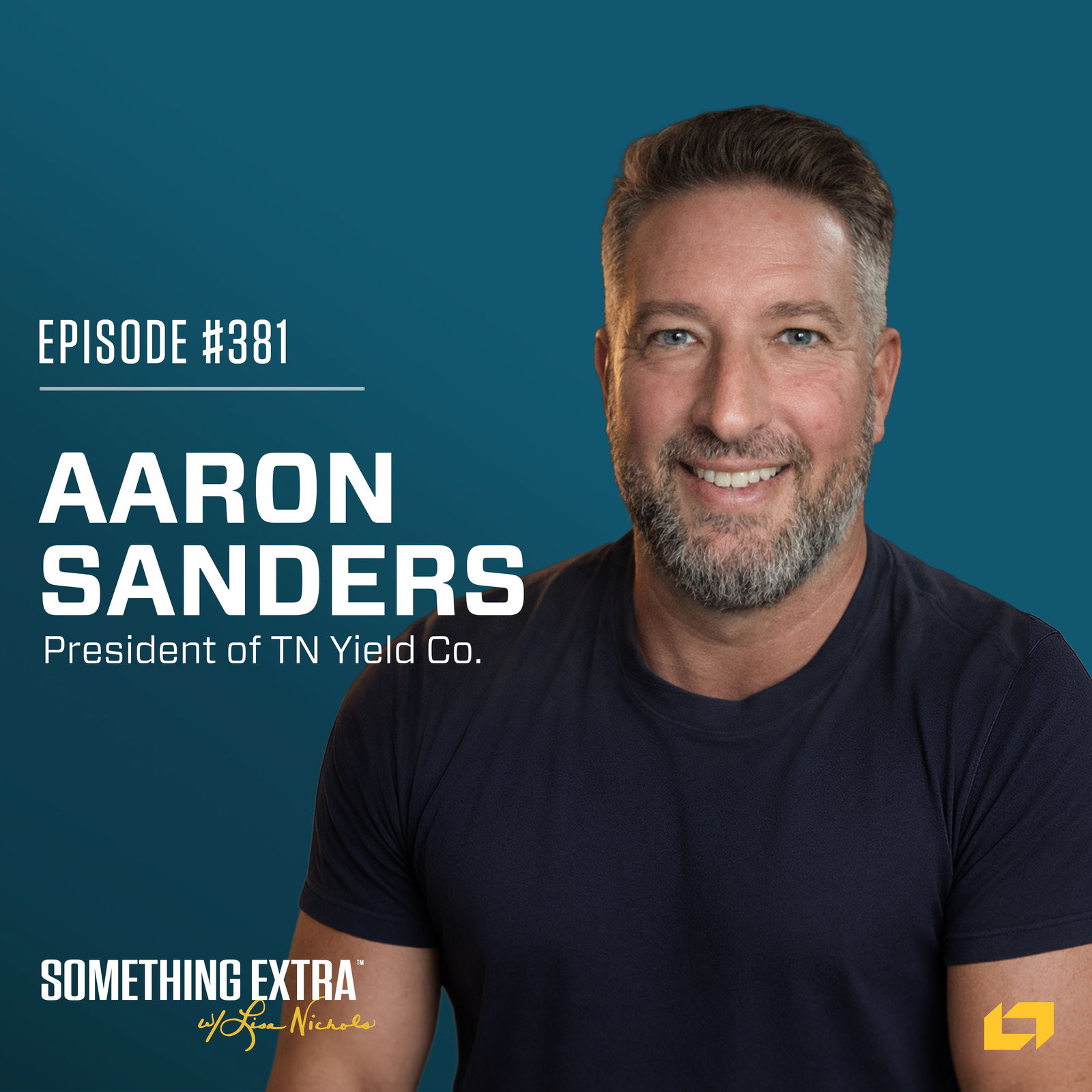
Scaling the Power of Human Connection w/ Aaron Sanders
Episode Details
Transcript
In this week's episode, Aaron Sanders, President of TN Yield Co, explains how he transitioned from a successful 16-year career in finance to revitalizing underutilized church properties into vibrant community hubs. He details the implementation of the "friendship bench" model and "intentionally awkward seating" to foster genuine human connections and combat rising rates of isolation. The discussion reveals how integrating the Hebrew concept of "Avoda" allows for a seamless blend of work and service that transforms local neighborhoods.
Guest Links:
Credits: Host: Lisa Nichols, Executive Producer: Jenny Heal, Marketing Support: Landon Burke and Joe Szynkowski, Podcast Engineer: Portside Media
Aaron Sanders
When I stepped back and started asking the question fundamentally, what do I do that will transform communities? I started looking at the utilization of church properties. And what I found is that there's three hundred and sixty thousand Christian churches. And out of those churches, they, close about four thousand of them net annually because there's just not much utilization anymore. And I thought, what if we were to take these underutilized commercial properties and utilize them to full capacity? It would do two things. One, generate enough income so that that community of faith was no longer struggling and gonna have to sell their building. And the second piece is it would create a hub of community. Lisa Nichols
It takes something a little more to lead with impact. I'm Lisa Nichols, author of Something Extra, and this podcast was inspired by our daughter, Allie, whose additional chromosome has shaped how I see people in leadership. Each episode features conversations with inspiring leaders from around the world about what truly defines how they lead and serve others. If you enjoyed today's conversation, please consider leaving a five star review. It helps more people discover the show. And if you'd like to go deeper, my book, Something Extra, is available on Amazon and through other major book retailers. I'm excited to have Erin Sanders on the show today. Erin is the president of TN Yield Company. Well, Erin Sanders, welcome to the Something Extra podcast. Aaron Sanders
Thank you for having me. Lisa Nichols
I'm so excited. Aaron Sanders
I'm so excited. I've been listening to, other episodes, and I just love the creative community that you've surrounded yourself with. So honored to be here. Lisa Nichols
And you're gonna be a part of it now. And I know that, I know you're gonna really inspire our listeners. So I always love to tell our listeners how I get connected to my guest. And, you know, it really kinda started with Jim Bechtold, who I don't know that you've had met yet, but Jim connected me to Lance Welch. And then I talked to Lance Welch, and he said, you need to meet my friend Aaron. And, yeah, that's the way that it all started. And, you live in an amazing, amazing little community, not little, but community in Tennessee that I told you that I love, outside of Nashville in Franklin. Yep. Right? Such a cool community. I just, I love that place. I've done one women's retreat there at South Hall. Oh. And I told you it was just, I just the quaintest little town. I just loved it. Aaron Sanders
I love it. So I've been here for about thirteen years and South Hall is an a really good example. So when I first moved here, there was one lone skinny donkey on a hillside, and he was right where South Hall is. And now South Hall, for those that don't know, it's just a it's a beautiful retreat place. But this area has grown really fast in a short period of time. But what's fun about that is there are a lot of people of like mind getting together and they're thinking about expansion, not just businesses, but wealth, good families and structure around that. So it's an exciting time to be in middle Tennessee. Lisa Nichols
I agree. I just love it. I just love it. Well, let's talk about this. I mean, you spent sixteen years in the financial industry before you stepped into entrepreneurship. And I read something that you said you were highly successful, but unfulfilled. Aaron Sanders
Right. Yeah. Aaron Sanders
And it really starts, I mean, just give your listeners, like, who is this guy? When I was twelve years old, I was probably the most boring kid there is. I don't know if you remember, this will date me a little bit. There was an AM radio station. It was called Money Matters and it was this, this radio show that you could get strategies. There was no Internet back then. So at twelve years old, I would make model airplanes and listen to Money Matters. By the time I was fifteen, I had saved up enough money for a car, but I wanted my parents to cosign a loan for me because I wanted to build credit. At nineteen, my wife and I were married and we built our first house because I had been strategizing since I was twelve, which naturally that kind of nerdiness leads you into a, successful career in finance or if you're doing anything on that that level. Lisa Nichols
That is incredible. That is incredible at twelve years old that you were listening to Money Aaron Sanders
Matters. I got a rubber band and throw it out. And I had this, I got this paper route and it was in an older neighborhood. So fifty five plus is where you had to be to live in that neighborhood. And I invented a process for, leaving the paper intact and putting it between the screen door and the main door so that when they open their door, it just falls onto the mat in their house. And that blew that business up three times what it was. And so I I started my entrepreneurial bent really early in just solving problems, which is, an entrepreneur's, wheelhouse. Lisa Nichols
Oh, that is so cool. Well, I'll just tell you real quick. I'll tell you the whole story sometime, but I started a flower business when I was seven. Aaron Sanders
Oh, great. Lisa Nichols
The only problem is I took all the flowers from our neighbor's garden. Aaron Sanders
Your supply chain was faulty. Lisa Nichols
Yes. My supply chain was faulty, but my cost of goods all sold were zero. Aaron Sanders
I love the Lisa Nichols
other thing. Yeah. It was going really well until my dad found out what I had done, but that's for another day. But yeah. Those seeds were planted, I believe, at an early age, you know, obviously, for both of us. But I love what you said about your your newspaper route. Even at that age, though, Erin, you knew that you needed to differentiate yourself. Aaron Sanders
Yes. Lisa Nichols
So that was your differentiator. That was your little something extra that you were doing on your on your little paper route there. I just I love that. Aaron Sanders
So much of it was intuitive. Now I look back and there's leadership books about all this stuff. But as a kid, I just was solving problems, and I wanted to sell more papers because that gave me more, candy money on a Saturday morning. So like that was the motive. Lisa Nichols
That was your why. Yes. More candy. Aaron Sanders
And a skateboard. I wanted to skateboard. And that was big at that time in life. Lisa Nichols
That's awesome. Well, let me I mean, you clearly felt something missing, though, because then you did jump in you to entrepreneurship. Many people feel that innately in their gut, Erin, in their soul. They feel that, but they don't have the courage to act on it. Yeah. Aaron Sanders
And that's where that another that theme of little something extra comes in, I because I was driven and at twelve years old, I was doing strategies and at sixteen, executing things that caused me to be successful at nineteen and twenty, I by the time I'm twenty seven, twenty eight, I have stepped up the corporate ladder, and I'm doing really well. I've got the five bedroom house, the three car garage. My kids go to private school. My wife stays at home. You know, all of the things, but I would always scratch the itch of Christian expression and ministry by volunteering at my church. I didn't wanna be paid for that, but I did child and family counseling, some premarital counseling. And and truly, what what broke me was a conversation I was having, my wife and I were having with a couple, and we were doing postmarital counseling. So this this had been resulted in punching a hole in the wall at one in the morning, and we helped them get their kids somewhere safe and then started the restoration process. And this lady said to me, it's just so amazing meeting with you and your wife. It's like we went through a dark forest all week, and we come out into this bright light on Saturday when we meet with you. But we go back into a dark forest on Monday. And this is where I started seeing success, the resources, the five bedroom house, the three car garage. It didn't really buy me any kind of relational equity to move the needle in people's lives, which actually is what mattered to me. Resources sometimes, more money makes a bad idea last longer. And that's really where my corporate life had left me. It wasn't a great idea, but the money was there and it made it last longer. And so my wife and I really asked ourselves the question, what do we need to do to put ourselves in a position that we're not just, group psychotherapy to help somebody? What if we actually connected them to, an expression of the kingdom of heaven that would change their lives, not just give them a moment's reprieve on a Saturday? And that was the nail in the coffin, if you will, for going down that road of what eventually led to quitting the the financial world, selling everything we had, and moving to Nashville. Lisa Nichols
Mhmm. Yeah. What year was that year? Aaron Sanders
That was twenty twelve, and we moved in twenty thirteen. Lisa Nichols
Twenty thirteen. So you moved from Wisconsin? Aaron Sanders
Right. We were right on the Minnesota, Wisconsin border. My office, everything I did was in Saint Paul, but we lived in Wisconsin, Hudson. Lisa Nichols
Mhmm. Well, I mean, but you and I have talked about this. God doesn't waste anything. Aaron Sanders
Right. That's where Lisa Nichols
So what you had been doing in corporate, how do you think that that was preparing you for even what you're doing today? Aaron Sanders
Yeah. So one of the things that I felt like, was vitally important was utilization of commercial properties. And that that's kinda started me down the path of asking, what am I doing in this corporate world is four zero one k's and retirement plans and billions of dollars of moved assets, but what are they actually doing to help communities grow stronger? And so then I started looking at underutilized commercial properties as part of an investment portfolio, to to be honest. And what I saw is that churches tend to have the most underutilized commercial real estate. They tend to be in the best parts of town because they were started thirty years ago when there wasn't really much of a town there, much of a city there, and the and the city has grown up around it, but it sat empty most of the time. And so when I stepped back and started asking the question fundamentally, what do I do that will transform communities? I started looking at the utilization of church properties. And what I found is that there's three hundred and sixty thousand Christian churches. And out of those churches, they, close about four thousand of them net annually because there's just not much utilization anymore. And I thought, what if we were to take these underutilized commercial properties and utilize them to full capacity? It would do two things. One, generate enough income so that that community of faith was no longer struggling and gonna have to sell their building. Aaron Sanders
Mhmm. Aaron Sanders
And the second piece is it would create a hub of community. Any business, as you know, whether it's flowers or newspapers, is going to have a an audience for it. Otherwise, you don't sell the product. And so what if we started use using those underutilized commercial properties in a way that facilitated community and connection outside of what a traditional church does Sunday mornings or Wednesday nights? What if we use those properties to highest best use? And that idea is what birthed where I'm at today and what I'm doing today. Lisa Nichols
So tell us that story. The company name comes from the Hebrew word, Avoda. Aaron Sanders
Yes. Avoda. Right? If we're gonna be real if we're not gonna be with us about it, it's Avoda. But we just say Lisa Nichols
Avoda. Yes. And what does that mean? Aaron Sanders
Well, that word is a Hebrew word and it means three things simultaneously. It means work, worship, and service. So in the original Hebrew language, when they when we've like, god is talking to people, he said there's one word for work, one word that is service, and one word that is worship, and those are three combined into one. So that's kind of the vision of the business that was started. How do we take what I do in my corporate world and facilitate a community of engaged people that are there to help one another, not just attend a church together, but what does it do to real life? And then the other piece that I just as a business person, I know that I give charitably to a church, but when they take that money and use it to do HVAC and, keep the lights on and and mow the yard and all of those things that have to happen seven days a week when they only use it one day a week. It just the ROI isn't good for me. So I was really excited to say, what if we create an outreach, a community hub of activity for the for that moves the needle in the community, but also generates enough income so that those charitable contributions now go to take care of the widows and the poor and the fatherless, people in our community that actually need the help. And Mhmm. That's really the the impetus behind it. Now I sit in and here where I'm at is a a fifty acre, two hundred year old property in Thompson Station, Tennessee. And the it's more it's originally, it was a vision and an idea, but now we're actually living in it. So there today is a beautiful day here, and our coffee shop is operating. We'll have about three to four thousand people a week just go through the coffee shop. Last year, I put two hundred and twenty thousand people through this property, and it is a remember, it's a church property, so it it would otherwise be closed on Sunday. Sure. But the community of faith here has said, no. We love the vision of seven day a week utilization. And we have story after story of lives being transformed. One of them was my favorite. I walked through the coffee shop. Now it's a busy Saturday and, and on here, it's in a two hundred year old manor house. So the house was built in eighteen nineteen. So there's business challenges with that when you have a two hundred year old house. So there's just that piece. Lisa Nichols
Yes. Aaron Sanders
But the coffee shop is called eighteen nineteen coffee because the house was built in eighteen nineteen. But behind the scenes, my staff knows that Matthew eighteen nineteen says where two or three agree as laying hands on any one thing that God will be there. So I have this process in the coffee shop. It's called intentionally awkward seating. And you can't disrupt that because I want people to have to connect with one another, not just buy coffee. My mission is to make them connect with one another because I know that when you have a relationship with somebody, you are statistically less likely to have depression, anxiety Aaron Sanders
Yes. Aaron Sanders
And suicide. So the coffee shop is Matthew eighteen nineteen. We're together and God is there. But from a missional standpoint, I want people to get coffee and find their friend because their friend is what's gonna prevent them from having depression or anxiety or, ultimately suicide. So our mission statement says we will go after double digit decrease in depression, anxiety, and suicide by intentionally creating a space for people to do life with because everybody deserves a community to do life with. Lisa Nichols
Yeah. Erin, when you started describing this to me, I just, oh, it just so resonated in my heart. I just love it for our and we'll put this in the show notes. But this is a beautiful property too. It sits on fifty acres, right, in Homestead Manor. So I think you host weddings there, all kinds of things. Right? Aaron Sanders
We started the the best compliment we've gotten is the city of Thompson Station came to us and said, for all intents and purposes, your property is downtown Thompson Station because there are so many people. You can't find parking and this is a fifty acre property and you can't find parking at ten o'clock on any given day, because the community is loving to be out here. And you're right. It is a beautiful historic property, and the house is very, southern charm. Right? Big pillars and all of that. And your guests can look in the, show notes and see that. But, yeah, it's a it's a beautiful model. We do weddings. We do corporate events. We do fireworks shows. We do, Christmas events where we make the holiday, got a whole holiday market onto the property in the month of December. So Lisa Nichols
I mean, I'm I'm sold. I wanna come. I wanna come. I wanna come and visit because I love that area anyway. And then when you told me about this, I'm like, I am coming. I am Well, Aaron Sanders
once again, my my sole, mission is to create a space where people can find one another, where they can connect. Really, the heart of this started. We bought the property, and it we didn't have a lot of money and a lot of ideas on how to move to the next spot. So I just opened up to the farmers market. Now this was August of twenty twenty. So this was right in the middle of COVID time. And so we had a a event venue that was open air, and there were I thought, I'm gonna call the farmers market people because they were meeting in a grass area around the corner out in the sun, and August in Tennessee is not a place to be in the open air. And so I called them and said, hey, would you guys wanna come into our beautiful event barn and have your farmers market? And they said, we would love to, but we don't have any money. And I said, well, we've got that in common that we don't have money. So we're just trying to figure out what to do with this property. Would you come and just bring some life to it? And that first day, there were seven straggling vendors that came in and set up shop. I'll never I set tables up outside, and a little lady was sitting at the table, and she had gotten some food from a food truck. And another lady came and timidly said, you know, there's no more seating. Can I sit with you? And when they sat down, an hour later, I saw them still talking with each other. And so I went over and I said, I just wanna say that you blessed me that during COVID that you were two talking with each other. And I'll never forget this. The lady looked at me and she started crying. And she said, I moved here from New Jersey and then COVID hit. And I have no friends. I have no connections. And today I just met a friend and I find that we knit. We both knit. Six months later, there are forty five vendors and they're the, the plot property's going. And I see the two ladies again, and they had formed a bond and a friendship. And it's out of that, that I created the eighteen nineteen coffee shop. Lisa Nichols
That is such a beautiful story. Well, Aaron, I say this all the time. You curate rooms where people come together and magic happens. Aaron Sanders
Exactly. Lisa Nichols
I'll tell you, on a much smaller scale. But when I launched my book, I we had a book launch party at a beautiful venue that my team had found. And, you know, it was an eclectic group of people, just a diverse group of people, some business colleagues, some, from ministry, just friends, right, that came to the, the book launch party. And these two ladies came up to me afterwards. Both of them had been widowed, and they met at the book launch party. And they said, we just met. We love each other, and we're gonna start cruising together. Aaron Sanders
Love it. Aaron Sanders
Yes. Lisa Nichols
I just it was, like, one of the highlights of my night just saying, oh my goodness. Bringing these people together. Bring people together, curate those rooms and magic happens. Aaron Sanders
People are just innately amazing if you give them the chance to have a safe place to be. How often have you had the conversation with that friend who is just a safe place for you, and you leave feeling so refreshed even though they didn't solve any problems? And that if we can if we can create a scale for that, to me, that's what the the believer, a Christian expression should be. Like, we should be able to find those relationships. And I don't want a barrier of a church service at ten AM on a Sunday morning to prevent somebody from having that friendship. So I built a business around it, and it seems like we're Lisa Nichols
I love it. Well, I have lots more questions for you, but we do need to take a quick break, and we'll be right back with Aaron Sanders on the Something Extra podcast. AD
Hey there. In a challenging business climate like this, savvy leaders look to technology to find an edge. This can mean the difference between staying ahead of the curve or playing catch up. It's time to collaborate with the highly skilled experts at Technology Partners. Our team of technologists draws upon decades of experience for your project. With each bringing a passion for solving problems and a track record of success, how can we help you overcome your biggest technology challenges? Visit technology partners dot net to book a free consultation with one of our leaders. Lisa Nichols
So welcome back to the Something Extra podcast, everyone, with Aaron Sanders. So, Aaron, you started Avada Holdings in twenty twenty. What were the biggest unknowns at the time that you were facing? Aaron Sanders
So I think the biggest challenge we had is getting people to buy into a vision that a church property would be a seven day a week thing. What people have this sacred and secular concept, that that's why I chose that word, aboda. It's because it's work, worship, and service. It's only one word, but it's same thing that happens on Sunday and Monday. So the real challenge was, one, getting the community to understand that this is a church property, but it's not gonna behave like a church property. So we have something locally here called the Spring Hill I Heart It. And I don't know why it's called Spring Hill I Heart It, but it's a Facebook group. And as you know with any kind of social media group, they have opinions about almost everything. And we this church group had bought a Jewel of Williamson County fifty acre historic property that everybody felt like they owned anyway because it's just a beautiful part of history. And we got blasted on social media because a church bought it. And you know what they would say? A church bought it. That means we're all gonna lose access to this beautiful place that we never get to go because churches typically shut their properties down. And so we had the the biggest challenge we had is to grin and bear it and prove a model that is different. And after about a year, all of those messages on Facebook and those net the naysayers were fans because Lisa Nichols
Became positive. That's cool. That's awesome. Yeah. Well, let talk to me about this. You talk about creating friendship bench spaces, and we've already talked about this a little bit. But, that term, I guess, comes from Zimbabwe. Aaron Sanders
Yeah. I was this was fifteen years ago, and I had finished my work day and was on the drive home. And I heard NPR had a a special where they were talking about Zimbabwe and the the challenges they had with depression, anxiety, and suicide. Initially, they said we're gonna hire psychologists to go and counsel people in the nation of Zimbabwe, but they didn't have enough money to do that. So they got one psychologist who went village to village, and he would train the elders to sit and listen, not solve problems, just to sit in the middle of the village and listen to people. And they would leave a bench in this the village after they train the elders, and the elders would sit on that bench. Now after a year, they had double digit decreases in depression, anxiety, and suicide nationwide in Zimbabwe. And you can Google this. There's a a paper or you can chat DBT and that's the AI thing that we're moving to. It's called Zimbabwe Friendship Bench Project, and it's out there. So white paper on it and explaining why it works. But that's the model that we decided to choose. When you have fifty acres of a beautiful green space and a mile long trail throughout, we put friendship benches out and we staff up extra on our business model and we staff up on our church model to just walk around and visit with people. If you're sitting on a bench, you're gonna find a friend. Lisa Nichols
That's so beautiful. I love that. Now I want to put friendship benches everywhere. Aaron Sanders
What's what's beautiful about that is we've just had a tragedy in our community. So, a business two business leaders in our community were flying into Steamboat Springs, Colorado, and they ended up they're following their GPS right into a mountain, and it and it killed the business leaders, two of them. And his son and his nephew were in the plane as well. And they were an integral part of this community. I mean, they there's they're part of the vision. And so we we just had to, close the door on their life yesterday at a at a ceremony. But the young adults were twenty one years old, and their community of young adults that have been doing bible study and life together actually got together. One of them has started a business that does metal work, and they're all put chipping their money in together to put friendship benches in honor of their friends that are fallen. And they're gonna have a whole process where the young adults watch on those friendship benches to make sure that the legacy of their friends continues to go, that they have friends and connection. So it's not only just a business model to to have that. It's a community piece where everybody gets to pull together. Lisa Nichols
Yeah. And so beautiful. You know, and I think I mean, kinda to your point, I mean, Erin, I I read all about that and have a slight connection, with Taylor Husky, through CEO Forum. But, yeah, I think modern society, though, I think is starving, really, for real connections and real friends. I mean, things have become so digital, and I'm grateful for technology because you can keep up with people across the miles. But, I worry Yeah. Especially about this generation Aaron Sanders
and And that's Lisa Nichols
what really understanding. Aaron Sanders
That's really what I saw happening. So I've I'm old enough now that I've got three grandchildren. I've had a my granddaughter born two days ago, so that was, my one Congratulations. So fun. But I started seeing a trend pattern when I talk about three hundred sixty thousand Christian churches. And, if I'm gonna be a believer, a Christian person, then I believe that those principles are to transform the world that I live in, not just to make me feel better about myself. But I see this trend of church properties and and all these fun things that I just described to you not happening across the country. And so why my motivation in that is what am I leaving for the next generation to have what you're talking about as AI progresses? And I love AI. I've used it for a lot of things. I think that technology is amazing, but it's gonna be more and more vital that you have a community hub of connection. And I see that gathering on a Sunday is not growing the way that it will be there to support my grandchildren. I pour everything into this to revitalize that. I say I'm planting seeds for trees that I will never live long enough to be under. Lisa Nichols
One of my favorite quotes, and that's precisely what you're doing. That's the legacy, Erin, that you're gonna leave behind. But you you talk a lot about stewardship versus ownership. I love that because I I talk that way too. But what is the difference? Aaron Sanders
So I look at it as I have a a mindset as a Christian of I'm advancing an outlet of the kingdom of heaven. The the Bible talks about you you I want your will, God, to be done on earth just like it is done in heaven. And for me, that means I'm stewarding something that is, owned by an entity that I work for or I serve, and it's not a corporate entity like it used to be. I look at the kingdom of heaven owns all things, and I am an aboda. I do stewarding down here to make sure that everything advances the ideology of the kingdom of heaven, and that is, at its base, love. This is why we train our baristas to, instead of making it weird, sometimes Christians can make things weird. I speak to that as as a Christian who has made things weird. Lisa Nichols
Yes. Aaron Sanders
Not throwing stones. But one of the things I tell our baristas is I want you to tell that person write something on the cup that's just one word, two words, something like that, and just tell them, when I ask what the purest love says about you, I just wrote that word on the cup and hand that to them. Make their day. Right? Blow gold on them from that standpoint. But you don't have to make it weird because God is the purest of love. The the kingdom of heaven is an outlet of a franchise of love on the earth. So why can't we just not make it weird and just say, this is what if I think of love and you, this is what I think of, and it'll change people's lives. Lisa Nichols
Yeah. That's so beautiful. Well, I was gonna ask you because I do I subscribe to what you just said. Sometimes it can be weird. But, you know, how can you live out your faith without being performative or preachy to people? And that is one way to do it. Right? Just those subtle little things. Aaron Sanders
Yeah. This this, I started telling a story earlier, but I'll swing swing back to it. It was a busy Saturday, and there's people all over the place. And I was walking through and somebody said, hey. Do you work here? And I said, absolutely. What can I do for you? And she said, can you explain the magic of this place to me? And I said, well, you have to help me understand what you mean by the term magic. What are we talking about? And she said, well, the magic is two days ago, I came to this property for the first time. And when I pulled off the road and my tires hit the rocks, I just started sobbing and I couldn't stop. She said my makeup was destroyed and I just wanted coffee, but I felt just this overwhelming, tears. I couldn't stop it. And she said, turned to the table and she said, today, I brought my family here and I want them to experience the magic because we have a really challenging subject to discuss as a family, but I wanted to discuss it in the magic that made me cry. And I said to her, are you a believer? And she said, no, I'm not. I said, well, I can bring you to five employees right now. And I wouldn't tell them, what, prep them. I would just say, what do you pray will happen when wheels hit the rocks? Because it's a prayer we pray every day when we open our property. And the answer to that would be, we pray that you would encounter the purest love, that you would encounter God when you drive onto this property. And so what you experienced, the magic that you experienced is the purest love. And he just wrapped his arms around you. And I turned back to her and she's crying and she says, well, maybe I'm a believer and I just didn't know it. So that's the covert. Don't make it That's awesome. Don't make it weird. Just absolutely live out your faith and structure your my business models around intentionally awkward seating and rocks that tinkle. And that means, like, my my maintenance people know I don't wanna hit a pothole when I come here. Well, why? Because that person's being transported. I I anticipate every person having that kind of an encounter. And have you ever hit a pothole and it snaps you out of everything? I don't need that. So my my maintenance people know their avoda is to make sure there is never a pothole. That there is Lisa Nichols
No pothole. Aaron Sanders
No pothole. The grass Lisa Nichols
No pothole. No potholes allowed. Yes. Aaron Sanders
And the grass is mowed nicely and the garbage is picked up and it looks pristine because God is gonna do his part to encounter them. We're gonna do our co laboring part to make sure that nothing interrupts it. Lisa Nichols
Yeah. Aaron, I could not love what you're doing more. I truly couldn't. I've got a little lightning round here for you, of questions. We could go on and on and on, but maybe we'll have to do a part two. Are you reading any kind of leadership? Are you a reader or a listener? Aaron Sanders
I am a audiobook listener. So I I have found that I need to do two to three x speed, and I can listen to a lot of stuff. Lisa Nichols
Right. Right. Is there one in particular that you've listened to recently that you would recommend to our listeners? Aaron Sanders
Yeah. I think that this is an annual read for me, and I'm in the process of going through it right now. And it is You Are the Placebo, and it's, trying to think of the author. Lisa Nichols
You Are the Placebo? Aaron Sanders
You Are the Placebo. Lisa Nichols
And it's really And you read this annually. Aaron Sanders
Yes. I Aaron Sanders
read it annually. And, it is an amazing book that helps you to understand your thoughts actually create your environment. And they're they're it's a very, psychological way of saying, just take your thoughts captive and make sure that they are not driving you and you are driving your thoughts. So it's so much creativity in these expressions, even like the double digit decrease in depression, anxiety, and suicide, that came from a, meditation time in the manor house asking what can I do that will will bring people into a place to get connection? And so slowing down and realizing a lot of the answers are in the six inches between your ears, but it's so loud that you don't slow down long enough to Mhmm. Joe Dispenza is the author of that book. Lisa Nichols
Joe Dispenza. Okay. That's awesome. Thank you for sharing that. Hopefully, next time I ask you, you're gonna say something extra. Aaron Sanders
Yeah. There you go. I actually I I do have the book. It's ordered. I don't have it in in hand, but I loved hearing the concepts through all of your podcast. So I'm so excited to read the book. Lisa Nichols
Yeah. Thank you, Erin. There's another one around mindset that I'm just gonna mention that I've been reading, that the listeners might want to pick up as well. And, Erin, maybe you've already read it, but time your thoughts. Aaron Sanders
I have not read that. Lisa Nichols
I'm at potato. No. That's the one I'm reading right now. And it's, I mean, completely what you just said resonates with me too because it starts right here. Right? So what we put in there and, you know, and then there's eighteen inches between your head and your heart. Aaron Sanders
Yeah. And sometimes that's the longest eighteen inches. I I know things here Aaron Sanders
Amen. Aaron Sanders
But I don't live them from my and that was really the change and the transformation of why I quit the corporate world and started doing what I'm doing now. It it finally made it from here to here. Lisa Nichols
Yeah, for sure. A daily habit that grounds you. Aaron Sanders
So every if my staff is listening to this, they're gonna just roll their eyes, but I have three strategies every day that I do. And I actually require not just my children to do it, but employees. You're gonna do spiritual development every day. You're gonna do physical development every day, and you're gonna do mental development every day. So that means you might take some meditation time. You might take some physical move your body because the endorphins need to get functioning. Lisa Nichols
Yes. Aaron Sanders
And then you're gonna learn something new every day. And I challenge people to learn something outside of your sphere because it was a couple of guys in a bike shop that solved the flight issue. Right? They they're the ones that outside of their industry, they had revelation that's that solved the issue that the flight industry was working on. So as a rule, breakthrough comes outside of your framework. So learn something outside of your framework. Lisa Nichols
That's so good. I love it. Well, I could keep going on and on. I've got lots more lightning questions, but we're running up against the clock here. I have to ask you. This is called something extra. Aaron, what's the something extra that every leader needs? Aaron Sanders
So there's something extra that I think we are taught, especially in the industry that I was in, to be risk averse. We we strategize around it. We buy insurance around it to make sure that we don't have that risk. The problem is that as a Christian business person, I faith is the center of everything I do. And if I look through the Bible and I see faith, it looks a lot like risk. And so I'm trying to change my language. The something extra is to take faith, not just as a concept, but as an an application, that substance of things hoped for, but the evidence of things that just not seen. And that's risky. So every business leader that you can extrapolate this down to, you just need to be more comfortable with risk because that's where the beauty is. It's messy. Family's risky. Taking having kids and, and getting married is all risky, but it's beautiful when it's done. Lisa Nichols
Right? That's so good. I've never had anyone say that out of three hundred and seventy seven gust. So thank you. I love it. Woo. Alright. Erin, this has been so much fun. Thank you so much for spending some time with us today, and I just know that your story is gonna help our listeners. Aaron Sanders
I really appreciate you posting this and pulling this community together, Lisa. Announcer
Something extra with Lisa Nichols is a Technology Partners production. Copyright Technology Partners Inc. Twenty nineteen. To learn more about this week's guest, check out the show notes at tpi dot co slash podcast. If you enjoyed this episode, consider leaving us a review. Thank you for listening to Something Extra.