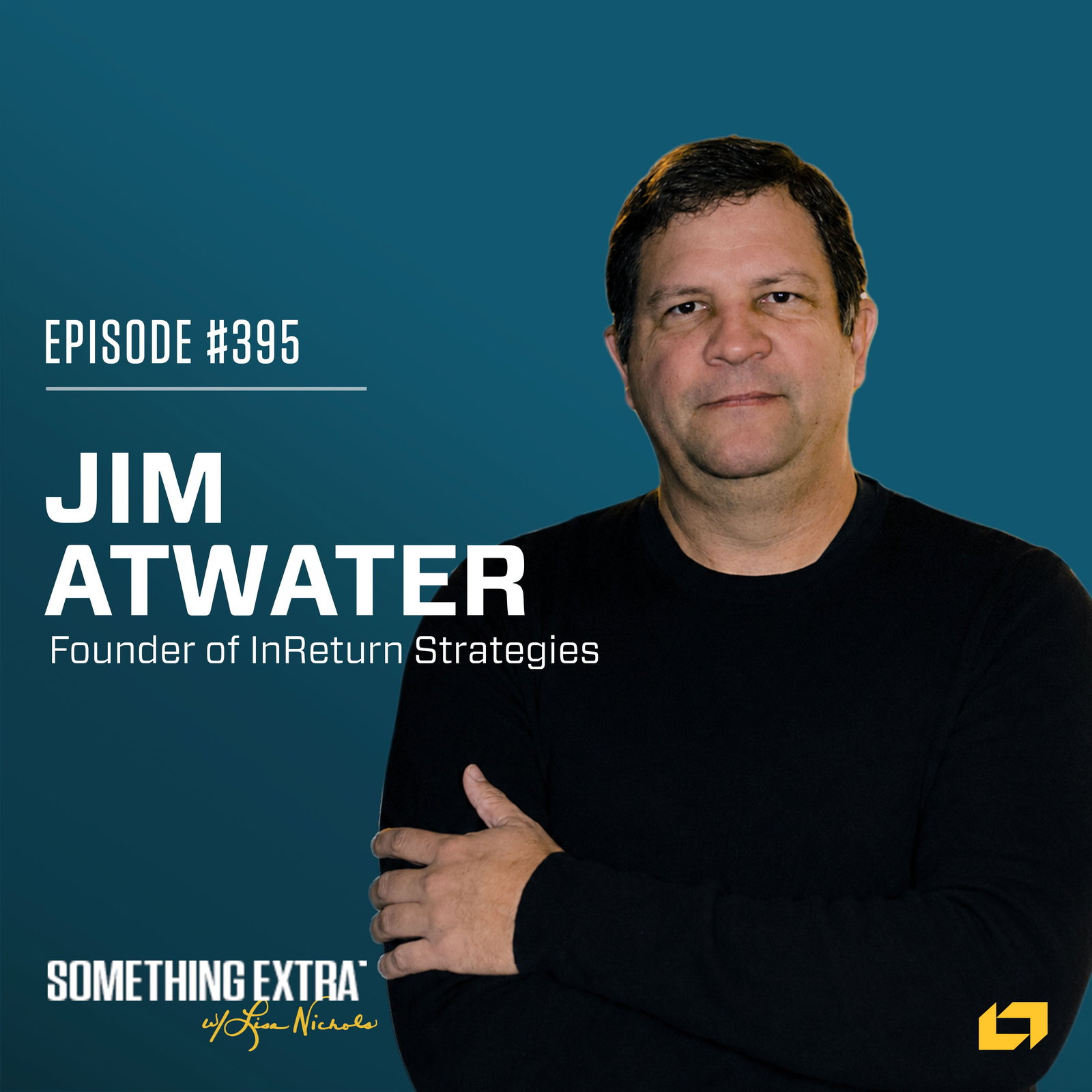
Redefining Inclusion as an Economic Opportunity w/ Jim Atwater
Episode Details
Transcript
Discover how lived experiences can transform into a catalyst for global innovation with guest Jim Atwater, Founder and CEO of InReturn Strategies and Aptly.org. In this episode, Atwater opens up about navigating progressive hearing loss and how those pivotal moments inspired him to revolutionize the way businesses view untapped talent. Tune in to explore how shifting the conversation from social charity to an $18 trillion economic market can unlock untapped business potential and redefine modern leadership.
Guest Links:
Credits: Host: Lisa Nichols, Executive Producer: Jenny Heal, Marketing Support: Joe Szynkowski & Dylan Price, Podcast Engineer: Portside Media
Jim Atwater
So that was one of the things I've always tried to help people with is don't get angry. And it's not about, you know, giving up or revengeand all this stuff. It's really nobody's trying to do this to you. You know? The people at the hospital, at the medical school, they just don't understand. People in seventh grade just don't understand. And so it's not always as bad as it seems, first of all. But if you can't if you can't stay positive in in yourself and look for what's right in front of you, that's really that's really important. I think one of the biggest lessons I learned. Lisa Nichols
It takes something a little more to lead with impact. I'm Lisa Nichols, author of Something Extra, and this podcast was inspired by our daughter, Ally, whose additional chromosome has shaped how I see people in leadership. Each episode features conversations with inspiring leaders from around the world about what truly defines how they lead and serve others. If you enjoyed today's conversation, please consider leaving a five star review. It helps more people discover the show. And if you'd like to go deeper, my book, Something Extra, is available on Amazon and through other major book retailers. Today, we are joined by Jim Atwater, founder and CEO of InReturn Strategies. Jim spent over fifteen years leading major operational transformations in corporate finance, but his true pivot came from personal experience. After navigating progressive hearing loss from childhood, he set out to fundamentally change how businesses view untapped talent. Jim is a strategic leader, true social innovator, and a pioneer in value driven business growth. Well, Jim Atwater, welcome to the Something Extrapodcast. I'm delighted that we can make this work today. Jim Atwater
Thank you so much, Lisa. I'm incredibly excited, first of all, to have met you and incredibly excited to be on your show that is gaining so much traction and absolute awards. I know you got last week. Lisa Nichols
Yeah. Oh, yes. Right. Yeah. That, you know what? And it's all because of people like you, though, Jim. It's you guys that are on the show that make the show. It really truly is. So very grateful for that. But you know what? First of all, I have to give a big shout out to our mutual friend, Jim Bechtold. Because if it weren't for Jim, you and I may not have met each other. Although, you know, you're Kansas City. You're not that far away. But, you know, we may have met each other, but I'm just so grateful to Jim because he always connects me to really special people. And I really appreciate that and always want to give him credit, so I'm grateful for that. But we've got a lot to talk about, Jim. But for those of you who for those listeners who have not met you, I really love for you to go back and tell the story behind that little boy who struggled through first grade, the hearing test, and how did that shape who you are today. And, honestly, it's shaping what you're doing today as, as your life work. And, so I know I've read the story, but I would love for you to tell our listeners the story. Jim Atwater
Lisa, that's a long way back. So let me let me think about that just real real quickly. First grade, I was seven.Lisa Nichols
First grade. Jim Atwater
And, Southern California. You know, it's unique. That's part of a unique long story because that was the first time I really figured out that people thought I was different, and they didn't know what to do with me. So every first grader back in the day had to take a hearing test, and, of course, I didn't pass it. This was, 1977. So hearing aids were there, but they were kind of awkward. And, so obviously, I I didn't have hearing aids, but the people administering the test didn't believe that I'd failed it. They thought I was just trying to do that.So they made me sit there all day while the rest of the school took the hearing test, and made me take the hearing test maybe, like, five or six times. And so I'm I'm seven. I mean, I don't know what's going on. And so I just did it. And, you know, fast forward throughout your life, well, you're in groups of people and, you know, there's group conversations going on and you can't really participate in those conversations. And decisions are being made socially with your friends and everything, and you're you're just not part of that, but you don't realize it at the time. You don't really realize what's going on. You're you're there, right, with a group. And but those things have impacts on people over time. And so it just made me acutely aware of how to really pay attention to people, I think, is one of those things. And it's not so much about empathy or those kinds of things. It's really just a fact as, that's part of how we how do we include people? Why do we include people? Why don't we include people? And so it's just an interesting thing, you know, when those things happen. Lisa Nichols
Yeah. Yeah. I mean, and I'm sure, Jim, just kinda like you said, they didn't really know what to do. You know? And it wasn't maliciousness probably on their part. It's just they thought you were kinda goofing off, right, and not really taking the test. And so a lot of times, it's a lack of education, I would say, a lack of awareness. Right? And, and I know that's something that you have spent your life, really advocating for differently abled people, and we're gonna talk about that. But, you know, you do have progressive hearing loss. Finally, you received cochlear implants, and I'm sure that that was that was probably opened up a new world to you, right, when that happened. Jim Atwater
Yeah. So when I finally lost my hearing, excuse me, when I was about 26or 27. And so that was when you're no longer able to discriminate speech. And so hearing aids we're not answering anymore, cochlear implants were still relatively new. It was nineteen ninety seven. I think you were only allowed to get one on one side. You wore a big battery pack on your belt. That that was what powered it. And a a big wire ran up to your head. It was really awkward. But but, interesting thing, they say, yeah, I did. It took a long time for my brain to be able to make sense out of those electronic signals that the device was sending it, because they've never heard those frequencies before. Lisa Nichols
Right. Jim Atwater
The higher frequency is, like, I've never really heard birds. I've never really heard that microwaves have a beep. And so just trying to figure out what all this noise was was kinda nerve wracking at the same time as fun.But now I love listening to music. I finally figured out you know, it took about eight years before I could process music in my head, and I just love it now. I'm I'm very fortunate. Lisa Nichols
Oh, I'm so grateful. I'm so grateful that you're able to hear music because I was thinking about you this morning, Jim, and I think that is the thing I would miss the most is just hearing the music. So I'm so grateful for that. But I read a story about you where a Latin professor refused to accommodate your hearing loss. I'm sorry for that. You know, I'm sure that was a very painful experience. I think you ended up switching schools because of that. Right? But, you know, what did that experience teach you? Jim Atwater
Yeah. So this is another one of those things that, little things that just keep adding up where, you know, you you you're not you don't feel fully in control of your path. At university, I was playing tennis. I was playing really good tennis. I loved it, made some great friends, and but I couldn't get the foreign language requirement waived. And not being able to hear all this is obviously before implants and everything else. And most of the foreign languages, obviously, they'retalking. So I did everything I could. I got a tutor. You know, I had really good grades otherwise. But I failed the class for the first time and eventually wound up transferring to Xavier in Ohio where they would waive the requirement.Lisa Nichols
The foreign language. Jim Atwater
And I took four years of art history instead. So, you know, Lisa, this was in a time when people really didn't understand. Lisa Nichols
That's right. Jim Atwater
Though I don't even know if ADA was there in 1988 or '89or whatever, but it was there's just there's just weren't any rules or understanding of what people could or couldn't do, and how to accommodate them. So, you know, looking back again, there's always a path that you're gonna take, but you'll see later along in my life where all of this stuff just added up to the moment that I'm in now. Lisa Nichols
Absolutely, Jim. That's what I always say. It's like life is like a bunch of dots.If you remembered, you know, the dots, right, in the pictures, and and it's like, as you're going through it, you don't really see how this makes a beautiful picture. Jim Atwater
Yeah. Lisa Nichols
But on the other side, give it a little time, and you can start connecting those dots and understand. Because you're a, you're a huge advocate. I mean, you're a huge advocate for differently abled people now, and, you know, you know what it was like going through. And so, you know, you're so much more equipped, I would say, to help in that regard and to help people. So, it it turned out to be a beautiful picture, but it didn't end there because I know that you really had a dream. I think your dream was to be this rural doctor. You had worked a summer in Colorado at a ranch. Jim Atwater
Yeah. Lisa Nichols
And decided you wanted to do that. Jim Atwater
Yeah. This is I always wanted to be a doctor, and I really wanted to be a rural doctor. And because I love being outside, and I love being outside of the city and with, you know, animals and everything. I just love the whole environment. So Lisa, when I graduated college with an economics degree, you know, I was in part of two honor societies, and I was on the top ten percent of the class. So I went after school to take premed classes so I could satisfy that before I applied for medical school. I really wanted the business degree to be a better doctor. And so after applying, they literally looked me in the face and said, Jim, those old doctors are not gonna repeat themselves for you. And even though I aced the interviews and all the stuff, I didn't get intomedical school. And so I was like, you know, that's five years of my income generating life that's just gone, right, and with nothing after that. And so but, again, that's in the moment, and all of these things start to add up. I did get to meet with the chancellor of the school after that, not with the purpose of, you know, trying to get back in line or anything, but really just to help them understand what was going on. Andshe just couldn't believe it. And so so she was like, Jim, if you apply, you don't have to take the MCATsagain. You just you just need to apply. I was like, you know, I'm I'm building a house. I'm having kids. I think I'm just gonna move on at this point. Lisa Nichols
So, basically, what it was is they were telling you that the older doctors to mentor you and that we're not gonna slow down Jim Atwater
Yeah. Lisa Nichols
Tounderstand you. And, boy, I mean, that's... Jim Atwater
You know, the the main point there, Lisa, is, you know, there's a million people like me. Lisa Nichols
Yes. Jim Atwater
At least. And so they've been spending tens of millions of dollars even since then, and they still are today trying to solve a rural medicine problem. Not enough doctors, but they're not looking in places where they might find them. Lisa Nichols
Yeah. And, I mean, you would've you would definitely have had, the smarts, right, to be a doctor, Jim. You had the passion because you had already decided that's what you wanted to do. So I just, I'm really hoping that, you know, even if there's people out there today that are listening that maybe don't really understand the differently abled community, that they'll come away with better understanding today. And that's my hope and my prayer, for our conversation. But, you know, I mean, you've had a lot of leadership lessons, Jim, come from facing barriers. I mean, your whole entire life, right, that many people never have to to navigate. I mean, you know, what what are some of those leadership lessons, because I know that you went on to work, I think, for fifteen years at American Century Investments. You know, your economics degree, I'm sure, came and your business degree came into, play there. You know? But what what are some of those lessons that you learned from facing these barriers and having to overcome? I'm sure resilience, never quit, you know, pivoting, you know, having a mindset to pivot, but, agility. What what other leadership lessons might you have learned? Jim Atwater
Yeah. So it's just interesting, Lisa. The lessons learned have been ongoing every day, you know, not just from the past, but I hope to learn something every day. Lisa Nichols
Yes. Jim Atwater
The most, most important thing is, you know, you still have to look at inward. You still have to look and see what you're doing and who you are and not get away from that, and not get angry. So I had I had a friend you know, I've helped a lot of people find their path into employment and everything they wanna do just by the nature of what I'm doing. I had one in the hospital. You know, he had ADD, ADHD. His father was not always there for him and so forth, and he was just angry about it. And so I'm like, you know, let's not get angry. Let's figure out, you know, how you're valuable, and let's talk about that. And he really took that to heart and started to just started to think, you know, people are gonna want me if I can talk about those things. And I'm not really in the hole that I think I am. That doesn't determine me and where I go. So that was one of the things I've always tried to help people with is don't get angry. And it's not about, you know, giving up or revengeand all this stuff. It's really nobody's trying to do this to you. You know? The people at the hospital, at the medical school, they just don't understand. People on seventh grade just don't understand. And so it's not always as bad as it seems, first of all. But if you can't if you can't stay positive in yourself and look for what's right in front of you, that's really important. I think one of the biggest lessons I learned. Lisa Nichols
It's so good. I love that Jim. Look for what's right. And right in front of you, if you look what you do have instead of get angry about this the negative circumstances. And you know what? Here's the reality with anger. It hurts you. I mean, it hurts you emotionally. It hurts you physically. I mean, it hurts the person that's holding the anger more than it hurts anybody else, really. You know, there's definitely studies that show that. Right? So, I love that you've been able to help people in that way. I bet, Jim, that you're a better listener. Jim Atwater
That's so funny you say that. I think I'm abetter observer, maybe.Lisa Nichols
Right. Jim Atwater
Because I growing up, I always had to I couldn't just listen and not pay attention to a person. I had to really pay attention to meaning lips and the mannerisms and what people, so I I guess I hear a little differently. I hope I don't know if I'm better. Lisa Nichols
Yeah. I love that, though. I mean, you're probably using, like you said, you know, the observing all thesenses a little bit more than a typical person. Right? Because you're you're watching body language. What's this person really feeling right now? What what is the, the why behind whatever it is that they're saying to me? You know, so I think I think what it boils down to, maybe a better way to put it, I think you're probably more attuned to understanding people and to trying to understand who they are. So was there, in your life, Jim, was there a mentor or really influential a person? Like you said, you've helped a lot of people kinda move past the anger and that sort of thing. Did you have somebody like that in your life that really helped you see, not the limitation, but the opportunity maybe? Jim Atwater
So I've had so many, you know, starting with my grandfather and my dad and, some very successful business people in Cincinnati from the Lindner family. And, but it's funny that you talk about that anger aspect because when I started one of my first companies, trying to help organizations pay attention to and see and engage hard of hearing people as a market. I was actually in this person's idea, and we were playing golf one day, and I was playing really bad. I really I was, I was starting to get angry, and he looked at me and said, Jim, you're just getting angry. You know? You know? You gotta you gotta focus on your next shot and your next shot. And so it was just as simple as that. Lisa Nichols
That's a leadership lesson. Right? Jim Atwater
So that gentleman was a a Pepsi bottling company, a franchise owner. You know, after I left American Century and wanted to do I've always wanted to do my own thing besides being a doctor. I was, like, trying to ask all the most successful people I know, what am I good at? What what do you see me doing? And he thought for a while, and he said, why don't you help people? How about you help companies so people like you, the hard of hearing market? And I was like, is that a market? I was like, you know, I've never heard that before. Lisa Nichols
Right. Jim Atwater
Yeah. So that was, you know, one of the interesting things. You know, my grandfather was a an ADG pilot in World War two, and he taught me how to be humble. He actually grew up in Mobile, Missouri, not far from you, and, anddidn't have much. And, but he was really, he really showed me how to pay attention to people and how to respect them, how to make sure that, you know, you're you're actually seeing you're not dismissing them in a way that, under circumstance, under context that you don't understand. Lisa Nichols
What was his first name, Jim? Your grandfather? Jim Atwater
His name was Jim Cross. Lisa Nichols
Jim. Awesome. Thank you, Jim. You know, thanks for grandparents. Right? That just, that's beautiful that he built that into you and just the humility you were able to observe, the new humility that he had and the respect for other people. I just I love that. Well, you did spend fifteen years at American Century Investments. Give me one or two lessons that you learned in that chapter of your life, Jim, and then we're gonna move on to really more what you're doing today. And, you know, I think you already alluded to the fact that you started Hear, H E A R, right? So you jumped on that entrepreneurial wagon in two thousand seven. But tell me just a few of the leadership lessons that you learned in American Century. Jim Atwater
Yeah. So the leadership lesson I learned the most at American Century because I started there, I was working part time while I was applying for medical school in the legal department. And then when that didn't happen, I just jumped on the first thing, which was part of the electronic commerce team. And, you know, this was the first opening of the web. It didn't really exist andthe Internet, and so I was one of three or four people on that team. I learned how to do HTML, and I was building websites all of a sudden. So, and that kinda led him to content management systems. And, you know, the great thing about that is that the web was at the center of the intersection of what was going on in the company. You kind of were a collective, a collective point. And so I got to see where all the silos were. I got to see where, you know, there were opportunities for value and stuff like that. So one of the biggest lessons that I took away from that was I'm just low on the ladder of, ecommerce department and a big financial company. And you see all this opportunity. Well, how do you impact it? And you're not a leader. And so I'm twenty something at the time. And I think at that, big the biggest lesson in my year was how do you impact things, where you have no control? Lisa Nichols
Yeah. Jim Atwater
How do you influence on how how do you get people to see the the opportunities that you see and and start to systematically build change for that? And so that was probably, in the fifteen years, I would say, the biggest the biggest lesson that I took away. Lisa Nichols
That's so good. How do you influence, right, without that title? And we know that you can, but there is, you know, there's something you need to learn there to be able to do that, right? So, that is so good. Well, Jim, we need to take a quick break, but we'll be right back with Jim Atwater on the Something Extra podcast. AD
Hey there. In a challenging business climate like this, savvy leaders look to technology to find an edge. This can mean the difference between staying ahead of the curve or playing catch up. It's time to collaborate with the highly skilled experts at Technology Partners. Our team of technologists draws upon decades of experience for your project, with each bringing a passion for solving problems and a track record of success, how can we help you overcome your biggest technology challenges? Visit technology partners.net to book a free consultation with one of our leaders. Lisa Nichols
So welcome back, everyone, to the Something Extra podcast with Jim Atwater. So, Jim, I love, what you shared about when you were working at American Century. I love that lesson that you learned how to to influence and maybe when you don't have the title. But in 2007, we already kind of alluded to this, but you, jumped on the entrepreneurial wagon, and you found it HEAR. You know, sometimes entrepreneurship gym looks really glamorous from the outside, but we both know because we've done it. Right? It is hard. It is hard. What do you think are some of the biggest lessons that you've learned personally about entrepreneurship? Jim Atwater
Yeah. Lisa, yes. It is hard, and there's no doubt. It seems done on the outside. Of course, the biggest lesson, I started being an entrepreneur, of course, before we had video chat, and those things are before it was widely used. And I couldn't just pick up the phone and go you know, I had toliterally go to where I was to meet with people, and things were very slow. And Lisa Nichols
Right. Jim Atwater
So I put so much weight on each one of those meetings because I found I had to nail it every single time. I mean, months could go by before the next one and or weeks and, if I had to drive to Cincinnati, if I had to go to Washington DC and so forth. And, really, as an entrepreneur, I'm sure you know that it never hinges on one thing. Okay. But, it seemed like it does. You're always trying to get the big thing, but that's not really what it is. It's really about learning and all the little things that you do every day that add up and the people that you get at your table. So this is really important, especially if you are trying to influence a change such big. And, I can't say enough. You know, there areso many I was on several accelerators, one that was associated with the Points of Light in out of Atlanta and Washington DC. And I'm in a really awesome group here in Kansas City called Pipeline Entrepreneurs. I don't know if you've heard of that. But Lisa Nichols
But I know the on yeah. I know the entrepreneurship the entrepreneurial ecosystem in Kansas City is very strong with the Kauffman Foundation, and you guys have a lot of great resources there. Jim Atwater
Yeah. And everybody is trying to help you. You know, there are tons of resources, and it's just sorting through those things. It's not always easy. It's not always beneficial. And keeping that focus on what you're doing and what you need to do that day and that week and everything is probably, you know, it's not life and death. Nothing is. Right? . But a lot of times it seems like it. So Lisa Nichols
Yes. Jim Atwater
You just have to realize that even the most successful companies, nobody's got very few people are going to win the lottery. That's all about the work and the time it takes to do it is never what you think it's going to be, as you know. Lisa Nichols
Yeah. Oh, yeah. There's so many things. Patience, patience. Things don't happen nearly as quickly sometimes as we would like. And I like what you said, Jim. It's not life and death. It's not life and death, but sometimes you feel like it when you're an entrepreneur, and you feel like everything is hinging on you and the decisions that you're making and the work that you do. So you younailed it. I mean, because yeah. And I even like what you said, and this is something, you know, for our listeners that all the accelerators, all the things we could be doing. But what is the best thing to do for your business? And so, you know, we don't wanna get into this mode of comparing our business or what we're doing to somebody else's because it's different. Right? And you're on your own different path. So I really like so much of what you said there, but, you know, some people talk about disability and inclusion, Jim, as being more of a social issue, but you talk about it as being an economic opportunity. Can you expand on that a little bit? Jim Atwater
Yeah. So this is really important because, if it remains a social issue, then we can't advance how we value. We know how to help those people, but we don't know how to value them if it's not an economic issue. And those are two very different things. And for a company who's in business to make money, other than what they do, it's the most important thing to understand is that your company, every company, you have everything. You own everything everybody needs to be part of life. You own the products and services that they need to be part of life socially with their friends and everybody else, and you own the jobs that they need to be part of life economically. And so most of the majority of companies, we haven't cracked a shop. My whole mission is how do we scale the value of our community, Lisa, into the economy? And how is from how we do things today? And what does that look like? What does the conversation look like? Can we build trust between our community and the companies that have everything we need to be part of life so that we can eventually determine our life outcomes? You know, this is really important because as a company, we may be doing tons of stuff. We may be giving away millions of dollars. We may be volunteering. We may that's the social backup. And, you know, we buy stuff. You know, Ally buys stuff, and she likes her stuff.Lisa Nichols
She does. She's a very good customer of Starbucks, Jim. Yes. Jim Atwater
So it was just this is really an eighteen trillion dollar global market. This is, you know, again, it's not how people are disabled or what they can't do, but how are they valuable is the question that we need to solve. And that's what we can't do today. We don't know because we've never asked them. The first thing that somebody says when they hear the word disability is, well, what can they do? What can't they do? You know? And then it becomes about that one person, Jim Atwater, applying for medical school, not can we leverage the deaf and hard of hearing population of a million plus people to solve the rural medical problem? It's just Jim. And Jim is very disruptive, and we don't know what to do with that. It's not necessarily worth our time.If I can't see past Jim, if I can't see past a deaf person, what I really need to know is well, how many of these people are there, their families, and friends? What do they want? What do they need to do? And but we're not having that conversation, and it's it's so important because, Lisa, I get calls from vice presidents of major companies asking me if I can help their twinswith cerebral palsyand so forth, you know, get a job, do something. Lisa Nichols
Right. Jim Atwater
And I'm like, aren't aren't you the the VP on this this huge company? You know?What I'm talking about, though, is the fact that that individual can't have a conversation at his company or other companies because it's the listener is not there. On the other side, they don't know how to have a conversation or and this person doesn't really know what to tell him. He doesn't want to go and and ask for help, or can you do a favor? Or you know, that's that's a social conversation. Right? Lisa Nichols
Right. Right. Jim Atwater
The economic conversation is how many of these VPs are there? How many twins are there? How many? What'snot disruptive? Can we find a thousand people in our around our business to do something for who wants to use our you know, that conversation just doesn't happen. The economic one just doesn't happen. Lisa Nichols
Well, I know you're out to change that, Jim. I know you're out to change that. And I know that you may not feel like you are, but I know you're making a dent. So I wanna talk about InReturn Strategies and Aptly, and I know they really work in tandem with one another, and these are both companies that you have founded. Can you, first of all, tell our listeners there's a nonprofit arm and a profit for profit arm. The InReturn Strategies is for profit. Aptly isin the nonprofit sector. But first of all, tell our listeners what are they. What are they? What are you hoping to accomplish with both of those? Jim Atwater
So a lot of this, what I'm what we're talking about is, how do we discover the economic opportunity? And, well, we have to have a direct engagement with this audience first. And to do that, you know, we don't know how to have this conversation other than how can I help you and so forth? How can I see you? How can it not be so much friction between for our marketing department to engage, for you to engage with us? So very simply, InReturn Strategies is support, profit, provides the companies with the tools that they need and the dialogue and the narrative and everything they need to be on this side of the conversation. And we're gonna help them know how to talk to people that they don't understand necessarily. And it makes it easy in a way that trust can be built. So it's not about inclusion. It's not about this top down thing. It's about, hey. We understand you're already here. And you're right in front of us, and we know you, but we don't really know how to initiate this conversation. But this is what we wanna do. We don't wanna just help you. We wanna build value with you. You know? I'm paraphrasing this, but, essentially, that's how the conversation, not on the last hundred years that we can't repeat if we wanna move forward together. But the conversation for the next hundred years should start with how do we build value. I'm sure that you have many business partners, and I'm sure that whenever you meet them, you're not working with them based on what they can't do. So why would we start there? Lisa Nichols
Why? It's so good. Jim Atwater
Yeah. That's the conversation of the past. And, Aptly, there's the other side of the conversation was, you know, how do we help these families, provide them with the tools to understand and communicate how they're valuable, who they are, where they are, what they wanna do, and so forth so that they can be part of that conversation with these companies. You'd think, so the vice president of that big company, he doesn't really know how to tell me how his twins are valuable. I heknows, but he doesn't really know how to tell it all the time in the context that we need him to. So that's what Aptly is for us, to give give those families a voice and collectively give them a voice so that it's not one person at a time, thousands, millions of people at a time. Lisa Nichols
Right. Jim Atwater
That information can be used. Lisa Nichols
So, Jim, I'm just thinking, if there's a company out there that is listening and they want to understand more, what does an engagement look like? Can you, like, just how would they even get started with an engagement to explore the economic value, not a social issue, but what can, what can they do? Jim Atwater
Yeah. That's a great question, Lisa. I appreciate you're asking it. So this is a situation again, we've been doing it this way for a hundred years. We've been seeing these people this way for a hundred years. We don't know what we don't know. And it's a situation where we really have to crawl, not walk before we run, but crawl before we walk.There's very little trust between companies in this audience because they have never been in direct engagement. Right? They've they've always interacted indirectly, through social sector groups and so forth.So all these parents might be sitting on a church basement or somewhere, together, with like families talking about what they what they want to do, what they can't do for themselves, but we really need companies to be part of that conversation. And so the first thing to do to answer your question is I need to help companies, you know, inform them of a little bit of consulting with the CMO, the strategic leader, about how to talk to these people and give them a playbook that is very simple, and they can integrate into because these aren't separate people over here. They are people they're interacting with. They just don't know it. Lisa Nichols
Right. Jim Atwater
So the first thing is, how do I talk to my employees? How do I talk to and it's not necessarily about inclusion. Again. It's about building value together, and that's a different type of question. Lisa Nichols
Yeah. I love that. I love that. One question, and then we're gonna talk about something extra. Jim, when you look ahead ten years, what do you hope has changed for people that are differently abled and other underserved populations? Jim Atwater
Oh, I hope that they are a valuable part of the economy. That's the goal. And what does that mean? What does it look like? Companies are actively engaging them through their products and services and not just their charity. And, ultimately, as they get to know these people through their products and services, and everybody in their company gets to know them because they're interacting with them, that will be done with all these top down social initiatives that really don't fit into business. Andthey have a great heart. They have a real purpose to bring awareness, But when it turns into, operations and how does everybody at the company understand what they're trying to do? They want to do those good things. But their day-to-daythinking, how do I prioritize this when I really am supposed to be spending my time on if I'm a wealth manager, inasset owner management and all these other things, some new products and innovating for my company to grow. These are kinda oil and water. Right?I'm hoping that every company will be able to have the conversation that I know how to have. And I'm hoping that I become those people are gonna start to trust that these companies actually want to build value with them, but they're gonna be so if I have a kid with autism, I'm gonna be able to walk into HR and not ask for a favor of being disruptive and usually probably fail at the end, there's gonna be a path for me through a front door and not through a disability program that the company works with and so forth. Lisa Nichols
Yeah. That's so good. I I pray that too, Jim. I pray that too, and I know you're on the front lines every day fighting for that future. So, we're with you. We're with you. Well, Jim, this is called something extra. What do you believe is this something extra that every leader needs? Jim Atwater
Oh, I think my bigsomething else. Put a lot of thought on this after reading your book, Lisa, is you can't have, there's no addition by subtraction. That can mean many things, but that's rooted in the fact that the differently abledhave been subtracted from life and social and economics for a long time. But not I'm not just pointing them out. There's many parts of society that have, but I think if we want to have the best long-termoutcomes as a company and growth for a company, we need to not just work past the short term, but really understand what's being subtracted when we do things. And, you know, that's hard to do, but it's not if we do the things that we're talking about. And we shouldn't be subtracting a million deaf people from being doctors. We shouldn't be, you know, there's value there if we can learn how. And when I was working on American Century, you know, and this was all about silos and breaking those silos down for business process improvement, and people just don't know. And it's really up to everybody just to be thinking, the company to provide the systems that people need to be able to be adding, individually understand their own value to always be adding instead of subtracting. Lisa Nichols
That's so good. That's a very I mean, that's a very unique answer, Jim. I've not had anybody say that, but knowing who you are and what you are trying to do, it is, it's so good. Yeah. There's no addition by subtracting. Sogood. Well, thank you so much for being on the show today, Jim. I really thoroughly enjoyed this. And, you know, I'm really hoping that a lot of people tune in, and they come away with a new perspective and a new paradigm about how they think about this. Jim Atwater
Well, again, Lisa, I'm so, so glad that we got to meet. I'll be meeting with Jim in Cincinnati Thursday morning. Lisa Nichols
Oh, wonderful. Give tell him, hello for me. He's truly one of my favorite people. And you guys share the same name, Jim. Jim Jim. You know? So, you well, thank you again so much, and have a wonderful rest of your day. And God bless you in all the things that you're doing, Jim. And, may God bless the work of your hands because it's important work. Jim Atwater
Thank you so much, Lisa, for having me. Speaker 2
Something extra with Lisa Nichols is a Technology Partners production. Copyright Technology Partners Inc twenty nineteen. To learn more about this week's guest, check out the show notes at tpi dot co slash podcast. If you enjoyed this episode, consider leaving us a review. Thank you for listening to Something Extra.