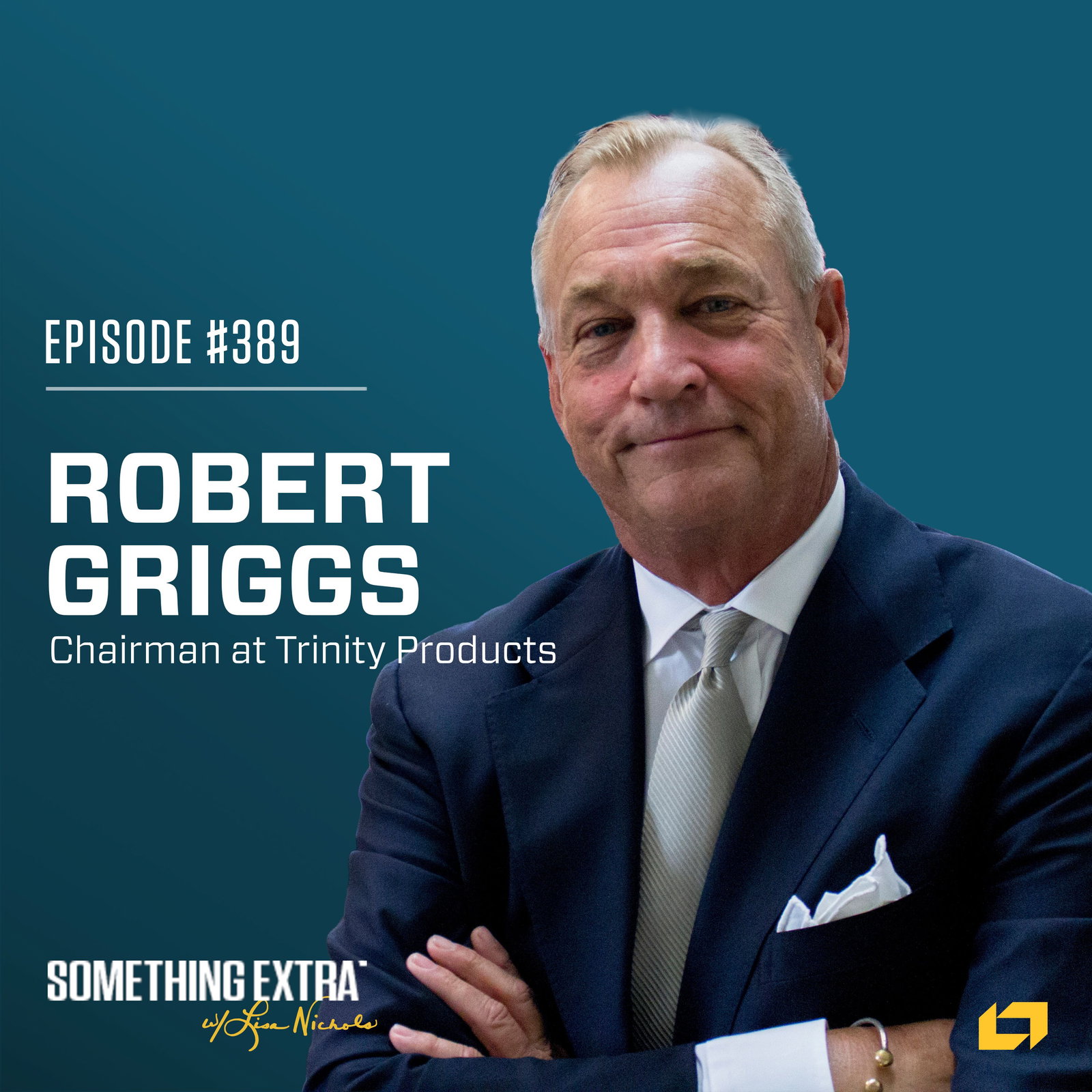
Robert Griggs
How do you really get successful, and learn to grow the business? Well, you turn the pyramid upside down and we as leaders focus on the foundation. It's the people that load the trucks. It's the people that are doing the welding. It's the people that are keeping the lights on. Alright? And so our job as leaders is to make their lives better. Okay? And two things happen when that happens. Our customers' lives get better because we deliver our products on time with high quality. And then secondly, as a leader, my life gets better because I'm not focused on all the small minutia problems. I get to go out in space and go, where's the next place to grow? Lisa Nichols
It takes something a little more to lead with impact. I'm Lisa Nichols, author of Something Extra, and this podcast was inspired by our daughter, Ali, whose additional chromosome has shaped how I see people in leadership. Each episode features conversations with inspiring leaders from around the world about what truly defines how they lead and serve others. If you enjoyed today's conversation, please consider leaving a five star review. It helps more people discover the show. And if you'd like to go deeper, my book, Something Extra, is available on Amazon and through other major book retailers. I'm thrilled to have Robert Griggs on the show today. Robert is a true son of Missouri and a titan of the manufacturing industry. He is the founder and chairman at Trinity Products and the author of the book, Foundational Leadership. Well, Robert Griggs, welcome to the Something Extra podcast. I'm so delighted to have you today. Robert Griggs
Thank you so much for having me. It's a real pleasure. Lisa Nichols
Yes. And I wanna give a shout out to Mary Anne Bingardee Lisa Nichols
That connected us. And I know she's been important in your life and in the Trinity story, But we were meeting one day, and she goes, you need to know Robert. And you and I had a quick little call, and I said, Robert, come on to the podcast. So Robert Griggs
She is quite the promoter as well and just a wonderful person. And so, I do a little speaking for them, and she comes out. I'm, on the board of her Missouri Made. Okay? And, she's involved with Missouri manufacturers and those sorts of things. So we have a lot of places where we meet up, so it's been great. She's awesome. Lisa Nichols
She is. I could not agree more. Well, I know that you are they call you a Missouri sun. Lisa Nichols
Yeah. True sun. You grew up in a small town in the Boot Hill. Right? Charleston? Lisa Nichols
And I think you came from a military family, farming community. And here's what I wanna talk about. You also went to Mizzou. Lisa Nichols
And here's what I wanna talk about, Robert. Two years after graduating from from Mizzou, you started Trinity Products. Robert Griggs
I did. And, I knew I always wanted to start a business. And, you know, today, we helped, you know, they just had a on campus pitch competition where there were eighty pitches this last weekend. It's called Mizzou Startup Weekend. And there was nothing then. You know, you just kinda had to know you wanted to start a business and you were willing to take a leap. So I got a sales job, and they didn't treat me quite right. So some of us left, and we started a company. I was twenty three and, just started buying and selling, and and, you know, it just grew. And what I learned from all the things that if you've been around the military, there aren't, there aren't colors in the military. They're just people. So that's one of the things you learn. You grew up in a small town, the farm, you learn to work really, really, really hard. Robert Griggs
It's expected. And I don't care what age you are, it's expected. And so those things come together. And by treating people right, I wouldn't say that I've trained in leadership. I I've learned it. I've studied it, and I know what I wanna have happen to me, and I know what I'm willing to do for everybody. And it's been a really, really remarkable ride. Lisa Nichols
Yeah. Well, I love that you just said that, because, you know, the age old question, Robert, is, are you a born leader? And I think there are some characteristics possibly, but you learn along the way, and I think that that should give people hope. Right? And and I say that you never reached a summit. You never there's always a next level. Right, Robert? Robert Griggs
Yes. I will tell you, we do a lot of personality testing, and I think there are certain certain wiring in people that make it easier to be a leader. Okay? And, so I will give that. But everything I've learned, I read, I study, and what I found just to experience, and this would be with most people, the more you give, the more you receive. Now I don't give to get things in return. I give because it makes me feel good. But guess what? My my basket is overflowing. And so what happens is you teach people that if they're engaged with you and you're engaged with them and we are working for a common cause, what I've learned over the process is share the profits, share the information, share the heartache, share the successes, and then what happens as you go along, everybody gets better. And so I think what you're gonna find in the book is a combination of Jack Stack and the great game of business. Right? Robert Griggs
Springfield Green Manufacturing. And then I combined, continuous improvement with it. And for that, we use a group called COCI Cycle of Success Institute. So we combine those two traits and taught everybody how to get better every day. We teach them how to run a business. I had a lot of people over my career say, they don't know how to run a business, and that's just not true because they run their household. Right? And you have a top number and you have taxes that come out and you have a car payment, you have a house or a rent payment, and you buy food, you buy gas, you buy groceries, and if there's anything left over at the end, it's profit. Yes. So they know totally how to do it, and it's just engaging them and teaching them a lot of the nuances of business. Lisa Nichols
Yeah. Yeah. I love that. Wow. You just covered a whole bunch of information there that that I Robert Griggs
I did. Did. But as you go into the details more, you you'll find the things it's just a broad stroke of what the book is about from, twenty twenty when it really changed, okay, to twenty three, four, or five. It's how I got to that point. Right? And and making those decisions. So there's a lot more to the story than just a a two minute clip. Lisa Nichols
Absolutely. Yeah. And I wanna dig in more, but I wanna go back because you had said something. You said, you know, you were had a sales job, and you were not really treated fairly. I think you got, snookered out of a five thousand dollar commission, Robert. Did. And that was kind of a that was kind of a pivotal change for you where you're like, you know, you wanna build something. Here these are your words. You go, I wanna build something where no one puts their hands in someone else's pocket.
Robert Griggs
Well and I was about to say that. Okay? Because it's very interesting. I keep my hand in my pocket. You keep your hand in your pocket.
Robert Griggs
And what happens is, what I've a couple of things in that. You the the company gets to set the formula. Right? And if you set the formula and you don't live by, well, guess that's not some place that people wanna be or and I was making seven hundred dollars a month, draw against commission and got paid commission. So I had a five thousand dollar commission check coming at Christmas, and I got twenty five dollars. And I called my boss and said, hey, man. What's going on? And he goes, Valley Steel didn't pay us. And Valley Steel at that time was a huge company in town in Saint Louis, and they were selling, I mean, two hundred million dollars in nineteen seventy eight when Steele was going for three hundred dollars a ton, you can't even amount it would be two billion or three billion today.
Robert Griggs
And but in those days, anybody would answer the phone. You could call the president in a valley or you could call the CFO or
Robert Griggs
So I called Harold Mabry, just and said, mister Mabry, it's Robert Griggs. We had this order, and he said, ask your boss how much money he owes me. So they had contra ed it. So I knew at that point that they were never gonna treat us right. Right? Yeah. So that's, and I like to take the high road on money, because two things happen if you don't. You create an enemy and you create somebody that has a long, long memory, and they tend to not forget and it just causes problems. So take the high road on cash, do your best, and, and keep going.
Lisa Nichols
So, Robert, I just I love the philosophy. We do have similar philosophies for sure. You know? And what I want to tell our our listeners is that I know, like, Trinity is well over, like, three hundred million dollar business today
Robert Griggs
Yes, ma'am.
Lisa Nichols
Which is crazy. I mean, you started from nothing.
Robert Griggs
Yeah. You know, there's something really important happening this year, the two hundred and fiftieth anniversary of America. And it's funny. I get to travel around. I grew up in the military, so I I was all over with my dad. My dad was in Korea, and we've been to Europe and lived in Germany. And I saw the Berlin Wall, okay, and Brandenburg Gate. And so, I remember that point. And, I do remember I was, man, probably in second grade, the Cuban Missile Crisis. So what we find here is even though some people might not wanna believe it, if you really work hard, you're gonna get better than most people around the world. If you haven't been to Africa or you haven't been to places you don't know what poor is. Right? And
Robert Griggs
I grew up in Southeast Missouri, and I grew up on a farm. And there were a lot of people that it was scary. And so the point being is America is a place where if you, put your will to it, good things can happen. Now it doesn't always work. There's luck involved, a lot of luck, a lot of opportunity. I say this, success is where opportunity and preparedness meet. Okay? So you have to put yourself in that position, and and I do a lot of speaking at the zoo and kids will ask me well or people will say, well, I worked hard. Success in that also comes with the risk. Okay?
Robert Griggs
And risk doesn't have to be borrowing money. Risk is, did you walk up to your boss and say, how can I help you? And how can I be supportive of of you? And by having the risk to say that, the gumption or the will, what happens is the more risk you take, the more reward you get because people see it. And and so risk is one of those things, but without risk, okay, reward gets tricky, and it has to be thought about in not just monetarily. It's all the other factors in
Lisa Nichols
it. Mhmm. And success. So good. That's so good. Well, we've already talked about your book a little bit, but you did, your book came out in twenty twenty three. It's called foundational leadership, and I love the subtitle, growth doesn't start at the top.
Robert Griggs
It doesn't. And so when we go back into this thought process and something I learned and, so I'm gonna hold up a v. Okay? And there's the pyramid and Lisa and Jenny and me and a lot of people are at the top thirty percent of that pyramid. Okay? Pretty successful, are gonna get paid almost no matter where we go. Right? Something
Robert Griggs
A decent wage. And so how do you how do you really get successful and learn to grow the business? Well, you turn the pyramid upside down and we as leaders focus on the foundation. It's the people that load the trucks. It's the people that are doing the welding. It's the people that are keeping the lights on. Alright? And so our job as leaders is to make their lives better. Okay? And two things happen when that happens. Our customers' lives get better because we deliver our products on time with high quality. And then secondly, as a leader, my life gets better because I'm not focused on all the small minutia problems. I get to go out in space and go, where's the next place to grow? You don't go from, let's see. We were, two point two million in nineteen seventy nine. We got to six million in two thousand. And two thousand was the point I realized I couldn't do this by myself. I needed something else, and I got handy Jack's deck book, great game of business and sharing the profits.
Robert Griggs
And I I dove in. I go I taught financial literacy as much of my job was teaching, because we don't control the outcomes in business a lot. Okay? There's a war going on. There's gas prices going up their fuel. There's out kind outside constraints that affect a lot of our success. So from two thousand and great game of business to two thousand and ten, we went to sixty seven million dollars from SIP. Alright? Then I learned again there, I go, although they can manage the expenses and the outcome, how are they affected? Right? How do they affect it daily? And so then I was at a seminar and I saw, continuous improvement. I had always felt like continuous improvement that made it difficult or was gonna be hard and you're a black belt and you're on blah blah blah. So what what I learned at then in two thousand ten was continuous improvement goes, what's not working? Okay? That's it. That's all the question is. You put a group of people that work together that are doing the job and you go, what's not working? You put it on spreadsheet. You organize it by, the priorities of we monetize, we organize, and we prioritize, and then you fix things, and then you meet again in two weeks, and you fix more things. And then what happens in this is you've taken all the barriers, the impediments to success for the people that are working for you out of the way. You make a standard that we all agree upon that they have the power to have input on and you walk in and say, you're giving me twenty feet an hour at sixty five percent productivity. So I need sixty five feet. Alright? And then you go back and track. Anything worth doing anything worth doing is worth, tracking. Right? Okay?
Robert Griggs
And then you post it. And so we just continue to get better. And then in twenty three, we did three hundred and some maybe two eighty five to three ten depending on so it wasn't me doing that. It was this system that's in this book that you would buy and read, and it was it's just a plan. I don't know why everybody doesn't run their business this way.
Lisa Nichols
Right. Oh, that's so good. Boy, you just you just gave us tons of gold nuggets in there, Robert. So the book that that Robert's talking about is Jack Stack's book, Great Game of Business, and it really kind of changed you know, it was a paradigm shift for you for sure. You know, what about this the five percent rule? So you you kinda struck a deal, and you did. I loved because I read that where you went through and you taught all of your employees financial literacy. You taught them how to read financial statements, all of that. But tell us about the five percent rule and the profit sharing, and how did this transform the behavior?
Robert Griggs
So when you get to the first part of when you're when you're you're giving key numbers, key metrics in your business. Right?
Robert Griggs
And ours, we were a combination fabricator, which is has high margins, distributor, and broker. So we went out into the marketplace. It's so easy to get data today, but when we started in two thousand, your banks helped supply it. And so we found that the top companies that we compared ourself to had a five percent net return on sales. So if you sold a thousand dollars, you made you made fifty dollars. And so it's just a number. We compared ourselves and then what we found is so if five was the top, what was the number that sustained our business? So three and a half percent net return on sales was the bottom because we had to make that much money to buy new equipment and to give raises and do all that. So the bottom is three and a half percent net return on sales. If we don't get above that, there's no bonusing. And then for every five, points above that, we went to twenty percent of the profits. So for example, if we had a, ten million dollar business, at five percent net return on sales would be five hundred grand, and we would say are a hundred thousand dollars with all the employees.
Robert Griggs
so it would be divided up. Now I had people, say to me, well, why would you give somebody a hundred thousand dollars? And I go, would you like to motivate them to be in the top of all your peer groups every single month, year, forever? Yeah. Because you can't do it yourself.
Robert Griggs
Right? And and so I I went and took this a little further. Let's say we sold a hundred million dollars, okay, which we would make five million dollars on. Okay? Would you share a million dollars? And here's where the numbers go. Robert Griggs is gonna have to pay forty five percent in taxes.
Robert Griggs
Alright? So what I've done is I've put uncle Sam in as my partner. And, so I'm sharing a million dollars with everybody. Do you think everybody shows up? Do you think the wives and the sons and the daughters and all the people hear about this and go, this is what I got and show up at work and are happy. Yes.
Robert Griggs
And it only cost me fifty five percent of what I would have made on that million. So I weighed the balance and said, I would rather them have it demotivated because I promise you we're gonna make more. And then the other part people, businesses would say is I'm afraid. Most business people are afraid to show somebody the books, because, really, in a ten year period, you knock it out of the park a couple of times. You really take it badly a couple of times, and everything else is kinda down the middle. Yes. But people think if you make a million dollars, you make it a hundred thousand dollars a month. Right? And it ends up being a million dollars. Well, really, it's not. You might make six hundred grand in one month, lose two hundred. And so by teaching them how the business works and fluctuates, it makes it keeps them very calm because they realize when things are bad, they're gonna get better, and they realize when things are good, unfortunately, keep your head down because they're gonna
Lisa Nichols
because it's gonna get worse. Right?
Robert Griggs
And so it's funny. It takes all the pressure off me.
Robert Griggs
I didn't have any pressure. Yeah. Tell me what's not working. I'm gonna fix it. When I fix it, I'm gonna ask you the question. Why aren't you doing what we all agreed to? And then they'll say, well, something broke and I go, well, why didn't you write a work ticket on it? Okay? There's always a reason that the process doesn't get
Lisa Nichols
Sure. Sure. For sure. Oh my goodness. This is so good, Robert. But we do need a quick take a quick break, and we'll be right back with Robert Griggs on the Something Extra podcast.
AD
Hey there. In a challenging business climate like this, savvy leaders look to technology to find an edge. This can mean the difference between staying ahead of the curve or playing catch up. It's time to collaborate with the highly skilled experts at Technology Partners. Our team of technologists draws upon decades of experience for your project, with each bringing a passion for solving problems and a track record of success. How can we help you overcome your biggest technology challenges? Visit technology partners dot net to book a free consultation with one of our leaders.
Lisa Nichols
Welcome back, everyone, to the Something Extra podcast with Robert Griggs. So Robert, in twenty twenty one, talked to me about this. You took the business to an ESOP.
Robert Griggs
Correct. It kinda felt in with our philosophy. You know, as a business person that is growing and let's take it from, you know, let's take it from, seventy nine or, I mean, let's see. What was it? Ninety three when I bought my partner out from two point two million to three hundred million. Every amount I mean, I lived a great life, but every amount of money I made got put back into business. Yes. Right? And so you have to have I went to everybody and said, guys, I need a liquidity event. Right? I'm getting old. I need to cash out. And so we looked at putting it into the private market, and then I just thought I really would rather there's some advantages or it didn't take anything. All the ESOP people go, well, your business is perfect because they all know how to read an income statement in the balance sheet. They know what business is. They're not gonna be afraid of it. So we ended up doing an ESOP. Had a couple really good years, and then the last two years have not been good. One of the years was the worst we've had, but as I go back, our job is just to show up and get better every day. Operationally, we did really well. We had some initiative during that period of time. We increased our productivity at the mill from about forty thousand tons a year to fifty five thousand tons a year. Okay? We, put on a product line called Tri Loc, which we invested ten million dollars in that we have a patent that we're now it's a press fit connection. We're now selling it. We've got an order in Nigeria. We're just shipping pipe to Nigeria to go under the Niger River. We have patents in the EU. We have patents in Africa and the Middle East. So we were doing a lot of really, really good things.
Lisa Nichols
Good things. Right.
Robert Griggs
Yeah. The market just gets in the way. And so as you learn, you don't like it, but you realize when it's bad here's the thing I would say to everybody. Guys, it's not good. So guess what's gonna happen? And they look at me and they go, it's gonna get good. Now
Lisa Nichols
we're in that
Robert Griggs
yeah. We're in that position right now. We've had a great first quarter. Second and third quarter are shaping up really, really nicely, and we're involved in the infrastructure business. So, you know, the the Francis got Key Bridge, for example, the one that went down in Baltimore. Right? Mhmm. Mhmm. We're we're putting the foundational pipe in for that. We've built pipe. We're the number one large diameter, meaning twenty four and above structural pipe manufacturer in America. And so we've done the Javits Center, of, Newark Airport, Venetia Bay Bridge. You know, the only thing you all might see is when you drive by a Topgolf, okay, all over the country, you've probably done twenty five of those. So or signs, quick trip signs, and you you would be shocked at how many signs we planted across America.
Lisa Nichols
Yeah. What a what an awesome story. What an awesome story. And the thing is, you know, Robert, as you're talking, I mean, that's the other thing that people need to understand. There's ebbs and flows. And you said it yourself. There's market conditions that we can't control, but let's control what we can control. Right? Let's focus on we what we can control, and there are plenty of those things. But let me ask you about this. I think this is really, I think this is I like this. You have a no lying policy.
Lisa Nichols
And if you lie, you're fired. But you have also a caveat where you say you can recant that, and you will be forgiven. Yeah. But, you know, I mean, where did that come from?
Robert Griggs
It comes from we do a lot of business over the phone and, you know, over the course of this, you have young salespeople, and everybody wants their customer to be happy. And it's very easy to say, yes. The truck is loaded or da da da instead of and what I really wanted to teach everyone was this. I don't know the answer. Let me get it for you. Or if you think the answer is bad, we we deliver bad news first. Okay? That's our mission. So you come in, we have a thing we call eat the frog. How would you eat a frog? Now I stole this from buying Tracy.
Lisa Nichols
Everything Tracy. Yeah.
Robert Griggs
Everything I've done in my life, I've stole stolen from someone.
Robert Griggs
But eating a frog is so every salesman has a frog on their desk. And so the night before you leave, you write down all the things that have to get done and you start with the worst one. I'm making that call. I made all my call bad calls on the way to work. Hey, Jim. Our truck didn't go out last night. You let me know what I have to do. I'm driving over to a plant right now, and I'm gonna get all the information. So guess what? Two things happened. I've gotten it off my chest. Jim has a chance. He's mad at you. Okay? But he also has a chance if you tell him early to figure out how to solve his situation with his labor and his things. And so, it it just went that way. And here's another thing to understand. I can fix a mistake. I can't fix a lie. Yeah.
Lisa Nichols
That's true.
Robert Griggs
You lose credibility with people when you lie. And so I am going to tell you a quick story. I told a friend of mine, two days ago. I was on a podcast, and he goes, are you gonna tell him the Anchorage, Alaska story? And I go, yeah. Sure. And here's the thing. We tell everybody everything, and we mostly start with the bad and then go to the good. So Right. We had a call system set up for the salesman because I grew up in the old days where you made a hundred calls a day and you would you would get a hold of twenty people. And of that twenty people, you would get three inquiries. And of those three inquiries, you'd close one. So it was a numbers game, and it just gave us something. So one of the salesman, who, unfortunate well, fortunately, was a number two salesman. We this is a story of when AT and T had minutes and you got charged per minute, okay, of LV long distance. So this was a long time ago.
Robert Griggs
We my, accountant young lady came in and said, I think AT and T has overcharged us by, fifty grand on our phone bill. And I go, no way. And so they did. They do they had it should have been six cents a minute and they charge us nine. So but she goes this was a Friday afternoon on the way home at four thirty. She goes, I got really bad news. She goes, x y z salesman called Anchorage, Alaska time and temperature four thousand time.
Lisa Nichols
Oh my goodness. Four thousand times?
Robert Griggs
Yeah. Now, this is a lying thing. So he got fired, but it also comes back to something that I learned as you change now when you're learning. I had the goal set up incorrectly. Okay? I I had making the number of calls and and that sort of thing. So it so I would tell everybody in business. What you started as your matrix of what happened, is calling really the thing that it just number of calls, or is it am I on the phone with somebody and building a relationship? Right? And so how do you measure that? So partly, it was my fault, but that's how we change. So the recant thing is, listen, you get put under pressure and you say something, you call your customer back and say, Jim, I just checked. It's not gonna be there. And you walk into your boss and you say, hey, man. I told them that, but I fixed it. And so but because people looked at me and go, man, you know, if you if you're fired or lied, are we gonna have anybody here? And I go, yeah, we are because we're not gonna lie and all we're gonna do is tell the truth. We're gonna get to the finish line faster without having to create trouble. So that one was instituted. We still live by it. And then the second one that happened probably ten years ago, that was twenty years ago, which took me a long time to find out, no drama. Because there
Lisa Nichols
That's good.
Robert Griggs
There are people and organizations that are drama kings and queens.
Lisa Nichols
They love it. They love it. They relish the drama.
Robert Griggs
Yeah. And so what we did, and that started ten years ago, we know who the drama people are and we coach them up and say, I gotta be honest with you. This is not working for us. And so we we coach them to change. And if they can't change, we just ask them to move on.
Robert Griggs
Because our regular lives and businesses are too hard to get caught. It's not
Lisa Nichols
Yes. Agreed.
Robert Griggs
Our rules are this. We have a boss. It's the customer. Serve them. Okay? Secondly, serve your employees by share we share the profits and we treat them fairly. Third, no lying. If you lie, you're fired. And then the fourth new one is, no drama.
Lisa Nichols
Yeah. Oh my goodness. Well, it doesn't do anybody any good, and it pulls everybody else down. Right? So I love I love those rules. Well, I'm gonna ask you one more question, and then, we do need to wrap up, and I'll ask you something extra. But I know that you are you know, you talked about continuous improvement. I know from reading about you, Robert, and even the short time that I've been able to talk to you, you are a continuous learner. You I mean, you said
Robert Griggs
heard about it.
Lisa Nichols
You know? I mean, I've heard you quote Brian Tracy, which I absolutely love to eat that frog. I'll tell you I'll tell you something really funny. So one day, I was trying to I was imparting these business principles to our grandson. And I was saying in Steuer, you know, they're because it was something about homework, and he really it was a subject he really didn't like. And I'm like, well, Brian Tracy says, you eat the frog. And I said, that means you do what you like the least the first.
Lisa Nichols
And he goes, well, Yaya, it could also be eat the peas.
Robert Griggs
It could be.
Lisa Nichols
And I said, yes. Because he will not eat anything green. So, but, anyway but I know you're a big reader. And, you know, I read this that here's some of your favorite books, and I wanted you to comment if there's anything else, To Kill a Mockingbird.
Robert Griggs
Oh, I love that one.
Lisa Nichols
Yeah. Skates of Fire.
Robert Griggs
From the south, so you know what that one is.
Lisa Nichols
I do. I do know what that one is. Is. Yes. I do. Think and Grow Rich, The Great Game of Business. We've already talked about Jack's Snacks book, Warren Buffett. I would say anything by Warren Buffett. Uncle Warren. Anything my uncle Warren's great. Elon Musk's book, Shoe Dog, that's a good one, by Phil Knight. Do you have any other ones that have just been really, inspirational and and foundational for you?
Robert Griggs
You know, the people don't the the Think and Grow Rich, okay, that is such a great story because it takes something nearly a hundred years ago, but all the principles are exactly the same. Mhmm. Okay? And so what it if you read think think and grow rich, what you're gonna find is all of this basic principles of treat people correctly, do the right thing. You know, I'm gonna go ahead and say eat the frog. Listen. When we make a mistake, we fix it. Okay? And when we mess something up, we are on the plane, and I've got one of my best customers ever, on things that we truly did poorly. Right? And, we thought we had systems in place, and we opened a second plant. And the the the the tribal knowledge here's another thing. When you think you have everything and you might have everything, locked down at home base, when you have a satellite base, you it's hard. Okay? And things get missed. And so, recently, I just read a really good one, but it was, Liar's Poker. And the reason I like that one is it talks about the bond market and the stock market of the eighties. Okay? And it gives you an idea of what Wall Street is like, which is scary. Mhmm. How they fix the game for them, but it's it's part of the world. And I just keep reading. I read things that I like. I read a lot of history. I'm excited about, the two hundred and fiftieth anniversary because I know a lot about about the revolution. So I tell people, and I was just at a Mizzou class, and I said, imagine, two hundred and fifty years ago, Ben Franklin, George Washington, Hamilton, John Adams, anybody that signed that declaration of independence, if we had lost, they would have been hung in Philadelphia and New York and then their bodies taken and then hung on the Tams River. Right? Mhmm. So how much courage did you have to have, okay, to go through and realize that everything that you work for probably sixty forty was gonna get taken away. There was no odds on that this was gonna work.
Robert Griggs
The Ken Burns episode that war of independence, I'm I'm watching the first few episodes again. You everybody should watch that because you don't realize how empowering. In order to get from Virginia to Philadelphia, okay, it took ten days. So they're riding on a coach or a horse to go to the Continental Congress. Right? Would anybody do anything for ten days and not be doing business today and have enough courage to do it for other people? And what you're gonna learn is we had the we had the north that wasn't involved in slavery, and we had the south that was involved in slavery, but they kinda tabled that topic because they wanted to become a country. Right? Mhmm. And they go, that's a fight I can't get they couldn't take on that fight today, but a hundred years later, we took on that fight.
Robert Griggs
And right. I was just out at the Reagan Library, and if anybody gets out there,
Lisa Nichols
I've heard nothing but amazing things about the Reagan Library.
Robert Griggs
He was the first president that I remember that I caught on to that made me feel good. Right? And made me feel how important and he's an Illinois native and, you know, he worked in, for the actors studio, the unions, so he understood people. And there's just I'm really proud to be an American, and I'm I'm lucky, lucky lucky lucky that I am, and I'm lucky to have all these great people that work for us that and they deserve all the good fortune that they're having.
Lisa Nichols
I agree. I agree. Well, Robert, just real quick, and I'm gonna ask you about something extra. If you've not seen the Reagan movie, watch the Reagan movie. It is so good, so well done. I just came away from there just feeling so patriotic, and it it's just a fantastic movie. But I have to ask you, Robert. This is called Something Extra. I ask every one of my guests, what do you believe is the something extra that every leader needs?
Robert Griggs
Well, I what I do extra is I went in the plant every day and I learned everybody and I asked them about their family and I kept up with them. And the other something extra that we did, in the when I was a kid, there was family there to support you, so you always kinda had a backstop. Okay? Mhmm. Mhmm. There there's not many backstops today, so Trinity ended up being a back stop for people. So if somebody had car trouble and things went wrong, we loan them money to get their car fixed.
Lisa Nichols
Oh, I love that.
Robert Griggs
We went the extra mile because, guess what, Somebody needs to do it, and we need them. And we never had a bad feeling if something went wrong and they didn't pay it back or the world ended. It wasn't that. We did it because we wanted to do good things. And what happens when you do good things for people, they talk about it. Right? And when you do bad things for against people, they
Lisa Nichols
talk about it. Right. Yes.
Robert Griggs
So why not do good things and make them wanna be involved with you and make them go the extra mile for you and make let them be successful while you're being successful. Right? So the more you give, the more you receive and, enjoy it and, you know, just show up and work hard every day.
Lisa Nichols
That's so good. This has been so good. You are just a a wealth of wisdom, Robert, and, I appreciate you making the time so much to be on the show today. And I really do believe that your story is gonna help other people. And Well,
Lisa Nichols
That's And that's why yeah. That's why we do this podcast seriously. So
Robert Griggs
And that Jack and I said, Jack, you changed my life when I read your book. Okay? And so I asked Jack to do the forward for our book and he said, I really like the avenue you took it from the shop out. And so I just hope that one person reads that book and changes something they do and something successful happens for them. And that would be a great thing to know.
Lisa Nichols
Yeah. Well, thanks again, Robert. This has been delightful for me.
Announcer
Something extra with Lisa Nichols is a Technology Partners production. Copyright Technology Partners Inc. Twenty nineteen. To learn more about this week's guest, check out the show notes at tpi dot co slash podcast. If you enjoyed this episode, consider leaving us a review. Thank you for listening to Something Extra.