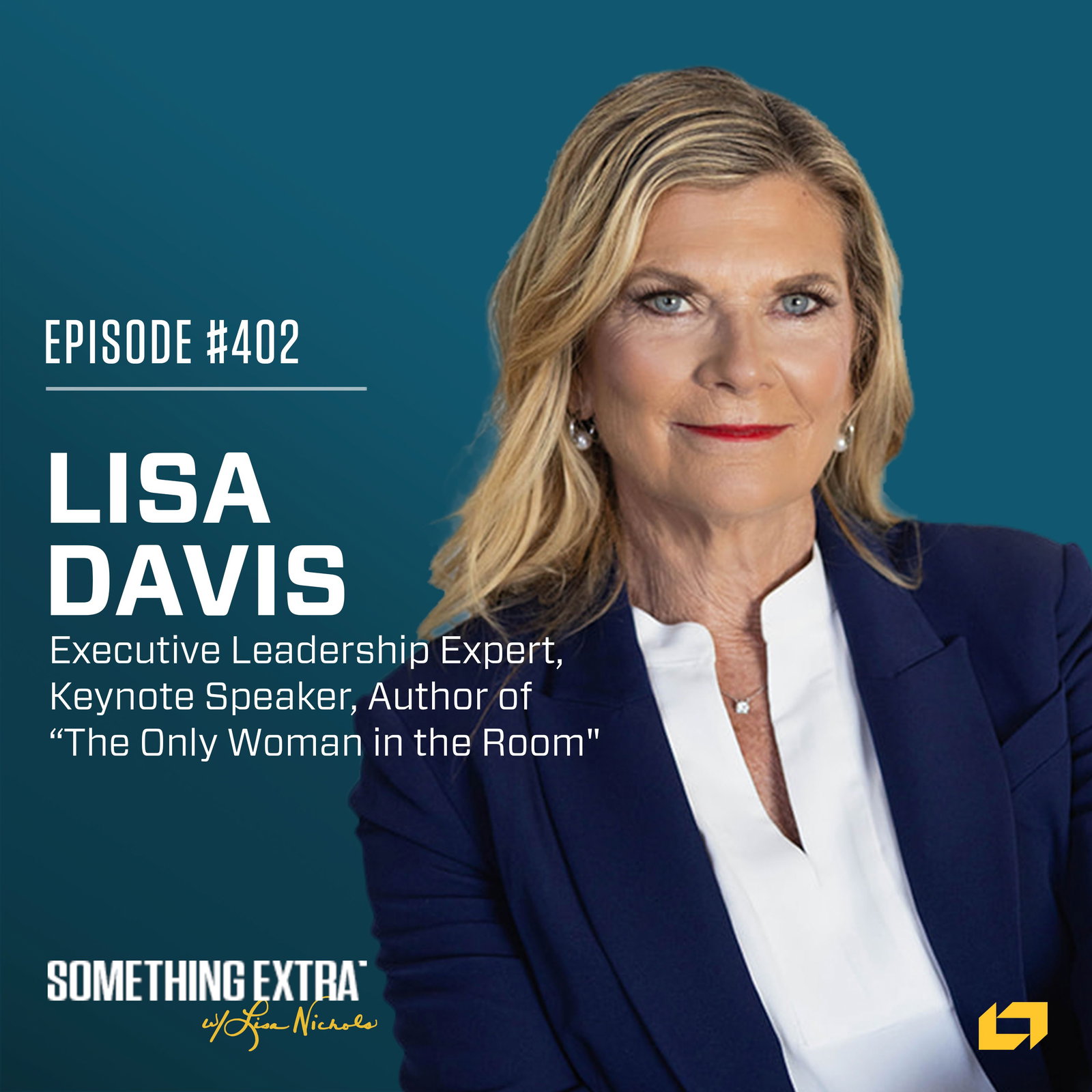
Lisa Davis
What are your core values? What are the foundation and principles that guide you? What are your guardrails? What lines won't you cross? And we see it time and time again with the pace and complexity of change that we're navigating, that leaders are under tremendous pressure, probably more pressure, than they've ever been before. And to me, that leadership because I always say AI might be the catalyst, but leadership is a differentiator. How will I become that leader in order to navigate my team, my organizations, and myself through this period of unprecedented change? Lisa Nichols
It takes something a little more to lead with impact. I'm Lisa Nichols, author of Something Extra, and this podcast was inspired by our daughter, Ali, whose additional chromosome has shaped how I see people in leadership. Each episode features conversations with inspiring leaders from around the world about what truly defines how they lead and serve others. If you enjoyed today's conversation, please consider leaving a five star review. It helps more people discover the show. And if you'd like to go deeper, my book, Something Extra, is available on Amazon and through other major book retailers. From high stakes federal national security to driving multibillion dollar turnarounds at Intel and Blue Shield of California, today's guest has broken barriers at every level of executive leadership. Joining us today is Lisa Davis, executive leadership expert, keynote speaker, founder of Davis Core Advisory, award winning CIO, CIO hall of famer, and best selling author of The Only Woman in the Room, How to Win in a Workplace Still Built for Men. Lisa Davis, welcome to the Something Extra podcast. I am so excited to have you on the show today. You and I connected, and I'm like, oh my goodness. I just I cannot wait for our listeners to learn from you. Lisa Davis
Lisa, it's so yeah. Yeah. I've been looking forward to our conversation as well. Certainly, after we finally connected I don't know what took us so long to finally bring our universe and our paths together, but I'm so glad to be doing this with you today. Thank you for having me. Lisa Nichols
Absolutely. And I immediately liked you because you got a great name. Lisa Davis
That's right. We have great names. Lisa Nichols
We do. We have great names. I always love to give a a shout out of how I meet my guest, Annalisa. And you and I have a mutual friend, dear friend, Dan Turchin. Lisa Nichols
And he's like, you two Lisas need to know each other. Right? Lisa Nichols
So shout out to Dan. Dan is the CEO for People Rain and just as a just a tremendous, tremendous, person. But, you know, you you have been, like really, I was, like, looking at your your CV, your resume. Lisa, wow. What a ride. You have been Lisa Nichols
What a ride. I mean, you have been at some of the most iconic companies and organizations and have done a lot. I mean, you I think how many years did you spend in the DOD? Lisa Davis
I had a full career in DOD, twenty six years. Crazy story. Started as a GS two. If you know anything about the government pay, you know, grade scale. So right out of senior in high school, started as a g g, GS two. They were recruiting engineers to the government. I was a computer engineering undergrad and wound up having a full career of twenty six years and retiring as a senior executive service member, which is equivalent, for those that don't understand, more to an admiral or general in military terms. So I made the whole journey, Lisa, on that pay grade scale from the bottom to the very top. Lisa Nichols
Very top. That's amazing. Wow. And I know that you spent some time in the DOJ too, the Department of Justice. Lisa Davis
My last role as the CIO for the US Marshals Service, a a fantastic role, incredible men and women and the mission of the US Marshals Service. Lisa Nichols
Yeah. Yeah. You know a thing or two about being a CIO. And then you went on into the the public sector or the private sector and Blue Cross. I think you were at Blue Cross for a while. You had Yeah. Time in the. Lisa Davis
Made that journey. It's hard to transition out of government after being a government civilian, and there's usually, you know, the typical track is the defense contractor. Mhmm. Really wanted to get to high-tech. That's where I had always wanted to be as when I started out as a engineering undergrad. And transitioned purposely to be the CIO at Georgetown University. Another fascinating experience, three years there, before finally making it to where I wanted to be, which was in high-tech, and had the opportunity to be at Intel for over five years, both on the IT side and then running a multibillion dollar p and l for their largest business group, data center group. And as you already called out, in that experience at Intel, which was a global business, multisector, recognizing that health care was really the digital laggard in terms of digital transformation. When Blue Shield of California was looking for a CIO, I thought it was an incredible opportunity for me to drive transformation and impact in health care. So I spent five years at Blue Shield of California as their CIO. Lisa Nichols
Right. And you are so right. They are a a little bit behind. Right? Lisa Davis
A little behind. It's maybe catching up a little bit. Still working on it. Lisa Nichols
Still working on it. I know. Our team is doing the same thing. Well, I just it what a journey. And now you jumped onto the entrepreneurial wagon, and you're you're, you know, you're the CEO of your own company, which is Right. I mean, you've really just gone full full spectrum. But I wanna talk a little bit about this. Your your book is titled The Only Woman in the Room, and I love the subtitle, How to Win in a Workplace That Is Still Built for Men. You know, was there a defining moment for you, Lisa, when you realized that phrase would become the story that you needed to tell?
Lisa Davis
You know, I was the only woman in the room being a technology executive and certainly starting my career, the first twenty years of my career in the Department of Defense, that it became a norm at how to operate. And it really shaped not only my leadership style, but also help me understand what it was going to take in order to build my confidence, subject matter expertise, finding my voice to speak in rooms when those rooms are predominantly, male military and civilian, right, people in those rooms. So it didn't really hit me, I don't think, Lisa, until you know, maybe I needed to be knocked over the head because it was the norm of how I operate it. Going to academia and then seeing again in in at Intel. And I call out a moment in the book where I'm an Intel executive. I have a meeting with JPMorgan, and I bring three three of my team members with me, all male, to the meeting. And I'm sat at the center of this huge, just huge conference table on the top floor of JPMorgan in New York City. And the JPMorgan team files in. There must have been twenty five, thirty of them. It was amazing to me. My first thought was, how many people does it take from JPMorgan to have this meeting with the four of us
Lisa Davis
From Intel. But they all file in. They're all male. They're all in the same darn blue suit, white shirt, same identical certainty, take their seat at the table. And I look around this table, and the the thought and I remember it like it was yesterday. I thought, my goodness. How is it possible at this point in my career as a c suite executive that I am still the only woman in this room?
Lisa Davis
It is not changing as fast as we needed to change. So the reason I wrote the book was and I think there's so much power in story sharing our stories because there's so many perceptions or you know, and and and we especially do this as women that, oh, she's got it all figured out. Oh, she must have had an easy ride. Oh, she was given the opportunity. And the reason I became so vulnerable in the storytelling, of what my journey was was for other women, diverse leaders, to see that, oh, no. She didn't have it easy. It took a lot in terms of grit and perseverance in pursuit of what her long term professional goals were. And I was hoping by sharing my journey, the setbacks, the learnings, the successes, the nine leadership principles that kinda guided my journey would help other women and diverse leaders make their journey easier.
Lisa Davis
So but the subtitle was really important, and I'm not sure people always get it. Yeah. Why I wrote this subtitle, especially when men pick up the book and see the book and the subtitle. And that's because our system and infrastructure at which we operate in was built after World War two to support the man going to work full time in the office and the women's woman staying home and and raising children and taking care of the family. And it is not the reality of what we live in today, where over sixty percent of women, work. Of that sixty percent, over a majority of those are primary breadwinners. Women sometimes choose to work. Many times they have to work.
Lisa Nichols
Have to work. Right.
Lisa Davis
Right? And the systems and the infrastructure. We still don't have paid family leave. We still don't have, flexible remote work opportunities. We don't have affordable childcare in this country. So the journeys of all of us that finally made it to that goal that we had for ourselves. You know? And I always just wrote an article recently for Katie Couric Media of like, hey, it's not about leaning in. It's about kicking down doors, figuring out how to go around them, staying true to yourself and your goals. And what does it truly take as a woman in order to have the successful careers we want?
Lisa Davis
A little passionate about this area.
Lisa Nichols
You are passionate, and I love it because you're right. I mean, I do think, you know, I'm I'm just gonna I'm a flip over here and just read this piece because you talked about intel. Yeah. And this was, this is called the subtitle of this, not it's it's in a, it's in the chapter six. But it says courage, the ticket to trust. Says when I arrived at Intel and found myself the odd woman out, I had two options. I could either quit or win.
Lisa Nichols
Quitting wasn't on the table. So quitting really was not an option for you, but winning meant earning the trust of a team that openly distrusted me. You said the moment that you stepped into the building, it hung in the air like humidity. You could feel the resentment. But then you go on to say, but you went in open and curious, fully aware that you had a lot to learn, and you weren't pretending otherwise. I let my team see that vulnerability instead of hiding it, because I believe trust begins when a leader is honest about what she knows and what she's still figuring out. You know? And I just I love that that you, you know, are are saying that it is okay to be vulnerable and to say, own what you know and what you don't know. But you built trust with the team and eventually overcame that resentment that they had, right, by leaning with vulnerability. So to your point, I do think it is important, to share our stories because I think there may be another woman out there that's like, oh, I can't be vulnerable because then that shows weakness or Yes. Maybe shows that, yeah, I'm not the right person for the job. Right? But no. It's okay.
Lisa Davis
It's okay. And it also keeps, I believe, Lisa, women back from taking those risk Yes. In those careers. And I always share the expression that growth happens at the exit of your comfort zone. Right? Every and when I made those career transitions and decisions, I would say they probably weren't vogue. A lot of people looked at my career and transitioning different sectors, although I was still a technology executive, it's like, this is kinda odd. And the expression I use in the book is nonlinear by design. It was purposeful because when I jumped sectors Mhmm. That that jump into that particular sector, whether it was academia, whether it was intel, or it was health care, I didn't know that sector inside and out. Right. I didn't know what the global supply chain was. I had never worked in supply chain when I went to Intel. So even though I brought a breadth of experience and knowledge as a technologist from my previous role, I very much stepped into roles where I had an incredible amount of learning to do. Yes. And I took that risk in doing that role because I knew it would stretch me. It would make me grow, that I would have to be curious and vulnerable. And, ultimately, as I reflect back now in those careers and by what and by by by no means am I saying it wasn't scary. And I was like, oh, man. How am I gonna do this?
Lisa Nichols
You had those feelings. Right? You had those feelings. And you were fearful.
Lisa Davis
Yeah. I was fearful. Absolutely. I was stressed out. What the hell is this? Why am I gonna do this? But I knew, you know what? I'm gonna figure it out. Mhmm. I figured out other things. I can figure this out too, and I can bring my knowledge, my experience, my expertise from a different perspective. That's the important of diversity
Lisa Davis
Of perspectives per perspectives. And it ultimately, I believe, made me a better leader, a better technology executive because I had had that breadth of experience across the different sectors. So, you know, I always encourage women and all leaders, actually. You know, you will never know everything you need to know when you're taking that next jump. You know, when you can do the job you're doing today and you can close your eyes at night and do that with your eyes closed, asleep, that should be a signal telling you, oh, I'm I need to stretch myself. I need to take those risk in order to really grow.
Lisa Nichols
Yeah. No. That's so good. That is so good. I'm I'm so grateful that you just went through all that because I think sometimes yeah. It's fear that holds us back from doing things. Right? And I love that quote, Nelson Mandela. You know, he says, courage is not the absence of fear. It's a triumph over it. Yes. You know? And for you to say, no. I was fearful because a lot of times, I think women look at other women doing those things and think, oh, wow. They've got so much more confidence than I am.
Lisa Davis
We just make it till we make it, whatever that expression is. Right?
Lisa Davis
You learn. You grow into it.
Lisa Nichols
You you believe in yourself. You know?
Lisa Davis
Believe in yourself, and you surround yourself with people. Yes. You know, that support network of, yes, you're gonna figure it out. It's gonna be okay. Keep putting another step forward. Mhmm. And and I've always believed as, you know, authenticity and that's why it's a chapter in my book. Being an authentic leader doesn't mean that you're not an effective performance driven, you know, execution minded leader. It's it's how you engage and support your team, how you lead with honesty and integrity and transparency. And at the end of the day, it's about followership. You know? Ask yourself, are these people that I'm leading today, would they be willing to sign up and follow me in my next job and, you know, lead with me again? And that's a sign of whether or not you're developing that type of leadership in your organizations.
Lisa Nichols
That's so good. Love that. Well, you know, after people finish the book, what do you hope I mean, there are nine principles in there. Is there what what do you hope that they feel, Lisa? And what's what's, like, one major takeaway that you hope that they take away after reading the book?
Lisa Davis
I love when women and not just women, but when when when men read the book and they say, oh, I'm empowered.
Lisa Davis
I got it. I can believe in myself now that I've given them some tools in the toolbox that gives them the confidence to pursue whatever personal or professional goal is. And I love it when a man and I, you know, I say this all the time. This is not just this book, not for not for just women. It's for men too. And I very much believe that these principles, and I talk a lot about this, in many of the groups that I work with. These principles are principles probably more important in this era of AI we are of leaders, of how to lead with conviction. Mhmm. What are your core values? What are the foundation and principles that guide you? What are your guardrails? What lines won't you cross? And we see it time and time again with the pace and complexity of change that we're navigating, that leaders are under tremendous pressure, probably more pressure, than they've ever been before. And to me, that leadership because I always say AI might be the catalyst, but leadership is the differentiator. How will I become that leader in order to navigate my team, my organizations, and myself through this period of unprecedented change? So when men read the book and they say to me, wow. I never knew. I got it now. My first thought is, were you living under a rock this whole time? You know, it's some of these some of these guys that I've been colleagues and friends with the whole time. But it gives a different perspective. And, of course, it really hits home for them when they have daughters entering the
Lisa Nichols
workplace. Sure.
Lisa Davis
Right? We get we get a whole new perspective.
Lisa Nichols
Absolutely. When we
Lisa Davis
have daughters entering the workplace of, wow. I had no idea. Yes. And they need be they need to be prepared Right. And understand what it is going to take to persevere and ultimately succeed.
Lisa Nichols
Yeah. So good. So good. Yeah. So I'm glad that you mentioned that because I was gonna say it's it's it's not just a leadership book for women. No. It's a leadership book for all. Yes. You know, so there are nine different leadership principles. Is there one that was the hardest one for you to learn personally, Lisa?
Lisa Davis
Well, that's an interesting question.
Lisa Nichols
Here's what we got.
Lisa Davis
I think they were a couple. I think there were a couple. Of course, it it those principles evolve, and I don't I think having all nine, there's not one that needs to happen before the other. Right? I think they all kinda build upon themselves and can stand alone on their own. There's a couple I wrote purposefully, that really stood out, and one was power. And I think that chapter is really important because, many women and frankly many leaders, we're not taught how to navigate power structures, how to build our power, how to use power responsibly. And we see many examples, where people don't use power responsibly. So what does it mean to have the platform, to have the leadership opportunity, to be at the executive table where decisions are made? And what is your responsibility as a leader? Not to make sure you're leading with conviction. You're leading certainly from a humanity stand standpoint as well. But also your responsibility to bring and pull other leaders and diverse perspectives forward. And also a responsibility to enable system change, to support leaders of all types and kinds sitting at that table. So I think the power chapter and, you know, it it also and and we know as we go through our careers and we can continue to become wiser in our learnings, right, in this journey that we're all on. That that power chapter is really important to understand the role and the importance we have as leaders and what that means to have power. Mhmm. And then the other chapter, that I think is an oxymoron for a lot of people is rest. Yeah. And
Lisa Nichols
I am so glad you brought that up because that's one of the things that I wanted you to talk about is rest.
Lisa Nichols
So tell me your thoughts on rest.
Lisa Davis
Well, you know, I had to learn this the hard way, you know, as, you know, and and it's in the book sharing my story of having to have open heart surgery and never expecting that to occur and the stress that I accumulated, certainly in the roles that I had had in in my own career. And I've learned that exhaustion is not a badge of honor. And what I talk about in this chapter is rest is a leadership strategy. And it requires a different mindset, and I don't I can't tell you how many leaders I meet with today, Lisa, that what they tell me is I'm exhausted. I can't self regulate. The pressure is, you know, from the board, from the CEO, whoever it may be. I've I've never felt this type of pressure before. And the response is that I'll keep moving on this, you know, hamster wheel trying to move faster, faster, faster. And what we really need to be doing is saying, wait. Take a step back. Because we've all heard, you know, especially as moms and dads, we need to be able to take care of ourselves before we can take care of our children, before we can take care of others. What's it's applicable in the workplace too. If I'm exhausted and burnt out, if I'm in the office twenty four seven on all weekends, we are setting behaviors that will be replicated by our teams. We're actually setting expectations for our teams Yes. With our own leadership behaviors. And the culture we create are the leadership behaviors I exhibit. Right? And there's all kind of data that supports this. Poor decision making, you know, the inability to be a systems thinker. Our emotions become more forward when we're tired and we're exhausted. So it's even more applicable in terms of leading today than probably ever before That we incorporate rest as a leadership strategy so that we can be there for our teams, be sharp in our decision making and our critical thinking, problem solving abilities, adaptability, flexibility. All these things don't happen if I'm exhausted when I wake up in
Lisa Nichols
That's right. That's right. Oh, I'm so glad that you touched on that because, I mean, I I do. I see myself included. I can I'd be I can get in that mode too. Lisa, like, oh, just work harder. Just work longer hours. Right? Yeah. Somebody said to me, I was talking to a friend a couple weeks ago, and they go rest is for tomorrow. And I said rest
Lisa Davis
is for This is a cultural thing. It that we have been trained
Lisa Davis
I really believe as an American work society. That's not how they think in Europe.
Lisa Nichols
No. It's not. They're trying
Lisa Davis
to figure out when their next vacation is.
Lisa Nichols
That's right. They're
Lisa Davis
taking a siesta in the afternoon.
Lisa Davis
Right? We here in America are just like, work, work, harder, longer, more, and that, you know, that has been conditioned into how we think. Yeah. It's not producing the outcomes that we want. It's not sustainable. Yeah. And, eventually, what we don't realize is the impact on our health. Mhmm. Right? I'm a huge health nerd, you know, about longevity. I've been a fitness instructor for a large part of my career. And now my lens is thinking in health span and longevity, and it was so telling to me that when I left corporate America in my last role and I know probably many of you can relate to the Sunday night anxiety of the weekend's over, tomorrow's Monday. What's on the schedule for the week, and what do I need to prepare myself for? Right. And and that Sunday night anxiety would sit on your my shoulders and, you know, the weekend thinking about, oh, man. Next week's gonna be a doozy of what it's gonna take for us to get through that week. I carry that for probably six months easily Mhmm. Because it was ingrained emotionally, physically, right, into my body of being in corporate America for over, you know, forty years.
Lisa Davis
Mary. So to unwind that conditioning
Lisa Nichols
Took some some work, right, to
Lisa Davis
A lot of work. You don't still doing it. And it's a year and a half, almost two years later.
Lisa Nichols
No. Well, you're getting ready to go to one of my favorite places for four weeks, Greece. So I'm really hoping you can continue to get some healing from that and unwind that. But Yes. Yeah. That is, so good. Well, Lisa, we do need to take a quick break, and we'll be right back on the Something Extra podcast with Lisa Davis.
AD
In business, the tendency is to seek out partners who are bigger, faster, stronger. When it comes to IT, you should be looking for smarter, faster, better. That's just what you'll find with the talented technologists at Technology Partners. Our experts develop custom solutions to tackle your most complex challenges, all to simplify your processes in the smartest, most efficient way possible. The time to be swift and nimble starts now. Go to technology partners dot net slash solutions and see what's possible.
Lisa Nichols
Welcome back, everyone, to the Something Extra podcast with my friend, Lisa Davis. Oh, boy, Lisa, you've just been this is a power packed podcast so far. Just so much good wisdom and insights here. You know, was, you know, was there ever a moment when you walked away from leadership? Did you ever I mean, I don't think you ever had a break. Right? You just went from one thing to the other.
Lisa Davis
Yeah. I I was never fortunate. Maybe I'll call it that way. Yeah. To kinda bake in a small
Lisa Nichols
sabbatical sabbatical?
Lisa Davis
In between Mhmm. In between roles. And part of me is, a kind of a glutton for punishment because I always seek those roles where, frankly, there was nowhere to go but up. Mhmm. It was major transformation. I love driving transformation. I sought after those roles, and those roles really required me to hit the ground running.
Lisa Davis
And it just seemed that every pivot I made, it was, like, an immediate start within the next two to three weeks. So, yes, it it it was certainly, one thing from the other. And then when I left my full time role in February of last year, immediately, started my own company, Davis Core Advisory, with my portfolio career, and I began writing my book. And, you know, it must be my engineering type a personality was like, okay. This isn't gonna be a two, three year project. I'm gonna get this book done in one year. Right. Right. I knew what I wanted to write about, and did that. I accomplished that in thirteen months. So that was that was terrific. And I spent the first part of my time away from corporate in doing so, and it was really an opportunity to kinda reflect upon the whole journey. Absolutely. And when I started writing the book and sharing the stories, I didn't have, oh, these are my nine principles, and I'm going to talk about these nine principles in the book. I had no principles. And the principles evolved from the reflection and the learnings of, oh, this is what it took for me to take that next step. This is what I had to learn. So the principles evolved from that, and that that was really kinda almost part therapy for me. And Yes. Shaping and telling that story and ultimately kinda curating, oh, it was this principle that really was the foundation of what supported me from this point to the next point.
Lisa Nichols
Yeah. I would I would one hundred percent agree with you because I learned so much about myself writing my book. Right?
Lisa Nichols
And it really helped you clarify your thoughts around the subject for one thing. You know? Because you gotta write it in a way that people can understand it. Right?
Lisa Nichols
think most books are, I don't know, meant to be, be able to re be read by, what, sixth graders or seventh graders, something like that. Right? But sometimes just getting that clarity and sitting with those things, I mean, I it was it was telling for me. And I've I've I've talked to other authors that have written in fact, I had a friend this morning I was talking to that his book is launching September fifteenth, and he's just like, it really was, like you said, kinda therapeutic. You know? Yeah. And, because you got all this stuff rolling around in your head. But when you start putting on paper, it really helps drive clarity, I think. You know? Yeah. So
Lisa Davis
The the hardest part for me was when I and when I wrote when I started writing the book, it was always more from a leadership lens and my learnings from a leadership lens. And, really, the personal stories, were not part of where I was going originally with the book. And when I shared the book, initial drafts with colleagues and kinda crowdsourced from different generations, the overwhelming response I got back was, oh, we want more of you. We want your personal story. That's right. I had to get really comfortable with that. Yeah. There's things in there. I'm like, oh, I can't go there. Oh, okay. Where can I go? Where where is that right balance?
Lisa Davis
And I never had intended to get that personal and vulnerable in my storytelling. But learning that that, I believe, is what ultimately people connected to.
Lisa Nichols
It is. You're
Lisa Davis
Yeah. That was that was a learning opportunity for me.
Lisa Nichols
You're exactly right. You know what? Because they see themself in that. It's like, oh, she felt that same emotion or she I went through that too. You know? I mean, I yeah. I just there it's powerful. It really is. What advice, Lisa? And I know that you I mean, you have a heart for women. I know that you have a heart for women and seeing women having a seat at the table. But what advice do you have for young women that are entering leadership, who feel like they have to prove themselves every day? What what advice do you have for them?
Lisa Davis
Well, sadly, you know, you do have to prove yourself
Lisa Davis
To a certain extent. And and I always tell young women that performing, executing, those are table stakes. And that is foundational to even I mean, I have a daughter who's twenty three years old, so I have this conversation Yeah. With her all the time because she's so driven, and she wants to reach the next level, and she's working so hard. And I said, this is part of the journey. Right? I think many times younger generations wanna know if there's a shortcut to getting to the top, or, mom, I wanna have a career just like you. And I said, well, you can have a career. Actually, I want you to have a better career than I had. But, you know, Alex, it took me fifty years to have that career, not ten in my twenties. I was very much learning and growing. So I always, advise young people, you know, get really good at what you do, find what you're passionate about, become a subject matter expertise, And know that's not enough because building your brand, building exposure, probably most importantly in your twenty, building relationships, connections, your network. As long as you're learning and growing, you're doing the right things. Mhmm. Stop doubting yourself. Stop thinking there needs to be more. It's part of
Lisa Davis
The part of the process.
Lisa Davis
Right? And you can't shortcut the process. Mhmm. Because that comes with age, comes with experience, it comes with relationships. It's part of the process and part of the journey. Mhmm. So don't doubt yourself. Stay true to who you are. Stay true to what you love. Work hard. Deliver results. But also recognize that as you do that, you're building your brand. You're building your exposure. And it's helping you to learn and to shape what direction I wanna go next. Because few of us pick a direction in our twenties and stay with that for the rest of our careers as we know.
Lisa Nichols
Yes. That's right. That's that that those are really good words of wisdom. And, you know, as you were talking, Lisa, I was thinking, you know, like, you're twenty, thirty years old maybe, and you want that top position. Guess what? Even if that, most likely, even if that top position was given to you, you're not ready for it.
Lisa Davis
Not ready for it.
Lisa Nichols
You don't have all the tools in your tool belt that you have to even take on that role. Right? So Yes. You know, but I love what you said. Just get excellent at what you do. Everything you do
Lisa Nichols
Learn and grow, and then that's part of the process. And you will be prepared then.
Lisa Davis
Then you will be prepared.
Lisa Nichols
Yes. For sure. So, I love that. Well, you know, yeah, we've we've talked about power. I'm glad you've already talked about power. I wanted to talk about rest. We've talked about rest. You know, let's talk about technology for a minute. You argue that technology cannot replace certain human qualities.
Lisa Nichols
Which human capabilities do you think, especially in this AI era Mhmm. Right now, Lisa, are gonna be even more important than ever? Let's talk about that a little bit.
Lisa Davis
Yeah. It's hard for a machine or a robot to be authentic. You know? Developing your leadership style around, authenticity, integrity, honesty, respect for others, appreciation for others, diverse perspectives. I mean, these are things that AI and machines will never be able to do with us. And, you know, we mentioned our friend Dan Turchin earlier. You know, Dan and I always laugh and talk about, yeah, we're team human. Because even as a technologist, technology is there to enable, to accelerate our strategies, the work that we're creating. And it shouldn't be viewed as replacing humans, but actually is amplifying the human potential. And those skills to me are critical thinking, adaptability, human judgment, wisdom that brings to the table. And, you you know, one other point that I wanna call out, it's so interesting in this era, and we hear so much about workers being replaced. And, you know, we're at a point now where more more women had left have left the work and have not left the workplace. I wanna say they've been forced to leave the workplace and not give them a choice. And we have this this group of both men and women that are fifty and older, that for lots of different reasons, but one a one AI being one of them is why those roles are no longer needed. And I just think back. I think so often that, you know, these are the people that have the wisdom, that have led through these type of transformational changes, that can bring that human judgment and perspective to lead these teams in probably one of the most complex times of technology that we've ever been in.
Lisa Davis
And we're letting those superpowers go. So I I think there's an incredible opportunity for these leaders to be in the workplace. It's an incredible opportunity to bring in new leaders to build the leadership pipeline of the future. And, you know, don't forget those soft skills. You can be this you can be the smart I always used to say you can be the smartest person in the room, but you're a jerk. Nobody wants to work with you.
Lisa Davis
Right? The the human skills and the soft skills have probably been never more important.
Lisa Nichols
Yeah. I love hearing you say that because I believe I believe the same thing. You know, you you were just talking about, you know, the smartest person in the room, you know, but don't be a jerk. I mean, I think humility is really important as a leader. You don't have all but but, you know, one of my favorite definitions of humility was CS Lewis. And he said, you know, it's not thinking less of yourself. It's just thinking less of your yourself less often. Okay? So just don't think about yourself all the time. Right?
Lisa Nichols
That was his definition. But how you know, sometimes people, think that humility and confidence cannot live in the same person. Right? But, I mean, how do you balance, you know, humility with the confidence? You know? I mean, there's a difference. I mean, I think well, I just wanna hear what you you have to say about it, and then I'll say what I think.
Lisa Davis
Well, I I think it's a great example. You know, taking risk, stepping into roles that you're not, frankly, a hundred percent confident in Mhmm. And that you know that you have learning to do, and you have to be open to listen and receive that learning from others that frankly may even be junior to you requires humility.
Lisa Davis
You don't have all the answers. Frankly, as leaders, we we never we never have
Lisa Nichols
all the answers,
Lisa Davis
which is why we should surround ourselves with the, you know, brightest and most capable minds and, frankly, people that are even smarter than us. That requires you to have humility.
Lisa Davis
To not have an ego and lead with your ego that you have all the answers. And as you and I know, no one has all the answers. So I absolutely believe. I think it's a great point. Humility and confidence can coincide in terms of the leaders that we need to be. And that means that we can be curious. We don't have all the answers. We can learn. We can grow. We can rely on others to help us do that. And at the end of the day, I think that's what our employees appreciate.
Lisa Nichols
Mhmm. Mhmm. Yeah. I agree. Well and I you know, what I was just thinking is, you know, the antonym for me of humility is is hubris. You know? And so hubris can look like confidence, can look like but that's not what we're talking about. We're talking about a different kind of confidence that still is respectful, of other people's opinions, all of those things. So, yeah, okay. So I know you had you had said this a couple times that you'd had so many awesome people, you know, that had poured into you. Is has there been one or two mentors in your life, Lisa, that really were instrumental? Even, like, maybe inviting you into the room, saving a seat for you at the table. Giving you hard, you know Hard feedback. Hard feedback. Right? Yes. I mean, it's not easy to hear, but you need those people in your life that are gonna say, you know, you're you're not really walking the talk right now or whatever the case may be. Have you had some of those? And tell me a
Lisa Davis
little bit about them. Have. And and this is a big part of the book is allyship. And, you know, the truth is I wouldn't have been where I got in my career without both male and female allies. So allies, are absolutely critical whether there's allies or mentors, whether they're sponsors. Make sure you understand the difference between both because sponsors are the people that advocate for you when you're not in the room. Yes. So you need to have both. I was fortunate to have both at various points of my career that helped me either make that leap to the next role, supported me, represented me when I was not in the room. And I think, you know, all of I would even say my last four or five roles, when someone else is saying, oh, if you're hiring x, you need to talk to Lisa Davis. Right? That goes back to representative of what your brand stands for and who you are as a leader. I think that's the ultimate sign. Okay. I've got something right here because I'm not applying for these roles. These roles are coming to me through my network for people that have advocated for me, have seen me in action. So being purposeful and establishing those mentors and your sponsors are absolutely necessary as you continue on your journeys. And and I wouldn't have been where I was without having them.
Lisa Nichols
Yes. Well and then what I say is, Lisa, if we've had them, which I have as well, we need to be them.
Lisa Davis
Absolutely. Yes.
Lisa Nichols
We we we can't forget, right, where we came from, and and somebody else needs that same mentorship or sponsorship. Right?
Lisa Nichols
Yeah. So good. Well, you know okay. So, can you talk just briefly, and then we're gonna move into something extra. But can can you talk briefly about, Two Strands, the Global Foundation?
Lisa Davis
Oh, Three Strands Global Foundation. Yes. Yes. This has been area I've been passionate in. Started with my work back in the US Marshals when, the US Marshals have a very close relationship with the National Center of Missing and Exploited Children. And, we worked very closely with them. When I moved to Intel, I had a young woman on my team that was involved with prevention of human trafficking at a state level. And we got together, started talking about the work that we've done, and we elevated that work. And I introduced her to the National Center to have Intel assist with the center at a federal level. So Intel supported modernizing their infrastructure, modernizing many of their AI tools and capabilities. So this has been a kinda a passion area of mine in terms of nonprofit work and areas where we can give back to our communities and have an impact on, frankly, very serious and growing issue, that's happening globally, but even more so in our country. So, you know, it's so interesting how the universe works coming full circle, leaving Intel, going to Blue Shield of California. And then that colleague saying, hey. Do you know that there is a nonprofit based out of Sacramento, Three Strands Global Foundation, that is focused on the prevention and determine of human trafficking and really work from an education lens on helping, those that have been trafficked, helping to educate, school aged children on the signs to look for. So it's it's work that I've been now doing, jeez, almost probably over ten years now Mhmm. And continue to serve as a board member now on the Global Foundation.
Lisa Nichols
Yeah. Such important work. We we we love that work too and have gotten very involved in the TiVo.
Lisa Nichols
The TiVo group and the TiVo Foundation because they're on the front lines every day fighting human trafficking.
Lisa Davis
And Yes. Yes. And there's there is more work to be done.
Lisa Nichols
There's more work to be done, but technology is a key component of that. Right, Lisa? I mean, that AI and being able to identify, you know, even missing children.
Lisa Nichols
So, well, let me ask you this. Yeah. Let me ask you this, and I'm gonna talk I'm two two more questions. I'm gonna talk about, something extra. But, is there a leadership habit that you have or something in your life, Lisa, that you never skip? Something that you do daily that you've just you never skip, you never compromise on.
Lisa Davis
Other than having my coffee?
Lisa Nichols
That's a big one. I haven't even had one cup of coffee today, but I I need it. But,
Lisa Davis
I think it's a it's an interesting question. I guess from a leadership perspective, what I never skip is doing the work, putting in the time, investing the time, not only in the work, but in the people Yes. Better doing the work. And then at this point in the season I am in my career, and you've already called it out, is, you know, paying that forward and pulling other women, and other diverse leaders forward and helping them accomplish their own goals. So I I think it's important to stay true to who we are, to get up every day, be passionate about what we're doing, do the work, know why we're doing it. And, you know, reaching a point now that when I choose to do the work, I'm choosing to do it because it brings me joy and it provides impact, and it's where ultimately I wanna spend my time.
Lisa Nichols
Yeah. That's so good. I love the word impact.
Lisa Nichols
Everything that we're doing, is it really impacting for the better? Yes. I'll put that little caveat in there. So you've got three children. You've got Katie, Christopher, and Alexander. Is it Alexander?
Lisa Nichols
I've got an Alexandra, Lisa. We didn't talk about that. Our youngest is Alexandra.
Lisa Davis
Yes. She's twenty three.
Lisa Nichols
Yes. Yeah. What what do you hope that they learn from you?
Lisa Davis
Oh, work ethic. Staying true to who you are, believing in yourself, having grit. You know? I was never a trust fund baby. You know, we had to we worked to accomplish Mhmm. That and what it takes to ultimately reach that success. Success? How do you define that success for yourself? Because we all define it differently, and I think it's important climbing the corporate ladder and hitting the role. You know? So many people I know climb that corporate ladder, and they get to that role, and they're like, this is it? This Right. This is what I had spent This
Lisa Nichols
is what I've spent my whole life doing? Yeah.
Lisa Davis
Yeah. Yeah. I so I I it's really important to have that self reflection. Yes. Agreed. And, you know, one of the things I'd love to call out because there is this perception. I don't know if you saw it, but there was a great Wall Street article journal that was done by a friend of colleague, Emily Riley. She did a survey of the top earning women, women that have reached the c suite and, you know, captured data of, you know, what drove those women? What did those women look like? And there's this perception that in order to reach the highest levels of your career, that you need to be single, I don't know, crazy stuff or cat loving or whatever. Whatever the adjectives that are used to describe Right. Women who have succeeded. Yeah. Right? And what the data showed, and I love this, is that the overwhelming majority of women who have made it to the c suite are women that have families, that have children. And that in spite of the system Mhmm. We found the way and a path to make it work for us. Mhmm. And I think that is such an important lesson for young women to understand that if you choose, and it's your choice, to do whatever you want to do with your one life, one beautiful life that you have, and that is having a career and having a family.
Lisa Davis
Right? You can move over. It won't be easy Yes. In the system that we are navigating today, but it is possible, and the data shows that. And I loved that article for those results.
Lisa Nichols
That's so good. I love that as well. And, obviously, I believe that. As you said, it's not easy. It's not easy. And you may have to ask for help. That's right. Then. Don't be scared
Lisa Davis
to ask for help.
Lisa Nichols
Yeah. Don't be scared to do that. Right? Yes. So, Lisa, this is called something extra. I wanna ask you. What do you believe is something extra that every leader needs?
Lisa Davis
Especially for women, I would say, own your power. And we hesitate because we've been culturally conditioned to almost shrink ourselves. Right? To not own that power that we have. And I'm a huge fan of Marianne Williamson's quote of, you know, our role is to be as powerful as we can be, to not shrink ourselves, to make others more comfortable. And I think if we can hold that at our core of who we are, and each one of us is a special, you know, special unique being that has been put on this earth for a purpose. Yeah. Own it. Yeah. Own it. Let it shine. Be proud of it, and never shrink yourself to accommodate someone else's own issues of who you are.
Lisa Nichols
Yeah. That's so good. I've never had anyone say that. So thank you out of four hundred and something episodes. So that was really good. I love it. You're unique. You're unique, Lisa.
Lisa Davis
That's right. I am. Definitely.
Lisa Davis
are much better than that.
Lisa Nichols
Oh, thank you so much. Thanks so much for making the time to be on the show, and I know how busy you are. We talked about that. You're crammed trying to get away to Greece. So No. I I
Lisa Davis
would I wouldn't miss it. It's it it was a absolute pleasure to talk with you, Lisa. Thank you so much for having me.
Lisa Nichols
Very good. Well, enjoy your trip.
Lisa Davis
Thank you so much.
Announcer
Something extra with Lisa Nichols is a Technology Partners production. Copyright Technology Partners Inc. Twenty nineteen. To learn more about this week's guest, check out the show notes at tpi dot co slash podcast. If you enjoyed this episode, consider leaving us a review. Thank you for listening to Something Extra.