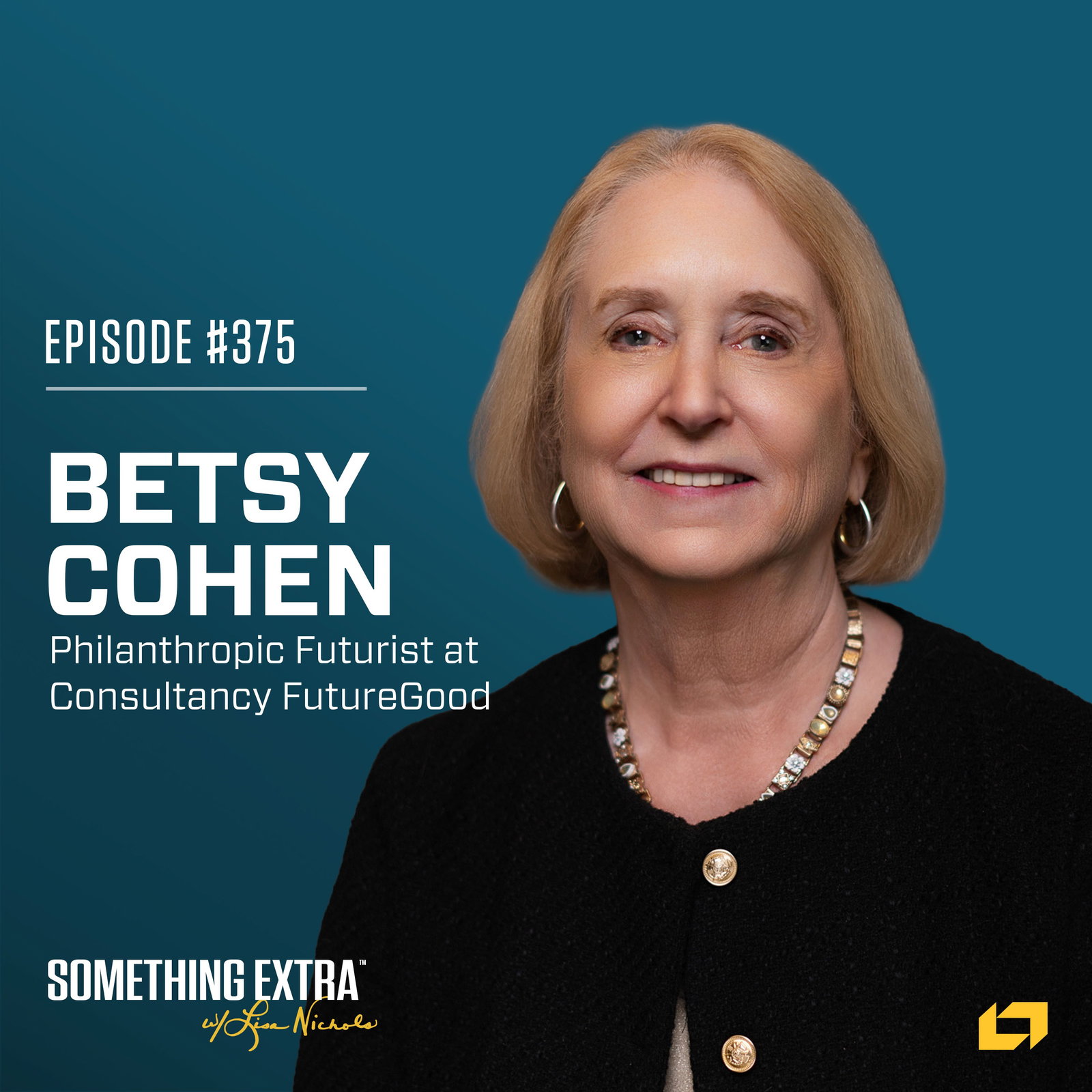
Navigating the Future of Philanthropy w/ Betsy Cohen
Episode Details
Transcript
Explore the transformative power of "wisdom work" with Betsy Cohen, a Philanthropic Futurist at the consultancy Future Good. After a 33 year career at Nestle Purina and over a decade spent building the St. Louis Mosaic Project, Betsy reveals how leaders can transition from achievement-driven success to a legacy of purpose and community connection. This episode dives into the evolving landscape of generational generosity, the impact of AI on nonprofits, and why the most effective leaders prioritize empathy and the "power of one" to create a lasting ripple effect.
Guest Links:
Credits: Host: Lisa Nichols, Executive Producer: Jenny Heal, Marketing Support: Landon Burke and Joe Szynkowski, Podcast Engineer: Portside Media
Betsy Cohen
So the field of futurism is usually in the business and the government arenas where there are people who are futurists. And as a corporate futurist in one of my roles, what your goal is to look ahead to see what is happening in the world, what's happening with business, what's happening with technology, what's happening with the environment, what's happening with new ideas that are coming in the next ten years, and then how do you prepare yourself? What are the scenarios, and how do you maybe put a little bit of money or resources or time into these new ideas that are coming so that you are prepared? Lisa Nichols
It takes something a little more to lead with impact. I'm Lisa Nichols, author of Something Extra, and this podcast was inspired by our daughter, Allie, whose additional chromosome has shaped how I see people in leadership. Each episode features conversations with inspiring leaders from around the world about what truly defines how they lead and serve others. If you enjoyed today's conversation, please consider leaving a five star review. It helps more people discover the show. And if you'd like to go deeper, my book, Something Extra, is available on Amazon and through other major book retailers. I'm thrilled to have Betsy Cohen on the show today. Betsy is a philanthropic futurist at the consultancy, Future Good. Well, Betsy Cohen, I am so delighted that we can make this work today. I just told you, I just I really adore you. I just do. You are just such an amazing human being, and you've accomplished a lot. But more than that, you're just an amazing person and encouraging. And I'm just so excited to have you on the show and get to share you with our listeners. Betsy Cohen
Wonderful. Lisa Nichols
Well, let's talk about this. And so you're not originally from Saint Louis. You're originally from Chicago. Betsy Cohen
I was born in Chicago, but, really, most of my growing up years were in Saint Louis. I moved here when I was in sixth grade, and my family has been here for generations. So I really am from here. Lisa Nichols
Yeah. Well, I know your dad was an executive at Sears, really, so that makes made sense. Right? But you've had multiple careers. You've had multiple you had multiple careers within a career at at, Ralston. You were there for thirty three years. You did a whole lot of stuff. I wanna talk about that a little bit. You know, Mosaic. I mean, now you're doing something totally different. Yo, Betsy, when somebody asks you today, what do you do, Betsy? What do you say? Betsy Cohen
Well, I've always been a connector of new ideas and people and having an impact. And if that was a corporate impact or a nonprofit regional impact or now it's impact with people and their purpose and their money and and how do they translate their lives into purpose. So it's really about those connections and making a difference. Lisa Nichols
Yeah. I would say that that is that's spot on for you, just making a difference. You know, in this current season that you're in, what is bringing you the most joy? Betsy Cohen
The joy comes from hearing what people care about. And I think that that is really so interesting because as each person, talks about what they do or what their foundation does or what their nonprofit does, I get to know more deeply what people care about and then see how that links to other things that are making either our region or our country better and stronger. Certainly, there are many things that are dividing people, But when I hear people talk, I see many more connections and try to build on those positive aspects of the things we all share and not the things that maybe are different in the way we might think. Lisa Nichols
Mhmm. Yeah. No. That's good. Searching for the commonalities rather than just the differences. Right? I love that. Well, you talked a lot about wisdom work, Betsy. You know, how is wisdom work different from achievement driven work that maybe earlier in your career, maybe it was from achievement, now it's wisdom? Betsy Cohen
Yeah. I think that we all have different ways that we want to lead our lives. And one of the things that I learned from my mom, who was pretty much a single working mom for for most of my life, because my dad died when when he was young and we were young, is that, you know, you need to be the CEO of you. And so for me, being the CEO of me meant having financial security for myself and my career. And so certainly I was very devoted to work in the for profit world and being a rising manager and then an executive at Ralston Purina and then Nestle Purina was important because it used my business skills, but it also met my goals for building my financial security and saving money and being able to invest money and build for for the future of myself and for my family. And so to me and often I recommend that people need to have a good understanding of what is at their core and how do they meet their goals. And for me, first, it was to have both work that I cared about, but also to meet all my financial goals. And after doing that, it allowed me to then branch off into work that was more about purpose and impact and community. And that then in turn led me to really now in my third career to say, what are the best things that I do with what I know and what I can give? I'm a fan of Arthur Brooks from strength to strength, who's a Harvard Business School professor and author. And he talks about the fact that as we get older, we have the ability, to certainly earn money if that's important. But in addition to earning money, we have the ability to do work that leverages the mentoring, the wisdom, the knowledge we have, because that's something that we do get as we get older. We don't have as much quick memory that we have when we're younger, but we have crystallized knowledge is what he calls it. And crystallized knowledge is all those connective ideas that we know because our judgment has come together. And those are things that we can leverage and impart, whether it's informal from family members or community members, business members as a mentoring, or if it's work we do, which is what I'm doing now, that I see as wisdom work because I I understand the interplay between business, government, nonprofits, foundations, wealth creators, financial advisors. So I can pull that wisdom together in a way that is unique because I have lived this, and it's something that I do now that someone who is much younger is not going to be ready to do. Mhmm. Lisa Nichols
Well, it's so beautiful, Betsy, because you're exactly right. You know, when we're younger, maybe we have the energy, but we don't have necessarily the wisdom. We may have intelligence, but the wisdom comes over time, right, with experiences that we've had. And, I love that, you know, because I think it's really important to be sharing that wisdom with with the world. I want to go back. You had mentioned your mom. So I know that you lost your dad at age ten, and I wanna say he was something like thirty eight. Yeah. Like, thirties. Right, Betsy? Which had to be so difficult. You know? I'm I'm sure for both you and your mom, and you had two brothers as well. So your mom had a lot lot on her plate there. You know, what did that season teach you about resilience? And you've already said that financial security was, you know, something that you took away from that, right, and a strong work ethic. And I think, if I recall, I think your mom did your mom even go back during that time to get her master's? Betsy Cohen
She did. So, you know, we, moved. We were living in New York for my dad's career. And when he died at thirty eight, my mom folded the tent and moved us to Saint Louis where all her family, all of our cousins and her her parents were. So we moved to Saint Louis, and she really had to reinvent herself and our lives here. And she went back to work being a working mom with, three of us that were ten, eight, and five. And, I really did see her have to pull her strength together to make a life for us, going forward and for her to be the best parent she could be, as one parent and to see how she built that life and was so devoted to what we all had to do together. And I think that that resonated for me with what you talk about with that something extra, because one of the things that I saw with my mom was she was working, but she also really cared about us and she cared about other people. But we had some really significant learnings, which I think is when in that era and sometimes now when someone is, in her case, a single mother, a single woman, people that were married just didn't reach out to her, even people she'd known her whole life. They're just busy. And so and she wasn't married. And so, she was marginalized. And and that was very hard. And so, you know, from that, she cared about others and reached out to others that were single and and found a a network of people. But it really made me aware that, you know, I have an obligation to look out for people that are marginalized. And so in my friend circle, when we get together, we have friends that are divorced or widowed. And it's like, I don't only think about, like, who are the couples? I heard a funny saying once they said, are you coming to dinner or to mate? I mean, in the answer, you're having people to dinner. But, yeah, people only think about couples and they don't think about that person single. Yes. So I'm always reaching out and thinking about who might be, not normally included and whether that's people that are more similar to me or if it's other people in the community or my work with our immigrant community or other parts of our community that are not the same, that have, you know, different abilities, who are differently abled, who are differently brought together here. So I have always felt deeply moved by what I saw her experience, and it really caused me to think about my connections to people differently and to make that one of my personal mantras. Lisa Nichols
Oh, well, I mean, I think our listeners can see why I really like Betsy Cohen. She I mean, that shaped you, Betsy, watching your mom go through that. And, I mean, that's that's why, you know, even today, I mean, I see you reaching out, you know, to to people who, you know, may not have that network or you know? I I just remember recently you and I were on a call, and it was really not at all about you. And you're just like, Lisa, how can I help you? And, you know, that's really rare. It's rare to find people like that, but, definitely a go giver. Well, you know, let's talk about this. So I know that you worked at Rosslyn for thirty three years. You rose through the ranks. You were vice president of many you started at Beck and Decker, but then you, went to Rosslyn. And, you were a business futurist Betsy Cohen
Yes. Lisa Nichols
Even at Rosslyn. So for our listeners that maybe what is a business futurist? Tell us more about that, Betsy. Betsy Cohen
So the field of futurism is usually in the business and the government arenas where there are people who are futurists. And as a corporate futurist in one of my roles, what your goal is to look ahead to see what is happening in the world, what's happening with business, what's happening with technology, what's happening with the environment, what's happening with new ideas that are coming in the next ten years, and then how do you prepare yourself? What are the scenarios? And how do you maybe put a little bit of money or resources or time into these new ideas that are coming so that you are prepared? And that when I was a corporate futurist, I was looking ahead at technology, and, actually, I'm the person that registered Purina dot com, if you can believe that. Oh, that's amazing. I have I have an early note that was written to the leader saying, I'd like to show you the Internet and what this means, and we should register purina dot com. And then I worked later on identifying environmental areas, and then I was asked to lead that when we worked on how do we minimize packaging and lower water, lower energy. So futurists are looking ahead and then bringing that back to what can a government or a business do to be prepared. And so that's something that as I was thinking in the last, you know, two years about what would my next chapter be about, I thought back to that skill set and how much I love my future as work. And I wanted to do something that involved that again Mhmm. As well as my experiences with government and nonprofits. And then I, ran into Trista Harris, who runs FutureGood, who is a philanthropic futurist. And I was like, I wanna be Trista. And so I, you know, sought her out and said, how can I join with you to bring the skills of futurism to foundations, nonprofits and family offices, people who have money? How can I bring these skills like you have done that had previously been in the business government world? And how can I bring those to these other causes and communities that need to have these skills? And that's really how I brought something from my past forward. Lisa Nichols
That is I love that. I love that. Well, I wanna talk a little bit more about that because you've got the future, future good book there, and, we can dig into that. But let's go back, for a minute here because you, you know, after thirty three years, you kinda took that bold pivot, right, and kinda did something a little bit more entrepreneurial, and you were the director for Mosaic for twelve years. You know, so how was that pivot how was that bold entrepreneurial pivot in your life? What narrative did you have to tell yourself? Betsy, was that scary, or were you like, no? I mean, this kinda brings together all the things that you're passionate about and your skills, and I can do Mosaic. And tell our listeners because we have listeners that listen all over the world. Tell them about Mosaic. I know where the name came from, but tell them more about that, and then I've got a lot more questions for you. Betsy Cohen
So as I was leaving my corporate career, I put out in the notice and talking to people that I wanted to do something that had to do with civic leadership or something because I had been on the board of the United Way and the Saint Louis Crisis Nursery. And as I was leaving my corporate career, I was putting out the word and networking saying, what is going on in the region where a leader is needed? And I was very open to working in many different ways, full time, part time, contract. And as it turned out through my networks, I learned that the World Trade Center had done two research studies that showed we needed to attract and retain more work authorized international people in this community, and they needed someone really to market and attract Saint Louis. And for me, in my corporate career, I had worked with many international people and I had mentored many minority and international people, and I had been a marketing expert. So I came forward and said, I think I'm the right person to become the first founding executive director of what was an immigration initiative that we then named the St. Louis Mosaic Project. And so for me, I saw a need in the community that I had a skill set that I could bring forward. I had also been running something called the Pet Lovers Coalition when I had been at Purina as one of the things which was a regional initiative in St. Louis to have fewer unwanted pets and more pets adopted, unless euthanasia, needed. And so I had run a regional initiative, which was a skill set that I would need to do the Mosaic project. I was a marketing person, and I brought that skill set into something new and I could create it. I've always been a visionary. And so I saw an opportunity in the region, and they saw that opportunity in me to have someone who knew a lot of leaders in town, knew a lot of people, had been proven as a regional coalition leader and a marketing leader to bring that skill set to the nonprofit World Trade Center, which is within the Saint Louis Economic Development Partnership, which is actually governmental. So it was a leap of faith on their part and my part, but it ended up being extremely rewarding, successful, and we had a very audacious goal. The goal was for our region to be the fastest growing major metropolitan area for foreign born people. And in twenty twenty four, we hit it. Yeah. And by hitting it, that actually was one of the reasons that made me think about what would be next for me because I had really achieved something that I had set out to do in twenty thirteen. Lisa Nichols
Yeah. Oh, that is so beautiful. Well, and I know it's personal until you do. Right? Betsy, because your family, your ancestors came from Czechoslovakia, I think, like, in eighteen mid eighteen hundreds. Betsy Cohen
Correct. Lisa Nichols
And, and and you saw, you know, what that was like for them to come to a a country and build a new life. Right? So very personal there. You know, what do you think was scarier to be the first woman VP at Nestle or to jump into this entrepreneurial world? Betsy Cohen
I think that, you know, all of us as we move forward, the world keeps evolving and, there always are new challenges. So sometimes you are the first or for you as, you know, a woman founder, CEO, the leader of the organizations that you have chosen to be a leader for that, you know, times change and then you have to put on new skills and then reinvent for the new world that we keep becoming part of. So, each time it's a challenge and you wonder, you know, what will that be like and, you know, can I really do it? I mean, we always have those moments of of doubt. And then you say, well, I'm gonna give it my best, and Yes. I'm gonna work with other people. And we'll have a team of us that are official and unofficial, and we will figure it out. And so you you just keep moving forward. And I I know that that's something that you have done, which is why so many people watch you and admire you and you're a role model because they see that you keep taking on new things, whether it's your business world, your community work, writing a book. And again, I wrote a book doing a TED talk, which I did that, you know, when you challenge yourself and that inspires other people to challenge themselves and you can mentor them and other people have mentored me. Lisa Nichols
Right. For sure. Well and, Betsy, I think too, once you do a few of these things, and I always say you you'll do it and you'll be like, okay. I did not die. I did not die doing this. It gives you the confidence, right, to and the courage, I think, to go try something else. So you know? But don't make no mistake. I mean, I'm sure Betsy's had times in her life where you're I know I have, where I've said, I don't know if I can do this or not. You know? What if I can't? You know, when we started our podcast in twenty eighteen, none of us knew what we were doing, seriously, but we just jumped in there. And, again, surrounded by really smart people like Jenny and, you know, our editor and, you know, people like that, it's like, no. We'll figure it out together. And, you know, so, yeah, don't be don't be afraid to live in the land of the uncomfortable. And I've got a good friend, Dan Roberts, who says, you know, growth never happens there. It never happens in the land of the comfortable. Right? So Betsy Cohen
Yes. And I also think that, you know, we other people really don't think about us like we think, oh, what are people gonna think? And the answer is they don't. Everyone is absorbed in their own worlds. And so, you know, if you take a risk or a chance, if it works out, that's great. And if you pivot and it doesn't exactly work out the way you thought it would, that's okay. You dust yourself off and you find the next path, and the rest of the world keeps going. And, everyone's trying to find their way with lots of unknowns. Lisa Nichols
That's so true. That is so true. And listen, I always say in technology too, without experiment, you're gonna fail, fail forward. When you fail, learn something from it, pick yourself up, and keep going. Right? So, I think anybody that you would talk to would say, hey. I've had a lot of those times in my life. You know, I used to tell when I taught JA junior achievement because I sat on that board for many years and loved teaching, junior achievement. But the whole story about Walt Disney, you know, when he had this idea, this harebrained idea for an amusement park, I think he went to five hundred over five hundred banks, Betsy, before he found a bank that said, okay. Yeah. I'll give you the capital to start this. Right? Can you imagine if he'd stopped at four hundred and ninety nine? We wouldn't have Disney World. Right? So, I mean, just do it afraid. Do it afraid. Well, now you like to say that time is precious, and it is you know, how did that awareness change the way you make decisions? When we think time is precious, time is you know? I mean, there's a limited amount of it. Right? How does that change how we make decisions? Betsy Cohen
I think being mindful of what your values are and what are the things that you want to be accountable for to yourself and to your family and to those close to you. I make a list every year, like for twenty twenty six. I have twenty six things, large and small, from personal health to time spent with family, friends, trips, community. And so, you know, I look at my list of things that I want to do, which are, you know, it's not the biggest buckets, but there's a number of things that I want to make sure I do that I focus on. So I remind myself one of them has to do with, you know, I have several friends that are facing some personal challenges and they're listed there is, you know, I want to make sure that I, you know, pay attention to them. Lisa Nichols
I don't Betsy Cohen
let that fall by the wayside. So, I try to think and be thoughtful about the way I spend my time for my work, for my family, for my friends, for the community. And, don't let it escape. I you know, I'm really mindful about it because, you know, I don't want to have regrets where I say to myself, oh, I wish I had focused on something different. But, I feel and partly, you know, when you, you know, lose your father very young, it makes you very aware that time is a gift and you wanna use it wisely. So I think about that a lot. Lisa Nichols
Yeah. Yeah. I was gonna ask you that. So thank you for bringing that up. That was one of my questions for you. I love this idea that you you work on your life plan every year. And you said you don't put it in a drawer. You keep it right there next to you, and you you review it. Right? Betsy Cohen
Yeah. Yeah. Lisa Nichols
There's such intentionality there, Betsy, living with intentionality. Because here's the thing. You know, if you don't if you're not intentional about that, it's kinda like what you said. Things are just gonna fall by the wayside. You don't wanna be on autopilot. You don't wanna be you want to be intentional. And and, obviously, sometimes, maybe the things that we put down don't happen because there's extenuating circumstances and things that come in our life that we can't control. Right? Maybe like a a sick loved one or something like that. But at least you have been intentional, you know, in in the beginning, I'm sure some of those things you're gonna be able to accomplish. So I love that. I'm so glad, to know that you do that. Well, we do need to take a quick break, and we'll be right back with Betsy Cohen on Something Extra podcast. AD
In business, the tendency is to seek out partners who are bigger, faster, stronger. When it comes to IT, you should be looking for smarter, faster, better. That's just what you'll find with the talented technologists at Technology Partners. Our experts develop custom solutions to tackle your most complex challenges, all to simplify your processes in the smartest, most efficient way possible. The time to be swift and nimble starts now. Go to technology partners dot net slash solutions and see what's possible. Lisa Nichols
Alright. Welcome back, everyone, to the Something Extra podcast with my friend, Betsy Cohen. So, Betsy, you you kinda talked to us a little bit. You left at Mosaic. You were there for twelve years, did incredible work. But in twenty twenty five, you became a philanthropic futurist, and you've been doing this since, March of twenty twenty five. You're the second in the country. Right? Trista is the first, and Betsy's the second. So tell our listeners about, what a philanthropic futurist, what do you do, and tell us more about future of good. You've got or future, future good. You've got the book behind you. I wanna hear more about that. And then we've got a lot more questions. Betsy Cohen
So as a philanthropic futurist, I work with visionary leaders of nonprofits and foundations, family offices, and financial advisors about several different issues. One is visioning for their strategic plans and having really a long term vision of where are they going? And then what does that mean in terms of an operating plan for the next three years? We do scenario planning, thinking about what are several of the possible scenarios that a foundation and their grantees or a nonprofit is going to be facing? And then how do they prepare themselves for a different future so they can continue to serve the people that they serve going forward? Another part of that is being hired to speak on the future of philanthropy. What is happening with people who have money and what they're giving to and why are they giving and how are they giving? Are they using technology now to do their giving? Are they doing more online? Are they doing more with certain kinds of vehicles for their financial future? But also, if you're a nonprofit or a foundation, what does that mean in terms of how are you receiving money? How are you deploying your money? What are those future trends? So, for example, as technology changes, what does that mean for nonprofits? What does it mean for foundations? How are they going to have to change their operations and maybe even change their staffing? What is AI going to mean as they incorporate this into areas such as developing grants, evaluating grants, applying for grants, spending the money for grants? So we bring forward what are these trends in the future? And then what is that going to mean today for how an organization is going to operate. The other thing is working with the financial advising firms. Many of them understand that they have wealthy clients. Some of them who may or may not be really understanding fully how they could have both pleasure and impact if they give more of their money to nonprofits or universities or other charities that they believe in. Sometimes they just aren't, as thoughtful as they might be if they had some more education or motivation or conversations about how they could do that, both for tax benefit and then for the emotional and the dopamine pleasure of actually giving to causes that they care about. Lisa Nichols
Mhmm. Oh, that's so good. Now what what are some of the trends that you're seeing? I mean, you already mentioned AI definitely with technology, but, you know, I mean, hey. You've been studying this. You've been doing this. I mean, are there trends that you're seeing? And then also, like yeah. Betsy, how do you think about generational generosity? Betsy Cohen
Yeah. So there is a shift of generational generosity as we look toward, those that are more mature, and the kinds of areas that they have traditionally given to. Bank of America has done a big study, and some of the information talks about the fact that the older generation has tended to favor, giving their money to, larger institutions, faith based universities, culture, some of the environmental larger traditional recipients, Younger donors that are kind of the under forty five year old donors, they really view it differently. They are looking at more of sustainability, sometimes social justice. They're looking at the world differently. They often maybe give to global issues for women. They're looking at giving money toward digital equity, digital access. They also the, under fifty year old donors, they're more likely now leaning toward donor advised funds that they can give money to and then designate it later. They wanna volunteer first often before they give money. They wanna give money with their friends, and they're more likely to do, a trivia night or a group activity where they give money toward something they care about and they're less likely to go to galas. They want smaller projects that they can see more impact. They want scoreboards and scorecards and dashboards. And then the older generation is more trusting and will give to a bigger legacy organization. So having conversations with organizations about how do you lean into these trends is something important. And foundations have a lot to do with that too, because they are looking now some of them are doing what's called trust based philanthropy where they're trusting more in the leaders of the nonprofits that they give to. And so they're requiring less, reporting, let's say, because reporting takes a lot of time and energy. They're all considering multiyear gifts to these organizations because if you start giving a one year gift and then immediately they've gotta reapply again and they don't even have results. So there are these trends that foundations and family offices and donors are considering, And it's important to think about the trends and whether they are something that can impact how both the recipients and the donors think about their generosity going forward and the kind of impact they wanna make. Lisa Nichols
Mhmm. Yeah. No. That's that's good. It's it's important for us to understand on both sides, right, kind of what those trends are. You know, is there a weak signal that you are seeing at all that leaders are ignoring, that we shouldn't be ignoring and giving? Betsy Cohen
No. I don't think there's a weak signal. I I think that a lot of people have the means to do more, but they get busy with everything else. And so they just don't take the moments they could or they keep giving to the groups they give to, and they don't think about how they could maybe add a few other maybe smaller organizations where their money would make a huge impact. Yeah. And they might have more personal pride and feeling of connection if they added to their current giving with some maybe local smaller organizations where it would make a world of difference to, have that impact. So I think it's just encouraging people to, be more thoughtful and understand. The needs are so great and are you know, there's a lot of needs. There's a lot of, uncertainty right now by some of the traditional funders, governmental and others. So, if you care about an issue, think about how you could continue to do maybe a little bit more than you did in the past. Often, people's portfolios have grown greatly over the last few years, but maybe their giving hasn't kept up. Lisa Nichols
Mhmm. Yeah. That's those are really good points. You know, to your it just reminded me, Betsy. So we have our corporate social responsibility program. It's called LIFT. I'm kind of a big acronym person. I love acronyms, and it stands for Lives Impacted Futures Transformed. And I can remember, a few years ago, there was an amazing organization that was serving children in undeserved areas. So, like, because their parents, a lot of times, would have two and three jobs. And it was, you know, this this this school basically would stay open, like, from six AM to midnight. And think about it. Right? You know, when, when somebody's working two shifts, they what do you do? Right? When that second shift starts. And so, anyway, we just we love the the the founders and the leaders of this and just love their mission. And we gave a little gift, a little gift, and I just remember them coming back to us later and saying how meaningful that little gift was to them. Because if it had not have been if we had not given that gift, they would not have been able to keep the lights on. Betsy Cohen
Yes. You know, large organizations are extremely important Yeah. For the communities. But for a small organization, it can mean all the difference in the world and your personal gift and personal connection to that can be even more meaningful. But it doesn't mean that there's any less need for the large legacy institutions. They certainly, are so worthy and need the continued support as well. And that's critical as they keep finding ways to show their impact as well. But you're right. When you get touched, when your heart is touched by a certain need, or a certain organization or a leader that you really feel inspired by, it's such a gift to be able to give a gift and help them be successful because, you know, your job is to do the things you do. But when you give money, it allows others to do things that we are not equipped to do, but they can do. Lisa Nichols
For sure. Absolutely. And that is a reason Greg and I have always said if we can just you know, we work to do better as a company. Right? Because the better we do as a company, the more we're able to help. Right? So, it all works together. It's all all the different components are really important. So, you know, let me ask you this, and I I could I could put I don't wanna put words in your mouth. I can just surmise what you're gonna say, though. When you were working with, Mosaic, in Mosaic can you just tell our listeners real quickly? Because you guys really went through and said, you know, you're very intentional about naming it Mosaic. And I've Betsy had mentioned earlier that she's done a TEDx talk. I would highly encourage you to go Google that. Go watch her, because I remember you explaining it and having the beautiful mosaic. But tell a little bit about where that name came from, and then I've got another question for you about your work in a mosaic. Betsy Cohen
Well, what was important for the community as we look to be a more welcoming, attractive place so that we could encourage and attract more international people to come here, I wanted to find a word or a concept as a marketing person that was welcoming and something that is listed as an immigrant initiative makes it sound like it's about other people, but not about you or me. And we actually did a brainstorming session, Kitty Radcliffe, who was handy heading up explore Saint Louis.Roslyn, who was the head of the International Institute, and we were looking at the research, and we were actually sitting under a poster of the new cathedral, and it has these beautiful mosaics. And so the word mosaic came up in our discussion and we said Saint Louis Mosaic Project that that has a nice ring to it because a mosaic is a beautiful, colorful combination for all of us and that we all make up a mosaic. And that is something. And for me as a marketing person, a mosaic is a welcoming, positive word that would be inspiring because mosaic is something that's positive. And, you know, for the Saint Louis Mosaic Project, when we are working with international students, corporations like Bayer and Nestle that are bringing international people here, international institute that is bringing, legally authorized refugees from around the world, all the groups, families that are reuniting. We wanted to be welcoming. And so the Saint Louis Mosaic Project had a nice ring to it. And so we felt inspired by that language. And that's why we called it that. And I think it was also a way I wanted to make sure that we had a name that when we were highlighted in news articles around the country and around the world, it would be very clear it was our work and not just kind of vague words. But if it's that St Louis Mosaic and Mosaic Project, we knew that was us. Lisa Nichols
Sure. Well and, Betsy, as you're talking, I'm just thinking that those end I've done a mosaic. I've done a couple mosaics before, and put them together. And you've got those individual pieces, But when all those individual pieces are put together, it makes a beautiful picture, a more beautiful picture. Right? Maybe that individual piece is beautiful in and of itself, but, boy, when you put the whole thing together, you know, that's when it really, takes on a whole new life. Right? So I just love that. Well, I mean, you your work there, I mean, how do you really what do you really teach you, Betsy, about the word belonging? Because we we love that word. Betsy Cohen
Yeah. Belonging is so important. And I think the programs that we created, we had programs for helping international students connect with employers for their visas. We have programs that are for work authorized international people to connect with people in similar work fields in this city, in this region to network toward jobs. We had programs so immigrant entrepreneurs could have more support for their businesses. So but in each case, when someone who is international connects with local people who have expertise, they also form a personal connection. And that's where that belonging piece because no longer is it a matter of you or the other, but we are in something together. And even, for example, when I would, you know, refer someone to technology partners, it's someone who had work authorization, had technical skills, and we just wanna start having people feel they're connecting to their own people and that we as a region have a lot of resources and people who care. Lisa Nichols
Mhmm. Yeah. That's so beautiful. We've already talked a little bit about this, but I just I wanna drive this home, a little bit more, on this. But you're really known, and if people and we've already talked about it, but you're a very authentic person. I call you what's called a go giver. You give first without expecting anything. You know, showing up as your authentic self. What do you what do you believe, Betsy, that's showing up? What is showing up? Or, you know, the vernacular I use a lot is I'm for you, f o r u. What does that really mean to you? Betsy Cohen
I think that's a great concept, Lisa. And I think, you know, right now, technology can make it easy for people to connect, but in some ways, it can be distant versus being in person. Lisa Nichols
Yes. Betsy Cohen
And, you know, ideally, we have both in person and virtual ways that we can be there for each other. I think it involves listening and seeing and hearing where someone really is in their life and in their journey and being thoughtful about what does someone need. Do they need empathy? Do they need a connection? Do they need a follow-up call? And listening clearly so you can follow-up in the way that is most meaningful for somebody else. Not not what I need, but what do they need and when do they need it? And and how can I make a note on my calendar so that I can do that? Write a card, make a call, send an email, follow-up. But it's being focused on the other in a way that is, truthful and genuine because I do care. Lisa Nichols
Right. Betsy Cohen
Right. Care. Many people care. And I think when we all feel that there are others out there, we don't feel alone and, you know, we know that physical health and now more than ever, mental health, behavioral health is so important that we all feel connected and feel that there are people who care about our well-being. And that's just it it can only happen with a personal connection. Lisa Nichols
Mhmm. Yeah. I mean, you just you just reminded me, Betsy, a couple things. One is in your TED Talk, you talk about the starfish story. You know? So we may have listeners that are sitting there and thinking, well, yeah, I don't even know how to help. Right? But I think we all have the ability to do something. Like you said, send a card, send a text. You know? I'm thinking about you. I know that you're whatever it is. You've got this big, issue at work right now. Just telling you that I'm thinking about you. If you wanna bounce anything off. I mean, can you imagine, Betsy, how much better the world would be if we would each just do a little bit? I mean, it's you know, do a little bit. But the starfish story that you told, I love I've heard that story before, and I love that story. You know? Because the the guy was standing there throwing them back in. Right? And then somebody said, what are you doing? You can't help all these starfish. And he said, well, it's gonna help the one that that I threw back in. Right? So, Betsy Cohen
I think the power of one is really important. And it's a word. It's a text. It's an arm on someone's shoulder, that when you reach out to one person, it makes a difference. And I think we can often be overwhelmed by the global issues, national issues, the things that are all so big. But I think, I'm a fan of Stephen Covey and seven and eight Habits of Highly Effective People. And one of the really important concepts is the the beginning, which is, you know, what is my circle that I can make a difference? And then, you know, you can have a circle of concern beyond that. But, you know, what can I control? And whenever I feel overwhelmed, I go back down to what is in my circle of control. Mhmm. I go back to what can I control then that grounds me? And, yes, maybe I have a little more circle of influence. But when there's things that are beyond that, some days I just have to bring myself back down to what is very basic with what I can control with what I do, what I say, who I interact with, what can I do for myself, what can I do for for one other person? Yeah. But go back down what's in your control, what's in my control, and make that one gesture. Lisa Nichols
Yeah. So good. That is just gold. That's gold. Well, I have to ask you this, Betsy. The common three line is what is the something extra that you believe every leader needs? Betsy Cohen
I think every leader leader needs to be caring. I think they need to be caring for the people that they have the responsibility, for supervising, working with, leading, and as colleagues. And so I think if there's empathy and care, you can have a core connection. And through that, you will have wonderful results for the goals that you are working on together. Lisa Nichols
Mhmm. I love that. And you know what? Here's the other thing is there's there's always a multiplication factor, isn't there, Betsy? You know, and a a ripple effect because you affect one, and then what if that one gets inspired to go affect another? I mean, there truly is a multiplication factor there. So I just love that, and I completely one hundred percent agree with you. And so I just wanna say thank you for showing up for me today and for our listeners and being for for us and just sharing all your amazing wisdom. I really, really appreciate it. Betsy Cohen
Thank you, Lisa. This has been a wonderful opportunity to, share our thoughts together, and I'm very appreciative. Announcer
Something extra with Lisa Nichols is a Technology Partners production. Copyright Technology Partners Inc twenty nineteen. To learn more about this week's guest, check out the show notes at tpi dot co slash podcast. If you enjoyed this episode, consider leaving us a review. Thank you for listening to Something Extra.