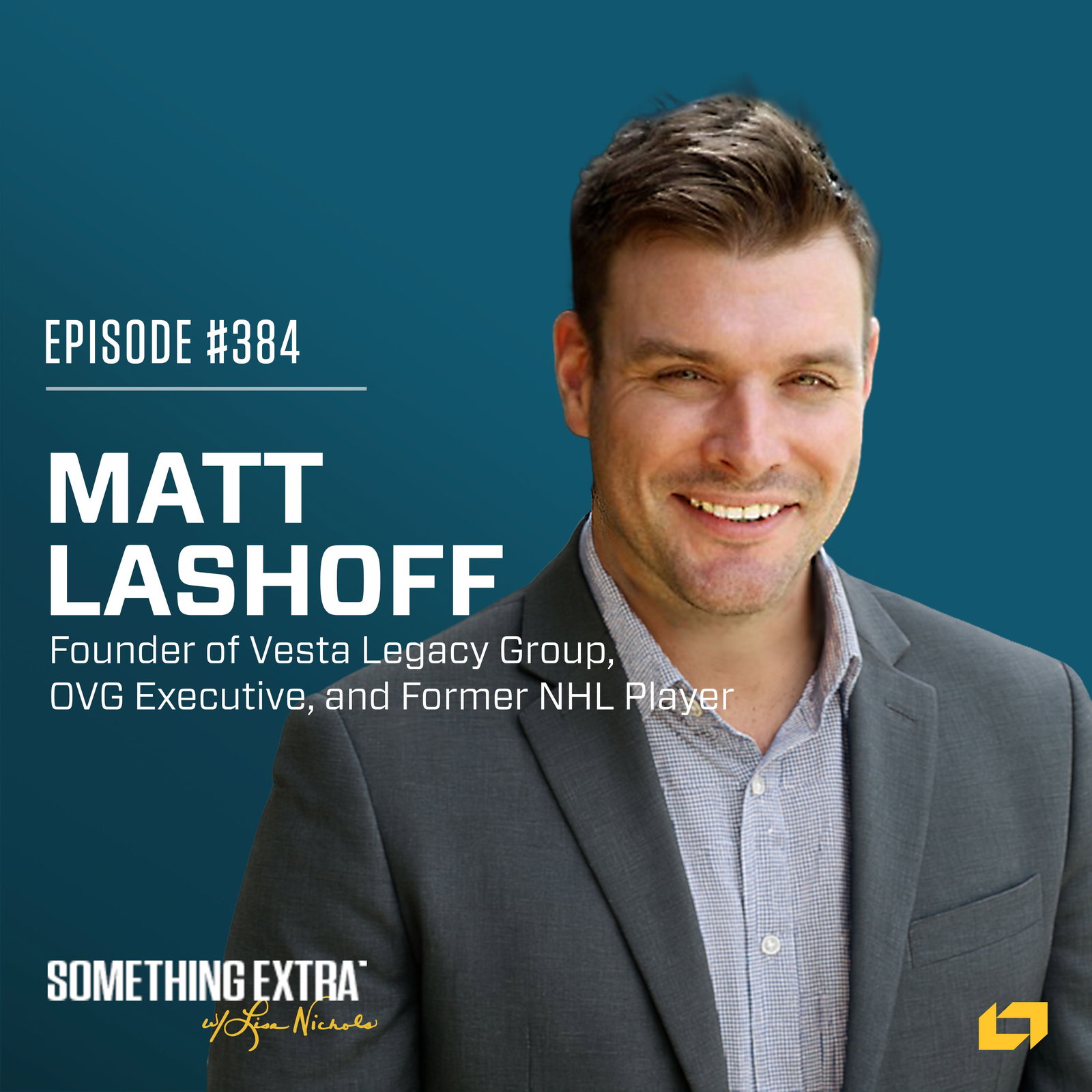
Matt Lashoff
For me, I think leaving the game and being involved in the game, the the short answer is it's taught me everything. I think, you know, how to how to work in a locker room, how to be a brother, how to be a father, how to be a teammate, how to be, you know, have somebody's back, all of the things that kinda come with that. First and foremost, you learn how to handle adversity and you learn how to be a teammate through that adversity, which I think is, you know, first and foremost, a tran very transferable skill as you continue to move on with things throughout the rest of your life. Lisa Nichols
It takes something a little more to lead with impact. I'm Lisa Nichols, author of Something Extra, and this podcast was inspired by our daughter, Allie, whose additional chromosome has shaped how I see people in leadership. Each episode features conversations with inspiring leaders from around the world about what truly defines how they lead and serve others. If you enjoyed today's conversation, please consider leaving a five star review. It helps more people discover the show. And if you'd like to go deeper, my book, Something Extra, is available on Amazon and through other major book retailers. Today, we are joined by Matt Lashoff, a former NHL defenseman who successfully bridged the gap between elite athletics and global sports business. Matt is also a musician and has released two albums. Today, he serves as a strategic leader with Oakview Group and the founder of Vesta Legacy Group, where he leverages his unique background in artistry and grit to develop world class sports facilities and legacy driven business ventures. Matt currently lives in Saint Louis with his wife, Kristen, and three children. Well, Matt Lashoff, welcome to the Something Extra podcast. I am so delighted that we can make this work today. Matt Lashoff
Oh, same here. Thank you so much for having me. Lisa Nichols
Oh my goodness. We're gonna have fun. We're gonna have fun. I love to tell our listeners how I meet my guests. They're always like, how do you meet these people? And I have to just give a shout out to our mutual friends, Matt and Maria Granados. Mhmm. Matt Lashoff
Yes. They're the best. They are the the ultra connectors and, obviously, faith based amazing people that we have in our lives. We're lucky enough to call them friends and, you know, obviously involved in a lot of different things going on in our lives with them and their families and and so fortunate to call them friends. So they're amazing, obviously. They always do this. They always they always make clash of worlds, which is awesome. Lisa Nichols
I I agree. No. I just I love them. They are just I tell people all the time, they're the real deal. Lisa Nichols
They really are. And so, we love you guys. And then, Matt, it's really funny because you and I have found other connections. So Jenny Hill, whom you've met, who is my I call her my second brain. Everybody needs a second brain. She's like, Lisa, I worked with Matt's wife, Kristen, at stages, and then we just hired another one of your friends in technology partners. So it's just it's so cool, isn't it, how Lisa Nichols
People are interrelated and interlaced. It's just yeah. I think it's beautiful, honestly. Matt Lashoff
It it absolutely is. I mean, I I think we live in a special community here in Saint Louis. And, you know, me being an outsider and coming into it, it's been a unique experience just to kind of, you know, embed myself in and see, like, past lives start to to clash, in me from a sports angle and then outside of it and whatnot. It's been an amazing experience and, definitely a special place and special people for sure. Lisa Nichols
I agree. I mean, Greg and I are originally from Kentucky. We were born and raised in Kentucky and were moved here, recruited here by McDonnell Douglas forty two years ago. And, Matt, it was funny because when we when we came to Saint Louis, we said, oh, we'll probably be here for two or three years and then move somewhere else. And, obviously, that has not happened because it is. I mean, I think it's, just a really welcoming welcoming community. But to your point, you did not grow up here. Lisa Nichols
You grew up in East Greenbush, New York. Matt Lashoff
Yes. I did. Little farm town outside of Albany, Upstate New York, nowhere connected to the city. I always have to kind of originate my, myself when we're talking about where East Greenbush is. But, yeah, a little small town, Upstate New York. You know, I had an amazing upbringing just outside all the time. You know, it was easy to play hockey up there because it was a lot of snow and a lot of ice and a lot of cold, but an amazing environment, very small community, you know, very rural environment. Lots of fun. Lots of fun. Lisa Nichols
Well, I know that, your mom and dad were very instrumental. And in fact, you know, we're gonna talk about this, but you were an NHL you know, you were a hockey player, NHL hockey player. We're gonna talk more about that. But I loved reading this about you, Matt, that your dad built an ice rink in the backyard. Matt Lashoff
Yes. Yeah. It's great. You know what? I'm trying to carry on the same tradition here in Saint Louis. It's a little more difficult with the weather, but it was amazing up there. I mean, my parents, you know, were so instrumental just in in giving and allowing us to do whatever we wanted. My brother and I have got one other sibling and who is is lucky enough to play professional hockey as well, and and I think it all originated with exactly what you just mentioned. You know, my dad being crazy enough to to throw some water on, in the backyard and letting us just go, and we had access to all these different sports and for some crazy reason, just started to gravitate towards hockey. But, yeah, we're trying to carry on the tradition as much as we can here with the weather, but we've got the rink up in the backyard in in the wintertime, and it doubles as a sport court, shooting session, yoga studio, basketball court, and everything else in the wintertime or in the summertime. So it's quite fun. Yeah. Lisa Nichols
But you know what? To your point and then your dad, and I love this about you. And this is something I did not know. And even, like, Derek that had, that we just hired, he's like, oh, yeah. He's a musician. He's a you know? So I've listened to some of your music. But the cool thing about it is, Matt, your dad your dad was a musician. And you said that you were around all these instruments all the time. You know what? It just makes me think, though, sometimes imagine if you had not had that access. Matt Lashoff
Yeah. I I feel a hundred percent. I, you know, I I think the other thing too with just our upbringing and our parents, the way that they they, taught us and allowed us to grow and expand was we were never really we were we had access to everything and we were open to everything, but we weren't really gravitated or pushed in any area. Right? So it was ours to explore every one of these things. You know, we had a very kind of, foundational artistic element in my household to your point with my dad being a musician, my mom having a very creative side. The sports was huge as well. And my dad played, you know, baseball at a very high level. My mom was always very athletic as well. They were not hockey people, not hockey players. There's no hockey in their background. But we were just in an environment growing up where, you know, like I said, it was very rural. There wasn't much to do. And we had access to, you know, everything from a sporting perspective, and an artistic and music perspective, and we were supported very heavily in that nature. Like you said, my my dad was a musician. He played in, you know, garage bands and bar bands for a very long time, so I was around that from the beginning, you know, sitting on amplifiers and CDL bars and watching my dad play late late late into the night. But it was amazing. It was an and and it grew to be an awesome outlet for me, through my entire life, right, just from a a writing and a creative outlet perspective and then, obviously, an outlet away from what ultimately ended up becoming my day job for a little bit, which was professional sports. So, yeah, an amazing environment and upbringing just to have access and just to be, you know, allowed to to grow in these lanes that we ended up gravitating towards. Lisa Nichols
Mhmm. Well and we're gonna talk about that. But I know you're really involved in the community and mentoring and that sort of thing, Matt. And, you know, it does make me just thank goodness, you know, more children need access. Mhmm. It's access. Right? Because you don't know what could be unlocked in them if they have the access to, you know, all of these things. But I I love that. So, you know, you left home at the age of fourteen. Woah. To pursue hockey. I mean, what what kind of things did that do internally for you? I mean, were you do you think you were mentally and emotionally prepared to leave home at the age of fourteen? Matt Lashoff
Absolutely not. No. I think I'm still, I'm still, getting over some of those things. But I'll tell you what, it it it again, just the supportive environment that I was around, I think, gives you and gives kids the confidence that anything is is allowed and able to be accomplished. Mhmm. If I had right? And so I think at the the time, I I do remember it, and we're reliving this right now with my own son who's about to take his journey on to the next stage of hockey around a similar age. And I think the biggest thing that that my wife and I have always talked about is, you know, you have to allow them to have the confidence to feel that they can do this. And there's going to be challenges and things are gonna be hard, but if the support's cast and the support system is there, then you truly believe that you always have the the bedrock to be able to continue to fail forward and to continue to grow, then you've got the resources and the protection there. And that was me. It was not easy. But I knew my parents and my family and my brother, were there. And it allowed and gave me the confidence to even feel I was ready to step into that. The false the false sense of security that was definitely there, which I think is, you know, that's part of the upbringing. Right? It's part of the process, which is great. Lisa Nichols
Is this Ryder? Matt Lashoff
This is Ryder. Yeah. Lisa Nichols
This is Ryder that's getting ready to take his journey. Oh my goodness. Well, let's talk about this, Matt, because in a similar vein, I'm really I can identify. I I grew up doing music my whole entire life and, you know, excelling in, academics. Right? Talk about this a little bit where performance and what you do sometimes can become your identity. Did you struggle with it at all? Did you struggle at all with this performance? I'm worthy if I perform correctly. I mean, talk about this a little bit. Matt Lashoff
Yeah. A hundred percent. I think, you know, it's it's super interesting, I think, going through it now as a parent, and seeing it from fifty thousand feet a little from a little different landscape and, you know, you realize how much you learned. And I I joke with a bunch of the players, that I talked to, former teammates and whatnot now. I'm like I'm like, if you if we could only zoom out in the middle of all of this, I think all of the chaos and the stress and some of the pressure that we end up putting on ourselves would, you know, be viewed in a very different light. But, to your point, I think any athlete at a certain stage of their growth within that sport, reaches a precipice of when, your performance is very tied to how you're feeling on a day to day basis. It's not or at least it should not be, and I think is a problem in youth sports now today is it should never touch even remotely close, to that when you are growing up and playing these sports. And and truly, the goal is that it never gets to that level even when you're playing professional because, and getting paid for it because, you know, then you're playing free and you're playing for the passion of the game and you're you're allowing things, you know, to ultimately, you know, transpire the way that they need to. But naturally, there's different pressures that get put on it and, you know, you're in an environment that is, you know, constantly judged from every different angle and and and every different way, shape, or form. And and those pressures and that stress end up falling on you and and and really the the most detrimental piece of it, and I think any athlete is is ultimately always been there, is predicating your performance on who you are as a person. And and I the goal is is how fast can you get out of that? Then how do you accomplish being able to get to the other side of that, you know, that that mountain, if you will. So, it's a struggle with every athlete, I would say, in in in every, you know, high performer ultimately, right, is is how do you battle that, you know, mentality of what does your performance mean and how do you ultimately accomplish the goals that you're trying to accomplish. Lisa Nichols
Yeah. No. I cannot agree more. And to your point, it's not just athletes. Lisa Nichols
Any high performer, it's like, oh, this is who I am. Well, no. This is what you do. Right. But it's not necessarily who you are. And, so, you know, I I don't think people probably most people don't really understand, like, at your level. I mean, I think you were you were first round, draft pick by the Boston Bruins, and this is about, what, two thousand five, two thousand six, something like that, Matt. Lisa Nichols
You know? I mean, that tell me about that moment. Tell me about that moment when you were, you know, when you found out that you were drafted. I mean, how how did you feel inside? Matt Lashoff
I I mean, it was surreal. You know? For real? Yeah. I mean, I think, you know, I grew up in a very, different place than than a lot of, hockey players do. Not a lot came out of that area is what I mean by that. We didn't have a whole lot to, rationalize what that meant. The only connectivity that I had to professional sports was the TV. And, you know, at the time, you could only get regional games and, obviously, you know, hockey started to get a little bit more national at the time through ESPN and whatnot. But that was that was all I had to be able to to to connect to the sport that I was so passionate about. So when you ultimately end up getting to the level of what has been on your wall for the entire time and that has been kind of glorified. Yes. You know, I had been to one NHL arena, up until the point that I was drafted. Like, there was no Wow. Kind of place that I was there other than these things that had kinda brought me there in the very, you know, near term from from the draft and when I was getting older. But so when it happened, it was very surreal. And and it and I think it took me a little bit to to figure out, that these guys were just people just like I was. Right? It's more patient, I think, and, like, a pedestal that some of it was put on in the beginning because you're like, I I had never seen it. And, ultimately, then you're there. You're in the same buildings. You're around the same people that you had kinda modeled after. You know, and it's so different now watching my kids go through it. There's so much access. There's so much visibility. There's so much more touch points that all of the people in general, not only just players have to professional athletes, and it was much different. And I can, you know, I can remember cutting things out of magazines and watching things on VHS tapes and trying as much as I could to watch and get access just because it was a passion of mine. But now it's so different. It's like these guys, we see people on the street that, you know, play sports or, you know, they look up to, and it's very easy. They're like, hey. How you doing? I feel like I know you already. Right? Because of so many of these things, which is an amazing thing. It was very different. So it was a very surreal moment, when it all ultimately went down from the draft and then, you know, ultimately, that's where the work starts. You know?
Lisa Nichols
Yeah. For sure. Okay. So I I listen. You're a first for me to have an NHL player on my podcast. I've had professional baseball players. I've had musicians. I've not had a player. But I have to ask you this, and I know, you know, I mean, I could surmise all sorts of things, but I'd love to hear it from you. What did hockey teach you about discipline and the character that you are even implementing today and what you're doing with Vesta and Haute View and you know? You've you've you're on an entrepreneurial journey now. You know, I'm thinking, my gosh. Matt, you're, like, NHL, musician. You've got albums out. You're you're an entrepreneur. I mean, you're that's that's really cool. I mean, you're kind of a triple threat. But, you know, what did what did it teach you? Like, learning hockey and and playing at that level.
Matt Lashoff
You know what? I think that the simplest thing, and this maybe the simplest way to put it, is is I think you learn through hockey to to execute and to continue to move forward when things are at their most inconvenient times. Mhmm. You know, first and foremost, to learn to skate is one of the most nonrational things anyone can ever do. And when you learn it in the beginning, no matter who you are, you fail immediately. Everyone fails immediately when they start to learn how to skate. So it becomes, this mental callus, I believe, that is built at a very young age, which is why I'm such a big proponent of hockey just in general for all kids to learn. Right? I think there's two things that I always talk about with young kids. It's, you know, play hockey and learn to do it, learn to skate, learn to get on the ice because you build this mental callous and then do gymnastics because you learn how to move your body. So I tell all these guys, all these kids these things just in general because I think it builds the bedrock of, your ability to handle and push through adversity and be resilient at a very young age. And you can start it when you're at a later age or whatnot, but that is what you start with from a hockey perspective. And I think our sport and any sport for that matter, and now kinda transversely what I'm doing now, you you learn to live in a comfortable place when things are are at their most chaotic. Nothing is easy from a sporting perspective in hockey, from a training perspective and or otherwise, and it really kinda sets you up, I think, for, or it set me up from from a learning development perspective on how to handle adversity at their highest moments and at its highest levels. Right? So, for me, I think leaving the game and being involved in the game, the the short answer is it's taught me everything. I think, you know, how to how to live in a locker room, how to be a brother, how to be a father, how to be a teammate, how to be, you know, have somebody's back, all of the things that kinda come with that. First and foremost, you learn how to handle adversity, and you learn how to be a teammate through that adversity, which I think is, you know, first and foremost a very transferable skill as you continue to move on with things throughout the rest of your life.
Lisa Nichols
Exactly. Well, it's resilience. That's the word that just keeps popping in my mind, you know, because and, you know, Matt, here's the thing. You know, that old adage that says you're terrible Arab thing until you're not.
Matt Lashoff
Right. Right.
Lisa Nichols
You know, I think sometimes people look at people that have accomplished a lot and go, wow. Look at that. But you know what I talk about? I talk about the iceberg. Yeah. Only ten percent of the iceberg is above the water level. Right? The other ninety percent. And so people don't see that piece. But, yeah, you're terrible until you're not. I'll tell you a funny story. So I did ballet and dance my whole entire life. Like, I started when I was four all the way through high school. And we in Kentucky, we did not have where I grew up, we didn't have an ice rink.
Lisa Nichols
But our I was I told you I was very involved in music. And so our choir got invited to, I can't even remember now, but some sort of performance in Chicago.
Lisa Nichols
So our choral director's like, I'm gonna take everybody. You guys all ice skating. And it was so funny, Matt, because I had all my friends go, oh my gosh. Lisa's gonna be so good because she does ballet and blah blah blah. I was the worst person on my my ankles were so weak that my, you know, feet turned in. I never did get the hang of ice skating. But, but everybody kind of it was a lot of pressure because everybody's like, oh my god.
Matt Lashoff
You're gonna be Yeah.
Lisa Nichols
Yeah. We're it's gonna be so good at it. You know? And I was the worst. It was it was terrible. But, yeah, I I agree. Ice skating is hard.
Matt Lashoff
It's hard. Right out of the box. It's hard.
Lisa Nichols
Yes. Alright. Well, let's move on. I wanna talk a little bit about your music and then kind of get into more, like, transition and what you're doing today. But, you know, you, you I laughed because you said you and your brother would, like, skate in this backyard ice ice rink until it got dark. Mhmm.
Lisa Nichols
would come in, and you would start playing guitar.
Lisa Nichols
And, you know, coming up with riffs and stuff on the guitar. Note really not much television. I mean, you were very intentional at a very young age, Matt, about doing things that were going to move you forward. But, you know, I mean, you've recorded two albums now. One's called Livin' on Heart. You know, there is a vulnerability, isn't there, about putting any kind of art out there? Because, you know, I wrote my first book that came out in September. And, I mean, I just know the angst because you're like, what if you put it out there and people don't like it? You know? I mean, how did that stretch you?
Matt Lashoff
It stretched me quite a bit, and and I will I I'll never forget this. I was kinda going through, you know, the early days of my, hockey playing career, and and music had always been an outlet for me. Right? Like, we talked about earlier, my my dad was a musician. It was the thing that I could kind of recluse into, and and, you know, release emotions and whatever it might be with all the rest of the things going on in my life. And I think it's always been something for me that's been able to to to be that release point, and and the element within my life that I've been able to kind of go into. But this the the the fear of actually putting it out there is a totally different thing. And and like I said, I I'll never forget what one of these guys told me when I was young into my playing career, and he he said, leave life exhausted. Do everything you possibly can do that you're that pulls you that you were pulled towards. Right? And I was playing, like, kind of one of these interview things, playing music that they thought they found out that this was a hidden talent of mine with the Bruins, and they asked if I would do something on what was at at the time that the NESN network. And I'm like, oh, yeah. Like, no big deal. Like, that sounds like fun completely out of the box, and I was Yeah. Scared to death to do it. But ended up doing it, and it got picked up by a Bruins fan in Los Angeles who was also a music producer. And, again, going back to that old adage of leave life exhausted, just kind of go at, like, see where where things go. You know, I got I got an opportunity. I said, hey. Would you wanna come out and and meet a couple people throughout, you know, the music world? And how how serious are you about this? Are you passionate about it? I didn't know how serious it was. What I really loved and I found out that I really loved I really loved writing. I really loved songwriting. It was that whole that it was not the performance piece of it. It was not, you know, being on stage. It was not getting in front of lights in a different way. It was the it was the the the songwriting element of it, the storytelling, the connective tissue to, you know, what was going on in my brain, which at the time, most of the times, it's pretty pretty much a big pile of spaghetti. So that was my way to get it out there. Right? Right. And, honestly, it's the the journey kinda started from there, and amazing things happened, you know, from a a person perspective and a networking standpoint. And I've met some of the most amazing people, in my life from a from a music standpoint by just saying yes and just falling forward with it. I'm not the greatest musician of all time. I'm not the greatest songwriter of all time. I love it. I feel like I can connect with people through it at times, when the stars align. But I was able to go in and meet some of one, you know, the most amazing musicians that we've all listened to on on records and and, songs and albums, throughout the history of of, music, which is amazing. But also meet those same people that they they were kind of teaching me lessons in their world and what they had gone through from a from a music standpoint to be able to transfer that into what I was doing on a day to day basis from a hockey standpoint. So it was, it was an amazing environment to to be in and to grow in. So what I would do, I would play hockey during the season, and then I would write songs in the summer. And I'd go to Nashville, and I would sit in the songwriting room on Music Row and meet with artists and meet with songwriters and, and then train in between that, and then I would go back to the hockey season. So it was a pretty wild existence for a number of years. Yeah. And I still talk to most of those people today. They're they're they're great friends, and it's an amazing industry.
Lisa Nichols
Yeah. Okay. So here's some things that I'm thinking as you're talking. The first thing is you've said that you were scared at you did it scared.
Lisa Nichols
Sometimes you do it scared. Courage is not the absence of fear. It's the overcoming of that fear. Right?
Lisa Nichols
You know, so do it scared. And then another thing that you said, Matt, that I just love and I found it true in my own life is the power of yes.
Lisa Nichols
The power of yes. I mean, because I know and I've got stories where we've said yes to things. And if we had not said yes to those things, we would not have met the amazing people that we have met. We wouldn't have had experiences. Now you have to I'm gonna I'm gonna balance that with this caveat. You gotta protect your yes. Mhmm. You gotta protect it, but, you know, don't don't not do something just because it feels uncomfortable or you're scared of it.
Matt Lashoff
A hundred percent. I I think one of the biggest things that people, in general and I've I've been in this stage a million times over. We all are, and I think it there's always a constant reminder that's that's necessary is we always feel the need or the necessity to feel like we need to be completely ready, completely confident, or completely clear in in what the next thing is before we say yes, before we take the chance. To your point, I love what you said just about protecting your yes because I think you have to, you know, make sure that that environment and those things are feeding what you feel is most important and that you're being called to that thing. And that's important not to just run around and say yes to every meeting and say yes to everything. You have to feel the draw and feel the movement towards it. And that and that's the other thing. Right? I think, you you know, movement is an amazing thing. When you can feel that it's rooted in in for me, like, your faith to be able to you towards that and feel confident enough to do it, but always reminding yourself that it it's it's a good thing sometimes to not have it all figured out and not think through all the things. And failing forward is a very courageous and a very movement oriented thing to be able to drive you to the next, you know, stage in your development or your life Yeah. World.
Lisa Nichols
So That's beautiful. That's beautiful. I mean, I just think about when Greg and I started Technology Partners, we didn't have this multimillion dollar strategy.
Matt Lashoff
Right. Exactly.
Lisa Nichols
Seriously, we didn't, Matt. We're just like, okay. We're just gonna take one step at a time here, and boy and we've we've we've failed. But to your point, failing forward and learning from that, right, is is what's really important. Well, gosh. I've got so many more questions, Matt, but we do need to take a quick break, and we'll be right back on the Something Extra podcast with Matt Lashoff.
AD
Hey there. In a challenging business climate like this, savvy leaders look to technology to find an edge. This can mean the difference between staying ahead of the curve or playing catch up. It's time to collaborate with the highly skilled experts at Technology Partners. Our team of technologists draws upon decades of experience for your project, with each bringing a passion for solving problems and a track record of success. How can we help you overcome your biggest technology challenges? Visit technology partners dot net to book a free consultation with one of our leaders.
Lisa Nichols
Welcome back, everyone, to the Something Extra podcast with Matt Lashoff. Oh my goodness. I have been enjoying this conversation so much, Matt. So much good wisdom here. But I'd love for you to tell our listeners what are you doing today. So you you're you're now an entrepreneur. I mean, tell me about Vesta. Tell me about Oakview. What are those? What's your mission?
Matt Lashoff
No. It's great. I appreciate it. And and thank you. You know, the at the at the end of the day, I think a lot of the things we've talked about, you know, have led to these two kind of next stages in my life, like, not being ready and and taking a leap of faith and trying to figure out what that next phase was. And, you know, what I've realized is that, you know, what I am most passionate about is is helping people kind of in that transition, in that difficult time period, probably because it was so difficult and and hard for myself. Right. But, you know, I I ended up when I retired, I I I decided that I wanted to try to find the the the perfect match of a of a career. I I'd had a journeyman's life in sports at the end of my playing days and was overseas. I played in Switzerland, Sweden, Russia, Germany. My kids could hardly speak English at the time, when we were coming back because we were all over the place. My body was broken down. My wife had put a career on hold. And, you know, the days of of, you know, my pinnacle was were over and and, you know, we needed to make a decision both for our family and, you know, also that very few people in sports get to make the decision on when they're ultimately done with playing. And, you know, the next phase of my life was was upon itself and and it it's a very arduous and difficult environment to be in. You know, you've done the same thing essentially from when you were five years old till when I was, you know, thirty two, thirty three years old. My my life hadn't changed a whole lot. I played sports. I played with my buddies. I hung out, and I played guitar. Right? It wasn't it wasn't a pretty good existence for a long time. And, you know, the the the what I really knew and really wanted to expand was a was a different mountain. I knew that I wanted to go on, and try to traverse and try to get involved in a different, in a different life, in a different mountain, but tangential to what I was still doing from a sports perspective. And and for me, that was business. I wanted to be involved in business and be involved and close to the sport that I love so much, which was hockey. And luckily enough, had a had an opportunity to join a startup at the time, called the Oakview Group, which is a a venue development and operations company, that, you know, builds arenas, stadiums, amphitheaters all over the country. I mean, is and works very, very closely hand in hand with sports franchises around the world. So the first project I was able to work on was Climate Pledge Arena, and the founding of the Seattle Kraken NHL hockey team, the thirty second franchise. It was a pretty cool thing to land in. But, again, it was it was a it it was an opportunity that was built on, you know, complete faith and blind faith in that in that manner, right, where it was a it was a startup company that was, founded by a couple of the presidents of teams that I had been a part of. You know, I I asked if I could work for free because I had no transferable, or I had no skills in that environment. I just wanted to learn. Right? And and they were Yeah. They were crazy enough to take a chance on me at the time, and and it was the it was the best thing that I had ever done, you know, from a from a a work and perspective. And it was the first thing I've ever done after playing. And one of the things that that that did for me was create an environment of different opportunities. The the sports world is such an amazing ecosystem of different humans, of different people, of different industries, of different opportunities. And, you know, the players that I had played with had consistently began to start reaching out as I was also helping, the Players Association of Hockey, you know, help develop this kinda next stage, this this transition, element that would help the players go to the next stage of their careers, when they were done and when they were ready to retire. So a lot of players were reaching out trying to get connected and learn about what was next and learn about different options and opportunities on it. And I realized that was a huge, huge passion of mine was to help the player out, help with the transition. And, essentially, that was the start of of Vesta legacy group and and what we're doing now. You know, it was born out of the environment of being, you know, in integrated into the sports space. But really from an altruistic standpoint was to how do we help, both athletes and business owners now as well, find out what that next phase is and get connected with business opportunities that they're passionate about, that they're Mhmm. Driven for. You know, it's such a hard place to be in when your name is in the newspaper a lot. People think they have access to you, one. People think that you're ready and want to do other things where they can take advantage of you for those things. So we've tried to build a very, you know, holistic environment where people, and and athletes, entertainers, and executives can come in a safe space and and help one be connected to companies that they love and they can help grow, while also finding an opportunity on what their next stage might potentially be. So it's been an amazing, growth journey, to your point from an entrepreneurial perspective, I'm learning those ropes every single day, which is exciting. But, you know, again, I think falling back to what your passion is and your purpose is, you know, for us, it's trying to pay it forward and and and help these players out and and people in a very similar situation that I was not trying to go through the same stuff that was, you know, so difficult at the time.
Lisa Nichols
Yeah. Well, Matt, I just love that because, you know, when when we're looking here, you know, we see all the different dots. We don't really see the beautiful picture.
Lisa Nichols
But I think, you know, God just really I mean, he's prepared you for where you are today. Right? If you had not gone through what you went through, there's no way that you would really be equipped to help others. Right? So I just, I think that that's I I love that. I love that you're doing that. Well, let me ask you this. What do you I mean, now you've you've you've been doing this. What do you how do you think about leadership?
Lisa Nichols
Do you how would you even describe leadership? Do you have, like, a way that you describe leadership? I mean, what is a leader?
Matt Lashoff
Yeah. It's a great question. Right? And I've been fortunate enough to be around so many amazing leaders from a sports perspective and from a business standpoint, you know, when when I've been done and you think about the kind of the ecosystem of all these different things that kinda coalesce in sports. So it's been, I've been very, very lucky to to be on the front end of a lot of that. And and I, what I've tried to do is take a little bit of each one of those those teammates that I've had, those coaches that I've had, the executives I've been around, and try to blend it into to what, you know, I feel is, you know, the best, you know, form of leadership. But I think the one thing is is it's always evolving and it's always growing and we're always learning about how we can add different skills and different things into that environment. But I think for me, it boils down to to, to the simplicity almost that we talked about earlier, and it's that resilience. It's the discipline to wake up and do things, when you always when you don't always want to do them.
Matt Lashoff
It's putting that step in front of you itself one after the other and continuing to move forward and the things that need to be done, not the things that want to be done. Yes. And I think if you can do that from a consistent basis, you know, whether it's hockey and, you know, you're waking up and you're getting the reps in and you're watching the video and you're talking to the other teammates and you're learning about what the other teams are doing or it's business and, you know, you're scouting on what your competitors are doing. You're teaching your your employees. You're being a supportive individual that's there. You're getting the grunt work done. You if you can continue to move forward one by one, not only are you going to to always be the person that can be looked at that's moving the boat forward. One of the things that we've always said in the locker room, it's like, don't if you're gonna ask other people to do it, you better be doing it yourself. Right? And you better be doing it Absolutely. And, absolutely. So yeah.
Lisa Nichols
Yeah. Yeah. That's that is so good. Yeah. I mean, I I just think whether it's playing hockey and you've got other teams, you you've got fans. Right? In business, you've got customers, you've got employees. You know, I always say we're just stewards. Mhmm. You know, really, we're stewards of that, and we just wanna be the best steward of whatever resources are given to us. Right? So, I love that. Well, you you are so big on I I want you to talk about this because my girls, Paige and Ally, own Kindred Spirits Designs.
Lisa Nichols
And you guys and they were there for skating under the stars, the skating under the stars event that you guys put on. Tell me about that event.
Matt Lashoff
You know, it's it's it's been an amazing journey with that. You know, my my wife who is, to your point, my my second brain, at the time my first brain too. Is, you know, obviously, the most amazing champion that we have in our house. I mean, she is the the real leader, I feel like, underneath our roof for everybody that we have. You know, not only our family, but otherwise. You know, we went through a situation with our youngest, Caden. You know, he was diagnosed with a rare disease and and, you know, my wife, Kristen, you know, always the advocate and always the one moving forward and trying to help and bring people together, you know, decided to to create an event called skate under the stars, where it brought together all other individuals who had rare disease and gave them access to to hockey, give them access to be on the ice when normally you can't. You know, obviously, like we talked about earlier, hockey and skating in in general is is is hard right off the bat. But it's also hard from an access point. It's very expensive. There's a lot of people on the ice. Pucks are flying around. So there's never really a a safe environment for even people to go out and feel what is essentially that freedom for me and what I had being out on the ice, just being skating, and and just being able to kinda go out and have fun. So what we've created or what she created and I I end up just supporting on at this point, It's an amazing opportunity for for kids and adults for that matter to to come out and enjoy, you know, hockey and skating in in in a in a safe place. It's been amazing the growth that it's that it's had. We get support from, the National Hockey League in the St. Louis Blues, all the triple a programs that are around here. I think it's been one of the most fulfilling things that we've been able to to see grow, not only because of what it means and what it's supporting and and and what's behind the scenes, but I think the joy that you're seeing in the kids' faces to be able to pull out. And I think also the joy you've begun to see in the people that are helping support it because of that joy that it's bringing the kids on the ice has been a really, really fulfilling and amazing experience. I I I cannot believe what it's come and grown into today. Each year we go back, I I'm just blown away by the support of everyone involved. So it's been a an amazing experience to be involved with. And I think to your point, you said it best. Right? The idea and the fulfillment of the event itself was was my was Kristen's and, you know, a little bit mine at a certain extent, but it's now we are stewards of this environment. We're stewards of what this is, and it's become its own thing, which is, you know, very,
Lisa Nichols
very Yes. That's so beautiful, man. And as you're as you're describing that, I really didn't know how it started exactly. But I just know my girls really enjoyed being there with you guys. It's a seed. Mhmm. You know, we plant a seed. And first of all, you saw a gap. Yeah.
Lisa Nichols
a gap. Right? And that's how many things start. You see the gap in the ecosystem, and you're like, okay. And especially if your heart is drawn toward that, you know, just planting a seed and watching it grow is just a really beautiful thing. I know you've gotta continue to water that seed, but, I that's just I I love it. And, you know, you're talking about the joy on the kids' faces and getting to see them do that.
Lisa Nichols
That's priceless. That's priceless. You can't put a price tag on that, really. So I love that. I love that. Well, let's talk real quick about your faith. And then I have a few just a few little lightning round, and then we're gonna talk about something extra. I know faith is really important to you and Kristen. Tell me how it shows up in your everyday life. I mean, with your business, Matt, what you're trying to do there, in your family, how you parent, How how important has it been?
Matt Lashoff
Yeah. You know what? It's it's everything. I think we've had our own faith journey. I've my my family has always been rooted in its faith, since the beginning. I think it's always been the thing that I had turned to. You know, we've talked about kinda different outlets, right, in in music and all the other things that are there. But there's one thing that I think roots consistently in it, and and it's our our belief in in Jesus and and our faith in general to be able to turn to for us, as a family and as a unit. And, you know, I think as you look from a parenting perspective, just from a a stewardship landscape, you know, always being able to turn back, to the word and being able to think through, you know, how are we being stewards of of of the Lord and how are we moving the the the word forward within our business, within how we're teaching our kids, has really been the bedrock of how we're continuing to move forward. You know? Like, I I would be lying to you if I said that that didn't get challenged at times, especially from when I was, you know, leaving hockey and, you know, felt like, oh my god. What's gonna happen next? You know, this is all rosy and easy, and I turn and I open the book up, and it's given me the things that I need. It was hard. Right? It was hard, but I always kind of rerouted back to that, and consistently gone back. And and the one thing that I, you know, was a lightning rod kind of in my head that kept, you know, showing up in in and dreams and waking up was Matthew thirteen, pick the seeds up and let them grow. Right? As as you Right. Through what we're actually trying to do, not allowing, the different distractions of the world to pick things up and to to pull you away from, you know, what is the most important piece. And I think as we show and try to lead for our kids and lead for, you know, the people within the business, and lead for other the players that were that are coming in. You know, everyone's got their different walk that they're on. But for us, I think just being able to be true to, you know, what and how we're moving forward in this world and being good stewards of of the Lord and his word, I think has been, you know, one, the most amazing joy that we've been able to kind of show to our kids and the other people coming through it, through the business and whatnot, but also, continuing to move forward and and do the growth and the learnings that that, you know, we're trying to do every day.
Lisa Nichols
Right. Yeah. I mean, Matt, life is not easy.
Lisa Nichols
It's not it's not all unicorns and rainbows. Right? I mean, there's there's hard, hard seasons. You know? And whatever it is, I I I tell people, find an anchor for your soul because your ship is gonna be tossed to and fro. Mhmm. You know? What is that constant in your life? And it you know? I mean, it may be something different for someone else. But I know for me, I know for you, even through those hard times, I mean, God has never ever failed me.
Lisa Nichols
Now it doesn't always look the way that I think it should look. Right. But that's okay because he's God and I'm not. Right. But but yeah. I mean, he has never failed me yet. You know? And, and it's constant that he doesn't change Mhmm. Which, you know, everything else in the world seems sometimes like shifting sand.
Matt Lashoff
It's a hundred percent. I think you nailed it too. Right? Just being open to the acceptance of the forms that it's coming in. Right? I think that's this thing. And, you know, as you talk through leadership and you talk through, you know, the faith journey, of just what is next, you know, to to exactly be said, you you the biggest piece is being open to accepting it. And it exactly like you mentioned, it doesn't always come in the ways that you were expecting or thinking that it's gonna come. So that's why you gotta stay open for as we get ready.
Lisa Nichols
Yeah. We could do a whole podcast on that. Well, I just I I'm gonna skip my lightning rod questions. I may ask you. I wanted to talk about habits and, like, daily routines and all that, but we're running out of time. You know, this is called something extra. Mhmm. So, man, I ask every guest, what do you believe is this something extra that every leader needs? What would you say it is?
Matt Lashoff
I think we've talked about it a lot. For me, it's the resilience.
Lisa Nichols
It's The resilience. Yeah.
Matt Lashoff
Yeah. Yeah. It's it's I think it's it it is I think it resilience can get wrapped up in a lot of different things. Right? Your faith, discipline, all of the things that you're leaning back on, to what is next. But, again, I think as we talked about it before, just being able to wake up and do the things that need to be done and not that want to be done, I think, is the most important thing from a leadership perspective, that anybody, can have. And it's the one thing that you can control. The one thing you can control is going up and doing the things that need to be done, not what everyone is saying, not what other people are doing, not what people are talking about. And I think, you know, that's the one thing that you you you sports shows you in spades. There's a lot of noise, lot of of things being talked about, and you have to do a really good job. And if you think if you see the best teams and the best environments out there, they do a very good job protecting that environment and and keeping that environment a very positive growth oriented one, where everyone in that room, and for me at the time, it was a locker room for other people, it's a boardroom, feel supported in what they're trying to accomplish. We're all trying to win, or we're all trying to get to the next stage, but we need everyone to kind of do their job, if you will, and pull them off.
Lisa Nichols
Yeah. That's good.
Matt Lashoff
That's good. And, and that resilience piece is a huge part of it. Right? Because things aren't to to what you mentioned earlier. They're not gonna be, you know, rainbows and sunshine all the time.
Matt Lashoff
You have the purpose and the drive to go forward. You're gonna have the discipline and the resilience to get up and wake up and do the things that need to be done for, you know, your mission that has to align with the greater mission of what we're all trying to accomplish within the room. So, you know, I I I think when in doubt, it's you know, I I we always we always tell the kids, hard hard things are coming no matter whether you like it or not. Hard things are coming. What are you gonna do when things get hard? And you have to have the tools, the resources, and ultimately, what it boils down to the resilience, to continue to wake up and show up more more importantly, and move to the next step.
Lisa Nichols
So good. So good. So wise, Matt. Hey. Listen. Thanks so much for making the time. This has been so much fun, and I know I know I know I know that this is gonna help our listeners. So I just appreciate you spending this time with me and sharing your wisdom. And, yeah, there's a lot of catchphrases that I'm gonna take away from you. So I appreciate your time. Thank you so much. Have a great rest of the day.
Matt Lashoff
Thank you for having me. Appreciate it.
Announcer
Something extra with Lisa Nichols is a Technology Partners production. Copyright Technology Partners Inc, twenty nineteen. To learn more about this week's guest, check out the show notes at tpi dot co slash podcast. If you enjoyed this episode, consider leaving us a review. Thank you for listening to something extra.