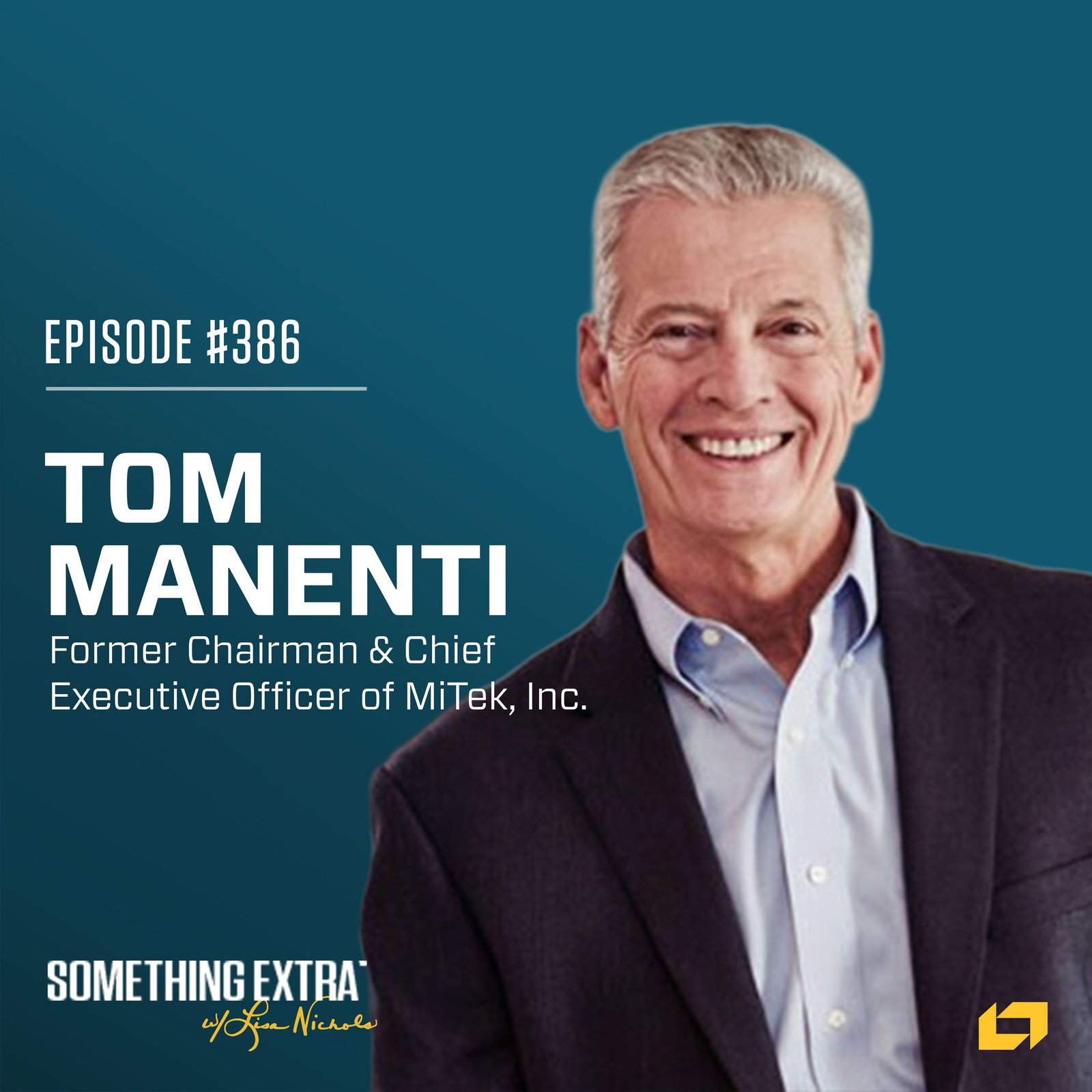
Led by Humility, Driven by Value w/ Tom Manenti
Episode Details
Transcript
This week’s episode features Tom Manenti, the former Chairman and CEO of MiTek, who shares his masterclass in leadership forged over a 40-year career. He shares a wealth of wisdom on building world-class organizational cultures, his unique experience reporting directly to Warren Buffett, and the "10/10/10 rule" that can save or shatter customer trust. Listen in to discover how a bedrock of faith, healthy empowerment, and level-five humility can transform your leadership and help you build a lasting legacy.
Guest Links:
Credits: Host: Lisa Nichols, Executive Producer: Jenny Heal, Marketing Support: Landon Burke and Joe Szynkowski, Podcast Engineer: Portside Media
Tom Manenti
Well, the ten ten ten rule is simply it may take you ten months to get a customer. You can lose them in ten seconds. And if you're if you're lucky, you might get them back in ten years. And so it just goes to show you, choose your words and everything because, you know, you can say the wrong thing in less than ten seconds. Lisa Nichols
It takes something a little more to lead with impact. I'm Lisa Nichols, author of Something Extra, and this podcast was inspired by our daughter, Allie, whose additional chromosome has shaped how I see people in leadership. Each episode features features conversations with inspiring leaders from around the world about what truly defines how they lead and serve others. If you enjoyed today's conversation, please consider leaving a five star review. It helps more people discover the show. And if you'd like to go deeper, my book, Something Extra, is available on Amazon and through other major book retailers. Our guest today has a career story that reads like a master class in leadership. After forty years at MiTek, former chairman and CEO, Tom Manenti, is widely recognized for his people first philosophy and his unique experience reporting directly to Warren Buffett. Tom brings a unique perspective on what it actually takes to build a world class organization and a legacy that transcends business success. Well, Tom Manenti, welcome, my friend, to the something extra podcast. I am so delighted we can make this work today. Tom Manenti
Thank you for inviting me. Lisa Nichols
I just been looking forward to this conversation so much because Greg and I have I don't even know how long, but I know that even when you were the CEO of MiTek, we were a partner for you guys, and then we know each other. You and I serve on the board for the CEO forum. We've got many different avenues that our lives have crossed. And just, Tom, every time we're with you guys, I mean, we just come we're richer people because you guys are in our life. And I'm just grateful, and I'm just excited to share you with all of our listeners today and all your wisdom. Tom Manenti
Thank you, Lisa. Lisa Nichols
Well, let's talk about this. So you did not grow up in Saint Louis. You grew up in the Bronx? Tom Manenti
I did. Lisa Nichols
In New Jersey. Tom Manenti
Right. Lisa Nichols
Yeah? No way. Tell me a little bit about growing up. Tom Manenti
Yeah. I grew up in, in the Bronx about, five blocks from Yankee Stadium. And, obviously, we're big baseball baseball fans, and, we lived there until I was eight years old, and then we moved to New Jersey. And my mother was, she was sick. She had, she was asthmatic and, it's my birth mother. I was blessed to have, you know, two two mothers really in my life. But and so we moved to New Jersey to try to help her. And after a year in New Jersey, she passed away and which was a huge, disruption in in our family. I have an older sister, so the she's three years older than me. And, you know, we were just left without a mom. So we moved from the Bronx to New Jersey, and we that was, you know, like, moving to the country, and it was very foreign to us. And, and then we had this big, you know, rock kinda fall on us, in September nineteen sixty. And, and but we we got through all that in actually a a very positive way, which, was a real blessing in our lives. Mhmm. Lisa Nichols
Did your sister somewhat Tom's kinda step in as the surrogate mom to so to speak? Tom Manenti
Well, yeah, she's she is the consummate big sister. We're very close to this day. We can't go a day without texting each other at least. But, but my my dad realized that we were still kids, and he had my grandparents. My Sicilian, old world grandparents moved from the Bronx over to New Jersey, and my grandfather was a barber. He he's a retired barber because he had a stroke a couple years before that. So my grandmother became, she was very vocal about this. She was now the mother of the house, you know, And it didn't it didn't sit well with my sister, quite frankly. Oh. She had a she struggled with that a little bit. And, but you know what? Everything, eventually really worked out for the best. And, it's hard to say that when there's been a death like that in the family, but we've been we were very fortunate for that. Mhmm. Lisa Nichols
That's tough, you know, at that age at any age to lose a mom, but certainly as a young young boy, that that had to been really difficult. Well, I know that you eventually moved to Indiana in nineteen seventy seven. Tom Manenti
I did. Lisa Nichols
That was a huge cultural shift, wasn't it? Tom Manenti
It it sure was. Yeah. Well I took a job. I was working in the post office in, in this little New Jersey shore town called Hazlett, and, I worked I always worked two jobs at least. I was actually working three jobs at the time. I'm not counting my my reserve military duty that I was also doing at the time. And I was, working in a gas station, and a guy pulled in one day I knew, and we were talking. And I was maybe having a little bit of a rough patch at, working in the post office. I don't know what that would have been about, but, I I asked him. I said, hey. How do I get a job like yours? And long story short, I got him a resume, and they had an opening in Indiana. And I almost didn't take the job because I thought, what company would I wanna work for that would hire me as a salesman? My background was accounting. I was working in post office, and I'm thinking, you know, this gotta be a a dysfunctional company. But the guy hired me and and, yeah, moved to Indiana, and I had a sales territory. All the great lakes states became my sales territory, and I learned the business. And I just started real really at the bottom of the ladder. Lisa Nichols
Yeah. I love that. Yeah. You've got some stories on sales, and we're gonna get into that. You've got some philosophies there. But, you know, one thing that I read, Tom, it was a cultural shift because you said that it was an other's way of thinking. Thinking outside yourself, thinking about others. Right? Tom Manenti
Yeah. Lisa Nichols
And and I also think and I think, I mean, Tom, for as long as I've known you, this is, really the bedrock of who you and Kathy are. But I know that I read also that you found faith in Indiana in nineteen seventy eight. Tom Manenti
It's true. Yeah. Yeah. That it it was I was raised Roman Catholic and, which I've always been grateful for, the things I learned, growing up in the Roman Catholic church. But, it was there was something lacking. And and in Indiana, it was different. Even the Roman Catholic church was different. I I started going to a Roman Catholic church in, Mishawaka, Indiana, sister city to South Bend. And, and, you know, he's just sitting with the I I went I went to confession one day and just sat in the pew right next to the priest and had a conversation with him. It wasn't you know, I didn't go to a booth and do all this other stuff, and it was like, wow. This is really different. So I obviously was, had something inside me that was seeking, you know, my faith you know, something in faith different from what I had, traditionally done. And then a friend from back in New Jersey actually had led me to faith in Jesus Christ in October nineteen seventy eight, and that started that journey, which, has been, you know, just something I treasure. Lisa Nichols
Yeah. It changes everything, doesn't it, Tom? Tom Manenti
It did. Yeah. Lisa Nichols
It really changes everything. Well, looking back now, how do you think, you know, how do you think accepting Jesus reshaped your leadership philosophy? Everything that you've done since since that time, what are some of the things? How did it shape you reshape you? Tom Manenti
You know, it it made me you know, once I started to be more serious about my faith, you know, it's it's one thing to actually, you know, go through that salvation, you know, process, but it's another thing to, you know, start navigating through. And and I didn't have anybody really to disciple me, so to speak. So a lot of it was just, you know, self reading. I was a a voracious reader anyway. So, you know, I would read in the Bible and I read commentaries and things like that, and I realized that there was a there was a way of life. You you don't, you know, you don't, you know, get faith in Jesus by doing something because he already did it. So Yes. You just get it by by believing, by having faith in what he did for me, identifying, with his substitution for me. And that really made me think, well, there's a you know, nobody says there's a code of conduct conduct, but you come to realize there is. And God was really good. He he just took a lot of things, a lot of desires for things away from me and, like, things that just didn't matter anymore. And that's really what got me, and helped me so much in business. You know, the first thing I had to overcome was the the peer pressure. You know, when somebody wants to ridicule you for now this, oh, now you you know, now you're a Jesus freak or you're a bible thumper or something like that and not taking the bait. And that wasn't easy. And, fortunately, I had some people that I had learned to reach out to, my friend back in New Jersey and and some others and my customers. I mean, here I am in the Midwest, and I'm calling on customers, and I'm starting to realize that they, you know, have the same faith that I have, but they've they're way, way more advanced. I mean, when I met Kathy, it was, you know, really the the biggest transformation because she really guided me, through this, Protestant faith that I had that wasn't, linked to a Roman Catholic church. So Yeah. So I started acting differently. And and and then realizing that I had to I either had to give in and compromise, my beliefs or my values, but that never set that never really felt right to me. You know? So I so I would just stand and say, well, you know, I believe what I believe. You know? And Yeah. If you wanna know more about them, happy to talk to you about it. You know? Lisa Nichols
And Yeah. Tom Manenti
Usually, they go running when you start asking. Lisa Nichols
But I bet you learned a lot from your customers. You had Oh my god. Tom Manenti
You were able Lisa Nichols
to have those conversations. Right? Tom Manenti
And yeah. I had a customer in in Canton, Ohio. I have to ask John Beckett if he if he knew this customer of mine, but he was raised Amish. And, he was a big customer. And I knew that he had been, he was very religious man as they say. And Mhmm. So I was a bit intimidated. He was oh my gosh. He just literally took me under his wing. If I had a question, he had a sermon for it, you know, as a response, but he was he was not pretentious at all. I mean, wouldn't know if that the man had two nickels to rub rub together, let alone, you know, tens of millions of dollars. You know? Mhmm. That kind of a relationship. And, and I I reached out to him many times over the years. He went to be with Jesus about five years ago, but, I still keep in touch with, his sons and, some other folks from his company. Lisa Nichols
Yeah. Well, we're gonna talk we're gonna get deeper into that because, you know, it it the legacy that you're leaving behind, that you are building to leave behind, Tom, you know, is faith runs through that. I mean, that thread of faith and what you're doing with your grandkids. So I wanna talk about all that. But let's talk a little bit about just work. So I know you said that you have a degree in accounting and business administration. You had some post grad work at Wharton. Tom Manenti
Right. Lisa Nichols
Great school. But, you you worked for Guinness Harp. You also worked for Gang-Nail. I think you worked for Gang-Nail where you were over sales for nineteen different states. Right? Tom Manenti
Yeah. Gang-Nail was one of the legacy companies of MiTek. Yes. MiTek was formed as a holding company here in St. Louis, and they owned one of two of our competitors, actually. And then we became part of the MiTek family, but we all had our own brands. It was kind of interesting navigating through that in the marketplace. You know, the customers are not stupid. They realize they real they think you're they think you're trying to create a monopoly. And we weren't trying to create a monopoly, but we were trying to, consolidate and make a little bit more sense out of you know, there were twenty two companies that did what we did at that time. And, so even though there were three of us that had kinda joined forces, you know, there's still another, you know, nineteen out there that we had to compete against. Lisa Nichols
Right. Tom Manenti
We were so and we ultimately did in nineteen ninety one, we, we did away with the, individual brands. So Gang-Nail went away as a brand. The St. Louis company Hydro-Air went away as a brand, and, and then another one we had called PanelClip. And we just all went under the MiTek banner. So, you know, that all took place. I I started in sales. I was in the field as a field sales guy for six years. I got more states. I got more responsibilities. There were different divisions. I started covering sales for different divisions. And then I my first sales management position, Iwas transferred to Miami where the headquarters of Gang-Nail was, And I was still the low guy. I was now I was the, the sales manager of the smallest division in the company. And then, eventually, I became director of sales for all of it and then then VP of sales. And then, ultimately, I became president of Gang-Nail. Lisa Nichols
Yes. Right. Tom Manenti
So that so I was president of Gang-Nail when we decided, and there was a president of Hydro-Airand a president of Panelclip, and we decided to consolidate. So that's how that was kind of the evolution of my career and how I ended up in St. Louis when we consolidated everything. Gene Toombs was already working for the company. He had been he had been running another division of, started as Gang-Nail, but of MiTek. And it was a wood products division where our products were mostly metal products and machinery. And, Gene and that business was doing terrible, and Gene was hired to either fix it or sell it. And, it was unfixable, and he told, the, the owner of our company at the time was Paul Cornellson who is a lifelong St. Louis guy. He was the number two man at Ralston Purina, and, and he left and bought this company that was failing. And he he he brought it back to life, and he hired Gene. And then Gene said we have to sell it. So we sold that company, and then Gene ended up my that was the first time he ended up my boss. So when we consolidated and I came to St. Louis, we split the country into three divisions, and I had one of the divisions. So I went from a president of a business unit to a vice president of the eastern division. Yeah. And then, that's kinda how it all evolved. And that's how I got to know Gene, but I knew him before. In fact, I was actually I actually advised him. He would ask me, you know, how to navigate through some of this industry stuff that he knew nothing about. But he was a he was a quick study, and and he he he learned he learned a little bit from me, and I learned an awful lot from him. Lisa Nichols
Isn't that the way it goes? Isn't that the way it goes? You know? I mean, mentor, mentee, you know, you learn as much. Right? Love Gene Toomes. You know, I served on the junior team up board with him for a while and, loved him. And, of course, you know, I had an affinity for him immediately because my dad's name was Gene. Uh-huh. And I would always tell him, yeah, my dad actually got to meet him one time before he passed away. Yeah. Before my dad passed away, and then, of course, Jean passed away a few years ago. But let's talk about MiTek a little bit because MiTek is really known for its strong culture and core values. You know, why what were the four the I think there were seven core values. Tom Manenti
Oh, gosh. Yeah. Lisa Nichols
That and you say the core values are unchangeable. Right? The way that we go about things can change because methods change, but the core values themselves. Well, do you remember some of those core values? I'm sure you do. Tom Manenti
Oh, yeah. Well, the number one, I still remember how we've how we how we came up with those core values. You know, I I I had left MiTekfor a short for about eighteen months. I actually was still a con I was still working on a big project for MiTek. The whole eighteen months, I wasn't actually employed by MiTek. And, and then Genecalled and asked me to come back because he wanted to retire, in a year or two, and he wanted me to come back to be CEO. So, which I actually didn't wanna do. I didn't wanna come back, and Kathy didn't want me to go back. And then, a lot of prayer about that Yes. Was because, we would have an opportunity to put a little bit of a different, flavor on on on the culture. Mhmm. And, and when we, when I came back and I actually just, I was attending a sales meeting as an observer. I was just you know, I knew a lot of the guys from the old days, you know, when I was there and running the sales department. And, and we went through an exercise to identify core values for the company. And I thought this is really cool. This is something I would have wanted to do once I became CEO, And but we we did it. And, and with thirty five in the room, we broke up into seven, groups of five. They even insisted that I'd be part of one of the groups. But they identified all these candidate core values, You know, all the kinds of ones that you would think of teamwork and all the all the all the things. And what I was most proud of all the time, you know, I was there from that point through my career as CEO, it was that unanimously, this team of thirty five picked integrity as number one. Oh. And that meant a lot to me. Yes. So it was, you know, it's integrity. It was, it was a a passion for excellence. It was a a commitment to the customer. It was, you know, ownership minded. It it was there were values where I don't remember every one of them, but there were seven core values that we came up with, and it all were very, very special. Lisa Nichols
Well, Tom, let me ask you this. You know, and Drucker, right, famously said culture will eat strategy for breakfast. Why is culture so I mean, strategy is important too. But I think it's cultures that every bit is important, if not a little bit more. You know, even in strategy, you can have a great strategy. But if you got a lousy culture, why why is that important? Tom Manenti
Well, culture is insidious in both a good way and a bad way. Lisa Nichols
Yes. Tom Manenti
Culture actually, is like a living organism in your organization, and it can it can be very disruptive if it's not the right culture. We had a great culture at MiTek. Gene did a great job of instilling, you know, in us that customers were so important. It wasn't always like that, because, you know, the, you know, predecessor to Gene was more of an operations guy. So it was more about financial stability. It wasn't real. The customers were a means to an end instead of really being the prize. The customers are the prize. You know? And and Gene, he he really instilled that, to the point where that never went away. I always said we started at with entrepreneurs. You know, so we were just, you know, that kind of a company. We were, sort of an innovative company, and then then we became a a process driven company and financially driven. And then under Gene, we became a customer driven company. And then I wanted us to be a value driven company. I wanted us and and and none of the others ever went away. They nested is what happened. Lisa Nichols
Yeah. You need them all. Tom Manenti
Every one of them. So it wasn't calling us. I always displayed them in a you're never in in in that kind of an order, but always in a, you know, continuum because they're constantly, you know, connected with one another. And and culture just really, it just made all the difference in the world. We it's because you want people to come to work because they want to come to work, not just because they have to come to work. Lisa Nichols
Right. Tom Manenti
And, and that was one of the things, I I had a friend that would say, you can get up in the morning and go, oh, I have to go to MiTek today. Or you can get up in the morning and say, I get to go to MiTek today. And that's a big difference. Yeah. I talked I've talked to other people that you you and I both know together, and yourself as well. You and Greg are an example of that. And, you know, we I always wanted to make sure people didn't come to MiTekevery day just because it was a job. Yes. For the first time they got an offer for more money that they were gonna leave, I I I really, felt great about finding out that people were being approached and not leaving because they didn't wanna leave, because we actually believe that everybody, was entitled to dignity and respect regardless of their role in the company. It did it didn't matter if you were the CEO, if you were the head of sales, if you were a packer on the stamping line, or, you know, whatever it might have been. And, we started to really get that. It took about five years to really see it on autopilot. Lisa Nichols
Yeah. That's so good. That is so good. Well, you know, I know that one of your philosophies, Tom, was empowerment. And you said almost to the point of abdication. In fact, I read something that said, sometimes I felt like, wow. You know, it really felt like you weren't doing anything because you you had abdicated. But why is healthy empowerment? What does that really look like? And I do think it's important. People want to have that ownership. Right? Tom Manenti
Yeah. Absolutely. It's one it's one of my most favorite things to talk about. Empowerment, you can't pay lip service to that. Yeah. If you say that, and that was one of our core values. And thanks for, you know, for, prompting me. You know? And Yeah. So empowered people is one of our core was one of MiTek's core values. And you can't say that and not do it. I used to say I have I had a saying, I know it's gonna sound weird, that if we're gonna say we are who we say we are, we have to be who we say we are. Lisa Nichols
Yeah. So good. Tom Manenti
So I would I would tell CEO friends, when they would say our people are our most valuable asset. And I and I I could love these people very much, you know, as my friends that see but I I would say I would say don't say that unless you are really delivering on that because your people know the difference. Lisa Nichols
Yeah. Tom Manenti
You know, it the, you know, the customers are really not the not the players. The players are are your people. And what you want your customers to experience, your own people have to experience that first. So so if if they don't feel empowered and if they don't feel valued Yeah. They're not gonna be as good at that being felt by the customer unless they're feeling it first. Lisa Nichols
How can they? You know? How can they, Tom? How can they project that when they don't feel it themselves? Tom Manenti
They can't. They can't. So I would tell my friends, I would say, just just be silent on that issue. Come up with a different phrase, but don't say our people are our greatest asset when they're not. You know? It's a Yeah. That was the kind of thing. I remember standing in front of a group in the factory. I used to love to do this. And, and I and I learned a little bit of this from a good friend who you know very well, and he just recently passed away, Bob Chapman. And actually going being on the on the shop floor and having conversations, and he had he had a a term for it, and I can't remember what it was, but, that's what I started to do. And so somebody asked me about this empowerment, thing. And, you know, cynically, like, yeah. Right. You know? And I said, well, I said empowerment starts with empowered leaders. So you're not gonna feel empowered unless I make sure the leadership team is is feeling empowered. And that's exactly what you were referring to about, you know, you almost have to abdicate responsibility. Right. But you're not because you're accountable. I mean, I'm I'm accountable. I'm the guy that has to deal with, you know, my boss if something goes wrong. You know? Yes. Even no matter who did it, it's still, you know, up to me. Yes. That that whole thing of an of of of, you know, not abdicate. But you have to really empower people even to the point when they make a mistake Lisa Nichols
Right. Yeah. Tom Manenti
That you don't just come down on them. I mean, you know, you're gonna have an opportunity to coach them later. But take care of the problem, whatever it is, and then let's all learn from it. Now is, you know, saying, you know, you can't you know, you you know, if you've, you know, fool me once, shame on me. Fool me twice, shame on you or something like that. But I can't remember the order of that, but you know what I mean? It's Yes. It's one of those things that, you know, you gotta give people a second chance. Otherwise, they're not gonna feel empowered. And that's what we did. And, yeah, I I had CEOs ask me, how do you do this? And I said, well, they asked me, what is, like, one thing I can do to be better at this? I said, get out of the way. Get out of the way. If you if you believe in your people and they're as valuable as you say and they're as effective as you say, let them do their job. And when they don't, then you have every reason. But if you're interfering all the time, then they're gonna say, well, that's really what, you know, I thought you wanted, so that's why I did it. Well, that's not a good that's not the best reason. Let's put it that way. Lisa Nichols
Right. Oh, that's so good. I'm reading you would love it, because I know you're a voracious reader, Tom, but I'm reading, John Maxwell's return on failure. Tom Manenti
Mhmm. Lisa Nichols
And, you know, his whole thing is you're gonna make mistakes. People are gonna make mistakes. So, like, when you empower, I mean, maybe somebody's gonna make the wrong call. But like you said, you've got to allow them to do that. Right? And it's just like, what is the return that you get on that? And just as long as you're learning from it. And like you said, again, if it happens multiple times, then, you know, then you may have to to make some sort of corrective action for sure. Speaker 2
Yeah. Lisa Nichols
But creating that psychological safety for people to try things and to you know, how else are they gonna grow? How are we gonna grow if we don't get to try? Tom Manenti
Well, they're not. They're not. They're just gonna it's just like pouring a liquid on on the countertop. All it does is just kinda spread. You know? It just it go it gets shallower Lisa Nichols
Right. The more Tom Manenti
it spreads, you know, and it's and that's what happens in an organization. Lisa Nichols
Yeah. So good. Well, we've got I've got so much more here. I'm hoping that we can get through it, but we do need to take a quick break, and we'll be right back with my dear friend, Tom Minenti, on the Something Extra podcast. AD
In business, the tendency is to seek out partners who are bigger, faster, stronger. When it comes to IT, you should be looking looking for smarter, faster, better. That's just what you'll find with the talented technologists at Technology Partners. Our experts develop custom solutions to tackle your most complex challenges, all to simplify your processes in the smartest, most efficient way possible. The time to be swift and nimble starts now. Go to technology partners dot net slash solutions and see what's possible. Lisa Nichols
Welcome back, everyone, to the Something Extra podcast with Tom Manenti. This is like a master class in leadership, people. So just get your pencils out. Get your journals out. You're gonna run wanna write stuff down here. But, Tom, you tell this story about your grandfather and your grandfather that had the barbershop. And it's such a powerful picture of an ownership mentality, and I know that that was part of, you know, think like an owner. Right? You know, tell that story what your grandfather would do. And then, you know, why is personal ownership? Why does it matter so much? Tom Manenti
Yeah. Well, my grandfather is is my father's father, and, this was in the Bronx, and he had a barbershop and on, what they called Avenue Saint John or Saint John Ave. They my grandparents used to call it Avenue Saint John, but and, and I used to see as a kid I mean, as a little kid, four, five, six years old, my dad would bring me to the barbershop, and I would see my grandfather when there weren't people in the chair. And he would be outside sweeping in front of his shop. And I asked my dad one time, why did grandpa always sweep in front of his shop? And he told me that grandpa always felt that if as long as he sweeps in front of his shop and the person next, you know, next to him and the person aft you know, all those stores would sweep in front of their shop, eventually, the whole street is gonna be clean. So it was that mentality of, you know, you have an owner. I don't own this, but I'm gonna keep this part of my, you know, my when I'm a steward over Yes. You know, clean and it's gonna be inviting and it's gonna be the right, you know, invite in environment for people to, respond to. But, yeah, I I'll never forget that that he said, yeah. If you and if you keep and if every street and every city did that, the whole city would be clean, and that would be a a good thing. And I I I we need more of that today, quite frankly. You know? Lisa Nichols
We do. And it's so metaphorical, right, for an organization. Because everyone in the organization owning their role, being the best version of themselves in their role, I mean, the organization is gonna run so much better. Right? Tom Manenti
Yeah. And you do it not he wasn't doing it for somebody to pat him on the back and say Oh. His name was also Tom. And he, you know, the, hey, Tom. You know, you keep your shop really, you know, swept clean or what you know? No. It it wasn't that. It was just this intrinsic, you know, thought that, this is the right thing to do. And then you see you would see them all doing it, you know, different parts of the day. Lisa Nichols
That's so cool. What a great I love I love the lessons like that will just stick with you one thing, and they're so transferable, I feel like. I mean, you know, I talk about Ally a lot. You know? I just feel like I've learned so much from her just watching, you know, that can be translated into leadership lessons. But we we see that every day if we've got the eyes to see it. Right? And I love that. Well, let me ask you this. You know, what are some leadership lessons, Tom? And you have seven grandkids, or do you have eight now? Tom Manenti
No. We have seven. Lisa Nichols
Seven. Seven. Every week. One for every day, and we're gonna talk about that. We're gonna talk about that, because I love, love, love what you do with your grands. But, you know and I'm sure you're imparting these kinda lessons all the time. But what are some leadership lessons that you think younger generations need to learn today? Tom Manenti
Well, you know, the the number one thing is trust. I learned a long time ago in sales. I was not a great salesman, by the way. I just was a relationship guy. Yeah. I I I really never saw I I used to do a I used to do a little talk called I've never sold a thing in my life. Lisa Nichols
Yes. Tom Manenti
It's always funny in the company with the technical guys, and they go, wait. This guy heads up sales. He never sold anything. But I didn't. I just I created relationships, and, and then eventually, you know, I mean, I would talk about our, you know, our products because they would ask me questions. And I would and then one day, they would say, you know, we need to buy one of those machines, or we need to start doing business with you, whatever. And then I just, you know, said, okay. Great. I'll set it up. But it's so it really it people buy from you because they like you Yes. And they trust you. Now your product has to obviously, you know, be relevant to their business, and it needs to be reasonable quality and and and competitively priced. But that's not the main reason that people continue to buy from you. They buy because they trust you. And it's the same thing in leadership. You know, I always say that leaders lead. Anybody who said, with some false humility, well, I like to lead from behind. What what is that all about? I mean, I've had to lead from behind. No. Leaders lead. You gotta get out in front. And I had a friend, somebody that you probably know, but I won't I won't mention. He he said to me one time, he says, how do you know if you're an effective leader? I said, look over your shoulder. See if anybody's following you. Just look around. And if they're really not following, if they're just waiting for the next thing, you know, the next command that you have for them, that's not leadership. Mhmm. I I don't know what that's called, but it's not leadership anyway. It's not effective leadership. So, trust. Trust is so important. I, talked about, the seven keys of trust. A friend of mine wrote a book, called People First. And, and the seven keys of trust as he articulates in the book are character, competence, confidence, caring, communication, consistency, and commitment. And when I was asked one time at a fellowship of Christian athletes national meeting, I was being interviewed, and they asked me what what one word would you say is, you know, the best virtue, you know, for for leadership? And I said consistency. And I've and and I didn't know anything about this book. I hadn't read this. I didn't even know Jack at the time, and and I just said I said consistency. I said, because, you know, the book of James says that a double minded man is unstable in all of his ways, and let not that man think he'll receive anything from God. Mhmm. So I I thought, well, I don't wanna be that kind of guy, and I don't wanna follow that kind of guy. I mean, who wants to follow a double minded person says one thing and does another or says one thing today and says a different thing tomorrow? Those those are double minded things. So consistency to me is it it it covers a lot. It's just like, you know, love fulfills all of the law, you know, that kind of thing. And so consistency is is one of the seven, but trust really is the key. And Yes. And trust is so easy. I used to tell my our sales guys. I used to call it the ten ten ten rule. And I Lisa Nichols
said glad that you're talking about that because I was gonna ask you. Talk about Tom Manenti
ten ten rule. Yes. We'll do that one before. Yeah. Well, the ten ten ten rule is simply it may take you ten months to get a customer. You can lose them in ten seconds. Lisa Nichols
Yes. Tom Manenti
And if you're if you're lucky, you might get them back in ten years. Lisa Nichols
Ten years. Tom Manenti
Yeah. And so it just goes to show you, choose your words and everything because, you know, you can say the wrong thing in less than ten seconds and somebody. And I saw that happen in our company. I I I I remember a guy. It was actually, it was with this mentor of mine from, his name was Abner Yoder from from, Ohio. And just one little statement totally offended Abner. And if, there weren't some of us that had a closer relationship with Abner and talked him off the ledge, we could have lost all of Abner's business. So so those kinds of things are important. So trust really just like in a marriage, I mean, you don't you don't ever wanna breach that. I mean, you breach that, it's oh, gosh. It's almost impossible to really, you know Lisa Nichols
To rebuild. Tom Manenti
Yeah. Yeah. Lisa Nichols
So okay. So shout out to our friend, Jack Lannom. Hi, Jack. Get Jack's book. Jack is phenomenal. He is phenomenal individual and just leadership guru, Jack Lannom. But, Tom, like, what are some of those things that you think can build trust? Consistency is one of those. Right? Being consistent with what you say and what you do. Where are some of those things that can build it? And then, you know, I mean, you can like you said, you can tear it down in ten seconds. Tom Manenti
Yeah. Well, people see people, can see right through, any kind of, of a of a Lisa Nichols
Fake. Tom Manenti
Disingenuous, you know, approach to leadership. Lisa Nichols
Yes. Tom Manenti
So, you know, you know, this I was saying earlier, you know, you can fool the spectators, but you can't fool the players. Mhmm. And when you don't realize that the people, you know, who are reporting to you especially, that they're the players. So, you know, you don't wanna try to fool them because, they know better. Yeah. So, you know, you don't wanna do that. And and when you when you you you you you know, when you, you know, deliver a steady diet of that, they see through it, and it just it's just phony. And and people, you know, they really, you know, they really snuff that out. So that's one of the things that I I think is important that, you be transparent, you be consistent. You have to, you really have to be humble. Yes. Speaker 2
And Tom Manenti
people people, you know, that people don't you know, what's the old saying? People don't care how much you know until they know how much you care. Know what I mean? Yeah. Yeah. So and that's true. I mean, I always wanted to I I knew how I wanted to be led, and for a long, long time, I was not led that way that you know, until Jean Toomes came along, you know, and believed, you know, a lot of the things I believed. I was just really, you know, kind of like a salmon swimming upstream, it seemed. And, and then, but when you, you know, you when you you have that and, you don't you I wanna be led. I wanna lead the way I I I wanted to be led. So if I wanted to be led that way, then I need to be a leader that way. Lisa Nichols
So good. We could do a whole podcast just on trust and how you build it and how it can, you know, it can be lost. Right? So I'm so glad that you talked about the ten ten ten because I was gonna ask you that. Well, okay. So what our listeners might not understand is MiTek is now owned by Berkshire Hathaway. Tom Manenti
Right. Lisa Nichols
So I wanted to ask you a couple things about uncle Warren. Okay? You know, Warren famously said intelligence and passion can never make up for lack of integrity. Right? And so, you know, for you, you've already talked about that, that that was the number one core value that all thirty five, it's so integrity is everything. And again, going back to trust. Right? Yeah. If you don't have integrity, then trust is gonna be broken. But what was it like working under uncle Warren? Tom Manenti
It was easy, actually. Lisa Nichols
Easy. Tom Manenti
It was easy. Yeah. He was, he was a great example of, what empowerment looks like. And, he, he he he says this all the time. I I think annually, they probably still do. They run the, the the the clip of Warren testifying before Congress, when, he was testifying because of the Solomon Brothers insider trading scandal, back in the early eighties, I think. And, he he runs that, and he takes total responsibility, for what everybody had done wrong in the company and and and vowed to to change it and turn it around, and he did that. But he, you know, he would just, remind us that we, you know, we can afford to make mistakes. We can afford to lose money. We can afford to lose a lot of money, but what we can afford is to lose one shred of our reputation. And so Okay. I just love the fact that, you know, I I reported to somebody like that, and, Jean worked like that. You know? You know, this year, it's twenty five years since since Warren bought our company. July of two thousand one was when, he bought the company. And so twenty five years to see the company, do so well is really good. But that's what working for Warren was easy. He had very he had very few rules. Lisa Nichols
Yeah. He was pretty hands off. Right? Tom Manenti
Very Mhmm. Hands off. And, and and he would be lighthearted about things, and, you know, you didn't have to lie to him if, you know, he was talking about financial things that were way over your head. You know, I would just say, I would tease him and I would say, well, you know, you keep talking like that, we're gonna have to switch to baseball. He's a huge baseball fan, and he knows I am. So, so that's, you know, one of the things that we would, do. Lisa Nichols
That's so good. So good. And I love what what you said he said. You know, that we can lose a lot of money, but we can't afford to lose one ounce of reputation. Tom Manenti
Right. Lisa Nichols
Everything. It really is. Okay. I've got so much more here, but I wanna kinda get into some of, more personal things. You know, I mean, you've said, I read somewhere, Tom, where you said you wanted to finish well. What does finishing well mean to you? Tom Manenti
Well, you know, my my daily prayer for myself I do actually pray for myself, and my daily prayer for myself is that I can be as healthy as possible and as strong as possible for as long as possible, whatever that is, so that I can serve God and lead my family well. And that really is my mission statement, I guess, you would say here in retirement because, you know, as, there's a line from the from the television show Blue Bloods where he, where Frank Reagan says, all I know is I'm closer to the end than the beginning. So I, you know, I know that. And and so I'm thankful for the opportunities, to, to pour into my grandchildren. I don't know if my my adult children are, you know, gonna allow me to pour much more into them. They're probably about bursting at the seams. My young she just turned forty. So, you know, the so they're, you know, they're moving on in their lives, but, their children mean everything to Kathy and me, and and we do our best to pour into them. So, really, that's what, you know, that's what's important. So finishing well to me is, is really living a life, of significance in some way. So wherever we can, that's what we try to do. Lisa Nichols
Yeah. You know, I heard somebody say the other day, Tom, and I thought it was so good that when they enter heaven, they wanna enter exhausted. Tom Manenti
That sounds like something my friend Larry Colette would say. Lisa Nichols
It wasn't Larry, but Larry could've said that too. But it wasn't Larry. It was somebody else that that I was listening to that that they wanna enter heaven exhausted. You know? Because you think, oh, and and this way, I see you and Kathy. I mean, you guys I know family is everything to you guys. You guys have been married for how long now, Tom? Forty seven years? Tom Manenti
Forty seven years this year. Yeah. Lisa Nichols
Forty seven years. Give us a couple of pieces of marriage advice for strong family. Because you guys for strong marriage, and I wanna talk to you about kids and grandkids. Because you guys you guys just clearly you love each other, and you just you have fun. You guys are still great friends. Tom Manenti
We are. We've we've said it for since we we were we were in our twenties when we met, and, you know, we just consider each other each other's best friend. Lisa Nichols
Yes. I Tom Manenti
know I know how long you and Greg have been together, so I Lisa Nichols
Yep. What did you do? Tom Manenti
Guys in the same way. And and and, we were just with a couple this weekend, and he's, he's ten years younger than me, and he's about to retire. And and they're they're they're scared that he's gonna retire. What, you know, what are they gonna do? And and I and I think, oh my gosh. You know? And it would never it never even dawned on Kathy and me that we wanna do anything but just hang out with each other as much as we can, which is what we do. Now I traveled a lot, in my career. I never really, kept a a log of all the miles in all the countries, but I know I've been to over forty countries and, all over the world. And and Kathy really she held the fort together. And to answer your question, one of the things is that Kathy and I, especially on all the major the big things, we were on the same page. And if we and if for some reason we weren't, maybe we were just, like, peeking at the page. We weren't on it. We would talk about it and make sure. And we and always did that, alone. We didn't do it. We didn't hash that stuff out in front of our kids, you know, at least not that I can recall. So, I mean, I'm not saying that we didn't ever have, you know, a flare up or something. Lisa Nichols
Right. Tom Manenti
Because I've had well, this our adult kids have said, you know, we've seen seen Kathy and I. Kathy and I don't realize realize we're doing it. I mean, some of my grandchildren say, why are you and and and grandma arguing? We're not we're not arguing. We're discussing. Like so We've heard that too, dog. Yeah. But the kids the the older ones will say you know, our our own kids will say, okay. You know, no fighting in front of the children, meaning them. You know? And Yes. We're not. Yes. Lisa Nichols
I just Tom Manenti
said Yes. But, you know, when you're together that long, you know, you almost you know, you can finish each each other's sentences. You know, you Lisa Nichols
know all of Tom Manenti
that exactly what I'm talking about. Right. But the the main thing, Lisa, is that that we compromise has become a dirty word. And and and I don't mean the comp you know, you never compromise your values, your ethics, and things like that. Those like you said earlier, that those are immutable. Lisa Nichols
Yes. Tom Manenti
But but compromise is okay. I mean, I I I I remember when in in politics, which I actually hate politics. I don't talk about it very much. But in politics, you know, they they used to be, you know, compromise positions, you know, where they had a actually, there was such a thing as a bipartisan decision on something, and and you don't see very much of that. And so, I mean, in the simplest form, Kathy wants to see a movie, and I really don't wanna see it, but I go see it anyway. She wants to see it. Yeah. Lisa Nichols
And you Tom Manenti
know what? I you know what movie I just went to see? I think I think we had this conversation. I had never seen the Devil Wears Prada original movie. I'd never seen it. Kathy's had it on, and it's been on in the background, but I've never really watched it. I kinda knew what it was about. And then that number two came out a few weeks ago, and, I'm the one that said, hey. Why don't we go see that movie? And she looked at me a little strange. And I said, yeah. Why? Let's go ahead. Let let's go see the movie. So we went to see it. I loved it. I had a great time. You know? I wasn't expecting to love it, but it was it was fun. It was fun to watch it. But I know that, you know, that I get great joy out of seeing, joy in my children, my grandchildren, especially my wife. So, somebody told me one time, you need to he's the guy that holds me accountable, and he said, you need to do a better job of making Kathy feel radiant. Aw. And don't ask me to define it. It's one of those things where you could say, I don't I can't define it, but I know it when I see it. Yeah. And when she's radiant, it's it's really Lisa Nichols
Life is good. Life is good when she's radiant. Tom Manenti
See, it's it's almost really like a, a bit of an elixir for me Yeah. That, you know, she's that way. And, so yeah. So that the compromise thing is it it it's important, you know, that when you're able to say, you know, that wouldn't be my preference, but if that's important to you, we're gonna do it. Lisa Nichols
Yeah. That's so good. So good. Well, I've gotta ask you this. This is so important. Now I've gotta ask you this, and then we're gonna talk about something extra. And I really seriously think we could do a five hour podcast here, Tom, but we're not gonna do that to our listeners. Your grandchildren. You've got seven of them. Katie, you've got all these amazing grandchildren. Seven of them, one of them for each day. And I will never ever forget, Tom, you telling me what you do for each of your grandchildren. And I want you to tell our listeners because there could be a listener out there that wants to adopt what you do to stay connected with your grands. Tom Manenti
Well, somebody had pointed out when when our our youngest grandchild, who's the only boy, by the way, and he'll be six years old, he was born on Warren's ninetieth birthday. Lisa Nichols
Oh, that's awesome. Tom Manenti
He was born August thirtieth, twenty twenty, and that was, that was Warren that was a fun conversation with Warren, by the way. He was gonna try to get an early admission, for my grandson to Nebraska. Lisa Nichols
Oh my goodness. Tom Manenti
He was trying to get a commitment he was trying to get a commitment letter signed. But, the so we had so when I had the seventh, just somebody just pass in passing said, oh, one for each day of the week. And I was in prayer the next morning, and I went, that's pretty cool. You know? And so I I started a thing. I I just call it, you know, our grandchildren's precious texts. I call them the precious seven. So, so you you know, so here's the here's the here's the days of the week. Monday is Sofia day. Today is Katie day. Tomorrow's Libby day. That's Olivia. Thursday is Anna day, Mariana. Friday is Nora day. Saturday is Maddie day, Madeline. And Sunday is Tommy day. And so Thomas get caps it off on Sunday. And I just started by sending a text, and they they used to be short text. They they got to be pretty long, and none of them complained. But but I send them a text and just kind of, you know, catch up what's going on. And then there's always a a prayer section, you know, where I I I have a a unique prayer for them. I don't cut cut and paste anything. I I just pray about what I should pray about for them, and then I I share it with them. And, and I do that every morning. Yeah. So this morning, I sent that out to Katie, and Olivia will get hers tomorrow. And and and most of them respond. If not if nothing else, they send me back a heart. You know? Yeah. Most of them respond, you know, so they know I know they got it, and they read it. And, Katie Lisa Nichols
Katie. Yeah. But sometimes she said that she even will send you something back. Tom Manenti
Oh, yeah. Lisa Nichols
That's something that she's learning. Right? You know? That will bless you. Tom Manenti
Yeah. Katie's the Katie's probably the best at that. Nora's pretty good at it. Nora's only twelve, and she's pretty she's pretty good at responding and, you know, giving me a little bit of feedback. Olivia, who's graduating, next week. So my school Lisa Nichols
I just love it so much. What what a legacy. What a legacy, Tom. And you have no idea where you're sitting, you know, just what that text may do for them that day. Tom Manenti
Right. Lisa Nichols
You know? It could just set their mindset in a completely different way. So I just love it. But okay. This is called something extra, and I ask every leader this. What do you believe, Tom? Is this something extra that every leader needs? Tom Manenti
Well, I don't think I don't think there's any big secret about it. But I what what Jim Collins wrote about it in in Good to Great, and it was about level five leadership, and the and the x factor for a level five leader was humility. Yeah. And that comes in a lot of different forms. It it comes in I mean, not everybody has to not everybody's like me, and I'm willing to talk about anything about my life. You know? They they're not quite that transparent. But, you you know, some of the things, that go along with humility, here's a practical one where you admit your mistakes. You just it's I I I caused that. That's my fault. You know? And and and and as CEO, if you're not willing to do that, then you're not gonna you're not gonna get to that special, you know, maybe promised land of culture that you're looking for in your company. So I I believe it's humility. Lisa Nichols
Yeah. So good. Well, Tom, this has been so much fun. Thank you so so much. I just know that I know that everything we've talked about today and your story and your wisdom is gonna help our listeners. And, I just I count count it a real blessing to count you and Kathy as friends of ours. Tom Manenti
Well, I couldn't have done it without Kathy. I can tell you that. Lisa Nichols
Alright. Well, very good. Well, have a great rest of the day, my friend. Tom Manenti
Thanks, Lisa. Take care. Announcer
Something extra with Lisa Nichols is a Technology Partners production. Copyright Technology Partners Inc, twenty nineteen. To learn more about this week's guest, check out the show notes at tpi dot co slash podcast. If you enjoyed this episode, consider leaving us a review. Thank you for listening to Something Extra.