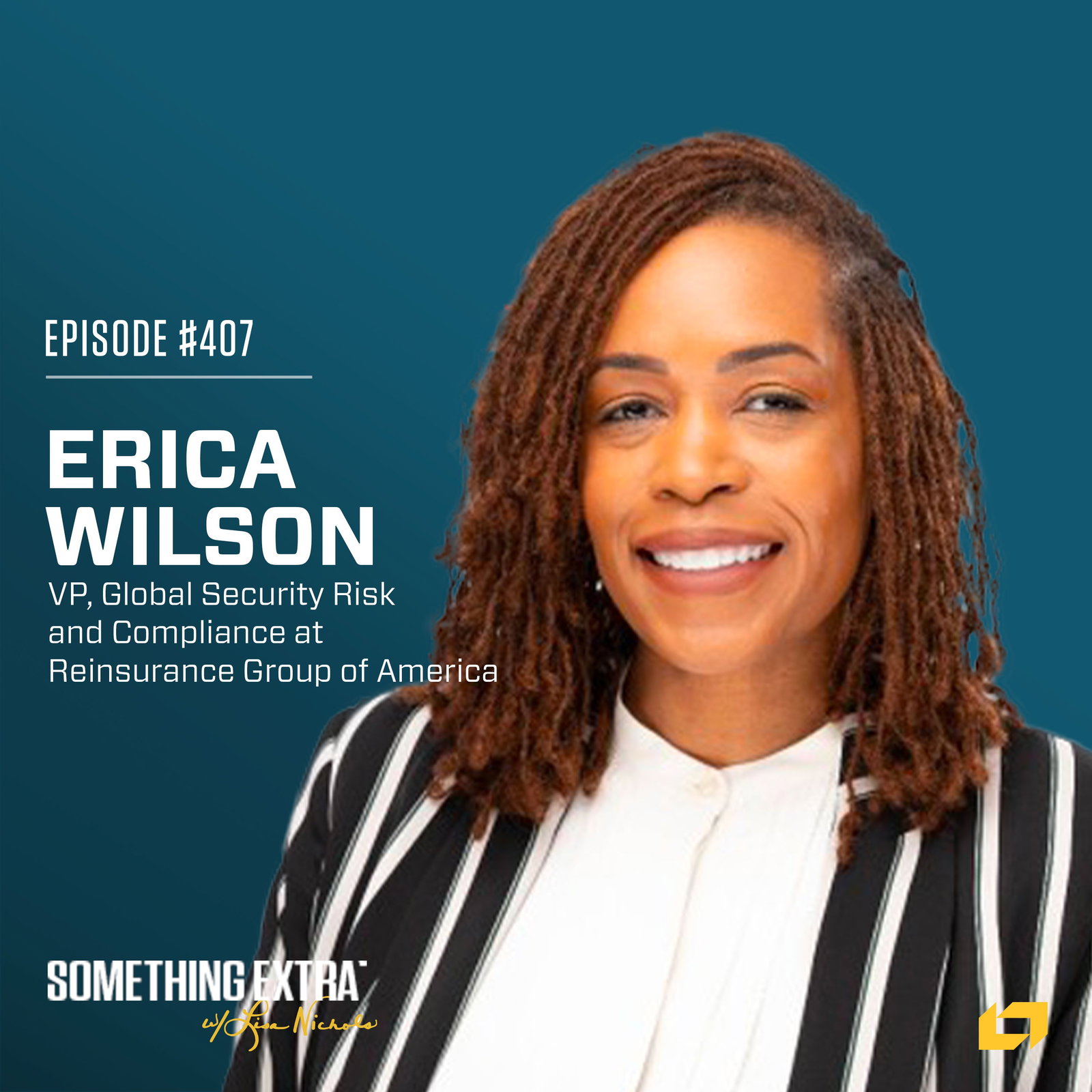
Empowering Women in STEM w/ Erica Wilson
Episode Details
Transcript
What does it take to lead through constant technology shifts and high-stakes risks? Erica Wilson, Vice President of Global Security, Risk, and Compliance at Reinsurance Group of America reflects on her career journey from an IT intern at Anheuser-Busch to an enterprise cybersecurity executive driving global risk strategies. She delivers powerful advice on cultivating self-composure during crises, empowering teams to become independent problem solvers, and creating opportunities for women and young girls in STEM.
Guest Links:
Credits: Host: Lisa Nichols, Executive Producer: Jenny Heal, Marketing Support: Joe Szynkowski & Dylan Price, Podcast Engineer: Portside Media
Erica Wilson
So I have a personal kinda mantra, and it's it's even on my LinkedIn. And it is see your potential, identify your purpose, and advance your passion. Right? And that was kinda born out of my passion for helping others get into tech and and cyber, particularly women and young girls. But it has to start with you. Like, you have to see your potential, and you have to know that there is something unique about you that you do offer because there's only one of you, right, is the way I like to think of it. So what skills and transferable skills and abilities do you have that can be useful? And once you identify that, then you can align it to your purpose. Lisa Nichols
It takes something a little more to lead with impact. I'm Lisa Nichols, author of Something Extra, and this podcast was inspired by our daughter, Allie, whose additional chromosome has shaped how I see people in leadership. Each episode features conversations with inspiring leaders from around the world about what truly defines how they lead and serve others. If you enjoyed today's conversation, please consider leaving a five star review. It helps more people discover the show. And if you'd like to go deeper, my book, Something Extra, is available on Amazon and through other major book retailers. Today, we are joined by Erica Wilson, vice president of global security, risk, and compliance at Reinsurance Group of America. From starting her tech career at Anheuser Busch to leading enterprise cybersecurity defense and advocating for women in STEM, she brings a wealth of hands on leadership experience to today's conversation. Well, Erica Wilson, welcome to the Something Extra podcast. Erica Wilson
Thank you so much for having me. It's so good to see you. I'm always delighted to see you, Lisa. Lisa Nichols
I feel the same way. And you and I, we're both in the tech community, so I think that's how we originally met. And you were probably one of the first cohorts, if not the first cohort in our technology leadership experience. Erica Wilson
I believe that is true. Probably, I wanna say back in twenty eighteen or nineteen. It's been nineteen, the beginning of the pandemic. Lisa Nichols
Yeah. A long Erica Wilson
time. Yes. And then even since then, I had served as a mentor Mentor. A lot of the the young ladies going through, the TechLX and then CyberLX program. So absolutely. Lisa Nichols
Well, thank you for that. Thank you for giving back, and I know you're huge about giving back and women and getting more girls in STEM. So we've just got a lot to talk about. Erica, it's gonna be hard to capture you in just one episode here. Erica Wilson
Well, I appreciate the time for sure. Lisa Nichols
We're gonna try. We're gonna try. So let's just talk about this a little bit. I know you started your career in IT at Anheuser Busch. Erica Wilson
I did a long time ago. Very long time ago. Yeah. So I started there as a a develop... Well, actually, I started as an intern. Let me just go back and say that. I started as an intern and landed a role there. I had just graduated from Southeast Missouri State majoring in computer science, and I was an aspiring developer. I did web development, COBOL development. Thought it was just one of the best career choices ever, and then I had an opportunity to participate in a leadership kinda training program. I've had a theme of being participants in those. And in that program, I was able to have rotational kind of immersions in different parts of the organization. And at the time, data protection was one of them, and I remember just feeling so excited about data protection and information security, and it really was just starting to pick up as a thing. It wasn't even called cybersecurity yet. It was, like, right at... Right after the dot com boom. And so I thought, like, there's probably some job security in this, you know, still being young, and that really was, part of my reasoning for going into it. I'm like, this is new and exciting. I think it's gonna be a problem to solve, and I like solving problems. And so that's kinda how I really shifted into cyber pretty early in my career. Lisa Nichols
Yeah. Well, you were correct. Yeah. Erica Wilson
I was right. Very important. I am. Lisa Nichols
You know? Yeah. You made a good bet on that. Yeah. And I love it because you kinda call yourself an accidental cybersecurity. You know? So I think that that's really... I mean... And I think I read something or I maybe made this up. I'm not sure, Erica, but you said it was really more job security. Erica Wilson
It was. Lisa Nichols
And you're like, I think that this is not gonna go away. I think this is gonna be important. But you have just gone on to do amazing, amazing, things in your career, and I wanna talk all about that. But I love this. I absolutely love this. But I read somewhere where you said every two or three years, you go to your boss, and you would say, what is next? Erica Wilson
Yes. Lisa Nichols
What is next? So you had this insatiable desire and appetite to continue to grow and learn. What do you think, maybe in your background or... I I mean, what do you think, Erica, that prompted you to keep asking that question? Because I think it's a great question. Erica Wilson
Yeah. So for me, I've always thought about a sense of purpose. Right? What what is it that that I bring, and what can I do to help solve problems? At the end of the day, like, I originally wanted to be a math teacher before I was even exposed to computer science. And so, you know, I I had a tendency to to feel like I'd I'd solve a problem or two, right, and spend some time fixing or building or developing something, and then I'd wanna move on to the next thing. And so it just organically kinda happened where I was, you know, excited about what was next and opportunities would present themselves to me. And, yes, very early in my career, I was able to kinda grow, under some great, leaders and friends in the industry. We were all pretty young. Gary Harbison is actually one I'll give a shout out to. We we started together very young and early, and I learned so much from him and and others, that kinda came through Anheuser Busch working in the cyber team. Lisa Nichols
Lots of great people came out of Anheuser Busch, Erica. Yeah. I can't even tell you how many leaders I know today that started their careers at Anheuser Busch or it seems like McDonnell Douglas. Yes. I know a lot of people in both of those. But... Yeah. Now Gary has now moved on. He's the global CISO for j and j Erica Wilson
He is. Lisa Nichols
Which is awesome. But, yeah. And I I know some of your your bosses, your prior... Jim Cavalier, a great boss. I'm sure he taught you a lot. But, you know, was there a particular moment, Erica? Maybe this even goes back to high school. I don't know. But was there a particular moment when you realized I can be a leader? Erica Wilson
I would say it probably does go back to high school. Right? So I was a student athlete, scholar athlete, and oftentimes, even on the teams that I played on, I was tapped on to be the co captain or the team captain. And so even looking back at that, it was like, oh, there were some leadership things that someone else saw in me then. So I knew I had the potential to lead, and then even moving on into college and being a part of organizations, having leadership roles in that. But maybe from a career perspective, I would say I always wanted others to succeed. So I have this passion for wanting others to grow and learn. I think part of that came from, like I said, I originally wanted to be a math teacher. So my my connection is wanting to teach and wanting to help others learn. And so from that, it really kinda shifted me into, like, leadership and having teams, that I can pour into and grow along the way. So I always knew it was there, but I would say, there's just a natural, gravity towards wanting to see people in their best and and be their best. Lisa Nichols
Mhmm. Well, that makes for the best leaders. Yeah. When they genuinely care to see the people that they are serving succeed. Erica Wilson
Right? Lisa Nichols
So it's not, it's not about them. It's it's about the other people. Right? So, you know, so what do you think, you know, if you if you could go back to your younger self, what what do you think you know now, Erica, that your younger self, you said that you and Gary were both young, and there were a bunch of you that started out. You know, is there something that you know now that you wish you'd known then? Erica Wilson
Wow. I I would say, that, like, I don't think I could have ever imagined technology to take us to the place it has now. Right? Mhmm. Like, we have had some some major milestones. I talked about the dot com boom. I talked, sometimes I talk about the transition from, like, on premise data centers to cloud as being another kind of big big thing. And now with AI... Right? Like, some of these things, I never could have imagined with the pace and the need to keep up when I put my cybersecurity head on, things that we would have experienced. But it's all been so rewarding to be a part of it. Right? I always say, like, technology can be used for good and evil. Right? There's always positive ways to use it, and then you have the the threat actors who are figuring out ways to target, and and use it. And so I don't think I could have imagined this world. Like, when I got into cyber, it was Mhmm. Again, to protect the organization first, to think about how to keep data safe, but all the different ways that technology has evolved and really made, this this, a rewarding career. I... It just blows my mind. Lisa Nichols
It it makes you... As you're talking, Erica, I'm thinking, what is it gonna be like in the next twenty years? Erica Wilson
Oh my gosh. Right? Lisa Nichols
Because I think the pace... The accelerated pace is just going to continue to get more and more accelerated. So Absolutely. It's just hard to even imagine. Right? But it's... To your point, it's really an exciting place to be Erica Wilson
It is. Lisa Nichols
For sure. Yeah. Well, okay. So, like, if you're looking back over your career, was there one move, one career move, Erica, that you felt like took a lot of courage? Erica Wilson
So my shift... So when I left Anheuser Busch, I left and went to Scottrade. Lisa Nichols
Mhmm. Erica Wilson
And Scottrade was, you know, new industry financial services, way more demanding. And that was definitely kinda betting on myself because I was comfortable at AB. I had spent, like, nine years there. It was amazing place to work, you know, with all the the great benefits and the the free beer every month that I could give away. Right. And I I went to Scottrade and and kinda grew up in leadership and management there. Right? My first, large team that I led. So I like to say I grew up in management there, and I really had the opportunity to understand what does it mean to work for a company that has requirements of being up and available twenty four seven. Lisa Nichols
Four seven? Erica Wilson
It was, yeah, it was kinda going in not really knowing that, like, coming from manufacturing and making beer. It was just very different and more demanding. So I I definitely would say that was a a big step in my career in terms of working in a place where what might have been good or okay was not acceptable, due to the regulatory requirements and the the things that we had to do for clients, working at Scottrade. But I... Looking back on it, I would not change anything. It was it was amazing shift. And then when I left Scottrade, I actually moved on to Cass as their first CISO. Did some amazing things there to help establish and further the program. That was also a big move. Right? Like, going from being a senior leader, to kind of a CISO Building. Supporting... Yeah. Building. Building. Yeah. Kinda supporting, the CIO directly. It was a it was a tall order, but very rewarding as well. So I've had a couple of moves that I felt like were just just in time, right on time, for me, and I I don't regret any of it. Lisa Nichols
Let me ask you. You know, if there is a listener out there and they're listening to this and they've got fear right now... I mean, I... And I'm assuming, you know, you often hear courage is not the absence of fear. Yeah. It's not the absence of fear. I mean, it truly is the resilience to move past the fear or move through the fear. If there is a listener out there, Erica, and they're a little... And and they're feeling like, hey. I just don't have... I don't think I have what it takes to make that next move. You know, I don't know enough. I'm not confident in it. What would you say to them? Erica Wilson
So I have a personal kinda mantra, and it's it's even on my LinkedIn. And it is see your potential, identify your purpose, and advance your passion. Right? And that was kinda born out of my passion for helping others get into tech and and cyber, particularly women and young girls. But it has to start with you. Like, you have to see your potential, and you have to know that there is something unique about you that you do offer because there's only one of you, right, is the way I like to think of it. So what skills and transferable skills and abilities do you have that can be useful? And once you identify that, then you can align it to your purpose. Right? So whatever that purpose is, what brings you joy, what do you get excited about? For me, I know it's problem solving. And and so Mhmm. When you identify that, then you can start working to advance that passion. Right? So what I would say is, first, know what what you love, know what you're good at, and and have that kinda sense of purpose to know what it is that could help you move on. And the the second thing I'd say is don't limit your own potential by saying what you don't have. Right? There are so many ways to to self learn or to be connected with the right people that can get you to the resources that you need that can set you up for success. So, generally, you're not in this alone. Right? Your your career journey is yours, but there are definitely gonna be people along the way who can support you, who can assist you, who want to help, that you just have to tap into that. Lisa Nichols
That is great advice. I love that. I love that. Well, now you're at RGA. I think RGA is number six, maybe, in the top reinsurers. I mean, it's huge. Erica Wilson
Multi built in. Two hundred. We're in the Fortune Lisa Nichols
two hundred. Yeah. Huge company. You're leading globally in cybersecurity risk and compliance. You know, how do you lead when the stakes are so incredibly high, but you don't have all the answers? And you may you may be leaning on the answer that you just gave before, you know, by surrounding yourself with other people. But Erica Wilson
Yeah. So the the sense of purpose, it starts with that. So the leaders I've worked for that have taught me the most is when they have a vision and they set... Help set the strategy, and it's something that you also believe in. So it gives you a sense of purpose. And the second piece is self composure. Right? We work in in a world that can get pretty... It gets pretty chaotic, right, in cyber with all the the issues that happen. Right? There's geopolitical conflicts and all kinds of things that daily, keep many CISOs up at night. However, you have to remain with some sense of kind of composure, because if you don't, then, you know, the team senses all the chaos, and then it's harder for them to focus and and get things done. And so I think those two things together are are very important. You... You're able to guide them with with strength and compassion and extending the trust that really is important when you have both of those. And then people will want to follow you. You know, my my leader now is really big on on reading books and and talking about leadership conversations. And one of the books, that we we read last year was Good to Great. And I know a lot of people, are very familiar with Jim Collins and his book. And so, you know, we've gone through a a lot of transformation, but at the end of it, you have to be a leader that's willing to make difficult decisions, to face truths, and, continue to improve and knowing that, you're on a journey, right, to to get to a good place, but good... Stopping at good isn't enough. Right? And so Yeah. All of those things are are are what I think is important as you kinda lead lead a team, especially in in tech and cyber. Lisa Nichols
Mhmm. Well, let me ask you this. Has your definition of good leadership changed over the course of your career? I mean, like, when you were younger, what did you... What... How would you describe leadership, and then how would you describe it today? Erica Wilson
Yeah. I I would say it has it has matured. Right? When I was an an early kinda leader, you know, with a small team, a lot of it... It... Always people oriented and people centered, but probably more in the, like, helping and helping to navigate where now I've grown into a leader that... It's something that I heard, even a couple of weeks ago. It's like, okay. What would you do if I wasn't here or I wasn't on vacation? So instilling in them how to actually go about solving problems instead of being the problem solver that I love to be, taking a step back and ensuring that they're able to, you know, take on those same types of abilities to to navigate problems on their own. And then just remembering at the end of the day that we're all human. Right? We are... We're going to have challenges. We're going to fail sometimes. Times. We just have to learn from them and get better. Right? Lisa Nichols
Yeah. Erica Wilson
And and that... When you show people that even... You know, I make mistakes. Right? No one's above that. That really helps with that connection where leaders truly will wanna understand, and they see the human side, right, that it's it's okay. Right? It's okay to make a mistake, but you have to learn from it and make improvements. Lisa Nichols
That's so good. That is so good. Well, when I think about what you first said, you know, instead of being the problem solver, teaching your team how to solve the problems Yes. You know, Erica, it just reminds me, that's where sustainability comes in. Because if you're not there and you're the only problem solver, that's not good. Right? And I'm thinking about that old adage, you know, teach a man to fish. Erica Wilson
Yes. Yeah. Lisa Nichols
Or give a man a fish, you feed him for a day, but teach him how to fish and you feed him for a lifetime. Right? Erica Wilson
Exactly. Yeah. Lisa Nichols
I think that is really a beautiful way way to lead. Well, I'm gonna ask you one more question, and then we do need to take a quick break. But I know you've worked across with technology, risk, compliance, security, business operations. How has this... And I think you call it... I think I read where you call it peripheral assignments. Like, you would sign up for the peripheral assignments. You know? Sometimes a lateral move, right, is the best move. It's not always up. You know? It... It's up and over. Erica Wilson
Yes. Lisa Nichols
You know, but how's that cross functional experience really helped shape you in how you lead? I think it's I think it's wonderful. Erica Wilson
Yeah. So, you know, the thing about careers is there's no right path. It's the path that works for you. And at the core of it, it's it's about relationships and getting people to, you know, trust you, to want to work with you, to kinda be that leader of choice that people actually are excited that you you get to work work with them. And so when I've taken roles that were more of a lateral, it it all comes back to, like, who do I get to work with? What is the exciting opportunity? And how are these connections that I'm going to build gonna help the company that I'm working for to drive further maturity, and improvements along the way? And so connections are huge. And and I'm really big on, you know, knowing, you know, who who can do what and who's good at what and how to tie things together so that people are successful. But then even across the organization, right, wanting people to understand that I'm willing, to be the person that you call because I'm happy to connect you with the right person or to get you the answer that you need. Lisa Nichols
Yeah. That's really good. That's good. Well, we do need to take a quick break, and we'll be right back with Erica Wilson on the Something Extra podcast. AD
Hey there. In a challenging business climate like this, savvy leaders look to technology to find an edge. This can mean the difference between staying ahead of the curve or playing catch up. It's time to collaborate with the highly skilled experts at Technology Partners. Our team of technologists draws upon decades of experience for your project, with each bringing a passion for solving problems and a track record of success. How can we help you overcome your biggest technology challenges? Visit technology partners dot net to book a free consultation with one of our leaders. Lisa Nichols
But welcome back, everyone, to the Something Extra podcast with Erica Wilson. So, Erica, you know, what do you think separates a good cybersecurity... Talking about good to great, a good cybersecurity leader from a really great one? Erica Wilson
That is a great question. And here's what I'll say. We always have to be steps ahead of the adversary. And so when you when you have a leader in cyber, they have to be a little paranoid. They have to be, willing to continue to improve because we can't be stagnant. So the great leaders always want to mature and improve. Right? The good leaders tend to say, okay. This is good for now. You really don't have that option working in this field. And so, you know, something is is likely to happen at at some point that will show you that you may have thought things were great, and then maybe they they weren't as great as you thought. And so I think that a great leader in cyber is one that wants to continue to improve and also has the right leaders and the right people in position based on what they bring to the team. Right? Because there's so many things that you can do in cyber, and it's actually one of the pitches of of why I try to get people to work in this field because you don't have to be extremely technical. You have to understand technology. But in the the area that I lead in the risk and compliance space, you know, we have former auditors. We have some attorneys, former attorneys on the team. We've we've had people I know that have been educators that kinda shift, and they can help in the awareness and training place. And so there's a lot of transferable skills, that you can bring along with you. Now for some of the roles, you do absolutely need to have, kind of the the technical skills and the capabilities. But at the end of the day, it's about getting the right people in the right place. The right seat on the bus is what I'd equate it to, to help you be successful, and then knowing that you need them. Right? No leader can lead without people that aren't following, right, and have have a vision and a strategy that they they want to follow and they believe will help the company be successful. Lisa Nichols
Yeah. Oh, that's so good. That's so good. Well, is there a leadership trait, Erica, that you think is dramatically underrated? And this can be any leadership trait. Erica Wilson
So this is... I'm gonna go back to the self composure, because there are times when you lead that you're going to have difficult moments, right, whether it's losses or personnel challenges, and you have to be able to maintain some composure. Right? Now I say that saying, like, that doesn't mean every every day is gonna be rainbows. But at the end of the day, I know that when I show up, right, that's something that I really strive to bring, and that's authentically who I am. But, like, how do we remain calm? How do we stay respectful? How do we communicate in a way that's gonna get us to the right outcome? Those are the things that I think are... Sometimes can get lost, especially in moments when it's intense, or you're not getting, what you need as quickly as you need. It's easy to get frustrated. Yeah. And sometimes they talk about energy. Right? Energy transitioning. Right? That energy passes on, and then now everybody's, you know, up in arms in the room. And so I really intentionally try, to kinda bring that that level of of self composure, when when needed. Lisa Nichols
That's so good. I, you know, I one hundred percent... One hundred and ten percent concur with that. I mean, I often say people can feel you before they hear you. Erica Wilson
Yes. Lisa Nichols
You know? The energy that you bring into the room, people feel it. So if you're... To your point, if you're all frustrated, if you're all... Then that's really gonna... It's gonna trickle out. You know? There's a ripple effect to that. Right? So... Erica Wilson
Yeah. The other thing I'd say about that, though, you know, like, just to be honest, right, there's gonna be times where you might be frustrated. Yeah. And when you have those moments, if you do end up not showing up in the the best way, Reflect periodically. Right? Reflect on how did the conversation go, what could I have done differently, have a conversation about the conversation, like, and get feedback. We we have a saying. So I work... Lou DeSorbo is the CISO at RGA, and, he has a couple of things that we... We've learned and things that he says a lot a lot, but feedback is a gift. But be willing to get feedback. Right? Did that message land well? Could I could I have said that differently? Could you improve my thinking? Like, those are all things that I think can help a leader even in the times you don't get it right to go back and do that self reflection Mhmm. And and make sure that, like, if I can just change one thing so that next time this happens, that's the one thing that I change. Right? You have that time to do that. Lisa Nichols
That's so good. So good. What do you think... Because cybersecurity is so important, and you and I have sat in lots of conferences, Erica, and I've heard for years. You know, if you're not... If if you're... You are not threatened, you know, if you are not hacked, you're gonna be. You know? I mean, it's just, you know, it's just... It's Erica Wilson
not if it's when. Right? Lisa Nichols
It's it... Yeah. It's not if it's when. But, you know, what do you think every CEO should be asking their cybersecurity expert in their company? Erica Wilson
So I I think, in general, you know, most most CEOs want to have confidence that the investments that they're making are reducing the risk exposure. Right? And so the question that they'll ask is, are we safe? Right? Are we... You know, or or how are things going? Or are we good? And the answer has to always be around risk management and what's acceptable. Right? So when I think about how to even respond to that, it's here's how we're doing. Here's where we can improve. And, again, here's the things that we're working on to get there. Like, those are all the things that I think CEOs should want to understand on a pretty frequent basis because the landscape shifts so quickly. Lisa Nichols
So quickly. And Yeah. Erica Wilson
Yeah, what what I... What someone may have told you three weeks ago actually could shift because of how quickly, the threat landscape changes. Lisa Nichols
Mhmm. Oh, that's good. Okay. Let's talk a little bit about AI. You already mentioned it. You know, it's changing virtually every aspect of technology. What excites you most about AI in cyber, and what concerns you? Erica Wilson
So I'm gonna answer that in reverse order. Let's start with gloom and doom. Lisa Nichols
The gloom and doom. Erica Wilson
Yes. So what concerns me is the... Because AI is... And and using it is is available, the threat actors, again, are able to use it to... At velocity and scale and to speed up the tactics that they've always had and and they've tried. Right? And so, you know, AI is just enabling them to move faster. Right? And so that... It... It's it's pretty scary. Like, if you you kinda follow some of the the things that that are happening, and how quickly companies are having to respond, right, in terms of keeping systems updated and patching. Right? Human speed isn't fast enough. Right? You've gotta Mhmm. You've gotta be much faster. So that's kinda the the scary side of it. The positive side is it has really opened up a new way of of working and kind of collaborating. Right? There's definitely ways to help make us more efficient. Right? Like, there's there's ways you can use Copilot or ChattGPT and, you know, all of these different things just to help you get to... I'll say things that you wanna consider, versus decisions, but things you might wanna consider or to help you work Mhmm. Faster. So that's actually all very exciting. And, I think over time, like, people are gonna start learning how to use it in a way that just makes their day easier, their workday easier, and even in their personal lives. Lisa Nichols
Yeah. Yeah. I agree. Well, let let me ask you this because we do all the exercising, you know, the fishing exercises and all that. Do you think it's more ultimately a technology issue or a people issue? Erica Wilson
Oh, absolutely. People. People. Right? Yes. People. Like, people Lisa Nichols
Yeah. Erica Wilson
Are... They... So everyone's a part of the cyber team is the way that I think about it because they can be the weakest link, the wrong click, or the wrong picking up the phone, or now deep fakes and, you know, thinking that someone on the other side of the video is really that person. It it is it always comes down to people, which is why you have to train and educate and Yes. Continue to push the messaging and talk about the examples. Like, when they happen, when bad things happen, use it as a learning opportunity. Right? When when other companies are in the news or something happens, right, take a step back and and understand, like, what what happened there and and, you know, how can you make sure you better prepare, or have the the proper things in place, so that it doesn't happen to you or your your organization. Lisa Nichols
Yeah. That's good. That's good. So if you're a listener out there, you know, make sure that you're doing the training. Make sure you're making sure your people are aware of what can happen. And, really, it's very, very critical. So I know let's let's shift a little bit, and you've already alluded to it. But I know, like, you know, you've talked about helping women, especially girls, getting into STEM. Why... You know, where does this come from, Erica? I mean, probably being a woman in STEM, but, you know, why is that so important to you? And, I mean, we got a lot... We... We've made progress. Right? But we still have a lot of work to do in the area. Erica Wilson
So this is... I'm glad you asked this question because it it really ties back to everything that that we've talked about so far. So I remember... I'll even go back to courses, as I studied computer science in college, being one of very few women, right, in the room. Right? And I mean few, like, two or three of us, and there's a, you know, whole whole room. Now that that set me up for what to expect in the real world working in technology, And it was the same. Right? You know, look across the room, even as I grew in leadership, even more. Right? It's like, okay. Like, there's there's not many women here. And what does my problem solving self think to do? Like, how can I help? Right? What can I do? So I I really I really had an moment, when I thought about it. Like, okay. I'm not seeing as many girls excited about taking on careers in tech or cyber. Not seeing a lot of of women that are interested in growing their careers. Like, they may have had an entry level type role. So what can I do? What part can I play in helping kinda change the trajectory one one person at a time? And so that's kind of how I really started with this. It was like, okay. How do I help? Instead of, you know, thinking like, oh, man. This this is horrible. It's never gonna change. Like, what can I do about it? Yeah. And the passion really just grew organically from that. And as I started, you know, I I did a stint of adjunct teaching at a few universities locally here in St. Louis, and I remember just, you know, making sure I personally connected with a lot of the young ladies in the class. And I have mentored several young young men as well, but really just making sure I make that personal connection, make... Offer myself as a resource, to support them in their career journeys. And then even as a leader, right, as as I see women working across technology, one of the things I did at CAST was help establish a women in technology kind of forum, and we come together. You know, we kinda talk about, career trajectory, like, ways to think about approaching, growing your career. And so it's just, again, ties back to me wanting to help solve the problem to help get more, girls in stem and then women growing their careers, in in technology. Lisa Nichols
Yeah. I love that you're a roll up your sleeves kinda person. Absolutely. I always say, don't stay on the sidelines and complain about something that you're not willing to roll up your sleeves and get involved in. Right? Erica Wilson
That is true. Lisa Nichols
So that is awesome. Yeah. And I really do think... Because I know that you had said that you wanted to be a teacher, you know, thought that you wanted to be a math teacher, but there is such a connection there. Because you're not a math teacher, but you're teaching and sharing wisdom with these young girls, you know, about STEM and their careers. And to your to your point before too, like, with cybersecurity, there is a lot more to it and a lot more things that you can do, I think, than even young girls, really understand in technology. It's not just sitting behind a computer and coding. There's so many things, right, that you can get involved in. Well, you know, I know... And you've already talked about mentoring mentoring young women. You you talk about mentorship, disconnect. And you said that there are women out there that would love to mentor a young person, but how do you find that? And then on the Converse side of that, if you're seeking a mentor, how do you find a mentor? Right? That's why I love our TechLX so much. Erica Wilson
Yes. Yes. Lisa Nichols
Yeah, Erica. Because that's one of the four pillars is every participant has a mentor, and we painstakingly match, you know, the participant too. But now you... I don't know. Do you remember who your mentor was when you went through TechLX? Erica Wilson
Oh, man. I'm trying to remember because I've had several. Lisa Nichols
You've had several? Erica Wilson
I don't remember, but I know someone that I am... I've I've closely connected to so many women, in St. Louis in technology, so it's hard to remember which one came through that program. Came through that program. Yeah. Yeah. Lisa Nichols
Yeah. But, you know, what I love about you... I mean, you were assigned a mentor, and you had nine months of a mentor, but then you've gone on to mentor others. And, I think that that is a really key piece too. Erica Wilson
Yeah. And when people reach out... Right? So I... I've had people reach out and say, looking for a mentor or looking for some support. And even if if they don't ask the question outright, I always start with, you know, what what is it that you're trying to achieve, and Mhmm. What do you wanna do? Right? They may say, oh, someone mentioned your name to me, and we'll have that conversation. And it's a two way relationship. And so I I always say, like, you know, we can meet as often as you'd like. Right? If... And we could meet, to talk about. So I always try to leave them with a challenge of of something to go and seek out or find or really kinda think about before we meet the next time, right, to just kinda keep them progressing along. But I I do enjoy doing it, and I love hearing about the success that comes along with it. But, yeah, it is definitely a two way relationship. So I would just say that for anyone who's thinking about how do you find the right mentor, like, first know, like, you have to also put in the work. Yes. And then, again, I'm gonna go back to connections because there might be someone that you already know or someone that you knows that would know the perfect person for you. So you gotta leverage leverage the network that you have. Mhmm. Lisa Nichols
Yeah. That... I mean, I can't reiterate that enough. You know, for our listeners, relationships are so important. And I always say, have the relationships, build the relationships. You're gonna... I mean... And you know this, Erica, like, in business, you know, if you build relationships across the organization, when it's time to really do something, you can go so much faster. Erica Wilson
Yes. Lisa Nichols
When you already had the relationship. Right? Erica Wilson
Absolutely. Lisa Nichols
Yeah. That's so good. Yeah. I love your mantra. I'm gonna say it again. See your potential, identify your purpose, advance your passion. What do you, where do you think that came from? Was there an origin to that? Did you have a mentor, or was that something you just having a a meeting with me, myself, and I? Erica Wilson
Yeah. So it actually came. So I was work... I was actually working with my cousin on a website because I wanted to... And this was, like, right in the thick of COVID, I think. I was trying to, again, how do I stay connected to people, since we're not meeting in person? And we were kinda going through, you know, my history and and some of the things that I still had... Aspire to do, right, with with a lot of the speaking and the, you know, the awards and all of that and kinda talking through it, and, we we came up with that. And so it's kinda stuck, but it truly is, how how I operate and and how I challenge others, to work and think through. Lisa Nichols
That's good. Well, you're a wife? Erica Wilson
Yes. You're a mom? Yes. Lisa Nichols
You're an executive, a board member, a mentor. How do you define success at this time in your life, Erica? And has your definition of success changed over the years? Erica Wilson
So early on, success probably was more around, you know, that continuation of growing in in my career, and I'm way past that now. Not because I feel like I have arrived or I've done all the things. I still love to learn. I still love to solve problems. Success now to me is is my work rewarding? Do I I feel valued? Am I being seen as being a... An active and willing participant in the work and all the things that I'm connected to? Right? And and that is not... Like, from the board, volunteer board roles, to the organization and the team that I work with, to my family, my friends. Right? All of those things are important. Right? Do do I feel valued? Am I am I... Do I have this sense of purpose? Am I fulfilled? And if if all that's aligned, then then I'm successful in my in my view. Like, it's... All things aren't gonna always be great as we expect. But when you kind of, you know, think and reflect on those things, that that truly is success. Lisa Nichols
Yeah. That's great. I love it. Well, let me ask you this, Erica. This is called something extra. What do you believe is this something extra every leader needs? Erica Wilson
I'm gonna stick with a sense of purpose. Lisa Nichols
Yeah. Erica Wilson
Right? You have to know your why, and then you have to have the ability to get others to believe in your why and that vision, to continue to move forward. Like, a a a leader really isn't a leader if no one's following them. Right? Have you thought about that? Like Yes. You're a leader and no one is following them. Back and nobody's following them. Lisa Nichols
Really a leader. Erica Wilson
Yeah. So having that that sense of purpose, is is really key and making sure that purpose is aligned, to the organization that you're working for. Right? Like, because that's important too. Right? And Mhmm. And and that you are truly... If you're in an organization, that their priorities are are first and top of mind when you work and... But it's aligned with, ultimately, things that are important to you. Lisa Nichols
Yeah. So good. Well, Erica, this has been so much fun. Erica Wilson
I know. It has been great. And I just wanna say congratulations. I saw you hit your four hundredth episode. That is so amazing. So kudos to you and your team for that. Lisa Nichols
Thank you. A lot of work, and the team, kudos to them. They they put in so much work. But I did have a friend last week. I was in a meeting, and he goes, he has... There were several of us in this meeting. He goes, what's one percent? Anybody know what one percent is? I'm, like, sitting there going, where where is he going with this? I'm not even sure how to answer this one percent. One percent of what? You know? And he said, and nobody knew. And he goes, one percent of podcasts make it to four hundred episodes. Erica Wilson
Oh, wow. That's a huge deal.Lisa Nichols
So he's like Something Extra is a one percenter. Yeah. And so I did not even know that. But, yeah, I was like, where where is Brian going with this? I'm not really sure what he's asking here, but... Yeah. So thank you for that, and and I'm just so proud of you and all your success, and you just you just shine. You you... You're just a shining light. You know? Every time I see you, Erica. So I'm so excited about, you know, your continued growth and your impact. And, yeah. So you so much. Erica Wilson
It's been so great catching up with you. Lisa Nichols
It's been awesome. Alright. You take care, and have a great rest of the day. You too. Announcer
Something extra with Lisa Nichols is a Technology Partners production. Copyright Technology Partners Inc twenty nineteen. To learn more about this week's guest, check out the show notes at t dot co slash podcast. If you enjoyed this episode, consider leaving us a review. Thank you for listening to Something Extra.