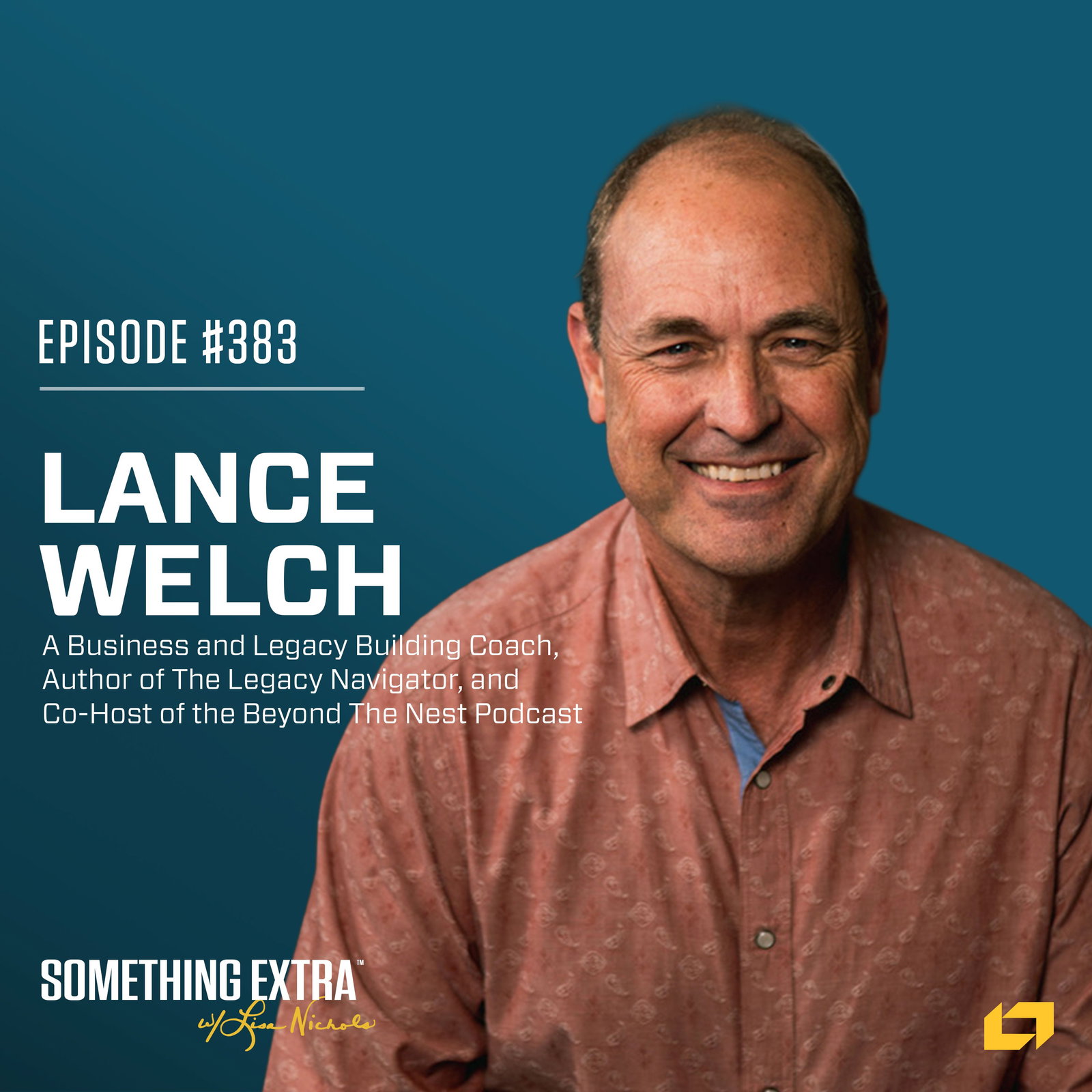
Building a Legacy That Outlasts Your Career w/ Lance Welch
Episode Details
Transcript
Stop viewing your professional success and family life as competing interests and start seeing them as a singular, powerful legacy. Lance Welch, Business and Legacy Building Coach and Author of The Legacy Navigator, breaks down the "Legacy Table" framework to help you transfer vision, values, and knowledge to those who matter most. By exploring the staggering 40% spike in divorce rates during the empty nest phase, this episode provides the practical tools needed to avoid becoming a "dictator" leader at home and instead build a foundation that creates a multi-generational ripple effect.
Guest Links:
Credits: Host: Lisa Nichols, Executive Producer: Jenny Heal, Marketing Support: Landon Burke and Joe Szynkowski, Podcast Engineer: Portside Media
Lance Welch
Everything you do will create a ripple effect in your life. And when we think of it as patriarchs and matriarchs, we get to have generational impact in everything we do. And and one of the concepts that is really kind of the foundational phrase of of the book is everyone leaves a legacy. It's either a default version or an intentional one. But for us to think we don't have impact on future generations is is naive. So the butterfly effect in its shortest form is everything you do matters, and it has a ripple effect that goes on forever. Lisa Nichols
It takes something a little more to lead with impact. I'm Lisa Nichols, author of Something Extra, and this podcast was inspired by our daughter, Allie, whose additional chromosome has shaped how I see people in leadership. Each episode features conversations with inspiring leaders from around the world about what truly defines how they lead and serve others. If you enjoyed today's conversation, please consider leaving a five star review. It helps more people discover the show. And if you'd like to go deeper, my book, Something Extra, is available on Amazon and through other major book retailers. I'm thrilled to have Lance Welch on the show today. Lance is a business and legacy building coach, author of the Legacy Navigator, and the cohost of Beyond the Nest podcast. Well, Lance Welch, welcome to the Something Extra podcast. It is so good to be with you today. I cannot wait for our conversation. Lance Welch
I've been looking forward to this. Lisa Nichols
I have been too. You live in Nashville? Lance Welch
Just about seven o'clock. Lisa Nichols
I told you, we love we love Greg and I grew up in Paducah, Kentucky. We had so many of our friends after college that ended up in Nashville. And, what a town. What a town. I've traveled there just recently for some business, and it is booming. Lance Welch
Still booming. It's and and and no signs of slowing down right now. Lisa Nichols
Right. Yeah. Yeah. So I hope to see you more because I'm hoping to be there a little bit more. So Good for you. But I have to I always love to tell my listeners. And, you know, I think I'm gonna do a little study on this, Lance, to go back and see how many people are connected to Jim Bechtold. Oh. Because Jim Bechtold is the one that connected you and I and said, hey. The two of you guys need to meet one another. And, when I heard about what you were doing, I was just like, you you have to come on the podcast, Lance. I love what you're doing. And then you went on to connect me to Aaron Sanders, who's also been a guest. It it's just it's beautiful just how that snowball effect It is. Worked. Right? Lance Welch
Yeah. Jim is is a he's got the gift of connecting. That's for sure. Lisa Nichols
He does. Yeah. He's got he's got lots of gifts, but definitely connecting. Encouraging is another affirmation. It's another one of his many gifts. I just love having him in my orbit. But, you know, you spent, I think, twenty eight years as an exec at Allstate. Lance Welch
Yes. Different level. Twenty eight? Yeah. Start out in sales and, for some reason, thought I wanted to get into management and just kept climbing. Lisa Nichols
Yep. Yep. So you you were an executive there. For for our listeners who don't know, I'm sure everybody knows Allstate, but it is a Fortune one hundred company. Yep. I think it's the largest publicly held personal line insurance. So, I don't know. That could have changed, but big company. Yeah. Big company, and you rose through the ranks. And I think, you know, let let's just talk about this. What what shaped you in your early years? I mean, you started out in sales, but just kinda tell us a little bit of the journey. And then I've got I've got scads and scads and scads of questions for you, but let's just talk about this for a minute. Lance Welch
Yeah. Okay. So started out definitely in sales. Because I was, you know, I grew up in a pretty poor household. My dad worked three jobs, hourly wage jobs the entire time I I was growing up. So I had a lot of incentive of what can I do with my life? He was an amazing dad, still is amazing dad. I still have him with us. But I knew that I wanted more than that, and, you know, it is so much easier today. I look at what my boys are building. They're they're all three entrepreneurs. Being able to build a business today is a lot different than what it was thirty, forty, fifty years ago. And so I I knew that for me to make a have a better living, a better standard living, I probably was gonna have to go into sales. I'd always been told that sales is either the highest paid, most enjoyable, or the lowest paid, most frustrating. Yeah. So from one extreme to the other. Right. And I just I love the freedom that it provided. I I love the opportunity to be able to, at in in the initial phases, it was all I was very self centered, very egotistical, you know, air my laundry here right at the beginning. But I just wanted to make a lot more money. And it started out in in life insurance sales, and when it became real was when I had to deliver my very first death claim. And it it was to a very young couple. Excuse me. We lived in Shreveport, Louisiana, and very, very unfortunate that it was a random drive by shooting. And totally I mean, most most murders are are uncalled for. This is just random. But when I delivered that death check to that young widow, she was twenty four years old and two two young children, it changed forever how I You know? What did I do? It used it went from me being able to win a trip to for my wife and I to go to a place we'd always dreamt dreamt of going to people cannot walk around without adequate amount of life insurance. And from that day forward, it's it just became a passion to be able to make sure that people did not have to endure the what we now call see the GoFundMe accounts that we see a lot of. Lisa Nichols
Right. Lance Welch
So began to to excel. Won, trips, we got to travel all over the world. And, you know, like most corporations, if they find a a, person who can sell really well, they typically think they're gonna be a good manager, which is not the case. Just because you can sell something doesn't mean you can lead people. But I always loved being a leader. Mhmm. I was introduced to John Maxwell and his content very, very early on and became just a fanboy of of John and what he's built. I'm now a coach within his organization, but, and I've followed him for probably the last forty years. And he has just got the most consistent track record of developing leaders, and he's known as the the world's greatest leadership expert. And so I just began to develop myself as a leader, grew in in the corporate ranks. And, when my boys were probably getting into the double digits, the ten to twelve years old, something clicked in me that realized that all of the content that corporate was pushing down to us as leaders to develop our teams, all I had to do is switch the verbiage from a corporate perspective to a personal perspective. And it was very similar content on what I started building for our family as far as year end reviews, family vision cast, quarterly family reviews, you know, the QFR versus a business's QBR. Lisa Nichols
Sure. Lance Welch
I just love the leadership side of things. And knowing that I had three young men in my house, I wanted them to be equipped to leave the house well. Not just leave. I wanted them to be prepared to leave, and that was kind of my quest into leadership. It was, yes, for corporate, but more so with what I could lead and equip my boys to do. Lisa Nichols
Mhmm. That is so beautiful. I just I love that. So did corporate, like because I know, like, success. I mean, you definitely had success. You I think at one time, Lance, you had three thousand reps, at least three thousand plus reps in fourteen different states. I mean, you were definitely leading. But when you were talking to leadership about this, it's not just, you know, I said leadership doesn't stop at the office. Mhmm. Leadership really, you know, cascades into every piece of our of our life, really, if we allow it to. Oh, we will. But I love that. Were you able to with the people that you were leading, were you able to translate for them? This is not just what you're doing here at Allstate for the business, but you can use these concepts with your family. Were you able to do that Yeah. With the people that you were leading? Lance Welch
We did. And and that was really what led to you know, the my wife and I have a podcast called Beyond the Nest. Yes. There was a a phenomenon that I began noticing that a lot of my my agents, my reps that were incredibly successful, but they were entering the empty nest phase of life, things were beginning to break down. And I began to to notice, and now I've recently found a statistic that actually supported what I saw, is there is a forty percent spike in the divorce rate at empty nest. And so when I began to start recognizing that there was something happening at that phase of life, then it would I love to study. I I love to research, find out cause and effect, and that did give a lot of opportunity to start talking about, you know, how do you succeed at work and home that it's not either or, but it's both and. And it would Mhmm. Pretty easy concept to to to transition into. Lisa Nichols
Yeah. Wow. And you see that so much. Right, Lance? I mean, we can get with work and our careers, we can get so entrenched in that. And then, you know, there's, collateral sometimes, unfortunately, that's left behind. Lance Welch
True. Lisa Nichols
So and so I know that that's you know, we're gonna get into that. That's, like, what you are really passionate about today, both you and Allison. But, you know, I wanna talk about this. So you you're very open. There was you you've got the three boys, and and I know that they're all, like, entrepreneurs, and they're successful. You say they were strong willed. Lance Welch
Yes. Lisa Nichols
Three strong willed boys. You know, I want you to if you can, talk to our listeners about this because you talk openly about the dictator dad phase that you went through. Lance Welch
Yeah. My wife could probably talk about it even better, but, she was always the buffer, between me and them. And, you know, I was I grew up an athlete. Lettered and everything. My jersey's retired. I mean, it was it was my life. My drug of choice was was basketball. Didn't get into actual drugs, but my my drug of choice was just as devastating because everyone had to take a back seat to that. And in the younger days, used to well, it's it's it's true now. I can say it used to be the concept of just kill them all and let god sort them out. I'm a high d on the disc profile, and I only had fun if I was winning. And so it was it was it was a drug that really drove me and, just about cost my marriage in the early days. And, you know, just the grace of God that we've been now married just over thirty eight years. So there is hope for all of us. Yes. And my oldest son, he is also a very strong willed, type a personality. And in the younger days, I I can remember so many times I can even get pictures or envisions now, the looks on some of their faces. It's like when you say things, you can't take those words back. But you can see that you talked earlier, collateral damage. You could see what you did. And my wife was always the buffer between me and them. And it was only through growing as a leader that I was able to realize, you know, I could I could lead just effectively at home as I did at work. And I can remember several times my wife would say, I wish you would study us and how to communicate with us as much as you studied your agents and how to communicate with them. Lisa Nichols
Wow. Lance Welch
And that was kind of a hard wake up call. It's like, I did. I spent an enormous amount of time to become a better leader in the corporate world. Yeah. I didn't until later learn that, you know what, I my family deserved every bit, if not more, attention on how do I study them and learn their language patterns, how can I motivate them to to grow in the areas that I want instead of just being the dictator and making it trying to make it happen? Mhmm. That makes sense. Lisa Nichols
That'll preach. That'll preach, Lance. That is so good. What do you think I mean, you know and, obviously, your boys have gone on to be successful in that. But what what do you think your family was feeling during that time? What do you what do you that dictator, what do you move from? I think it was you, and I could be wrong on this because sometimes my memory fails me. But I feel like you may have said to me, you know, you kinda move from even a coach to a consultant. As your kids get older. You know? I think you're the one that said that to me, Lance, and I thought that is so good because, really, a consultant as they get older, you know, they're asking for your help. Right? Yeah. Instead of you going, let me tell you how it is. Let me tell you what we need to do. Right? So, you know, maybe there is a listener out there that's like, gosh. I feel like maybe that's me, you know, that I'm more of a dictator. You know, what are some of the things that you can start doing? But, you know, you you talked about studying your family, but how do you move from that dictator to more of that consultant type mindset with your children? Lance Welch
Mhmm. Well, I think just like anything else, there's gotta be a level of awareness that that something isn't quite working. And, you know, was it Einstein said that it's it's the definition of insanity to continue to do what you've always done and expect different results. Lisa Nichols
Right. Right. Lance Welch
And, you know, so if something isn't working, it does not make sense to keep doing the same thing. And one thing that we have learned as parents of you know, I would say this would be go going to parents of, mid to upper teens into young adults, is if we continue to dictate how to do things, we are literally robbing our children from being able to learn how to do things on their own. Society rewards, obedience. It doesn't always reward strategic thinking. But the the value prop comes in when you're able to think through solutions. And and our society doesn't always appreciate that. I know that when I used to take the boys and check them out of school to take them to John Maxwell events, the teachers thought that I was ruining their education, and I saw it exactly opposite. You know? So they that was counted as an unexcused absence for them, but they didn't appreciate that. And I'm and I was totally okay with that because I wanted my boys to be, in environments that were bigger than them, that were over their heads, and they didn't understand what John Maxwell was talking about or, any of his speakers when they were thirteen, fourteen years old. But all three of them will tell you that those were some very instrumental days for them to recognize, one, dad cared enough to go against status quo. Lisa Nichols
Right. Lance Welch
It taught them to really how to think for themselves. But back to the what your really question was is, are teenagers, upper teens and young adults, they will grow to the extent that you allow them to grow. And what we learned the hard way is that age group, they don't wanna be fixed. Even if you, as a parent, feel like they need to be fixed, they don't wanna be fixed. Anytime we, as an adult, look to address something that our upper teens or or young adults don't ask us for, it is viewed as criticism. And that's that was a hard lesson for us to learn is unsolicited advice almost always comes across as criticism. Lisa Nichols
Yeah. Oh, that's good. That's good. That's gold right there. Well, you know, as you were talking, Lance, I just I just thought about this. And it's like that dictator dad is speaking to their head Lance Welch
Mhmm. Lisa Nichols
But you're certainly not capturing their heart. Lance Welch
Correct. That's a good word. Lisa Nichols
In fact in fact, you're pushing that piece away, I think. Right? So yeah. That's so good. Well, for you, what were some of the hardest habits to unlearn moving from, you know, the dictator dad to more the consultant dad? What were some of your habits that you had to unlearn? Lance Welch
The the I'd say the hardest one for all three of them was that I knew the only right way to do something. When we continue as parents or even as leaders this is something we talk a lot with a lot of my clients. Ask your your your subordinates what do they feel like the right solution would be. Even if you know the I the right way to do it, chances are it's not the only right way. And if we're gonna talk about the the child parent scenario is if I will ask them, I will be amazed at what they will come up with. But as long as I just keep telling them what to do, I literally I'm it's like I'm cutting them off at the knees, and I'm robbing them of the ability to learn to think. So the hardest thing for me was to not always step in and, quote, fix things. And it's so much easier. I I a phrase we use a lot with our kids, always have is it's you you can choose your inconvenience. It is inconvenient for me to ask my sons, even to this day, what do you think? I can I can tell them what to do in Lisa Nichols
about five Lance Welch
in about five seconds? Yeah. Or I might take fifteen minutes to ask them, what do you think should be done and walk through the process. So it's inconvenient to take that extra time to ask them the question. But if I refuse to be inconvenienced now, I can promise you I'll be more inconvenienced later. Lisa Nichols
Yes. Oh, that's good. That's good. You know, Lance, you know and I know you have a book too, and we'll talk about it, but the something extra book, it just reminded me of a few things. So I start the book with humility. Mhmm. And if you think that your way is the only way, That's the opposite of humility. Lance Welch
Right. Right. Lisa Nichols
Right? That's the opposite of humility. And then the other, you know, leadership trait, character trait that I was thinking about, also a fruit of the spirit, is patience. And I know for myself, sometimes, I am not long on patience. I'm short on patience. Lance Welch
Yeah. Lisa Nichols
So what you just said, I can tell them in five seconds Lance Welch
Yeah. Lisa Nichols
Where it might take me fifteen minutes to explain, but the inconvenience now is going to save you in the long run. And I just think that's gold. That is gold. Lance Welch
And your willingness to be inconvenienced now, it is literally, in my opinion, setting them up for success later, which obviously reduces my inconvenience later. None of my boys are on my payroll anymore. They've all moved out. They're they're they're spending on their own two feet. I I've got two amazing grandchildren that we get to just spoil. So, yeah, it's a matter of, choose your inconvenience. Steve Harvey had a talk a while back. He was he called it choose your hard. Same basic framework. You know, choose your inconvenience. You you can choose it. You can be inconvenienced now or greater later. It's your choice. Lisa Nichols
Yeah. That's so good. That is so good. Well, I wanna ask you one more question, and then we need to take a quick break. But you and Allison have a podcast called Beyond the Nest. I would really, really, really highly recommend our listeners go get that podcast. Do you guys, does a new one drop every week? What's the cadence for you guys' clients? Lance Welch
Yeah. Usually, it comes out every Tuesday morning. Lisa Nichols
Every Tuesday morning. Okay. Well, we'll put it in the show notes, you know, how people can listen. But what do you think you know, because somebody might be sitting there right now and going, oh, you know, yeah. I'm a little lost. I'm a little lost right now because we're in this empty nest or that empty nest is coming. Mhmm. You know, What are some of the things that couples can do now, you know, lenient to keep from and and, you know, you gave the one statistic, which is a staggering statistic, forty percent. Yeah. Going through divorce in that empty nest. Lance Welch
Well, it's actually it's actually worse than that. It's a forty percent spike Lisa Nichols
A forty percent spike. Lance Welch
In the empty nest. Yeah. So which way it's going to be there, it's bad as we know. Lisa Nichols
Bad as it is, but it's goes it goes up in that case. Give us some practical things that a couple can do now to prepare for that. Lance Welch
Oh, man. First thing is don't do it alone. You know, there's such value in in community, either your own local community, you know, your close circle of friends, is a huge, huge benefit. Resources today, Lisa, there's so there's so many more resources today. Internet opened up the world to that. YouTube, the podcast, books. What we note, there's not a lot of books, though, with this this segment, empty nest phase. There's a ton of books on what to do when you're expect you know, the toddlers and the the younger age, but there's not a lot of resources out there. But the number one thing is don't do it alone. Don't believe the lie that no one else knows what you're going through, has ever they've never experienced this, depression. I was visiting with with someone we're gonna do some collaborative work, with here pretty soon, and him he and his wife have a business together. He's an event planner. She's a travel planner. And then when they asked you know, we got through the business side of what we're looking to do with them. They asked what I did, and I end up telling them about the Beyond the Nest. The call went a totally different direction. They are getting ready to be in an empty nest phase, and the mom has been dreading it for for two or three years already. She's beside herself. And if she wants to have a conversation with with Allison just because she is scared to death of Yeah. What's gonna happen. So the number one thing is get in community. You know? Find resources Lisa Nichols
Good. Lance Welch
And don't do life alone. The other is to recognize that our job is to equip our kids to launch. Right? We don't It's Lisa Nichols
a natural order. Good. Right, Lance? Lance Welch
There was a a early book. I've always been a massive reader, but, there was an author. He's passed away now. He's a guy named Steve Farrar. Wrote many, many good good books on you know, if there's any dads that are looking for parenting or dad type books, the number one thing I would do from Steve is one called The Point Man. Fantastic book. But in one of his books, he tells that his dad told him when he graduated high school, he said, play the man. Shook his hand, not a hug, but shook his hand and walked away. And he said the rest of the drive to school, he's trying to figure out his words. He said, what the hell does that mean? We had no idea what did it mean to play the man. And that always stuck with me. It's like, my boys are not gonna have to ask that question. You know? So a lot of it, we get to learn either by our own trial and errors or ideally, we get to learn from someone else's. But sometimes we're just stubborn headed, and we're gonna learn it our own hard way. But the number one thing for me is learn from others. Lisa Nichols
Yeah. That's good. That is so good. Well, Lance, we need to take a quick break, and we'll be right back on the Something Extra podcast with Lance Welch. AD
In business, the tendency is to seek out partners who are bigger, faster, stronger. When it comes to IT, you should be looking for smarter, faster, better. That's just what you'll find with the talented technologists at Technology Partners. Our experts develop custom solutions to tackle your most complex challenges, all to simplify your processes in the smartest, most efficient way possible. The time to be swift and nimble starts now. Go to technology partners dot net slash solutions and see what's possible. Lisa Nichols
Welcome back, everyone, to the something extra podcast with my friend, Lance. Well so, Lance, I read a blog that you wrote in twenty twenty three about the butterfly effect. And, you know, you talked about well, I don't wanna I don't wanna steal your thunder here, but it was kinda something about the Nobel Prize and that sort of thing. Can you explain what is the butterfly effect? Lance Welch
Everything you do will create a ripple effect in your life. And when we think of it as patriarchs and matriarchs, we get to have generational impact in everything we do. And and one of the concepts that is really kind of the foundational phrase of of the book is everyone leaves a legacy. It's either a default version or an intentional one. But for us to think we don't have impact on future generations is is naive. So the butterfly effect in its shortest form is everything you do matters, and it has a ripple effect that goes on forever. Lisa Nichols
That's so good. That is so good. Well, let's talk about your book. K. Because you released a book early twenty twenty four, I think it Yeah. Was. Got it on Audible, called the legacy navigator. Tell me why you wrote the book. Tell me a a little bit about the book. How was that experience? Because, you know, I just wrote my own book, and it is an experience. Lance Welch
It is indeed. And and I laugh because, I just turned sixty this year. My wife and I both turned sixty. We had our thirty eighth anniversary. We had just an amazing family trip. But we, when it's like, it doesn't matter how old you get. You still have moments of, did I really say that? And and I it started with me asking my oldest son who who's got a really successful podcast of his own, millions of downloads a month. He's got a very successful business. But I asked him. I said, hey. Why don't you give dad some referrals for my coaching business? And he said, well, why don't you create some content so I can say, hey. Check out his content instead of, hey. Work with my dad. Right. And I'm like, like, what? And he said, write a book. All the boys, my wife, they they said I should have written a book a long time ago, and I just did not ever see myself as an author. And, you know, our identity is such a powerful thing. Lisa Nichols
Yes. Lance Welch
It it took probably a year into the book after the book launched before I was even comfortable saying, yeah. I'm an author. I don't know why I had to hang up on it, but I did. But, anyway, so I'm thinking, alright. I'm gonna write it on sales. I've been in sales since college. The first sales job I had was selling water Lisa Nichols
know. Water Lance Welch
and cookware door to door. Talk about rejection. So Yeah. I got about a thousand words in, and it was, like, such a roadblock. It was so painful. I didn't even enjoy it. So I was like, I'm gonna write something else. I'm gonna write on leadership. John I've read so many books of John Maxwell's. I'm like, I could recite most of them. This will be easy. Again, I got it about a thousand words in, and it was just painful. I just did I wasn't enjoying the the experience at all. Mhmm. And I have an exercise that that I call give giving the pen. I'm talking about giving God the pen, and and I just sit and I listen, and I'm I'm just writing down thing whatever thoughts hit my head, I'm just writing them down. And this particular day, I felt like the question is, well, what are you really passionate about? And the first word that hit my head was a legacy. And it's like, oh, well, what if I were to write about a legacy and do a study? What does legacy actually mean? Because most people when they hear leave a legacy, they automatically think of finances. Lisa Nichols
Financial. Right. Lance Welch
It's not even that's not it at all. But so once I got on the topic of legacy, I never stopped writing. I mean, I was done then in about four months of writing the rough draft. And it's it's not a long book. It's a three hour listen on Audible, you know, a hundred Right. A hundred and forty pages. But I didn't have a problem ever sitting down and writing two fifty to a thousand words. But it was like once I figured out what god wanted me to write about instead of what Lance wanted to do, all of the information just began to flow. It was not hard to write. I mean, this sounds I don't want to sound arrogant, but it's like, I'm now pulling from thirty years worth of working with high net worth families in the different sectors of what I got to do. And it's it's got a lot of life examples in there, a lot of true life examples, a lot of application questions. It I didn't want the book to just be read as a piece of entertainment. I wanted it to be generational impact. I wanted there to be exercises in there that if people were serious about it, they weren't not gonna have to reinvent the wheel. They just have to follow through on the, yeah, on the chapter implementation sections. Lisa Nichols
Mhmm. Yeah. I I love that. I think that's so important because I did the same thing with my book. I'm like, I don't want people just blowing through. I want reflection questions and exercises that they can sit with. You know, you walk through a legacy table, and you say that there's four legs. Most tables do have four legs. Yeah. Stool sometimes have three. Right? The tables have four legs. Speaker 2
Yeah. Lisa Nichols
So what are the four legs, and why do all four legs matter? And to your point, a lot of times, I do think, Lance, people, when they think about legacy, they think about the financial inheritance that they're gonna leave. But it is that is, like, a minute part Yeah. Truly Lance Welch
Yeah. Lisa Nichols
Of the whole Lance Welch
And and the legacy table, I give credit to Allison on this. Again, she used to tell the boys when they were younger, boys, you will always have a seat at our table. You may not want it, but the seat is always there for you. And so that framework, it was like no matter what the boys did, which they did plenty of bonehead things. They still do. They're a Welch. They will always always They're a Welch. Have a seat at our table. That it's a non that's a given. So it was from that framework that's like us began to build around. What does the table do? We know what the power of family meals and all this is. No argument there, but I use that as a framework of if we were to assign a value mechanism to each one of the legs, what does it mean? So leg one, it was vision. Leg two is value. Leg three is knowledge, and then leg four is the wealth. And each each one of those legs, we walk through how do you transfer your values to the next generation? Well, it is incumbent that you know what your values are first. Lisa Nichols
Yes. Lance Welch
Right? And then there's an exercise in the back of the book that helps people walk through what are your core five values as a family. I would say ninety plus percent of America has everyone operates from a value base. I I'm not saying they don't have values, but I mean Lisa Nichols
haven't defined it. Lance Welch
They haven't defined it. Lisa Nichols
They yeah. They haven't written it down. Lance Welch
No. And this exercise allows a husband and a wife, if if it's a couple, if it's a single parent, god love you. Do the exercise because what it does is it helps you ground every decision you may now make based upon a proven method of these are my values. I went through the exercise, and this is what it means. Mhmm. And then you know, so each one of the legs, there's exercises in the book to get to it. But to your point, the the wealth leg, which is the fourth leg, the reason it's the fourth one is if I've done leg one, two, and three well, there's an entire industry set aside that makes leg four incredibly simple. Mhmm. Mhmm. Lisa Nichols
Yeah. That is so good. I just I love it so much. I would encourage our listeners because I do know people. You know, I've got a friend, Matthew Porter, that was a tech exec, entrepreneur, CEO, then tech exec. Lance Welch
Yes, ma'am. Lisa Nichols
He does that with his family. He's got a vision. He's got a value statement. Rick Lytle, who is another Rick and Jeannie Lytle, he's the CEO for CEO Forum, has done that with his girls from the time they were little. You know, they do, you know, vision boarding and, you know, they've got a mission statement as a family. And I just I think goodness gracious. We spend so much time, Lance, with our businesses Lance Welch
Yeah. Lisa Nichols
Coming up with our core values and our mission and our vision. Why aren't we doing that with our families? Lance Welch
Right? One of the number one questions I was asking thirty years ago. Yeah. Lisa Nichols
Yeah. I agree. I agree. Well, I wanna ask you this. You you know, and some people may think this is morbid. I don't think it's morbid. I think it's a good exercise, but you talk about a powerful story about reading your own obituary. Yeah. And it's a very transformative exercise. So it's kind of like I think about Covey. You know, start with end in mind. What do you want people when you're gone at your funeral, what do you want people to say about you? And you then you work backwards. Right? Lance Welch
Correct. Lisa Nichols
Can you talk about that story and why that it's so powerful? And people might feel weird about that, but you know? Lance Welch
Yeah. No. I love the story, and and most people don't don't know about it, but, and I'm I'm sure assuming you're talking about the two brothers from, the the diminutions expert. Is that the one you're talking about in the book? Lisa Nichols
Yes. Yes. Uh-huh. Lance Welch
So there were two brothers in the late seventeen hundreds. Alfred and Ludwig. They were brothers and both incredibly successful businessmen, but Ludwig passed away. And in error, the journalist that was writing the obituary wrote it about Alfred, the younger brother. And so when Alfred opened up the the paper and was beginning to read thought he was gonna read his brother's obituary, he was actually reading his own. And this was written by a third party that was labeling him as, the the king of death, the munitions expert, just obliterated him. And he was reading this thinking, this is how I'm viewed and immediately decided that this would not be my legacy. And he was worth hundreds of millions of dollars even back then. And he made the determination then that he was going to set up a foundation to reward those who worked in the peace efforts that brought peace to to the all the communities and societies. What's interesting, and I didn't even put this in the book, when he made that decision, he only lived another five years. So it wasn't like he had decades and decades to build on what he started. Yeah. But most people had recognized that even though he made a determination and only to to change the way he was gonna be viewed and only lived another five years to make it actually happen. His legacy has now made worldwide impact ever since. You know? So Alfred Nobel was his name, and we now know it as the Nobel Peace Prize. Lisa Nichols
Right. Lance Welch
Reading his own obituary was allowed him to have an awareness. Now we say you cannot address what you're not aware of. Mhmm. But once he became aware of it, he decided now is the time to change. And so I believe, honestly, that's where this exercise came comes from. You hear a lot of coaches and consultancies that will say, hey. Write your own obituary the way it is now. Write it the way you want it to be. What is the gap? And now how do you address it? I really believe it probably came from this Alfred Nobel Peace Prize story. Lisa Nichols
Yeah. I absolutely love that story. That'll be a story that sticks with me. Right? And so what I take away from that what I take away from that, do the exercise, first of all. Lance Welch
Yeah. Lisa Nichols
Figure out what the gap is. But, Lance, it's not too late. Lance Welch
Never. Lisa Nichols
You can change that. Right? You can change how you're gonna be viewed. And so, yeah, that's so so beautiful. I love it. Well, let me ask you this. What, you know, what's the role that faith has played in your journey? Lance Welch
Oh, man. Everything. Everything. The just the the acknowledgment that, well, one, I'm not alone. I am not a creator. I'm not God. There is God, but and I am not him. I honestly believe that I would not be married at this point. Our first couple of years so, you know, the first year was wonderful. Years two, three, I wouldn't wish on anybody. And we, you know, we talk about that in in one of the podcasts. You know, we had a a newborn, and she went home. She left. And her daddy sent her back. And That Lisa Nichols
was good for him. Lance Welch
It was. And it was a really good lesson for her, but also for me, but it was it was one of those wake up calls. And there was a a young I say young man. He's about two years older than me, still one of my closest friends. We don't we're not in the same states anymore. But, Lisa, when I talk about community, when I mentioned that earlier, there was a young man. He was probably two years older than me. He was an amazing tennis player, and mine was basketball, but he was teaching me how to play tennis. And I had carefully constructed these walls around me that you only saw what I allowed you to see. Mhmm. You know, we might have a fight, Allison and I, on the on the way to church, but when we got out of the vehicle, we're smiling. Everything's great. Lisa Nichols
Right. Lance Welch
We pulled into the driveway one day after playing tennis, and he goes, hey, buddy. Can I tell you something? I'm thinking he's gonna tell me something about tennis. And I'm like, yeah. Sure. He paused for a second, and he looks at me. He goes, you're being an ass to your wife. Caught me completely off guard, and it made me so mad Because I'm like, who who gave you permission? Are you. Yeah. Who are you? And so we had a little bit back and forth, and it ended with, hey. He goes, I'm sorry I offended you, but he I just want you to know you ever need me. I don't care what time. It could be two AM. You call me. I will be there. And I told him, don't hold your breath. I was so mad. Unfortunately, within the week, we had had an a a spat over something probably stupid, and I ended up punching a hole in the sheetrock. And then I looked down at the clock, and it was one fifty eight AM. And his voice came back, and I'm like, I'm gonna I'm gonna I'm gonna call. I'm gonna see what happens. Lisa Nichols
Type him up on this. Lance Welch
He was there in about ten minutes. I had never Lisa Nichols
allowed to your house? Lance Welch
He came to my house. Wow. I had never once allowed anyone inside this these parameters. Yeah. And once I did, I'm really like, there's some freedom in this. I started to go into he led a men's group at our church, and I started learning that other men actually had a fight with their wife on occasion too. I realized that I had been doing it the hard way and doing it along, alone all that time. So from a faith perspective, it was such a wake up call to have someone be so brutally honest. They cared about me enough and my marriage enough to be brutally honest. Yes. That is priceless. It is priceless. Amazing. Lisa Nichols
It reminds me of my guest that was on last week, Lance, and, he talks about having a corner man. And he's like, you gotta have a corner man or a corner woman. You gotta have that one person, accountable, women holding one another accountable. And I know for me, I've had people like that. You know? I've had I've had one lady, and I'm telling you, you know, I mean, she she got a hard conversation with me one time and said, Lisa, you are not honoring your husband right now. And kinda to your point, you know, at first, you're like, what? What are you talking about? No. She was older. You know? She's probably about ten years, older than me, but I respected her. And I knew that she loved me, and she, you know, she was and I'm telling you, it was a pivotal point for me in how I how I viewed that. So Yeah. Yeah. I mean but it's hard. I'm not gonna lie to you listeners. If you're out there and you're feeling like you're on an island, get off the island. Get off the island and get get in community with somebody. So, yeah, so important. Well, let me ask you this, and and maybe this would tie into it. If someone's listening today, Lance, and they realize they're really off track they're off track. They're not in alignment in their life. What is one step one step that they can take today to change their legacy? Lance Welch
Oh, wow. There's so many things. For me, from just a faith based perspective, is slow down and, lean into the quiet. And for me, ask God, where do I go from here? Lisa Nichols
Oh, that's good. That's good. That's good. And he promises that when we call on him, he will answer and show us things that we do not know. Yeah. So that's a beautiful world world. Lance Welch
Oftentimes, it's it's the quiet whisper that he's leaning into for us. And that's why I'd like get into a quiet place, embrace the stillness, the quietness. We are addicted to busy as a culture, and to busy, it's usually chaotic. It's noisy. It makes it really hard. Doesn't mean that God can't get our attention. But if if I can acknowledge I am off track and I wanna fix it, I'm believing that there's enough discipline and willpower to to slow down, lean into the quietness, and just ask the question. Where do I go from here? Lisa Nichols
That's beautiful. Well, let me ask you this because I ask every guest this question. What is the something extra that you believe every leader needs? Lance Welch
Oh, man. I think you nailed it to begin with humility. Yeah. Humility is it goes so far, at work, at home. It is incredibly hard to argue with my wife when she's leaning into humility or vice versa. Right? It just kinda nips it in the bud. Same with dealing with your your teenagers or your adult children. Humility will will stop most arguments. Lisa Nichols
Yeah. That's good. That's a good word. Lance, I knew this was gonna be good. I knew it was, and you, this did not disappoint. Thank you so much for being willing to share your wisdom, and, I just pray that it helps people. Lance Welch
Amen. Lisa Nichols
I know that it will. I know that it will. So thank you, my friend, and I hope to see you in Nashville face to face. Lance Welch
I look forward to that. We'll make it happen. Lisa Nichols
Yes. Absolutely. Announcer
Something extra with Lisa Nichols is a Technology Partners production. Copyright Technology Partners Inc, twenty nineteen. To learn more about this week's guest, check out the show notes at tpi dot co slash podcast. If you enjoyed this episode, consider leaving us a review. Thank you for listening to Something Extra.