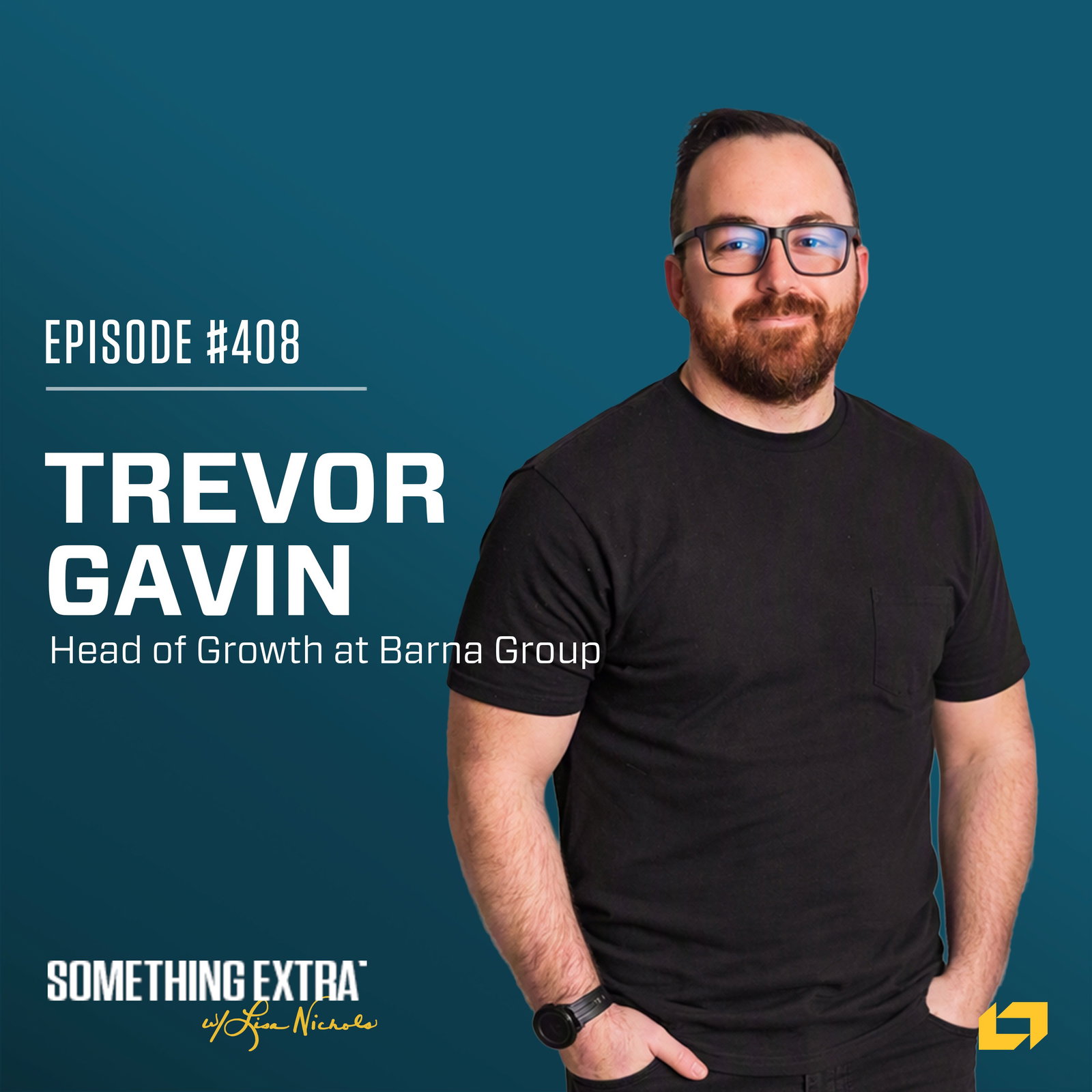
Breaking the Exhausting Cycle of Pure Achievement w/ Trevor Gavin
Episode Details
Transcript
This week, dive into an honest, game-changing conversation with Trevor Gavin, Head of Growth at Barna Group. Trevor pulls back the curtain on the hidden trap of tying self-worth strictly to professional output, detailing his journey from early burnout to cultivating profound emotional and spiritual health. Listen in to discover how intentional silence, curiosity, and deep inner healing can transform the way you show up for your work, your family, and yourself.
Guest Links:
Credits: Host: Lisa Nichols, Executive Producer: Jenny Heal, Marketing Support: Joe Szynkowski & Dylan Price, Podcast Engineer: Portside Media
Trevor Gavin
I'm thinking through a lot about productivity and a lot about leadership, and, and I think I certainly believe the lie that if I if I just get smarter about how I work, then I will overcome the internal obstacles. And I do believe that God hard... Hardwired us, designed us to create, to cultivate, to have dominion, and and and he gives gifts. And so it's not to try to divorce these things or pit them against each other, but how do we become, grow in holistic, humanity? Lisa Nichols
It takes something a little more to lead with impact. I'm Lisa Nichols, author of Something Extra, and this podcast was inspired by our daughter, Ali, whose additional chromosome has shaped how I see people in leadership. Each episode features conversations with inspiring leaders from around the world about what truly defines how they lead and serve others. If you enjoyed today's conversation, please consider leaving a five star review. It helps more people discover the show. And if you'd like to go deeper, my book, Something Extra, is available on Amazon and through other major book retailers. Joining us today is Trevor Gavin, head of growth at Barna Group. Trevor's career spans executive sales, growth leadership, and pastoral ministry. He joins the show to share his personal journey of shifting from shame driven achievement to leading from true identity. Well, Trevor Gavin, welcome to the something extra podcast. I am so delighted. Oh my gosh. We've already been having an incredible conversation before we even started. Trevor Gavin
Yes. Such an honor to be here, and thank you for making the time for it. Lisa Nichols
Yeah. I'm excited. I'm excited for our listeners to hear your story. I'm excited for them to learn more about what you're doing, today. But, you know, I'm just gonna start. How many of my podcasts... I'd like to go back and say, how many of my podcasts does start with Jim Bechtold? Trevor Gavin
Yes. Lisa Nichols
Jim Bechtold connected us, Trevor Gavin
and he Lisa Nichols
said, Louisa, Trevor's story is amazing. It's incredible. You have to meet him, and and, and we did. And, I'm just... I'm really just delighted to have you here. But let me just start by saying, what part of your story do you think people need to understand now, you know, to really understand who you are today? What what part of your story? Trevor Gavin
Yeah. There's, there's a quote that I read a while ago that has been so meaningful to me, and the quote, basically goes like this. Most people spend the first half of their life building a ladder, trying to climb up the rungs and whatever it is towards achievement, towards their goal, to realize at the beginning of the second half that they've leaned it against the wrong wall. And that story for me, that, tells a lot about how I have experienced, growth, how I've experienced ambition and drive both just in life generally, but in business in particular. And then to realize, as I'm transitioning, looking at second half of life now and where I, where I wanna go and in my life and growth and maturity that, a lot of the first half of life was spent building out of, mixed motives to be sure, but, was largely driven by, a lot of fear and some shame. And that comes through my past through, a lot of my story. But being unaware of it for a long time and what was motivating me and the complexity of it is I kept getting rewarded and affirmed for the things that I was doing outwardly, but being completely disconnected to what was going on inside of me as what was motivating me to do these things. Lisa Nichols
Yeah. Well, I tell you, that part resonated with me because, you know, you said that you let out of achievement. Trevor Gavin
Yep. Lisa Nichols
And work was where you went to actually prove yourself. And, Trevor, I don't think that is unlike a lot of people, myself included. I've been there before too, you know? But when did you first realize... What was your turning point where you realized that you had tied your achievement, you know, to your value rather than your identity? Trevor Gavin
Yeah. There's actually... So there's two stories that come to mind on that. The first one is my... The way I grew up, I had great parents, but my mom got sick really young with a disease called Addison's disease and it functionally changed our entire life. You know, we went from having family dinners and schedule things to my dad working to try to be the sole. And so the culture that got created in our household was unspoken, but as we need to survive, and it's all hands on deck. And so what came from that, for me was a strong level and a need for protection and independence. And so I just kinda had to figure out how to do things on my own because my mom needed to be taken care of. My dad needed to provide. I was only seven years old at the time. And so that independence, actually became a source of motivation and achievement because I learned at an early age to kind of figure out things on my own that I shouldn't have at that time thinking back on it. And so that was that was already in me. And I think God has hardwired me towards, being decisive and action and things like that. But there's a a shadow side to all of those things even in the way that God wires us. And so, so that was a big part of my story. And then when I was, when I was nineteen, my dad died unexpectedly. And my dad and I were, best friends. And despite, despite all of the challenges that were going on at home, I never, I never remember him missing a football game, a football practice, or anything like that. And so my dad died unexpectedly at at nineteen. And because of my mom's illness, it again kinda threw in another level of need for independence and provision. And so from that point on, I then kicked into overdrive towards achievement. And at the time, you know, I didn't go to college. I actually had dropped out of junior college. I was in pastoral ministry. I felt a call to go plant a church with my wife, in a different state. And so we got married at twenty one. We had our first daughter at twenty three. We went out and planted our first church at twenty three. And then we also were part of co founding a fintech company at twenty three. And so for me, at that age, I had nothing but energy and drive. And so I used that, and I... And it was for all good things. I was trying to provide for my family. I was trying to fulfill, this call that was on my life. And then at twenty six, I had two different things happen that, that changed everything for me. Number one was a burnout. I just did not have the emotional capacity, the chronological maturity, the boundaries, the limits in place to slow down. And so my body did that for me. I really like the flying either. You get to choose a Sabbath or a Sabbath will be chosen for you. And, the first option is much better. But the second option, the second option happened to me. And so when that burnout happened, I was struck with the reality that I could not produce at the way that I wanted to, and my body would not allow me to do it. And so that was the one of the first times of looking back and going, well, if I can't do that, what am I worth then? And I had established an identity without it being conscious at all, that my value and my worth from God was based on my production for, for him. And so it felt a bit employee employer relationship. And then, on the work side, if I couldn't produce the same way that I had been, then what value am I worth to my wife, to, my friends, to anybody else? And that had all been running under the surface that I was completely unaware of. And so I had to, that that has been a long journey and continues to be a long journey because I tend to look at life a bit black and white, and it's either a win or a loss or success or failure. And so there's not much curiosity there for me at times. And so that led me to, believe that I'm a failure, which led to deep shame. And the only tools in the toolbox that I had at the time to know how to deal with shame was to try and outwork it. And so therefore, I tried to put in more to to be able to overcompensate for the shame that I couldn't even identify at the time because it was just running under the surface unquestioned. And so that was a crisis for me. And then the second one was unrelated to, business or anything. But we had, when we had our first daughter who was also named Allie. When she came out, it was, you know, classic. I think every every parent can relate to it. I just I fell in love with her the second I saw her. It's my daughter. She's my little girl. We were attached and bonded, immediately. And then, we got pregnant with, our son, about three years later. And when he was born, I felt I... That that same thing would be true. And now I have a boy. I have a sports background. We're gonna be able to play catch together. All all of these things. And when he was born, I did not have that attachment with him. And it was very disorienting for me. And so I kind of thought through it. I go, well, maybe it's, it's the second child. It's different than having a first child. Maybe, you know, the attachment, will come. And for probably about two months, I felt a disconnect between me and my son. And that showed up, and I tended to wanna hold Allie and take care of her more and not so much with, with my son, Bear. And about three months into it, I was holding him one day, and I had, an epiphany, in the moment. And what happened in that moment is I felt, this deep sense of grief, which was, I think I was trying to protect my son from me dying early and having to go through what I went through with my dad. Mhmm. And so in a very subconscious way, I... My body was saying, if I create distance from my son, then if I die young the same way that my dad did, then he won't have to feel the things that I still feel today, that I still go through. And I had this really profound moment between me, my son, and God, which was either I lean into this because I don't I don't know how many days I get. And I love him with everything that I have, the way my dad did for me. And whatever is going to be is whatever it's going to be, I don't get to control that. Or I protect myself in a way that I think that I'm trying to protect him. And then I ultimately know I will likely sabotage our relationship. And so that was, as I was unpacking that there was a lot of control. There was fear. I didn't want him... I don't want him to have to go through what I went through. But I had a moment to make a decision there, and I've had to continue to make that decision. And now my son and I have an incredible relationship. And, and I love him, you know, with all of my heart. But that, that moment spoke to me about, well, this is actually how I live. I'm trying to protect myself because I'm dealing with, fear of death, of control, of grief Lisa Nichols
Yes. Trevor Gavin
Anxiety, fear of failure. And so now I have these two things that are happening when I was twenty six, where I'm trying to chase a ghost and making my father proud, who I don't have. I I don't have him to look to wisdom how to navigate this situation. We also ended up, exiting the company when I was twenty seven with a successful acquisition, and that, you know, has its own, challenges and great things around it. But I have this opportunity, where I'm trying to chase this ghost, and that's leading me leading me to greater achievement, which is ultimately not fulfilling what I wanted to fill, which is leading me to greater shame. And then I have this protection thing where I have, this fear and anxiety that is also leading to shame about how I'm showing up with my family. And all of those things kind of hit right around the same time and, and forced in a really loving way for me to rethink the way I'm showing up and the tools that I have in my tool belt are not the tools that are going to help me get to where I ultimately want to go. And then I gotta figure out what do I do with that. Lisa Nichols
Mhmm. Gosh. Trevor, thank you so much for your vulnerability with all of that. I was just... I spoke at a group on Friday, and the whole the whole theme of this conference was AI, the human humanity in the age of the era of AI. Yeah. And that is one thing nobody else can do for us. It's something a machine cannot do is the inner work. I mean, you've done a lot of inner work. You've done a lot of inner work, and I think, you know, so many people just go through life, and they don't wanna go there because it's too hard. It's hard. Trevor Gavin
It is. Lisa Nichols
Inner work is hard work. Trevor Gavin
Yes. Right? Yes. The disorientation of it all. Mhmm. And especially when I'm trying to be productive, I'm trying to produce, I'm trying to grow. Yes. You know, that all felt like wasted time, because I need to get back to accomplishing these things. Lisa Nichols
Yeah. Trevor Gavin
And and yet the rub between it is, that I wasn't becoming the type of person. You know, one of one of my favorite quotes is, the best thing that God... The best thing that the world gets out of you is a transformed self. And so I started to think through, well, who who is the type of person I'm becoming? And if I fast forward five, ten, fifteen, twenty years, do I like that direction? Is that who I want to become? And my fear was at the time, and this is part of my past. I have a lot of divorce in my family through generations. I have, alcoholics and all these different unfortunate things in my family line that have, really terrible decisions that have hurt generations. And so when I looked down the future a bit, what I saw was someone who outwardly was very successful, had a really good LinkedIn profile, drove a good car, but both individually and as a family, were completely deteriorating. And, were an absolute mess. And those, that didn't seem like a win anymore in the same way that it did prior. It wasn't a trade off that I wanted to make anymore. But I didn't really have any tools to know how to... Okay. So now what do I do? Lisa Nichols
I mean So what did you do? I mean, the tools were, you know, work harder. Just work harder. Work harder. Yeah. Right? But what what tools did you start to put in your tool belt so that you could be a different person and show up differently? Trevor Gavin
Yeah. And that was the, I wanted... There was a line given to me by a mentor, which was I wanted to become the type of person for whom it was more natural to do the things that Jesus didn't, or I wanted to become the type of person for whom it was more natural to have an identity that wasn't rooted in just my achievement and things like that. So, the inner work that was part of my journey was a lot... Was therapy, was spiritual direction, was going back, to look at the grief and the trauma that had happened and to honestly name that and confront that. I think the big part of it was I was just trying to outrun it all with achievement. And, and, you know, failure is a great teacher in that too. I had a couple I had a couple big failures in in business, e... Even in our church that didn't go the way that I thought they would go. I just... I thought everything would be up into the right. And if I could work harder and read more and be smarter, that I would somehow avoid all of those things. So failure is a great teacher. And one of the things that I learned from failure was, when everything comes true that I didn't want to come true, I still had friends and my family stick by me. And so I had to, I had to update the story that I was telling, which the story that I was telling was that everybody dies and everybody will eventually leave. So therefore don't get too close and don't be too vulnerable out out of protection. And so I had to update the story in my mind because after some of these failures, after burnout, people didn't leave me. So then I was really confused because Yeah. I didn't think that... And I still struggle with this today, which is I I do not think that I'm lovable, based on who I am. Rather, it has to be based on what do I I achieve and produce for other people. And so I had to update the story that, okay, if if these people didn't leave me, what does that mean? And then I'm struck with the reality that I have to either believe that they're hoping that I get back on the right track and that I'll start winning again or that they actually care about me for me. Lisa Nichols
Really love you. For us. Yeah. And for you. Trevor Gavin
And if that's true, maybe that's true about god as well. And if those things are true, what would that do to the way that I live and show up again if it's actually not as true as I believed it was that achievement and performance were my primary identities and, primarily, why people and god, would love me. Lisa Nichols
Aw. It's so beautiful. You know, I wasn't gonna go here, but I'm gonna go here now because we're kind of talking about it. But I just, you know, Ally, my Ally has the something extra. Trevor Gavin
Yes. Right? Lisa Nichols
Yes. Exaggerate chromosome. And yesterday, I wrote something that she, just a couple things that have happened that she just... It really just I started thinking about how she shows up. And one of the things that she does, Trevor, that I absolutely love... And this is pure. I mean, because she doesn't know any other way, really. But I said, you know, sometimes she'll meet somebody, and she'll just, like, stop and say, I really love your heart. And I'm like, you know what? She's not saying, hey, Trevor. Yeah. I love that you accomplished this. Hey, Trevor. I love that you founded this tech company. Yeah. I love how you look. Yeah. You know? Yeah. None of that. Yeah. She goes, I love your heart. Trevor Gavin
Yeah. Lisa Nichols
And, boy, I mean, Trevor, it just, like, really strikes me because I'm like, oh my goodness. And the beautiful thing about that, that is exactly the way our heavenly father sees us. Trevor Gavin
Yes. Lisa Nichols
You know? I mean Yes. He said to Jesus, this is my son in whom I am loving him well pleased before Jesus did anything. Trevor Gavin
Any any healings, any teaching, any miracles, anything. Lisa Nichols
Right. Yeah. And that is precisely... And god looks at our heart. And so it just reminded me of that. Trevor Gavin
And beautiful. Lisa Nichols
Yeah. It's beautiful. And nobody taught Ally that. I mean, I've never even heard somebody else say that. Yeah. But she'll say that. She'll meet somebody, and she really does have that ability to see right to the heart. So Yeah. Anyway, just so beautiful. Thank you so much for sharing all that. And I just know that there are gonna be listeners out there that are like, yeah. I probably need to do some deep work. Yeah. I probably need to do some inner healing. Trevor Gavin
Yeah. Yeah. And it's... You know, now being, you know, I'm getting close to forty. I'm thinking through a lot about productivity and a lot about leadership. And, and I think I certainly believe the lie that if I if I just get smarter about how I work, then I will overcome the internal obstacles. And I do believe that God hardwired us, designed us to create, to cultivate, to have dominion, and and and he gives gifts. And so it's not to try to divorce these things or pit them against each other, but how do we become, grow in holistic, humanity? And so that I'm showing up at my work. I'm showing up at home, the way that God has designed me rather than, you know, putting on a mask. And that was part of what I what I felt as I look back. And and now at this point, look back with compassion because that... All of us are doing the best with what we have, and had at the time and what we were handed down. That... That's exactly what I was trying to do. But realizing where some of these things were actually coming from, which a lot of it was anxiety and shame and fear, that leads to really great things on the outside. But, it is exhausting. And I do find that in talking with with leaders now, that there is a low grade weariness and exhaustion even when things are going really well. Lisa Nichols
Well... Trevor Gavin
Not just when, you know, the p and l doesn't look great or EBITDA isn't where it needs to be, but even when things are going really well. And so what do we do at that point? Lisa Nichols
Because I think part of it probably goes back to a little fear. Yeah. What if it doesn't keep going well? Trevor Gavin
Correct. Lisa Nichols
Or what do we need to do to keep it going well? Correct. Trevor Gavin
And Lisa Nichols
that's, you know, exhausting and just... Boy. I just know for myself, I can't do any of it on my own. Trevor Gavin
Yeah. Yeah. We're not in the outcomes business. Lisa Nichols
No. And and when I've tried to do it on my own, that is when I really get exhausted and burned out. But, you know, what God calls us to is faithfulness. Trevor Gavin
Yeah. That's that's right. When Lisa Nichols
we're faithful, he will bring the harvest and the fruit. Right? Trevor Gavin
Yes. So And if it is true that his yoke is easy and his burden is light Mhmm. If that is true, then how are we to experience that? And that's something I I think about quite regularly because I think there's a number of yokes and burdens that I put on myself that nobody else put on that. Nobody else put put that on for me. Yes. God didn't... Sometimes my employer didn't. These are things that I've chosen to put on me for a whole slew of reasons. And yet, we have a different invitation, that is such a gift and and the most profound invitation, to be able to live in. And so I'm curious about that and what that looks like. And I'd love to know for you, as I'm, you know, again, approaching kinda second half of life and, you know, there's, a great quote that I heard too about success doesn't have the same things to teach us in the second half of life as it did in the first half. And so, you know, I'm thinking about different pieces and, of who I want to become in the second half of life. So I'd I'd be curious to learn from you on, some things that you've learned along the journey as well. Lisa Nichols
Oh my goodness. Well, I'm still learning. Yeah. I learn every day, and I struggle with some of these things that we're talking about. You know? I can still fall into that trap. Trevor Gavin
Yeah. Lisa Nichols
But realizing that, you know, for me personally... And I know our listeners may be in a different place. But for me personally, you know, my faith is central Yeah. To everything. And I have to... You know, the word abide. You know, John fifteen five is one of my favorite verses. You know? Yeah. I am the vine. You are the branches. He who remains in me and I in you will bear much fruit. Trevor Gavin
Yeah. Lisa Nichols
And then it goes on to say, for apart from me, you can do nothing. Trevor Gavin
Yes. Lisa Nichols
And I know that there have been times where I've tried to do things in my own strength apart from him. Yeah. But I'm not gonna achieve anything of any eternal significance without him. You know? Yeah. And so, yeah, there's a lot there. We probably have to do another podcast. Trevor Gavin
Yes. Yeah. Yes. That's so good, though. Lisa Nichols
So let me ask you this. And, yeah, we're... I'm... I've got a lot lot of questions here for you. But what rhythms have you put in place personally, Trevor, to keep you from going back into that place? Because we can fall back into it. Like I just said, I... They won't fall back in there too. Yeah. But what rhythms have you put in place to keep yourself from going back there? Trevor Gavin
Yes. I... There's, there's three rhythms that I would now call my anchor rhythms. And and I, I fail at these regularly. But they are anchor rhythms for me. Silence and solitude, Sabbath once a week, and curiosity. Silence and solitude for me, just taking a couple minutes in the morning to be silent, to be quiet. It is... It makes my skin crawl at times because it seems unproductive. Lisa Nichols
Unproductive. Trevor Gavin
A waste of time. And yet, gives me the opportunity. It allows my body a few moments to let some things come up that I've been trying to push down, or rep... Repress or not deal with. And so in a very quiet and gentle way, it allows for some of those, things to come up and for me to be able to, name them honestly and be aware of them and become curious about them. So that might be, you know, Monday morning knowing that a a really busy week is is ahead of me. There's some crucial meetings. There's some deals that need to get closed or things like that. And, I'm feeling anxiety about that, in a way that is going to change how I show up. And I have noticed for me, you know, leadership leaks. Edwin Friedman has a great book called The Failure of Nerve, and he talks about how leaders are the thermometers of the room. Yes. And I can find that although you might not necessarily hear it in my tone, in a raised voice, or anything, but my anxiety will leak out in how I talk to someone and what I ask for them when I ask for it to be done or something like that. That then creates a temperature of anxiety in the room where everybody now feels a little bit off. We can't quite name it, but we all feel a little agitated. And so now we're trying to force something that might not need to be forced. We're trying to push something through, maybe a bit premature. We're trying to cut a corner to get a deadline hit. And so it just gives me a chance to become a bit aware of those things, try to name it and to be honest. And then and then I I try to be honest with those that I work with around, hey, this is... I know we've got a big project that we're doing or there's a deadline on this. I I just want you to know I'm feeling a little anxious around it. And so this is how I'm kind of showing up. So silence and solitude, Sabbath, a twenty four hour period where I choose to believe that God actually runs the world, not me. And as ridiculous as that sounds, it is a reminder to me that, God is the one keeping things going. And it's a reminder to me that, God enjoys me for me and not for my production. And that he is the one who has designed and hardwired rest and joy and play into the universe, and that's a gift that I get to receive. And then the third one is curiosity. A a mentor told me, that shame often leads to binary thinking, and binary thinking and curiosity can't coexist. And so when I Can Lisa Nichols
I explain that? Binary thinking. Trevor Gavin
Yeah. This... I I mean, this illuminated so much for me personally. When something, when something goes wrong, when it doesn't go the way that I want it and want to, and maybe I didn't show up in a meeting the way that I thought I should, I didn't produce something the way that I thought that I should, My automatic response to that tends to be shame, which is you failed. You should have done better. You could have done better. Somebody else in your seat would have done better. And so rather than be curious about that, I just believe that. So that's the binary thinking, which leads to it was a failure or a success, which leads to shame. And so when I get into a shame cycle, the only... For so long, the only way I've known how to get out of that is to work my way out of it and to achievement and to have people tell me that I did a good job and that will get me out of it rather than going, I I I wanna be curious about how that meeting went. And is it true that it didn't go as well as I thought it did? Did someone say something, about that to me? Is this something that I'm projecting onto the meeting because I didn't get the affirmation that I thought I did? And what can I learn about that? And maybe it didn't go as bad as I thought it did. And if that's true, then... Okay. Then what what is that actually telling me about myself and about the people that I'm leading or serving or meeting with? And so by just taking a moment to go, I just wanna get... I wanna be compassionately curious about that. Yeah. And and go That's Lisa Nichols
so good. That is so good. Trevor Gavin
What does it... What does that mean? And then what do I need to learn from that? Lisa Nichols
Yeah. That is so good. I love it. I love it. I love it. I'm gonna remember those three. Alright. I've got a lot more questions for you, Trevor, but we do need to take a quick break. Yeah. We'll be right back with Trevor Gavin on the Something Extra podcast. AD
In business, the tendency is to seek out partners who are bigger, faster, stronger. When it comes to IT, you should be looking for smarter, faster, better. That's just what you'll find with the talented technologists at Technology Partners. Our experts develop custom solutions to tackle your most complex challenges, all to simplify your processes in the smartest, most efficient way possible. The time to be swift and nimble starts now. Go to technology partners dot net slash solutions and see what's possible. Lisa Nichols
Welcome back, everyone, to the something extra podcast with Trevor Gavin. So, Trevor, oh my goodness. This has been so refreshing to my soul just to talk to you, and I just I... It's just... Thank you so much. Thank you for just being vulnerable and walking us through your process because I really do believe, I know it's helping me. So thank you so much for that. But let's talk about this. You know, I wanna talk a little bit about BARNA. You've done a lot of amazing things in your career, but right now, you're the head of growth at BARNA. Yeah. And when you and I initially spoke, I told you that I led kids in... Kids worship for a number of years, and I was constantly looking... I still look at Barna research, but there may be... Barna's headquartered in Dallas Yes. Texas. But there may be listeners out there that's like, who is Barna? What is Barna? Can you, like, just give us a little snippet of who Barna is? And I've got lots of questions. Trevor Gavin
Yes. So Barna's been around for forty one years now, and we exist to help interpret the times to be able to show people, and help people know what to do with that. And so we do that primarily as a research firm as it relates to, faith, to Christianity, to trends that we're seeing. So as you mentioned earlier around AI, that is, AI is is one of the areas that we're studying right now because it has so many implications as it relates to work, relationships, all all of it. So we primarily do, research initiatives on these very large scale projects to be able to help organizations, nonprofits, churches, etcetera, understand what's going on and then to be able to have the wisdom, most importantly, to know what we should be able to... What we should do about those things. And so we have a lot of research. We have syndicated research that we have done. We have a book publishing that we do. We have consulting to be able to come alongside organizations and help them navigate the complexity and the day and time we live in to be able to help them think through mission critical things and so they can serve their, their audience more effectively. Lisa Nichols
Yeah. If our listeners wanna learn more, where would they go? What's the URL? Trevor Gavin
Super easy super easy. They go to barna dot com. We are always posting new editorials based on the research that we're doing. So a lot on AI right now, especially as people, you know, are going to AI for, really therapists, companionship, existential questions, all of those things. So we have some really profound research that's coming out on that, but they can go to barna dot com to learn more about all of that. Lisa Nichols
Very good. Very good. Well, I know that you guys have done a lot of research on this, Trevor, and I wanna talk about it. What separates the leaders who finish well from the... Those who quietly don't finish well? And what is that research telling us? Trevor Gavin
Yeah. It's it's no surprise, especially in the Christian community. It feels like we see a headline every week of a leader that, is not finishing well, through a multitude of reasons. And so one of the things we're learning right now is about the pressure that leaders are facing and what they're doing to try to navigate that pressure. We do know that the stats show that, leaders have a challenge as it relates to relationships, having a couple people in their life that they can be honest and transparent with about their struggles. Isolation tends to be one of the things that really hurts and cripples leaders. I think in faith, outside of faith, I believe we are meant for relationship. And so being isolated is one of those detrimental parts to our leadership as well as our humanity. Some of the other things we're learning around, like, even hobbies, leaders who have hobbies tend to, be a bit healthier, because they have outlets emotionally, physically. They have other places for joy and for happiness, things like that. So relationships, hobbies, and then emotional mental health, kind of, you know, some of the things we talked about. The profound pressure that people are feeling leaders inside of the Christian faith, outside of it, the profound pressures that people are feeling because how thing... How fast things are changing, how dynamic it is, and how disorienting the economy feels on a global stage on... In our own lives, etcetera. And those pressures, are mounting for leaders, and they don't appear to be going anywhere. And yet Right. We... As we look at the data and we look at what people are doing, there are ways to be able to navigate it that we can thrive. And so we are start... We are hoping through longitudinal studies, studies that happen recurring, that we can actually see some shifts in leaders' health and their longevity in the hopes that we can make the changes necessary to be able to finish well. Mhmm. Lisa Nichols
Well... And I think, you know, as you're talking about that, Trevor, I'm thinking it's it's people like you really being vulnerable with your story. It's like if you keep going down this path where you just work harder and harder and you don't have... You don't honor the Sabbath, have that twenty four hour period where, you know, you don't feel like you have to accomplish. You can just be. Yeah. You know, I think it's... Because I think sometimes there's not a self awareness that it's even happening, right, until it's too late. Trevor Gavin
Yes. Lisa Nichols
Right? So I think that's a really important part of it is having people tell their stories Trevor Gavin
Yes. Lisa Nichols
That I was going this way and, you know, I was getting ready to crash, or maybe I did crash. Yes. Right? So Trevor Gavin
Yes. Lisa Nichols
You know, I mean... And you kinda already talked about this a little bit, but what are some of those warning signs, you know, that a leader can look for to go, you know, I I think I'm not not heading in the right direction. I think my ladder may be up against the wrong wall here. Trevor Gavin
Yes. Yeah. The... One of, one of my mentors said, you should look at your emotions the same way you look at the dashboard in your car. And so, you know, we've all had the experience of the check, check oil light come on. And Yes. We see that and we go, no, I'm good. I've got a I've got a couple more... A hundred more miles before I need to check that. I'm not gonna worry about it. And then you see the low tire pressure come on, and you go, that's only two PSIs below what it needs to be. I'll I'll be fine. And that... While it's at that stage, you go, oh, this is a quick fix. I can go to the gas station, put more air in the tire. I'm going to, get an oil change, and it's fifty bucks. No no problem. What happens when we, don't listen to those check engine lights and things like that over time, they get worse and they can become catastrophic. And so when when we're thinking about that, you know, our body is a major profit, not not a minor profit. And so that can come through a number of different ways, which tightness in our chest, tight shoulders, never being able to feel like we can relax, never feel like we can turn it off. The way we think about the future, starts to impact that if we're, beginning to think more negatively, our own motivations start to change, for some it's lethargy, the lack of motivation to be able to get up, to be able to do the things that we were doing. For me, the big one that showed itself was my inability to be present with the person that was in front of me. So, you know, Lisa, you and I could be having this conversation, but I'm thinking about the meeting that I have after this. I'm thinking about the project that is due. I'm thinking about all of these things. And while we're able to have a conversation, I'm not present at all. I could be checking my phone, looking at an email, waiting for it. And that was a big indicator for me that that something's a bit off is because I don't feel like I can be present with the people in front of me. And, of course, where that shows up most was with my kids. And so when I start hearing from my kids, dad, I... You're on your phone too much. That was an indicator for me. Lisa Nichols
Yeah. Yeah. And Yeah. Trevor Gavin
I want to justify that behavior because, it was an important email. It was an important Slack. I'm waiting for a signature on something. And, and and that has its place and things like that. But there was a repeated behavior and pattern, where I would try to escape. And I would love to use my phone for that. I would love to use other things, and my kids my kids notice it. Lisa Nichols
They noticed it. Right? Yeah. And they'll call me out. And my kids have called me out on things. I remember one time, few years ago, you know, because I'm sure you you get this. I mean, I could be doing something different every night of the week if I wanted to be. You know? There's something to go to. Right? Trevor Gavin
Yes. Lisa Nichols
And there'd been three nights in a row. You know, I had a wake, you know, for a friend that had lost her dad. I mean, three things in a row. And our grandson Sawyer piped up and said, Yaya, I wanted to do art last night Trevor Gavin
Wow. Lisa Nichols
And you weren't here. And I was like, whoo. You know? I mean, leave it to your children out of the mouth of babes. Right? Trevor Gavin
Yes. Yes. Lisa Nichols
And I think God uses them, you know, really does sometimes get us back on track. Trevor Gavin
Yes. Right? So loudly. So loudly. And that's Yes. One of the other things, Donald Miller talks about the difference between resume virtues and eulogy virtues. And I found that to be so profoundly convicting and inspiring for me, which is to say at at our eulogy, the last thing that I hope anyone mentions is an acquisition that we had was, a seven figure eight figure deal that closed or anything like that. But I'm hopeful that it'll be, that I got to do art. That, you know, that we did art together, that we played some games together, and that, I remember, you know, my hope is that I, is that I remembered for someone who was present, fully present. And that I think about Jesus there. And again, for for those that, that faith isn't central. But I... When I think about Jesus, his mission effectively was to get the church up off the ground, save the world. And yet when you see him in the New Testament, the way he speaks to people of zero social class on up to the most people that we would be impressed with, it would appear that he has nothing else to do in his day other than to be present with the person right in front of him. And I find that to be so compelling and convicting, because often my mind is going a hundred different directions. Lisa Nichols
I hear you. Yeah. I love that. I'm glad I'm glad that you brought that up because, I mean, I always said he was interruptible. Yes. You know? Yes. You know, pleasantly interruptible. Yes. You know? Yes. Because... I mean, yeah. Yes. Jarrah's daughter, he's on his way. Right? And the woman with the issue of blood comes and Trevor Gavin
Yes. Lisa Nichols
It's not like... He's like, no. You know, don't bother me. I got it. I got a mission. I've got an agenda. Trevor Gavin
Yes. Lisa Nichols
I just love that. If we could just be more like that. If we could just be more like that. Oh goodness. Let me see. Yeah. What does... Okay. So we often measure leadership though, by the world standards, EBITDA Yes. Revenue, you know, followers Yes. Organizational impact in the world. You know? But what does Barna's research suggest that we should be measuring? Trevor Gavin
Yes. We're, we are looking at a lot of different research around this, in particular, in, in the church space as well. And so we're having early conversations about what the future church might look like. And I would say the one that is probably most relevant is around AI. And I think one of the gifts of the church that the church can be in the world is the best place for human connection on the planet. So as things go more artificial, and it is our belief that we were created, hardwired, for relationship, that that's going to be an area that has desperate need and implications for. And so as we think about those things, for the future church, etcetera, the place of human connection that is irreplaceable through anything artificial needs to become more central. So we are big believers in trying to leverage the gift that AI helps us with, but not at the extent or the expense of human capital and human relationships for ultimately the flourishing of our society. Lisa Nichols
Mhmm. Oh, that's so good. That's so good. Oh my goodness. I probably had three more pages here, but we're running out of time, Trevor. We needed to, we needed to to make this a longer podcast. Let me let me, go here. Okay. I told you, not in a weird way, but I've stalked you. Yes. Okay? Yes. Trevor Gavin
Not in a weird way. Lisa Nichols
Do you do you do jiu jitsu and you go, yes. I do. I love I love that. Yeah. How how how does that show up for you? I mean, it's great conditioning. Right? Trevor Gavin
It is, it is great con... Conditioning. It is the most, humbling thing I've ever done in my life, repeatedly. Yep. But this, it is a place for me. Again, it demands it demands a hundred percent presence, because if I'm thinking about anything else, I will end up in a rear naked choke or an armbar. So it demands me to be present. Yeah. It is a fascinating, art which, you know, involves your entire body. And so, for example, our professor can show us an armbar, and he can show us the three steps to be able to do that. And then what you'll do is you'll go practice that with your partner in a static environment where you just mechanically do step one, step two, step three, and we will drill that multiple times. And then by the end of it, you go, or I go, oh, I think I got an arm bar. And then we'll switch into... Then resistance will come in. So instead of just doing it statically with no resistance, they'll put resistance in. And then I go, oh, I'm actually not as good as I thought I was when there was no resistance. And then that'll move into what is called a live environment where we're actually rolling. And then I can do it at all. And if I try to, it looks incredibly clunky, and then I typically get submitted by something else. And, that practice of learning again how to become the type of person who can see an armbar and do an armbar, takes so much time and repetition, over and over again to be able to do that has been a real leadership lesson for me. The other leadership lesson for me that has really helped is there is such a small population of the world that does jujitsu that even tries it for Lisa Nichols
Yeah. Trevor Gavin
Very obvious reasons. There's an even smaller population of people that continue to do it because it is painful. It is humbling, but it is one of the greatest things I've ever done. And so there is a culture in jujitsu that just celebrates you showing up on the mat again. Lisa Nichols
Oh, I love that. Yes. Celebrate the fact that you showed up. Yes. I love that. Trevor Gavin
It's hard enough to come in the first time. Yeah. It's even harder to come in the second time after you've been beaten up. Lisa Nichols
Beaten up. Trevor Gavin
And so there is just a culture of celebrate. You showed up again. And if you keep showing up, then you're gonna see improvement in these areas, and you will get better and all of that. But I just... I love the thought of in a world, especially leadership, we have personal lives, we have our work lives, we have what's going on in the economy and the world, all these different things. And there's just times where I just wanna celebrate people, you showed up again. And let's let's just name name that and honor that because it's not always easy to do that. And that's been that's been a profound lesson for me on... Especially days where I wake up in the morning, and I don't wanna get out of bed. And I think, okay. Let me just try and show up one more day Show up. And get on the mat again. Lisa Nichols
That's so good. That's so good. I'm gonna ruminate on that. I really love that. When we finish, I'm gonna tell you a funny story about our son, Jordan, that did the... I'll tell you a funny story. But, again, stalking you. Trevor Gavin
Yes. Lisa Nichols
I know that you were a huge reader. Trevor Gavin
Yes. Lisa Nichols
And so I wanna go through just a few of these really quick, Trevor, for our for our listeners, and then I wanna talk about something extra. Trevor Gavin
Great. Lisa Nichols
So Cal Newport. Trevor Gavin
Yes. Lisa Nichols
You go, anything written by Cal Newport, I'm going to read it. Trevor Gavin
Yes. Lisa Nichols
So, I have I have ordered a few of the books that you recommended. Yes. I've read Deep Work. Great book. Turn the Ship Around. Trevor Gavin
Yes. Lisa Nichols
Great. It's a Trevor Gavin
great leadership book. Lisa Nichols
Ego is the enemy. Yes. Oh, I have not ordered that one, but that one sounds really good. Trevor Gavin
Yes. Yes. Those those books have been so influential for me. And Cal Newport in particular, you know, he he contra... In deep work, he contrasts deep work versus shallow work. And shallow work is, is work that we basically kinda steal, and we just iterate on a little bit. But the people that we think about through history that have made significant changes and advances, there's a way in which they work that was very different. And he talks about distractibility. And, you know, again, in this age where I've got an iPhone, you have a watch, you have your iPad or whatever it is, you're answering text, you're answering Slack, you're answering email. And it's... For me, it's all done in the name of efficiency. And so I think I'm winning because I'm efficient. I'm the fastest to respond or whatever the case may be. But I'm not actually in the business of, just efficiency. I'm in the, business of contribution. And I wanna make a contribution that is going to have a meaningful impact in someone's life, whether that's a piece of software, whether that's in our context, research to be able to help people make strategic decisions, whatever that is. I want to make a difference and a contribution that is impactful. And to be able to do that, especially in the world that we live in, and I grew up just kinda pre digital memory, but I grew up in a world filled with technology, and my kids even more so are natives to all of this. Lisa Nichols
Yes. Yes. Trevor Gavin
I have to be so intentional to carve out time, to focus and to have deep work. And the problem is I get into that, and my mind immediately goes into a thousand directions. I have to empty the dishwasher. I have to vacuum. I have to pick the kids up. There's four emails waiting for me. And so I don't get into deep work immediately and go, great. I'm so focused. I'm gonna go deep on what I want to and try to figure out. I have to sort through a million different things that are going through my head to even get to the point where I can I can settle in? And so his work on that on deep work and then, his book slow productivity, was such a game changer, obsess over quality, work at a natural pace, pick one thing. I mean, these are... I think these are differentiators in our economy today of trying to go at speed and scale. If we can do deep meaningful work that, fits within our humanity, that doesn't compromise the things that are most important to us, I think we'll be able to contribute in a deeply impactful way. Lisa Nichols
Yeah. That's so good. Yeah. I ordered that one. Slow productivity. It should be here today. Trevor Gavin
Yes. Lisa Nichols
I'm looking forward to it. Maybe you'll add something extra, the something extra book to your Trevor Gavin
I absolutely will. I absolutely will. Lisa Nichols
Alright. So that's a perfect segue. Trevor Gavin
Yes. Lisa Nichols
What do you believe, Trevor? Is this something extra that every leader needs? Trevor Gavin
This was tough because I've listened to so much of your podcast, and I've heard people say humility, curiosity, a number of things. And I go, yes. That... Those are all those things. And as I was thinking about it today, I think the one that I would would suggest as something extra would be healing. And and maybe specifically inner healing. I think regardless of if faith plays an important role in your life or doesn't, the need for doing the inner work and going on the inner journey, separates us, from a lot and will help us to show up holistically in all the areas of life that demand us to do so in a healthy way that is going to impact people for good. Lisa Nichols
That's so good. There... I have never had anyone say that out of four hundred plus episodes. So that is so good, Trevor. I think I could talk to you for hours and hours and hours and hours.... Trevor Gavin
So much control. Lisa Nichols
Yeah. But I I will have to do that offline. Trevor Gavin
Yes. Lisa Nichols
Thank you so much. Thank you so much for being with me today, for sharing your journey, for sharing your wisdom. And, I just know it's gonna help our listeners, so I appreciate you. Trevor Gavin
Thank you. It's mutual. And thank you, Lisa, for, just being you and how curious you are when you show up and gracious you are to other people, and, and the joy and love that you exude in, in these podcasts and the time that we've been able to chat. So thank you for being you and inviting me into this opportunity. Lisa Nichols
Absolutely. Have a great rest of the day, my friend. Announcer
Something extra with Lisa Nichols is a Technology Partners production. Copyright Technology Partners Inc twenty nineteen. To learn more about this week's guest, check out the show notes at tpi dot co slash podcast. If you enjoyed this episode, consider leaving us a review. Thank you for listening to Something Extra.