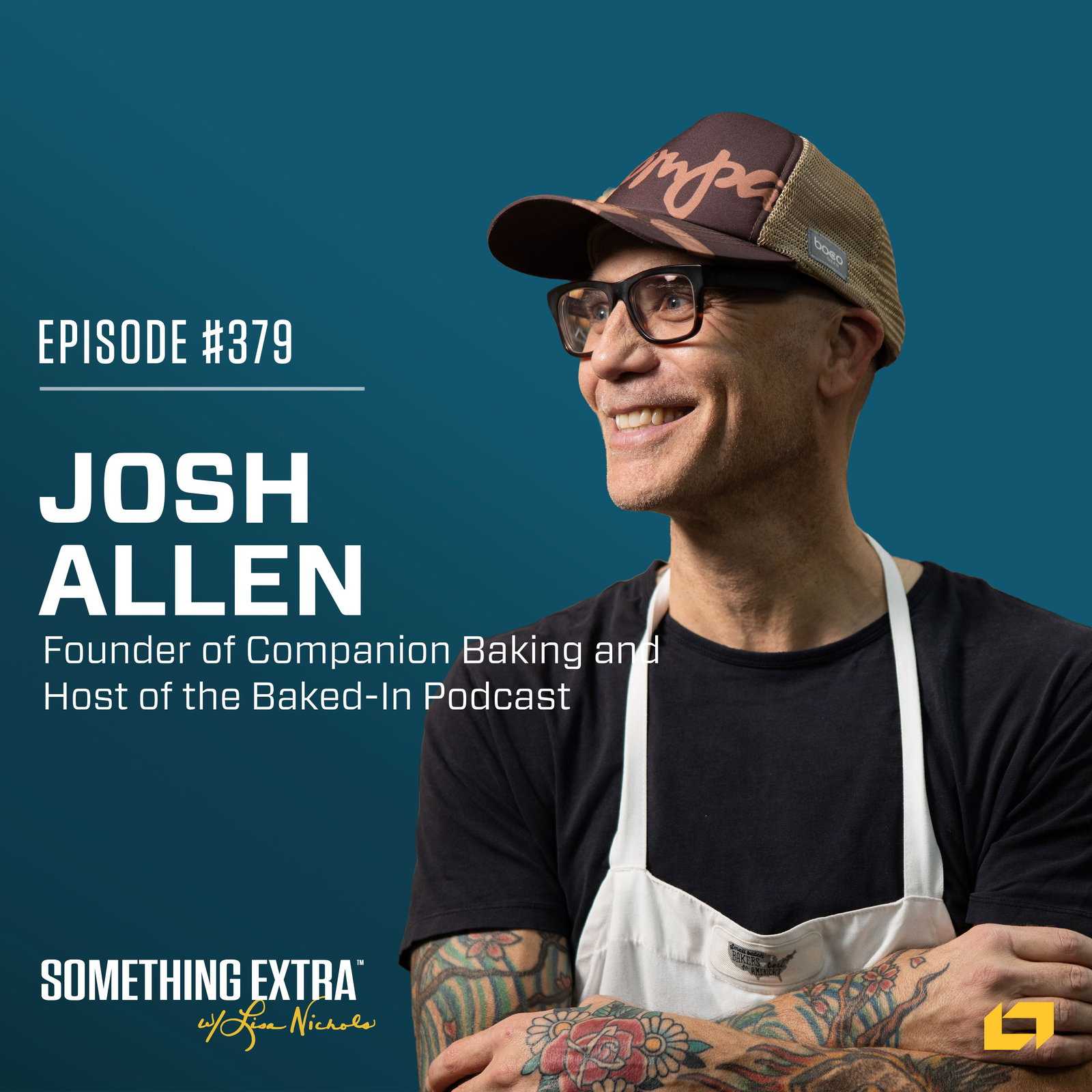
Breaking Bread and Nourishing Community w/ Josh Allen
Episode Details
Transcript
Josh Allen explains how he scaled Companion Baking from a local St. Louis startup to a national supplier by remaining agile through industry challenges like the pandemic and shifting dietary trends. He details his commitment to the 1% for the Planet initiative and food insecurity causes, proving that a company's internal soul is just as important as its external success. The conversation offers profound insights into maintaining grit and fostering deep-rooted relationships with employees and vendors to leave a lasting legacy of integrity.
Guest Links:
Credits: Host: Lisa Nichols, Executive Producer: Jenny Heal, Marketing Support: Landon Burke and Joe Szynkowski, Podcast Engineer: Portside Media
Josh Allen
Well, like I mentioned, the four c's are our our companions, our customers, our community, and our company. And so, you know, very similar. I mean, I mean, look at Herb Keller said it a long time ago with Southwest Airlines. It's really the same idea. Right? If and you said it yourself. If we take care of our people, they will in turn take care of our customers. If our you know, if we take care of those things and we support our community, all of that will come back to us as a company and take care of ourselves. And so, you know, we've just gotta put our energy where we can put it. And and you know, one of our core values is nourishing our community, which is a big piece of what we do. Lisa Nichols
It takes something a little more to lead with impact. I'm Lisa Nichols, author of Something Extra, and this podcast was inspired by our daughter, Allie, whose additional chromosome has shaped how I see people in leadership. Each episode features conversations with inspiring leaders from around the world about what truly defines how they lead and serve others. If you enjoyed today's conversation, please consider leaving a five star review. It helps more people discover the show. And if you'd like to go deeper, my book, Something Extra, is available on Amazon and through other major book retailers. I'm delighted to have Josh Allen on the show today. Josh is the founder of Companion Baking and host of the Baked In podcast. Well, Josh, welcome to the Something Extra podcast. I am so happy that we were able to make this work. Josh Allen
I'm thrilled to be here. Thank you so much for including me. Lisa Nichols
Well and you had me on your podcast. I think that was, like, two or three months ago. Josh Allen
Yeah. But I've got this tiny little podcast, and you've got this big international best selling podcast. So it's, it's an honor to be included. Lisa Nichols
Oh, well, I'm really, happy that we were able to make it work. You're you're a fascinating guy. That's for sure. And I always love to tell our listeners kind of how I meet my guest. And you and I got connected by the UHI UHY women. Josh Allen
Correct. Lisa Nichols
Kim Anderson and Mary Anne, Vingardi. Right. Josh Allen
Kim is is the the wife of JB Anderson, who's my producer on the show from Gaslight Studios. Little plug for Gaslight Studios. But, yeah. So they connected us, and I was thrilled to do it, and we had a great time. Lisa Nichols
We did. We had a great time. Well, let's, let's jump in. I mean, I know you graduated from Stanford. You could have pursued, you know, many traditional paths, but what drew you to bake breaking baking and breaking bread, I guess? I love to break bread with people, but what drew you to baking bread? Josh Allen
Well, I I mean, I fell in love with it early on. I mean, I remember stealing my sister's Easy Bake Oven when I was when I was a kid, and there was something magical about baking brownies with a light bulb, from the beginning. But I grew up in the food business, so my family was a a broad line institutional distributor. So they sold groceries, to restaurants, hotels, hospitals, schools. Eventually, that business was sold to US Foods when US Foods was rolling up regional distributors across the country, but I had grown up in that business cleaning trucks as a kid, cleaning out the freezer, making hotshot deliveries in high school, and really went to school always thinking that I would end up somehow in that industry. But then I got a job. I was racing my bicycle and racing triathlons in the Bay Area. When I finished school and wanted to work at night so that I could continue to do that during the day for a couple years before what I thought was moving back home to Saint Louis, ended up getting a job in Whole Foods in Palo Alto. I think that was, like, the fifth Whole Foods store in the country at the time, and started working in the basement overnight baking bread and just absolutely fell in love with it. And that was sort of the end of it. I mean, at that moment, I knew that I had found something that I'd love to do. I, you know, would bake all night and then go home to my house and bake more bread while I was trying to train for races and stuff and just really loved it. Spent a couple more years in the Bay Area before, bringing the craft and what little knowledge I had as a twenty four year old back to Saint Louis to open the bakery. Lisa Nichols
Yeah. Twenty four years old is when you started Companion Baking. What do you believe, Josh? Because I'm thinking back to when I was twenty four. What gave you the courage or maybe even that naivety to take that leap? And, of course, you had seen your family. I think it was your grandfather that started Allen Foods. Right? Josh Allen
My great grandfather, actually. Lisa Nichols
Your great grandfather started Allen Foods. Right? Josh Allen
I mean, he was the typical story. He came over, he came over, made it as far as O'Fallon, Illinois with with the money he had, you know, through Ellis Island and then got to O'Fallon, had a donkey and a cart, and then general stores. And then during World War two, they converted the business to to frozen and grocery, wholesale and kind of grew that business from there. My dad ran that company for for over forty years. But, I I mean, obviously, it was always entrepreneurial. And then when I found something that I had a great passion for, the wonderful thing about my family is they were incredibly supportive. I borrowed the money from my grandfather to buy the oven, from France and and buy our first mixer and and rented space from them in South Saint Louis, in order to do it. And so they were incredibly supportive, and and, obviously, they had a really wonderful name in the industry, in the in the restaurant business, in the hospitality business in Saint Louis. And so that was always an inroad into the backdoor to meet with chefs and restaurateurs in order to sell products. So and you said it a second ago. I mean, there there's also the element that ignorance is bliss. I mean, I I didn't have a clue what I was getting myself into. Never thought more than, you know, a couple of months down the road. I mean, if you would have told me then that I'd still be doing it thirty three years later, I would, I would have laughed. I mean, I didn't have a five year plan. I just wanted to make bread and and and find customers. And my grandfather told me to shut up and listen to your customer. They'll tell you how to grow your business. And and I followed that advice advice, continue to do that today, and we're still sort of going at it, I guess. Mhmm. Lisa Nichols
I I remember reading that what your grandfather had told you, and I chuckled because it is true, though. Right? Your customers will if you listen to your customers, they'll tell you how you need to evolve. Right? Yeah. Josh Allen
And and I think your customers want you to be successful. I mean, as long as you take care of if you if you make a good product and you service them well and you value the relationship, they wanna continue to help you be successful. And so you've gotta figure out ways in which to give them that opportunity to do that. And so we started with I think I was making four different items, five different items when we started, and we would sell bread to a restaurant tour. Maybe it was sourdough bread for the basket on the table, and then they would say, hey. We need a a hamburger bun for lunch. Can you can you work with me to develop a hamburger bun? So we would do that. And then we were selling, sourdough breads and and buns to the Ritz Carlton. And they said, well, we need banquet rolls for our banquets. Can you develop a a, you know, a line of banquet rolls? And so we did that. So it was just constantly listening and figuring out ways in which we could further create stickiness, if you will, with those customers by making more and more things and penetrating deeper into their businesses and becoming a more valuable supplier or baker for them. And and we get a kick out of that. It's really where our passion is is is helping our customer tell their story with our product. And and we just we have continued to listen today. And, you know, we've evolved the business into mainly a custom manufacturer. So that's really what we're doing now, every day, and and it's a real joy. Lisa Nichols
Yes. Well, that's great advice, Josh. That's great advice for anyone. You know? Listen to your customer. I have to ask you, we just bought our companion bread last week at Dierbergs, and it is good bread. So listeners, if you have not had it, go and get your bread. But where does the name come from, Josh? Josh Allen
So the the Latin root of of companion is compane, which means with bread. So a companion was literally someone with whom you broke bread or shared bread. So that's where the name came from. And I guess that's the Stanford education side of me that that that Lisa Nichols
Yeah. That helped you come up with that. Josh Allen
You come up with that. Lisa Nichols
Right? That's great. That is great. Well, let me ask you this. So nineteen ninety three is when you found and, of course, we founded Technology Partners in ninety four. So we were right there at the same, Josh Allen
Feels like yesterday, doesn't it? Lisa Nichols
I I well, yeah. Sometimes. And then sometimes I'm like, I don't remember what I did before. You know? It's it becomes such a part of who you are. Right? But let me ask you. When you've pulled those first baguettes out of the oven, what was your vision for for companion? Was it just like, I'm just gonna kind of do this and see what happens, or did you ever think that you would be this national? I don't know. Are you international yet? Josh Allen
No. No. Just national. We are selling across the country. So we've we've allowed the business into frozen now. So for for the most part, we're selling frozen product across the country. But Mhmm. I mean, no. I think, unfortunately, I didn't have too much of a plan. I mean, I I I just sort of believed that it would keep working. You know, I I think, again, taking care of my people, we call them our companions, but taking care of our employees and our bakers who would take care of our customers, who would then take care of the community. And then, hopefully, if all of those things happened, we could take care of our company. We called it taking care of the four c's. That was sort of the Yes. The value statement that we had, and and it just seemed to work. And we've always been a little improvisational, I guess, in the sense that we, you know, we don't say no a lot. We say yes and then figure out a couple weeks later if that was the right if that was the right answer. You You know, we've had to backtrack on a few things. But for the most part, we've sort of let the the universe guide us in in that respect, and it's led us down some really interesting paths. We we're in the cafe we have a cafe in Saint Louis now as well. We had a handful of those for a period of time. And even the frozen business was us selling yes to a customer in Columbia, Missouri that needed product, you know, delivering a couple hours away, which led into shipping them brought across the country. And and so I think that willingness to sort of run with things and and being open to opportunities and not being so structured or finite in sort of our vision was was beneficial. Maybe in the same sense, it it hasn't been as well organized, but at least I had a lot of energy all the way through, so we were able to to get away with it. Lisa Nichols
Yeah. We are so similar in many regards, Josh, because at Technology Partners, we've always said, if we take care of our people, treat our people right, treat them like family, if we take care of them, they'll take care of our customer, then our success will follow. And we've kinda done the same thing. I mean, I don't think we had this big grandiose strategy, thirty year strategy or plan, but but it's just taking one step at a time and just continuing to work hard and, like you said, serve your customer and, you know, and then because sometimes I think things come along, right, that you didn't even envision Josh Allen
at all. Absolutely. Lisa Nichols
You know? So Yeah. Josh Allen
I mean, we're we're we're servicing customers now that we never envisioned servicing. And so it's and if we would be close minded in terms of that approach I mean, as long as we can make a product that we're proud of and something that I would wanna share with my kids and share with my family and and we can find customers for that, then that's what we're doing. But we're doing things like mix ins for frozen custard companies. I never thought we would be doing something like that, but there are these beautiful baked goods that they're mixing into frozen custard. We have delis and restaurant chains that are that are using our product. We have a customer in the south that uses a a dough ball we make to make brioche doughnuts. And, again, like, we we've just sort of followed the path of trying to work with with quality people and and folks that we wanna have a relationship with and building those relationships. And and it's led us into a lot of different products and opportunity. Lisa Nichols
Yeah. I love it. Love it. I think it's just such a such good sage advice there. Now the food industry can be really difficult, though. It can be brutal. You've got lots of regulations and FDA. You know, have there been some really hard lessons, that you've had to personally learn as a founder being in the food industry? Josh Allen
I mean, I think most of the lessons are around, I guess, the the hardest part is people. Right? I mean, my grandfather always said if it wasn't for your employees or your customers, your job would be easy. And I always got a kick out of that. And I I I think that's true. I mean, I think I think sometimes taking care of folks is hard to do. You know, I think probably the biggest challenge for us was was the pandemic. I mean, I I I can't imagine anything that's gonna you know, knock on wood, we don't have to deal with that again in in my lifetime, but certainly the challenge is, you know, we lost seventy or seventy five percent of our revenue overnight with the pandemic because the restaurant business pretty much just disappeared, at least in the short term, certainly. And it's it's rebounding back. And then all the commodity challenges with flour and butter and eggs and sugar and stuff like that. But really, it was the turnover. I mean, we hadn't talked much about turnover historically. We we still have a number of companions who've been with us for thirty years and more than twenty years. But at the same time, we have a big group of folks that have had have churned quite a bit during the pandemic, and that was the hardest part. It was it's hard to treat folks well and lean into trying to build a wonderful culture, but just sort of the nature of the world during that time was folks were just in and out, and they were scared, and loyalty wasn't that important to folks. And and Mhmm. Just things were changing quite a bit. And so, I mean, that has been the biggest struggle because for us, you know, we're very hands on in what we do. So losing quality people or losing people and turning them over means our product quality is is more of a struggle, and we gotta pay more attention to that, and it slows our capacity down. Right. So it's just sort of you know, it it all builds from our people, no different than your business. If you I mean, when when those moments are well where you're surfing along and everybody's happy and in a good spot, things, the bread seems to be better, customers seem to be happier, and then at those moments where hiccups exist with your team, then it leads to those other challenges. And so Yeah. You know, by far, that was the hardest part. I think prior to that, you know, we we had some growth spurts that were challenging, but those are fun problems to solve. And and I guess the only other thing was the Atkins diet in the early two thousands. Lisa Nichols
Oh my goodness. Yes. Josh Allen
We did deal with that. So, you know, it's funny though because we opened during the the low fat craze, and so I don't think I had an appreciation for, you know, the mid nineties. It was go ahead and eat a dozen bagels. Just don't put any cream cheese on them because everybody was eating carbs. And then, obviously, in the early two thousands, it flipped and went the other way. And so we were a little bit more mature as a company. And so we definitely saw, you know, folks becoming carb aware, I guess. And and Yes. You know, the the biggest example to that was, you know, I mentioned the Ritz Carlton and banquet rolls. When we first opened the business, if the Ritz had a banquet for a hundred people, they ordered two hundred and fifty dinner rolls. Now if the Ritz has a banquet for a hundred people, they order twenty five dinner rolls. Like, that's where the world has gone. Like, people just aren't you know? So the nice thing for our business to a certain degree though is people have traded up on their carbs. So if they're gonna eat carbs, they want a better quality carb. So that means better quality bread, sourdough breads, you know, sandwich buns that are more unique or differentiated. And so we get the flip side of that too is is because we make a higher quality product, folks come to us for that differentiation. But the amount of of bread that's consumed is definitely different than it used to be. Lisa Nichols
Yeah. Wow. And, of course, Josh, those are all things you could not have predicted. All the things that you just said are things that you could not predict. So Right. Just having that agility, and adaptability, I believe, as a business is really important. So, you know, how you know, truly now, it's become this national platform. You know, how do you feel like that you have scaled without losing that soul? Is it just what we talked about, like making sure that you've not sacrificed on the quality, making sure that you understand that this this brings you joy? I mean, that you still you still have joy in baking the bread for Josh Allen
Yeah. I I think the biggest thing and you talked about it too with your business. I mean, taking care of our people is the number one priority. Yeah. But I I will say that historically or when you when younger because I was the one out there leading the team making bread every day, it sort of happened by osmosis. Right? Because I'm on the floor and and everybody worked with me because I was working eighteen hours a day and so it sort of happens. But as that as the business grows and scales, you gotta codify that more and and write it down more and and and talk about it differently. And so how you how you talk about your core values and your mission, it has to you know, we lead every meeting with a core value story. You know, what have we seen in the last seven days, you know, with the group of people that are in that meeting, whichever group that happens to be. We talk about something that somebody who exhibited one of our core values. We talk about safety, but we, you know, we talk about it. We lead with safety and and the metrics behind it. And we didn't always do that. And I think what we learned through the pandemic was, look, there are a lot of people now in the business that haven't been around for thirty years. And so you in order to teach them and in order to to make sure that they carry that forward in the way they do their job and the way they interact with our customers or our vendors or suppliers or whoever it is, we've gotta really we've gotta really write that stuff down and talk about it in a way that's different. So I think we spend a lot more energy trying to communicate who we are and what we're about than I felt like we needed to. I guess I thought it would sort of happen by accident because I Right. Because I had all of the relationships. Right? Every vendor talked to me. Every customer talked to me. But that that absolutely isn't the case anymore. And so I've I have a wonderful team of people that that communicate that message message very effectively, but it's become much more intentional than it ever was. Lisa Nichols
I love that. I love that you start your meetings with these stories. And to your point, the people that have been around for a long time know the stories. Right? But you've got so many new people, and they need to understand the stories too. And, we see the same thing that kind of that tribal knowledge needs to be passed on. And so I don't believe you can communicate too much, Josh. Josh Allen
No. Absolutely. And and especially as you grow your business outside of Saint Louis, your customers can't you know, the customers are new to your story also. Lisa Nichols
That's right. Josh Allen
It's easy in Saint Louis. You know, the the restaurant industry is is, I guess the word incestuous is the term. You know, a chef ends up somewhere else. The staffs move around. You know, so once somebody buys our bread at one restaurant, they end up at another one. And within the Saint Louis region, you know, our name carries a lot of weight in the in the industry. But as we've tried to expand outside of that, that goes away too. So we have to tell our story differently and more intentionally also to our customers. And so whether that's through the website, whether that's through the the podcast that I have to try to tell stories, whether that's through the the sales sheets that we pass out, you know, all of that stuff becomes so much more critical as as you attempt to scale and expand your reach because it's, again, it's just not gonna happen automatically like it used to. Lisa Nichols
Right. No. Good point. Good point. Well, you know, let's talk about this, the four c's, because you had mentioned it earlier. What are the four c's and how did this framework come about? Josh Allen
Well, like I mentioned, the four c's are our our companions, our customers, our community, and our company. And so, you know, very similar. I mean I mean, look at Herb Keller said it a long time ago with Southwest Airlines. It's really the same idea. Right? If and you said it yourself. If we take care of our people, they will in turn take care of our customers. If our you know, if we take care of those things and we support our community, all of that will come back to us as a company and take care of ourselves. And so Mhmm. You know, we've just gotta put our energy where we can put it. And and, you know, one of our core values is nourishing our community, which is a big piece of what we do. We're a one percent for the planet company, so we focus a lot of things on environmental issues and a lot of food insecurity issues with them. So we have a really strong partnership with the Saint Louis Area Food Bank and with Operation Food Search. And, you know, all of those things are are hugely important. And I do believe that it's our obligation as successful business owners to give back, like and I also think it pays dividends. I I I do think that there is there is value in those relationships. I mean, we the one percent for the planet, I mean, it's a it's a big ask of a small business to give one percent of your top line revenue, to those causes. But I also, in many respects, kind of look at it almost like a marketing expense. I do think it tells a story, and I do think that what a wonderful way to tell a story by also being able to help environmentally and and and with food insecurity. Like, if we're gonna spend a dollar on something, what a great way to spend it. And and all of those things sort of come back and have value. And so the the four c's sort of built out of that framework. It was, one of our leaders a long time ago that sort of helped me put that together and talk about it. And it sort of has led to our core values and our mission and and all of that stuff. So Lisa Nichols
Mhmm. Josh, I love what you just said because the one percent because I think what's really important is I think that allows the world to see the heart behind your company, that it's not just about the almighty dollar. I mean, you want to do well so that you can do really good in the world, right? And I think more than ever, I think people want to understand that what they're doing every day matters and that it's purposeful and meaningful and being able to give back like that, I'm with you. I do believe it pays dividends. Josh Allen
And I think, you know, interestingly enough, I think the internal story is more powerful than the external. Yes. We have customers that appreciate that we're a one percent for the planet company. And, yes, we have customers who who have their own agendas for regenerative agriculture or oven and taking bread out of the oven. They also recognize that that we're committed to nourishing our community, and they get to do that too. And, look, an hourly baker doesn't always have the means to give back, but they can give back as part of our team. They can help us direct the choices as to where those funds go. We we allow some of the we do companion directed giving within the environmental causes. We do a lot of volunteer days at the Saint Louis Area Food Bank where folks can come out with us and box groceries or go pass out food or or whatever we're gonna do it. And and it really means almost more internally than externally. It's great that the external validation happens. But Right. But, honestly, the internal story, we were, we probably didn't even realize how impactful it was in until we got into it, and we realized it's that's probably a much bigger deal. Lisa Nichols
I agree. I completely agree. Well, Josh, I have a lot more questions for you. But we need to take a quick break, and we'll be right back with Josh Allen on the Something Extra podcast. AD
In business, the tendency is to seek out partners who are bigger, faster, stronger. When it comes to IT, you should be looking for smarter, faster, better. That's just what you'll find with the talented technologists at Technology Partners. Our experts develop custom solutions to tackle your most complex challenges, all to simplify your processes in the smartest, most efficient way possible. The time to be swift and nimble starts now. Go to technology partners dot net slash solutions and see what's possible. Lisa Nichols
Well, welcome back everyone to the Something Extra podcast. So, Josh, we were just talking about your companions and how much they love that, you know, what you guys are doing in the community and nourishing the community. What are some of the other things that you guys do? Are there other things that you guys do to make your, your companions in the workplace feel valued and seen? Tell me a little bit about that. Josh Allen
It's a great question. I mean, we do we do family meal once a month. So our our chief happiness officer is also a former chef, and so we do we do a family meal once a month. We're you know, we work twenty four hours a day in the bakery business, and so she'll so she'll produce something that we can serve over the course of twenty four hours. So sometimes we'll mimic what one of the concepts, one of our customers have. You know, we have a fried chicken concept out of the south that we make a bread for. So we did chicken tenders all day and and grilled the bread that we serve with that and give, you know, folks a chance to try it. Sometimes we'll bring in products from some of our customers to share. Maybe it was frozen custard with one of our mix ins or something that we'll do. So family meal is a big part of it. One of the things that I learned from my friend, Tamara Keith, who owns Clementine's Creamery here in Saint Louis, Tamara does. We started doing Christmas pictures. So we have Santa Claus come one day, and we invite any of our companions to bring as much of their family as they want. And we do holiday photos for people and just give them the downloads. And so, you know, we spend a few thousand dollars on a on a photographer and on bringing Santa in. But it's so wonderful to see these folks, again, who most likely couldn't afford to bring a professional photographer in to do Christmas photos, and they'll bring twenty people in with them sometimes. And and everybody's sitting around Santa. So that's been a a great thing, and shout out to Tamara for that idea, because I think it's great. And then just all of the different community support. We were, my wife battled breast cancer. We've had a number of folks within the bakery that have battled breast cancer, so we're big supporters of of, of the Pink Ribbon of the Pink Ribbon organization. We also do stuff with Komen. We're big fans of Pedal the Cause because of my bicycle. So we we feed breakfast to everybody at Pedal the Cause and invite our team to go out and help, you know, feed breakfast to thirty five hundred or four thousand riders. So a lot of those kind of community things that we give folks an opportunity and and access to. So it's really just I think it's having those conversations and telling those stories, and also giving folks chance to, you know, try the product, take the product home, share it with their family, bring their family in. You know, those kinds of things are really important. It's not it's not necessarily big things. It's a it's a lot of little things. Lisa Nichols
It doesn't have to be. Josh, I have seen sometimes it's the smallest things that really make the biggest difference. It could be a handwritten note to someone, truly. Right. But here is the underlying heart behind it. It's intentional living. Oh, absolutely. Intentional. Right. Because if you're not intentional, if you don't sit and think what you could do, then it's not gonna happen. Kinda to your point before, it's not it's not gonna just happen by accident. You have to be Oh, and Josh Allen
it's I mean, you mentioned the handwritten I send handwritten birthday cards to every you know, we have a hundred and fifteen people, but I'll send those out in their birthday month. And, you know, a hundred and fifteen people don't say thank you, but, you know, the the ten or twenty of them that that it really impacts, it makes it worthwhile to to spend the thirty or forty five minutes a month that it takes to send out those cards. And and you just realize just how important it is. And different things are important to different people. And, you know, you can't wait for everybody to be thrilled with the whatever the benefit or whatever it is. We do a picnic every year. Half the team brings all their family and loves it, and the other half doesn't show up. But but, you know, my dad told me a long time ago, you you gotta do it for the people that come and the people that find value in it, and you can't let the people that don't because that it just for whatever reason, it doesn't work for them or they're not interested, but that doesn't make it a bad idea or not something important to do. Because if you let the Lisa Nichols
Good. Josh Allen
The handful of folks not interested dictate that you don't do anything, then you're making a big mistake. Lisa Nichols
Yeah. Oh, that's so good. That is so good. I love that. And I love that you I did not know this, that you have a chief happiness officer. Josh Allen
Yes. Well, we I mean, she used to be the director of HR. Like, what a terrible term that is. Right? Like Lisa Nichols
Right. Josh Allen
Right. In essence, her job is to make people happy. Like, she's responsible for the recruiting all the way to the retirement, and we hope that folks make it that whole that whole series. But, you know, what are the things that she can be doing every day to the bakery? She meets one on one with a hundred and fifteen people every month, or every couple of months. You know? Supervisors, it's every week. Leadership development, you know, career path. You know, we do tuition reimbursement. How can we folks you know, give folks an opportunity to better themselves? Not everybody's, you know, gonna find a career in baking. It doesn't mean they aren't an incredibly valuable companion to us for whatever that Mhmm. Chapter of their lives it is. And so how can we help them be better, be stronger? It's not necessarily school for baking. Like, we have folks that that learn how to knit and we reimburse tuition on, like, even if it's a hobby. Like like, make yourself better. Learn something new. Lisa Nichols
Woah. Josh Allen
That's incredibly valuable. Lisa Nichols
Oh, I agree. I agree. And even those hobbies, when you're encouraging that, Josh, I'm sure you've seen that with the triathlons and things like that that you've done. It it informs other parts of your life.Josh Allen
Absolutely. Lisa Nichols
When you expand your your interest and expand your brain, you know, to to take in other things. Well, you were twenty four years old when you found a convenient. If there is a twenty four year old out there that's listening and they're thinking about starting their own business, what advice would you give them? Josh Allen
I think that you you gotta have grit and and perseverance. Like, I mean, I that's it. Right? Like Yes. Thank god I had it. I think the triathlon and the bicycle racing and all of the training I mean, certainly from the physical demands of baking because baking can be pretty physical. It's hot. The hours are not particularly wonderful most of the time. But but if I didn't have that grit and perseverance and certainly the immigrant family and and just my the entrepreneurial nature of my family's business taught me a lot. Like, you gotta show up and go to work. And and showing up is is our number one core value here. We talk about that all the time. Like, showing up for yourself, but also for your for your friends and your peers and your company. Like, that's that's an important thing to do. And and I know in this day and age where everything is so immediate, if you want something, it's delivered to your house and then, you know, you don't have to go out to eat. You don't have to go out to buy groceries. You don't have to go out to date. Like like it like Yes. Immediate gratification is such a big piece of the younger generation now, and and that's just not how it works in business. And I think the the advice is is just to have that patience that if you just continue to do the right thing, take care of your employees, take care of your take care of your vendors, take care of your customers, you know, do business with integrity, I do think eventually it'll pay it off. But it just it takes some time. Lisa Nichols
Yeah. No. That is great advice. I love that. You know, this is kind of along the same same line, but, you know, what we see sometimes and and you said it yourself. You know, sometimes hopefully, you're not doing that now, but there was a period of time where you're working eighteen hours a day. What I I see that a lot, you know, where founders just the buck stops with them, and they don't know how to turn it off. I mean, how do you keep balance? I know that you I think you have five kids, don't you, Josh? Josh Allen
Yes. I do. Lisa Nichols
And so how do you how do you keep yourself from burning out? How do you stay curious and fresh? And I know growth is really important to you, but got any advice there? I mean, you've got five kids, and I'm sure they are all super busy. Josh Allen
Right. I mean, I think, you know, I I I guess you gotta try to find it. Right? I I think the biggest thing is building a wonderful team. And so I I do think there are parts of there are moments where there's not gonna be equal balance. Like, I don't ever believe that you have balance in life. There are just moments where you gotta lean into certain things, and and there are moments where you gotta lean into the business. If if things are growing quickly or if there's a challenge, you gotta lean in. And then there are times where you have to lean into family if you have a medical situation or a or a challenging situation with the family or the time is needed for sporting events or school or whatever it is. And I think it's it's picking those moments and and trying to communicate effectively to your team what you need, you know, what your needs are, but also to your family what your needs are. And and I I don't wanna say that it's easy to do all the time. It's never easy to do, but anything that's that's anything worth doing isn't easy. Right? Lisa Nichols
That's right. That's right. Josh Allen
I I and I think it's just it's a it's an ebb and flow. So I don't know that there's particular advice. I think it's again, it's kind of leads to that improvisational nature that we tried to we've always used to build the business. You just gotta sort of go with it a little bit and and believe that you're gonna come out the other side. Lisa Nichols
Yeah. That's good. That's good advice. Well, I know that you host I want you to talk about this for just a minute. I know that you host your own podcast, Baked In Podcast. We talked about that in the beginning. I was fortunate to to be a guest on your podcast. What have you learned about leadership by sitting on the other side of the microphone? I don't even know if we have enough time, Josh. Josh Allen
I think I think it's the same thing. It's all those little things. Right? It's Tamara's little little things that she did to to help her folks. It's it's metrics that other folks look at. I mean, I'm I'm just a super curious guy, and and Saint Louis is just a wonderful giving community. We talked about that a little bit at the beginning. And and, you know, the the leadership. We we really have developed some wonderful businesses here, some of which just service the local community, many of which are are national and have grown, you know, well be outside of Saint Louis. And so that opportunity to sit down with folks and you know, I mean, as much as I wish that you and I would have just had a cup of coffee one day, the way people get together I mean, sometimes a podcast is an excuse to to be able to sit down with somebody that maybe you wouldn't have crossed paths with. And so there's so many different leadership lessons that come out of those conversations. And and I've been much more open to meeting folks for coffee and and and just sort of the term networking always felt very manipulative to me, like, that you were trying to get something out of somebody. Or but I just realized now that that taking that minute to connect with people has tremendous value. Sometimes it leads to a sale or introduction down the road, but a lot of times it just means to learning something new and and seeing something differently or being able to help somebody else. And and sometimes helping somebody else leads to different opportunities. And so the podcast is just a wonderful excuse to sort of to sort of, I guess, formalize some of those connections. Lisa Nichols
Mhmm. Yeah. It's about building a relationship, Josh. You know? It really is. It's about building a relationship. And to your point, sitting down with somebody, understanding their story, you you may not be helped in that moment. There may not be something that comes back to you, but it may be something that you can deposit into them. Josh Allen
Absolutely. Lisa Nichols
So it's, I I think it's just it it has been one of the greatest joys of my career, honestly, is hosting the podcast. I just absolutely love it. When you think about your life, Josh, and companion, in your life as a father and as a, father to five and as a husband to your wife, I mean, what do you hope people remember about you? Josh Allen
Oh, wow. Well, I hope I'm gonna be around for a long for a long time, and I can still continue to formulate that for people in their minds. I, you know, I I think I think that I brought integrity to what I do. I think that's the most important thing. I mean, that's the look. Your kids are watching everything that you do. Your our companions are watching everything that I do. Like like, I think that's the thing that that my dad told me early on. Like, pay attention to the little things that you're doing because people are people are watching. Right? Like, I I had a chef, Bill Cardwell, who who had a restaurant in Saint Louis for a long time, and he used to have a restaurant inside of Plaza Frontenac, which is a a mall in Saint Louis or a shopping center. And I remember walking across that with him, and he was picking up trash. It wasn't anywhere near his restaurant, but that was just the nature of the way that he like, he felt like he needed to make the area in which he was part his community inside of that mall, you know, he he just took that second to pick up trash. And I always think about that when I'm walking inside of our building or walking into somebody else's restaurant that it doesn't take a second, but to but to help make the area a little brighter and a little cleaner. Because I and sometimes people are watching. Sometimes that example I don't think Bill thought I was paying any attention to what he was doing. I mean, this was probably twenty five years ago, and I have never forgotten that moment walking across Plaza Frontenac with him. And so I I I try to do that with everything. Right? Like, we we we choose which vendors we we buy products from, and those relationships are hugely important to me. And and we don't jump ship to save, you know, twenty five cents on a on on flour, sixty cents on sugar. I mean, if somebody services us well, takes care of us when we have an emergency, you know, you have to treat us fairly. We're gonna pay attention and go you know, we're gonna shop the business every once in a while to make sure we're being treated fairly, but those relationships matter. And and Mhmm. I hope that people remember me for that willingness to formulate to form those relationships and the value that I placed in them. Lisa Nichols
That's so good. Josh, as you were talking, I was thinking there is a famous saying out there, and I don't remember if it was I don't remember who who who said it, who coined it, but leaving somewhere better than you found it. And I'm like, that's precisely Josh Allen
I think it was like Smokey the Bear, I think. Lisa Nichols
It's Smokey the Bear? Yeah. I'm not I'm not really sure. I felt like it was like a, I don't know. I I felt like it was, Winston Churchill or something. I don't know. But whoever. But I was thinking, as you were saying that, I'm like, that's what it means to leave something better than you found it. You know? If there is something there, I love that. And, yeah, you're right. I mean, people are always watching. We're always influencing whether we believe it we are or not. So I love that. Well, let me ask you this. This is called something extra. What do you believe is the something extra that every leader needs? Josh Allen
I I think it speaks to that relationship thing. I mean, I I guess, you know, you can use empathy. You can use authenticity. What whatever word choice you wanna come up with, I think it's it's believing in the integrity of those relationships with our people, with our vendors, with our customers, with our banker, with with all of those things. I think it's it's coming to that with a real, with a real caring sense about it and believing that you know, and I don't like the term win win, but it's I mean, it's believing that that that there's integrity to both sides of the relationship and that you've got to treat people fairly, you've got to expect to be treated fairly in return, and that you put value into all of that stuff. I mean, in the end, we're just taking flour, water, and salt and making bread. So we don't, you know, that it's not rocket science what we're doing, but but we do believe that that bringing people together to break bread is something that's incredibly valuable. And and we look at that with all of the relationships that we're able to form with the business. And I think I think leaders have to bring that because you there's you can't fake that. People know it too quickly if it's if it's not authentic or you don't have empathy for those relationships. And, you know, things happen. People make mistakes. Challenges arise. You know, stuff happens. And and if you have all of those relationships intact, I think you can you can get through those times, much less scathe than you would be without them. Lisa Nichols
Agreed. That is so good. Well, I am looking forward to breaking bread with you soon. Okay? Josh Allen
We'll do it soon. Yes. Lisa Nichols
Let's do it. Thank you so much, Josh, for making time to be on the show. It was a really, a joy to be with you today. Josh Allen
Well, thank you, Lisa. I really appreciate it. Announcer
Something extra with Lisa Nichols is a Technology Partners production. Copyright Technology Partners, Inc, twenty nineteen. To learn more about this week's guest, to learn more about this week's guest, check out the show notes at tpi dot co slash podcast. If you enjoyed this episode, consider leaving us a review. Thank you for listening to Something Extra.