Lisa Nichols
Chromosomes. Little strands of nucleic acids and proteins are the fundamental genetic instructions that tell us who we are at birth. Most people are born with forty six chromosomes, but each year in the United States, about six thousand people are born with an extra chromosome, making them a person with Down syndrome. If you've ever encountered someone with Down syndrome, you know that they are some of the kindest, most joyful people you will ever meet. They truly have something extra. My name is Lisa Nichols, and for thirty years, I have been both the CEO of Technology Partners and the mother to Ali. Ali has something extra in every sense of the word. I have been blessed to be by her side as she impacts everyone she meets. Through these two important roles as CEO and mother to Ally, I have witnessed countless life lessons that have fundamentally changed the way I look at the world. While you may not have an extra chromosome, every leader has something extra that defines who you are. Join me as I explore the something extra in leaders from all walks of life and discover how that difference in each of them has made a difference in their companies, their families, their communities, and in themselves. If you liked this episode today, please go to Apple Podcasts or wherever you listen and leave us a five star rating. Lisa Nichols
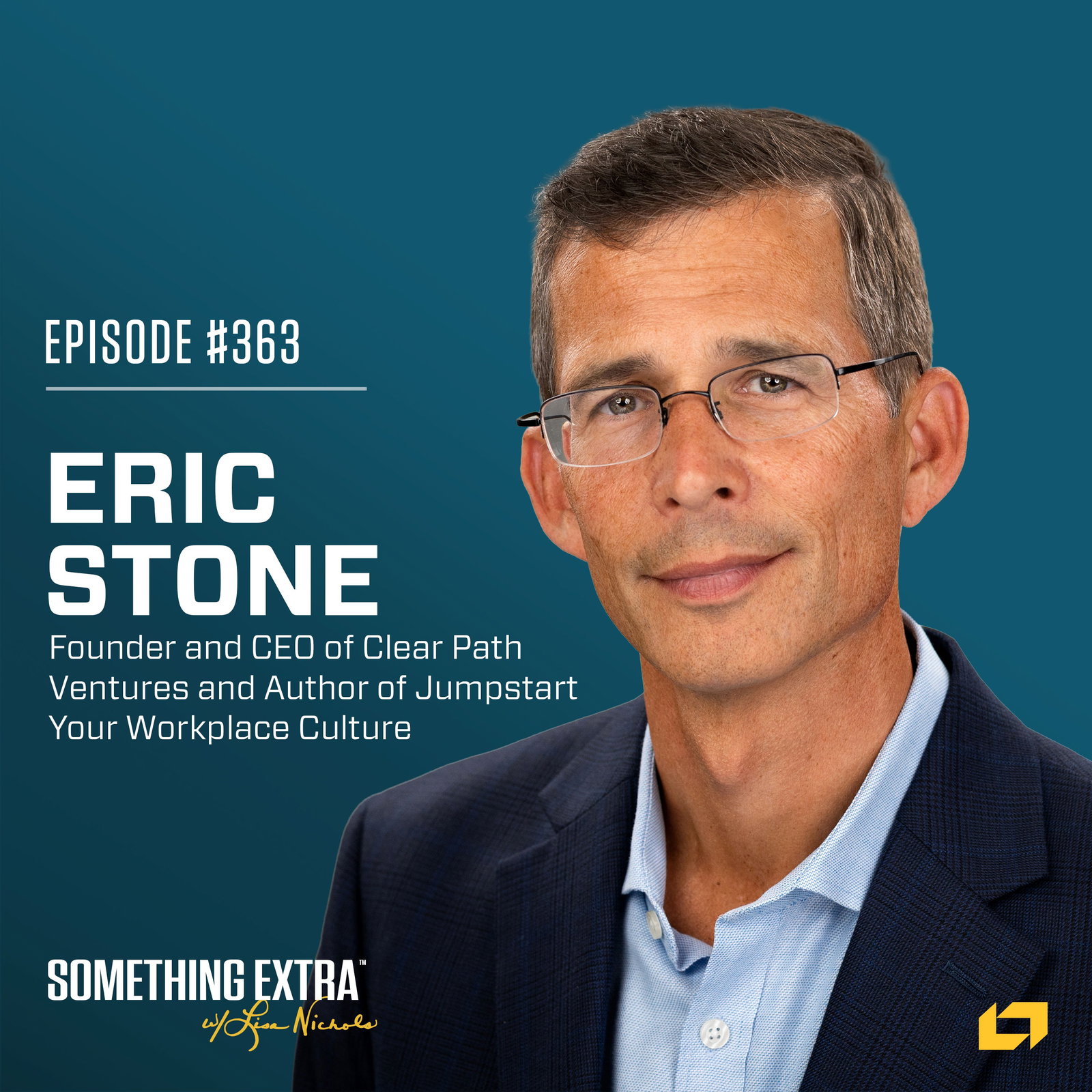
Before we get started, I'm excited to share that my book Something Extra is now available. It is rooted in the remarkable spirit of our daughter, Ally, and the heartfelt conversations we've had on the podcast. You'll find wisdom and practical tools to ignite the leader within you and uncover your own something extra. Visit something extra book dot com or find it at Amazon or in all major bookstores to order your copy today. I'm delighted to have Eric Stone on the show today. Eric is the founder and CEO of ClearPath Ventures and the author of Jump Start Your Workplace Culture. Well, Eric Stone, welcome to the Something Extra podcast. I am so delighted to have you on the show today. Thank you so much for making the time. Eric Stone
Lisa, it's a pleasure to be on Something Extra. Lisa Nichols
Well, we're gonna have fun, and you have got so much wisdom. I don't know how much we're gonna capture, but we're gonna try to capture a lot of your wisdom today for our listeners. And I have to give a special shout out to our mutual friend, Tim Sater. Eric Stone
Absolutely connected the dots and put us into this situation that we are in today. So absolutely grateful. Lisa Nichols
I'm so grateful. Aren't you? I'm just thinking. I'm so grateful for those connectors in our life. I didn't ask him to connect me, but he said, hey. This is somebody I think you should meet. So you and I may not have crossed paths otherwise. So I'm really grateful for people like that. Eric Stone
That not enough of Tim's out there. Right? Not enough of Tim. Lisa Nichols
I agree. I agree. Now don't let your head get too big, Tim. Yeah. We love you. We love you. Well, Eric, gosh, there's a lot that I want to cover, but I know that you grew up in Western Massachusetts. Right? What are some of your earliest memories of that, and were there some things that happened in your childhood? I know your parents, and you can talk about them too, were very, very influential, even in your love for business. So just tell me a little bit about growing up. Eric Stone
You got it. Like you said, grew up in Western Mass. Grew up born in Springfield, Massachusetts where the hall of fame the basketball hall of fame is. And at about the second grade, moved into Longmeadow, Mass. My parents moved us to try to get into a bit of a a better school system. The one thing that really when you say, hey. What are the things that shape you in your life? One, believe it or not, was I was the smallest kid in my class. So so out of all the things you don't probably want, I was the small. Now when you're the smallest, things don't always come easy, and you must be quick on your feet. And so or, you know, kids will make funny and have fun with it. And I think early on, it allowed me to be very quick witted, and I had to be. And it allowed me to be a little resilient, and I had to get pretty tough because things, things weren't always smooth for the little guy. You know? Mhmm. And also in school was not easy for me. So I was not a gifted student. I was someone who would put in the I beat a I beat a page five times. It just didn't always resonate with me. And yet another thing that really, I think, separated me as I went on in life was my ability for the details to consistently do something for an extended period of time until you really master it. And so I think being that small individual, you know, had some challenges learning too eventually. You know, I just figured it out. And so always loved business. I was the paper route guy, the odd jobs guy, started our own business with a buddy of mine, and we had no idea what we were doing, but we're really enjoying making a couple of bucks. I was one of those kids absolutely motivated by money. Some are, some are not. I definitely was. Mhmm. So motivated by the the the Olympics. Right? So nineteen eighty. I'm ten years old. I see the US Olympic team come together, a group of college individuals who overtake Soviet Union and eventually win the gold medal. Always fascinated with what are these individuals doing? Why are they coming together to do something really special? And so that continued to ripple. And then my parents, my dad was a a textile salesman, and I used to eavesdrop over here in all his conversations after a long business trip and the ebbs and flows of his experiences. And my mom was a teacher, so that coachability and teaching and and took a little bit of that. My childhood, a great circle of friends was so important to me as I went to high school and college, majored in business, and I land on, eventually, a company called enterprise. But but those are, you know, the early roots of things. Lisa Nichols
Yeah. Oh, I love that. I love that. So really and truly as a as a little guy, I mean, you kinda had to come up with some coping mechanisms and quick wittedness, and and I'm sure that served you well all through life. People love to be around people that have a great sense of humor and can, you know, turn turn an or an ordinary moment into something extraordinary. Right? Eric Stone
Absolutely. I mean, it's it's just those things that allow you if especially in negotiations in business or problem solving that allow you to really, for whatever reason, have an opportunity to think maybe just a little bit quicker. Though I still always have to, you know, allow the rinse for reading stuff. You know, it allowed me some some things that made me definitely better. Lisa Nichols
Yeah. That's so good. That is really good. Well, you know, I know that you your dad really did, inspire you and influence you for your love for business. And so you probably, at a young age, probably decided you knew that you wanted to do something in business. Right? Eric Stone
Absolutely. Yeah. I know there was just something there that I didn't know what it would end up looking like. You know? And then I don't know if you remember, but there was a movie god. Was it in the late eighties Wall Street? The Gordon Gekko. So so this was a a movie, the the highs and lows, the good and bad of a guy named Gordon Gekko. And, you know, again, just being attached to this individual who was always dressed to the nines and, you know, I just somehow something something stuck.
Lisa Nichols
Something stuck there. Yeah. I'm sure you were much nicer than Gordon Gekko.
Eric Stone
Yes. That's why ebbs and flows you always take from the good and make sure you don't lose the bad.
Lisa Nichols
Yes. Not quite as ruthless probably as he was. But I know that you you when you started enterprise and we've talked a little bit about this, you've had a really illustrious career at enterprise. But when you started there, I think you, you know, you were a one person office. Yeah. Eric? I mean,
Eric Stone
you're one of four. You know? So you're one of four. You have no idea what you're doing, and you're certainly counting on a lot of individuals to help you with your learning curve and and your overall employee experience. Yeah. So one of four, no idea what I was doing. And to be honest, in the beginning, I don't know if I would have said I had the best training that I would hope for. But what I did find was this bond with some of the people we would work with, and that was the big thing. It's kinda like they say finding, you know, your best friend or a good friend at work is really important for engagement, and that was there in spades.
Lisa Nichols
Yeah. That's good. I'm sure you carried that forward with you too because as you became moved up the ranks, you know, you probably were were looking for that for people, you know, making sure that they felt like they belonged and that they were plugged in to the group. And
Eric Stone
Yeah. Such a a good point, Lisa, of the things I might not have received really became these inspirations or a catalyst to what was the foundation of our blueprint as I started to take a bigger leadership position, and the things I did get would be implemented into an initiative. So, yeah, really, really important to take again the things I might not have gotten. Of course, the things I did get, I just doubled down on them.
Lisa Nichols
Mhmm. Right. Well and into that to that point, you know, I mean, you climb the ranks to become one of the most decorated regional vice presidents that the company had seen. I think you ran the most successful, smooth running, profitable region in the history of the company. That's pretty remarkable. I mean, what what were the leadership habits during that time, Eric, that were nonnegotiables for you?
Eric Stone
Yeah. That well, it's it's interesting you say that. We we formulated, what we would call, commitments. You know, it's kind of how we phrased it. And but but to get from where we started to where we were were so many things. But just to go on, the nonnegotiables were these things that we utilize what I actually eventually came to call the think tank. And those were a group of our managers who would get together with me personally every other month and really strategically think about things that were either missing the what are we losing on? Where is the opportunity? And where are we winning? You know, what are those things we wanna continue to do? Mhmm. And to me, the things that that think tank group brought out, because they were truly the voice of the region. They were very close to all their fellow coworkers and would pull all of the information that was really important. And those meetings were inspirational to coming up with things like our commitments. Those things that we all agree on, those three to five key business initiatives that we're all going to be in support of. Taking those three to five key initiatives and making sure it's put within the training infrastructure of your organization. And I think that's where a lot of people sometimes miss it. They have the initiative, but how are we training and developing the individuals to be able to execute it to the highest of level? And we didn't make it too deep. It was the three to five key commitments that everyone would have. They would call them as district slightly differ only in how they might deliver it, but with the same goals and expectations that we would have. Those goals and expectations were put into the employee review. So now whatever I looked, wherever I was going, whether it was an employee review, my typical daily life at a a branch, it was it was the same thing. It got traction. Traction allows you to do a lot of things. And so those commitments were were critical and, to where we ended up becoming, as you mentioned, fortunate to be one of the more prestigious regions within the company.
Lisa Nichols
Yeah. So let me ask you. Let's let's dig into the think tank here. So it's all your managers, right, that were underneath you were part of this think tank. Were those three to five initiatives, Eric, were those did those change? Or because you said you guys met monthly. So
Eric Stone
Yeah. They well, I would say they evolved. So you have something. And and and what it was actually wasn't all the managers. It was, it was those nominated by their peers. So so they would get nominated by the group. Mhmm. And there would be up to seven, and we'd have a rotation as we wanted it as a leadership initiative as well. And so they get nominated by their peers. They would control the agenda. And what would eventually happen is we would have those those keys. So now those keys, what ends up happening with any organization is right sometimes when it's there for an extended period of time, it can get stale. This think tank group allowed us, instead of just always doing a bounce pass for a basketball analogy, would sometimes find a way, okay. That's getting a little stale. What do we need to do for a behind the back to create a little bit more excitement? And so you take the the initiative and give it a little extra juice, a little bit different. And we would take that difference, of course, Lisa, and make sure we trained it on how to execute that difference
Eric Stone
Whatever it may have been. And so it definitely evolved to become I would say you get a a bachelor's degree. We wanted to create a master's degree in the rental car industry. And that's how we would evolve of constantly giving them the right material, equipment, and information in order to achieve the desired outcome. We had to keep giving them that because you can't just raise the expectation without raising the level of training.
Lisa Nichols
For sure. And that's probably that was probably the difference right there is the the training that you that you mapped back to that initiative. I love that. You know, you say one of your isms, I guess, if you will, is you say that culture is what happens when the leaders aren't in the room. How did you cultivate that level of ownership? I mean, I think about extreme ownership. How did you cultivate that, Eric? And it's probably it probably started with this group of of this think tank, I would imagine.
Eric Stone
Well, you know, I would say we we really focused on these I called it a philosophy or pillars of engagement that allowed because step one, you always gotta build trust. So I can't just walk in and they're going to trust me overnight. And so anytime I took over a new opportunity, we would we would really hone in on these factors. And so the things that made a difference to make people believe, to create culture carriers, to do all those things when I'm not around because we'd have fifty brick and mortars. I can't I can't be at them. I can't answer the phones, you know, and and things like that. And so it was what are we doing to encourage a strong relationship with our manager? You know, what are those two to three initiatives that we're going to truly from the hiring process and and all the way through hire to retire type of stuff? What's the initiative that we're gonna truly believe in that strengthens relationships and builds trust, those seeds of trust? The second was just clearly communicating your goals and expectations along the way. So we wanted everyone to have a role, and we just wanted them to star in their role. I would say then, of course, we've already mentioned right material equipment and information in order to achieve that Mhmm. Outcome. Okay. Now I've got it. Now I can be successful. They've removed the noise by clearly communicating. Now I can be successful and execute personally and professionally to to help them develop themselves in and out of work. So if we had a work meeting, we might spend twenty minutes talking about how you might wanna budget and take your own analysis of our own financials. Take that at home. Go look at your cable bill. Go look at the, you know, whatever it
Lisa Nichols
is. Good. Yeah.
Eric Stone
You know, and bring in a component that it's not just all about what we're doing here. Mhmm. And then lastly is recognize effort, but reward excellence. So you gotta find some way to to thank people for what they're doing. And and that is what helped us create some of that belief. We just live that, and each one of those would have an initiative or so, right, under what we're all trying to do. And so the best example would be with the first one, a strong relationship. We called, or created through the think tank something called the thirty minutes of fame. It was our way to once a month at the minimum, you would meet with your team for, you know, ten or fifteen minutes. How are you doing, Lisa? Tell me about what's new. And then the last half of that is, well, let's talk about some of the goals and expectations and things that are gonna help you be be successful.
Lisa Nichols
Yeah. That's so good. I love it. Well, you wrote a book. I've got it right here. It's gonna start your workplace culture, a road map for igniting high performance. Who would not wanna read that book? I mean, because we're all wanting to make sure that our workplace cultures are the best that they can be, and, certainly, we want high performing teams. I'm gonna read the way that you, describe culture. It is here on page six. Let me get here. You say a high performance culture happens when a set of shared values and beliefs drive the right behaviors, creating a consistent experience and desirable outcomes. You know? And so I think probably in your think tank and and getting those commitments and those shared beliefs, everybody has to have that. Right? And then cons then everybody agreeing to that, and then that is going to help you be you know, the outcomes be more consistent then, you know, so I just I love that. What are some of the what are some of the biggest misconceptions, do you think, Eric, that people have about workplace culture?
Eric Stone
Well, I I think they think it's soft, philosophical, all about your hugs and high fives.
Lisa Nichols
Yeah. Kumbaya kind of stuff. Yeah.
Eric Stone
Yeah. Yeah. So and and don't get me wrong. Those are there are components that you wanna know, hug and high fives, I guess. But I I think it's just completely misunderstood. I think it is something that is it is the catalyst in my it is the catalyst to execution. The reason it's there's so many reasons why it's important. But when you look at why people do the things they do, why do they have these behaviors in action, which is the shortest definition of culture is they just feel inspired to do the thing that they have come aboard to do because they feel they're supported. There's empathy, as I like to say, with accountability. Mhmm. There there is high character with high standard. They it's borders are empathy with accountability.
Lisa Nichols
Mhmm. Without the accountability, you have no results. Yeah. Yeah. Right? I mean, it it is soft if it's just empathy. But, yeah, I've got a good friend, Pat Aspen. She says, just because I am soft apart doesn't mean I'm not hard of hand. And what she means by that is, you know, it's both of those things. Right? So, so important. You know, you say that culture is measurable
Lisa Nichols
And it's predictable. Tell me more about that, Eric.
Eric Stone
So so one of the biggest things when I was doing research for the book was reaching out to hundreds of people and and really just saying, you know, hey, Lisa. What's workplace culture to you and how do you measure it? And you'd hear crickets. I mean, it really people it it was this thing they couldn't find a way to describe and or measure. And so the one thing I remembered is anytime, whether it was in my career at enterprise or or just helping others get there, there were there were a few things that showed us the way. Number number one is engagement from many of the statistics led to really good outcomes, really good increase of customer satisfaction and loyalty. It shapes even the things like dependability and reduct reduction of absenteeism and all of the things that matter. Profit, of course, matters. And so I double waited and took a look at engagement's one piece, but then they the retention's another. And so what we did is I I had six things that I put all together. I should say the double weighted were really the customer and employee experience. So so those two actually would be on the top. What is your engagement of your team? You do have to periodically periodically find a way to figure that out through surveys, conversations, think tanks, whatever it is. And and when your when your employees are are in that good spirit and they're enthusiastic and motivated, it tends to trickle over to to the customer. And so those were just red flags to me that if we're gonna measure, we gotta start with the employee side and the customer side. And there's a variety of ways that organizations can get a net promoter score and customer satisfaction score. And then the ripple effect really then actually trickles to more of the retention things. Because I can stay with the company. I just might not be motivated. But you still do need to look at it. You still need to keep it, a gauge on that. Depending on if you're a new or established company, you know, profit and or market share might be really important that you have to take a look at. So numbers are really gonna matter. Inclusivity is something that you you've gotta figure out. Are you mirroring the demographics that you do business in? Does that align? And those were just a few things that you could put together and get your own baseline. So I created in a sense a little bit of a formula that would allow you to check the health of your organization. But that doesn't mean there aren't other warning signs. You know? And so so the warning signs, for example, all of a sudden, ethical violations start spiking. You know, that's a cultural problem. Mhmm. So so there are all of the the too many silos, especially when you don't want silos. You know, that that that's something that's a red flag. Absenteeism, you having a happy hour and no one shows. Just little obvious things. The artifacts in organizations. You might have these buzzwords or these things that when you go in a restaurant for example, you either see or don't see. You might see a championship belt and someone holding their sales belt around. That's exciting. That's culture. That's something. If you're not seeing these things, those are signs. You don't even need a need a scorecard. It's like when you do go into a restaurant, Lisa, you can feel the energy. I mean, you can't. Is it good? Is it bad? You could get your own barometer. I just happen to use a variety of terms that would really allow me to get a baseline.
Lisa Nichols
Yeah. That is so good. That is so good. Yeah. I I love that you brought up the cultural red flags. And and, you know, we have to be we have to pay attention. I mean, we really do have to pay attention to to what is going on and those those little signs. Like you said, I love that. You know, you have a happy hour. Nobody shows up. You know? There's something going on there. Right?
Eric Stone
Yeah. And that goes on to depending on if you can. But if you're in manufacturing, man, the leaders gotta walk the floor a lot.
Lisa Nichols
Yes. You just have
Eric Stone
to because you we talked about commitments to begin. But the worst thing that can happen is when you you think you're instrumenting this game plan. You go into the field or observe. I call it listen, observe, and learn, the LOLs of of that. And you you find out actually that the team has a point. There is a reason they can't do one of the initiatives. We missed something. We thought we got it. We didn't supply them with enough to be successful. And so it allows you to check the reality of by having a presence, and I think those are the basic things. Just Yeah. Just have a consistent presence.
Lisa Nichols
Mhmm. Yes. Management by walking around, I think it's what it's called. I think so. Yeah. You gotta be, and then I've got friends that talk about Gemba. You know, like, being on the shop floor, you gotta be where the work is happening so that you can see. And and to your point, there may be obstacles that you weren't aware of that's preventing them from even completing that initiative. So so important. Well, let's talk about this. And then, I've I've got a couple more questions, and we'll take a quick break. But I wanna talk about your metaphor your metaphor of the road trip that your family would take a lot and mostly to Cape Cod, I think.
Eric Stone
Yes. Very good. Yeah. Yeah.
Lisa Nichols
Yeah. You know, how you know, you said that family trips in the Rockwood camper.
Lisa Nichols
Connect to leadership. I mean, tell tell me a little bit more about that.
Eric Stone
Oh my god. Well, the funny thing is is on those road trips, you better have boundaries because in those days, you know, my brother and sister were on each side of me. I would, of course, get the worst seat possible because I was the youngest. And God forbid you went on someone's side of the the the tracks, you would be getting, you know, a nice elbow maybe in the time. And so you better have boundaries as you go on those road trips, and you better come prepared because you better have in those days, we're the walkman. You better have some sort of device that's gonna preoccupy you to stay focused and do what you wanna do. Hopefully, on the road trip, I call it choose your passengers carefully. Well, I couldn't choose my family, but it was important that we had a strong relationship that would allow us to go on those four hour drives up to wherever we were going. Mhmm. And so, you know, the road trip, very similar to culture, is it's just a journey. It it it's not something that is developed overnight. So
Lisa Nichols
Well, those passengers, I'm thinking, it's the same in in, you know, when you're developing a team. Right? And when you're putting a team together, you wanna make sure, you know, you're picking the right passengers, and making sure those passengers are on the right in the right seat too, I think, is really important.
Eric Stone
There's a funny, at least a funny Turkish proverb in it, and it goes something that when a clown moves into a palace, he doesn't become king. The palace becomes a circus. And so when you're bringing in the wrong people, bad things can happen to your point about the hiring process, which could be another book in itself.
Lisa Nichols
Yes. Yes. Yes. Yes. And I and we've talked about that. You probably have another book in you, Eric, so we need to be on the lookout for that. You know, you talk about on any great road trip, there's detours. Do you have an example of a detour? Sometimes my, my friend, Dennis Muilenburg, who used to be the CEO for Boeing, he calls it side trips. And he always talks about don't don't like, what how does he put it? It's like don't despise the side trips because sometimes the side trips are when really cool important things happen. But do you is there an example of a detour in your career, that you made, Eric, that you could, you know, tell us about? Or, you know, maybe it was a blessing. Maybe it was a blessing in disguise. Well, I mean, I would
Eric Stone
even just say, you know, one of the things that have made this topic so popular is there's five generations in the workplace, each each valuing different things that are important to them from the Gen z all the way up through the boomers. So, you know, the one of the things that was a a detour for me is when the millennials in the time were the new generation and me really not getting the fact that wait a sec. What what it seems like time became a currency, and we had to understand this. And so by being in the field and understanding that what used to work is not working anymore, and we came up with, in a sense, generational perspective training. So it wasn't just that I could learn from the millennials at the time, for example. It was so the millennials could learn my worldview and my point, or I should say from the gen x, so I shouldn't say mine. And so this this we were missing the mark. We were missing some of the mark. And through digging in, we then said, my god. Not everyone is motivated the way we are all motivated. Now we know people are motivated differently, but that generation really was a shift. Mhmm. That that shift allowed us to come up with initiative that we called scheduling with precision. So we said if time is important, let's ensure that we're doing something to free up your time. Let's look at all of our initiatives. Let's look at all of the reports. Let's look at everything we got, and let's try to streamline some things that might be better served so you can execute some of those things in work, but be able to be, have a great life out of work. And so we did this scheduling with precision that became a bit of a detour. We really refined what we would give out, what we would, expect during certain times. And so there were a lot of things that we had to synthesize, and I really think it started from a generational perspective.
Lisa Nichols
Mhmm. Yeah. So important. That's, you know, we could probably spend the rest of the podcast just on that, you know, with the five generations in the workplace and understanding that. But, we do need to take a quick break, and we'll be right back with Eric Stone on the Something Extra podcast.
AD
Hey there. In a challenging business climate like this, savvy leaders look to technology to find an edge. This can mean the difference between staying ahead of the curve or playing catch up. It's time to collaborate with the highly skilled experts at Technology Partners. Our team of technologists draws upon decades of experience for your project, with each bringing a passion for solving problems and a track record of success. How can we help you overcome your biggest technology challenges? Visit technology partners dot net to book a free consultation with one of our leaders.
Lisa Nichols
Welcome back, everyone, to the Something Extra podcast with Eric Stone. Oh my goodness. Eric, you have got so much wisdom, so much wisdom, so much experience, but you're not that old. Not that you're old. You're just experienced. Right?
Eric Stone
There you go. That's right. That's right.
Lisa Nichols
You talk about the five factors of engagement, and I think this will be really helpful for our listeners because I think everybody is trying to figure out how we can make sure that our employees are more engaged. Can you can you dig into those, you know, five factors a little bit? And is there one in particular that you think leaders sometimes underestimate?
Eric Stone
That's a great question. I well, so for the first one, for example, so so strong relationship with your manager and especially as we go into the the world of hybrid and remote and in person and how the the beauty of the factors is it it doesn't discriminate against generational perspective or where you're working. You still need to have a strong relationship. Now how you have that is gonna be harder, let's be honest, if it is something that is remote. Now I have eleven nieces and nephews, three kids of my own, and they have their circles of five. And they're all really the gen z type, and some are mixed with in person remote hybrid. So it's it's great to use them as a barometer. Mhmm. And the key for relationship building, especially in if we circle to the hybrid side, is just what are those things that you're gonna be able to do from the onboarding piece, from the employee journey piece? I think you just have to take a time out and truly road map what you're trying to do to create that relationship. Some of them could be as simple. I wish we had the technology twenty years ago that if I wanted to visit someone in New Rochelle, New York, man, I could just join a morning meeting and hop on a a a virtual call. I mean, I lost opportunities to do that. It would have made me much more omnipresent, and I could have made more relationships that were built. And so I think for each of them, you you just have to figure out what can we do, whatever work style we're in. The okay. So what do I think that clear communication of goals and expectations would be the one that I think is shockingly I I just talked to too many individuals. And, you know, you go around a boardroom. Let's say you're part of a board and you say, hey. We have a great cause here, whatever that cause may be. And you ask each board member to describe either the purpose of the organization or in thirty seconds, go and tell me what we're all about. And you are going to hear some drastically different things. And I I don't know well, I do know why, but but I mean, that to me is the one that I think we get in such a rush. There's a flavor of the week mentality at times. We're just trying to flush all this information so it's off of my chest and you now know it and you better learn it. Mhmm. I think it gets lost there.
Lisa Nichols
Oh, I could not agree more. I could not agree more because I always say there is an issue or problem. It's usually that it was not communicated well or the person receiving it wasn't really understanding and you moved on too quickly. Right? But, but it's so good. Yeah. So your five are relationships, communication, resources, development, and recognition. So I I really do believe that you're right in that that, you know, communicating. Well, let's talk about that then. So if that's one that is underestimated, how can leaders get better at clearly articulating what what the expectations are, Eric?
Eric Stone
Great. Yeah. Great segue into I call them the ABCs of communication. And when you look at the the, a, amplify. So so what is the organization we talk three to five key priorities. Right? What are those things we're gonna truly amplify? It might be the new technology that came out. It might be the new initiative or the initiative that we have. It is those big hitters that everybody in the organization must have. I'm gonna give you an example of of a of an amplifying a message. If it was new technology, I would recommend and this is what we would do. So if a new technology came out, we would first bring, all our managers up in person. Now you might not be able to do it nowadays, so you have your virtual setting. And we would go over this really important thing that we're gonna have. This new technology, how to utilize it, the three key things that we need to focus on to execute the technology properly. From that meeting, they would go back and they would have a morning huddle with their team. Their assistant managers would now either come up virtually, I guess, nowadays or in person. We'd go over the same thing with the exception of they had to tell us what the meeting was about before we go over this little scenario. So what was communicated to you? Yes. They would then go back. We would have a recap for each level. Here's the recap high level, can't be too long of what we discussed. They then would now take the entry level position and and morning huddle would be discussed. We would not stop there. So, of course, morning huddle, I wanna know what's topical. Oh my god. This technology, that's really exciting. But how are they gonna use it? Well, we use the fifth factor, the rewarding excellence or recognizing and rewarding great performance, and we said we're gonna come up with a little contest because this is gonna be amplified to everybody. Whoever utilizes this technology the best from a usage standpoint, we're gonna allow you to receive said award for the month. And so that is just amplifying one small way. We then, of course, as I even mentioned earlier, that stuff would be now in your employee review. We are not talking about it once. It's not just a morning huddle. It wasn't just the meeting. It's in your employee review under leveraging technology or in other category. Like, you it is there is you can't not know about it. There's just too many talking points.
Eric Stone
Then you got the b. The buffer is also an art. These are the ways I called it the distraction catcher in the book. Like, you know, you've gotta find a way to avoid some of the noise and synthesize things throughout your organization. Easiest example, of course, we have too many meetings. Let's maybe we consolidate the meeting. I don't need a fifteen page document, Lisa. I just need the the three things that are really critical to know. And so the organizations that buffer that are also key. And then the c is convey. They're just really good at our holiday parties coming up. Everyone knows about it. Nice to know, not necessarily need to know everything about it, but they just balance. And when you buffer and convey, your amplify compounds. And I think that's what great organizations do.
Lisa Nichols
That's so good. That is so good. Love it. Love it. Love it. Well, you know, let me let me talk to you about this. I mean, you you after your corporate career, last year's career, I mean, number one region in the history of the company, I mean, just really incredible. You you started ClearPath Ventures, I think, in twenty eighteen. You know, what was the biggest mind shift for you going from this large corporate structure to now you're kind of on the entrepreneurial wagon? You know?
Eric Stone
Well, first, I I never thought I would do it. And and this was a formulation of of relationships from the past who are calling me and saying, hey. I could use some help. And so ClearPath was a way to hopefully make their vision moving some of the obstacles a little bit a little bit clearer. What was really evident right away is well, I had a huge support staff who I could just kinda delegate as they say, pass the assist. I mean, I was I had so many great people, and they allowed me to be even better. And when when you when you start something, and it's you, and it's you're creating a proposal for a speaking opportunity or for a client meeting, and I never had to really do that. I got a bunch of people. So that was everything was it was much slower for me because I had to really take time to eventually create my shell or drafts or kind of cheat sheet of of a a few big things that would help me. Even invoicing. I mean, you're creating an invoice. I mean, I never really had a voice.
Lisa Nichols
Did that. Right? Yeah.
Eric Stone
No. Yep. Or me
Lisa Nichols
Or the accounting department did that. Right?
Eric Stone
That's right. So rewarding, but rewarding much differently. Challenging and just challenging a little bit differently.
Lisa Nichols
Yes. Yeah. I'm just thinking, Eric, scheduling my meetings. You know, my you've met my EA, Jenny. It's like, oh my goodness. Where would I be, you know, without her? Because she does all of that. Yeah. But in the beginning, I mean, Greg and I started our company thirty one years ago. Wow. And in the beginning, we were the, you know, customer service. We were the sales department, the accounting department, you know, the whole nine yards. So Yeah. But well, you know, you, I yeah. I really I want to let our our our, listeners know, go get Eric's book, jump start your workplace culture. I know that it's gonna really help you. I know you're gonna love the book, but also follow Eric. And, Eric, I was looking at lots like, you put really awesome stuff out on LinkedIn, you know, articles and blogs and things like that. Here's one that, you know, you talk about. You say, you know, hiring the right person is one of the hardest challenges any organization faces. The problem, most candidates bring their a game
Lisa Nichols
And their rehearsed optimal answers. You know? So the secret is real insights come from seeing their typical responses. So tell us a little bit more about, like, your strategy when you were hiring people. I mean, how did you how did you pull that out, the the truth?
Eric Stone
Yes. Oh my god. Well, let me first say in the beginning, I was probably terrible. I mean, as I was originally starting in a branch manager trying to interview this person, I'm sure I made so many mistakes and biases I probably had. They call them the horn halo effect. Or at least if you said you're a Red Sox fan, I'm hiring you. You know? I love Red Sox. We're we're
Eric Stone
And so it it was trial and error. But what I found that worked best for me and my team was I was the third stop. And so I was really checking to see if this was going to match that culture we had. And I needed to find a way, as you mentioned, to find their typical verse optimal. And the best way to do it was to try to make them as comfortable as they could in an interview setting. It's one of my favorite lines I even opened up with. I know this is stressful. My goal is you're interviewing me just like I'm interviewing you. Please understand that. And I wanted them to just tell me a little bit about them. I know this is this is something Elon Musk actually does is tell me your story. And that would be anything. And what it allowed them to do was just hone in on the things that were important. I try to find commonality into those some of the thing. So I just wanted them to tell me who they were. By telling me who they were unprovoked, I didn't have to, you know, look for key buzzwords about were they gonna be persuasive, were they going to be really great with customer service. It's what they told me was gonna be really important. I then had a little bit of a couple of tricks along the way. So even before the interview, I called it attitude effort and coachability were really the big things that I always wanna be mindful of. I think if you have that, you're in really good shape. Mhmm. But even how they would treat my HR manager or executive assistant when they would come to the interview. So when I'm done with the interview, I would always go and say, when you just introduced yourself, how'd they treat you? And this was a character test, and you learn a lot from people on what they do or don't do.
Eric Stone
Then there was the question. I do through the interview, I wanted to get them I I don't wanna say I I wanted to take an opposing side. So I needed to see that if I push them in a professional way, if I really challenge them on a thought, are they gonna hold ground? Are they gonna believe in the values that have got them to where they are? And so there would also be something of their conviction to something. Another biggie was what does work life balance mean to you, Lisa? I needed to understand what they claim work life balance is. Everyone looks at it quite differently. Differently. So I wanted to understand those things. And so it was really it was more of like a psych evaluation, I tell you. That then I was not looking it wasn't right or wrong. So if you if you disagreed that, on customer service, I would sometimes say, is the customer always right or wrong? You know, can they be wrong? I didn't care what they said. I didn't care if they said no. The customer is wrong. I just wanted to understand their thought process that went behind why they would make a statement.
Eric Stone
So I wanted to encourage them to just tell me who they were and find little moments that I might give them a little push at the end. And my last thing I would usually say is when you leave this interview, I want you to talk to a mentor, someone who who you really trust, who you really believe in. And I want you to tell them all about the good and the bad of of where you're going to be coming, and I want you to take your time. Because if we call or when we call, I don't want you to make a rash decision. I want it well thought out. And I've seen this with my nieces and nephews and kids. It's like you get an offer and and they just don't even know what to do.
Eric Stone
And so those were just whether it was few questions or things that I traditionally look for, but more importantly was training my team to not have some of those biases, to ask the right clarifying questions so you don't think they said something when they just didn't articulate it the way they wanted. And that's why it's this art and science, and it is not easy. And I've I had many a mistake in my day.
Lisa Nichols
Oh, yeah. So so have I. So have I. And and to your point, you know, I can remember hiring somebody because it's and it turned out to be a great hire, but they went to our our university. I'm like, oh, great. Yeah. Yeah. You know? Because, yeah, the the association.
Eric Stone
Right? Effect. It's the Halo Effect.
Lisa Nichols
Right. Exactly. Well, you've got so many great ones, here. I love this one. You know, it's called Get Up. And, you know, it's all about a coach and a, you know, player falling down, and the coach says get up. A lot of people criticize that coach saying you were too, you know, brash with him or you weren't empathetic enough or whatnot. And and he said no. You know, I knew that this player could get up and and do well. And you said that real leadership isn't always about comfort. It is about calling people to their potential, especially when it hurts. And sometimes love sounds like get up, not because you're weak, but because someone knows you're strong.
Eric Stone
Oh, and, you know, I it is one of that interview, like, that just gave me my own little goosebumps. Like, that that coach was it was just so right on. And almost with one of your questions of this misconception of culture, it's not a lot of love. The love was believing that that person could rise.
Eric Stone
And and that's this that's this uniqueness of what special workplace cultures look like.
Lisa Nichols
Yeah. That's so good. Well, just listeners, go and follow Eric. Trust me. You'll be glad that you did. Oh my goodness. I have all kinds of other things. You, if you can have dinner with one leader, and I think you mentioned, which I absolutely love too, coach John Wooten
Lisa Nichols
To pad who you would have dinner with.
Eric Stone
He is he would absolutely be on the Mount Rushmore of the people I would I would have loved to have have, have met and learned from.
Eric Stone
would he would absolutely be one. You know, I I I you gotta throw a Warren Buffett for this. I'm very much about humility. I love the people. I tell it to my kids all the time. The ultimate flex is not flexing. You know? Warren Buffett doesn't need a flex. He drives his, you know, whatever year Buick in the same house.
Lisa Nichols
Same house that he's been in the whole time.
Eric Stone
Yeah. His principles. He follows his principles. He follows his values. He executes to the highest of level and has become this oracle of Omaha. And what what a story. It's just amazing.
Lisa Nichols
Right. Yeah. So many awesome leaders out there that we can learn from, but I I could not agree more. Go get the book, Wooten, if you don't have that. And, Wooten on Leadership, it's really just phenomenal. Well, goodness gracious. You you wrote this book. You've won I I know that you don't want you you would not want me to say this, but this book has won lots of awards. It's won the hustle and heart award, the pinnacle achievement award, international book award. So congratulations, Eric. That's that's really phenomenal because there are a lot of books out there. Well, let me ask you one more question. I could ask you a lot more questions, but but we don't we're running out of time here. What is the something extra that you believe every leader needs?
Eric Stone
I would I might have to give you two only because we talked about, you know, like, real estate location, location, location. In in corporate world, it's communication, communication, communication. And we talked about the importance of those a b c's. I will say, you know, trust is one of those things within your organization that is gonna be unbelievably critical. You can't go from where you want if people truly don't believe in the message. Mhmm. And then maybe a small thing, and I don't know if this is this necessarily that extra thing, but I sometimes think we fall we always think we have to learn from failure. I saw this thing from another coach, and it we're going to learn from winning so we don't have to learn from losing. I thought that was really interesting approach that we always think we're supposed to lose, but own like, when we lose, that's our biggest learning lesson, and it is. And and and most of mine probably are for losing. But let's learn let's learn from winning too. I mean, that's okay. Right? We wanna be great. And so that was something I recently saw that I think could really help people Yeah. That there's more ways to continue to be coached.
Lisa Nichols
Yeah. That's good. I think I even read something about that, with the the Japanese. Was it a rowing team?
Eric Stone
Oh, yeah. Yeah.
Lisa Nichols
A rowing team and the American team and Yeah. You know, I mean, learning from winning. I mean, they won every time. Right? And, yeah, that's good. Well, Eric, this has been so good. Thank you so much for being with me today, and I know that this is gonna help our listeners. And, I just wish you the best of luck with all that you're doing. I know you're gonna be helping a lot of people.
Eric Stone
Thank you, Lisa. And great questions. Really appreciate it. It's a nice different flavor, and, I really enjoyed it.
Announcer
Thank you for listening to today's show. Something extra with Lisa Nichols is a Technology Partners production. Partners production. Copyright Technology Partners Inc, two thousand and nineteen. For show notes or to reach Lisa, visit tpi dot co slash podcast. Don't forget to leave a review on Apple Podcasts, Google Play, or wherever you listen.